Italy has an almost unfair concentration of palaces, but Reggia di Caserta plays in a category of its own. Vast, theatrical, and unapologetically ambitious, it is one of those places where scale alone already tells a story. The palace appeared in Star Wars as Naboo’s Royal Palace in Star Wars: Episode I – The Phantom Menace and Star Wars: Episode II – Attack of the Clones: lending its regal interiors and monumental symmetry to the planet’s political heart.
This article follows my personal visit and reading of the site: part historical exploration, part pop-culture and design detour, part infrastructural admiration. Caserta is not just a palace you walk through; it’s a system you move inside.
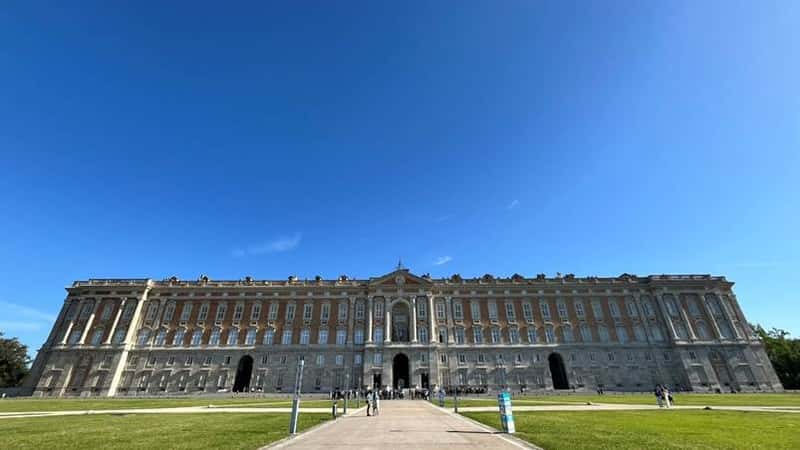
A Bourbon dream built in stone
Construction of the palace began in 1752, commissioned by Charles of Bourbon, who at the time ruled the Kingdom of Naples and Sicily. His ambition was clear: to rival Versailles and Madrid, while creating a new political and administrative capital safely inland, away from the vulnerabilities of Naples’ coastline. The architect chosen for the task was Luigi Vanvitelli, one of the most respected figures of European late Baroque architecture.
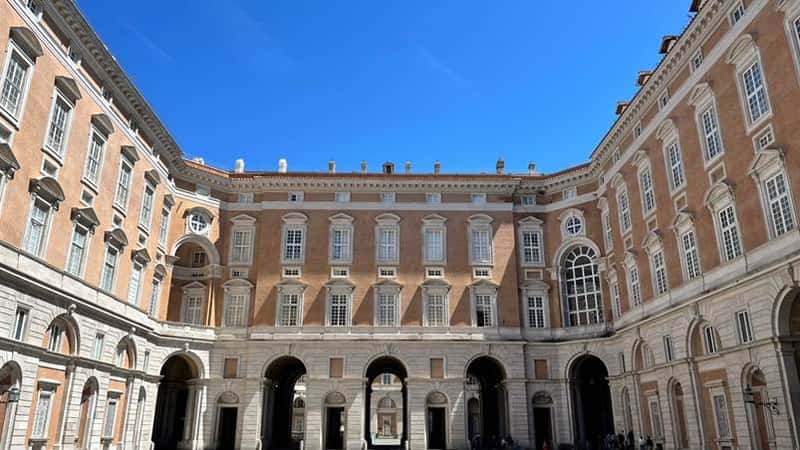
The result is staggering. The palace contains more than 1,200 rooms, arranged around four monumental courtyards, connected by staircases designed to impress before they even function. The interiors move between Baroque exuberance and early Neoclassicism, mirroring the cultural transition of the time. Everything here speaks of order, hierarchy, and control, from the axial layout to the rigid symmetry of the spaces.
The gardens: where Architecture Dissolves into Landscape
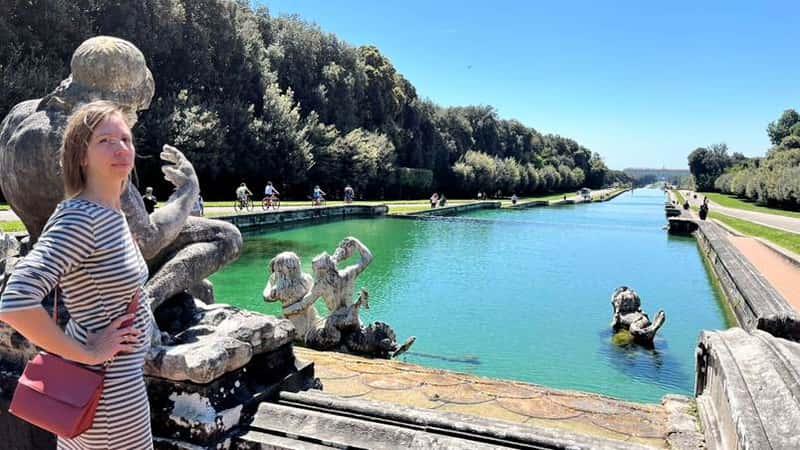
If the palace asserts authority, the gardens extend it into nature. Stretching for nearly 2 miles, the main axis of the park rises gently away from the building, creating a visual corridor that draws the eye upward toward the hills (called Il cannocchiale – The spyglass). This portion of the garden, which stretches even further into an English-style landscaped area, is not meant for wandering aimlessly, but it is a controlled perspective, designed to be read as a sequence of scenes, exactly like an opera.
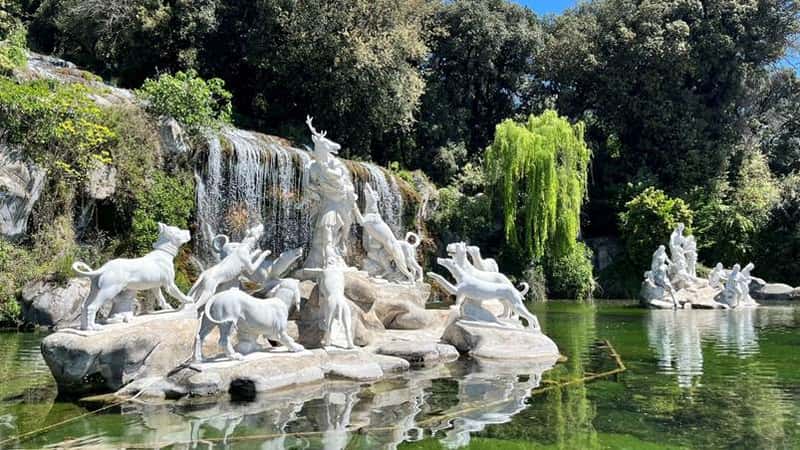
Along the central axis, a series of monumental fountains unfolds: the Fountain of Diana and Actaeon, the Fountain of Venus and Adonis, and others inspired by classical mythology. Sculptural groups emerge from water basins, staged against the slope of the land, turning hydraulics into narrative. I felt the walking uphill through the gardens to be a truly physical experience—I felt the distance, the incline, the time it took—making the display of power extremely tangible.
The Waterworks: an Engineering Masterpiece
None of this would exist without one of the most extraordinary infrastructural achievements of 18th-century Europe: the Aqueduct of Vanvitelli. Completed in 1762, the aqueduct carries water over 25 miles from the Taburno mountains to Caserta, using gravity alone.
Its most iconic section, the three-tiered arches crossing the Valle di Maddaloni, looks Roman in spirit but Enlightenment in execution. This was not decorative infrastructure—it was precision engineering, built to guarantee constant water pressure for fountains, cascades, and daily court life. Standing in the gardens today, watching water flow uninterrupted from basin to basin, it’s impossible not to admire how seamlessly technology and spectacle were combined.
Court Life, Power, and a Bit of Gossip
Like any royal court, Caserta was also a stage for personalities, tensions, and excesses. Charles of Bourbon never truly lived here—he left Naples in 1759 to become King of Spain—but his successors fully inhabited the palace. His son Ferdinand IV of Naples, later Ferdinand I of the Two Sicilies, was famously more interested in hunting, food, and informal life than in court etiquette.
His wife, Maria Carolina of Austria, was the opposite: politically astute, deeply involved in governance, and determined to modernize the kingdom. Their mismatched personalities played out within these rooms, between rigid ceremony and moments of deliberate informality. Caserta was both a symbol of absolute power and a very human space of rivalry, boredom, alliances, and occasional scandals.
A Jaw-Dropping Contemporary Space
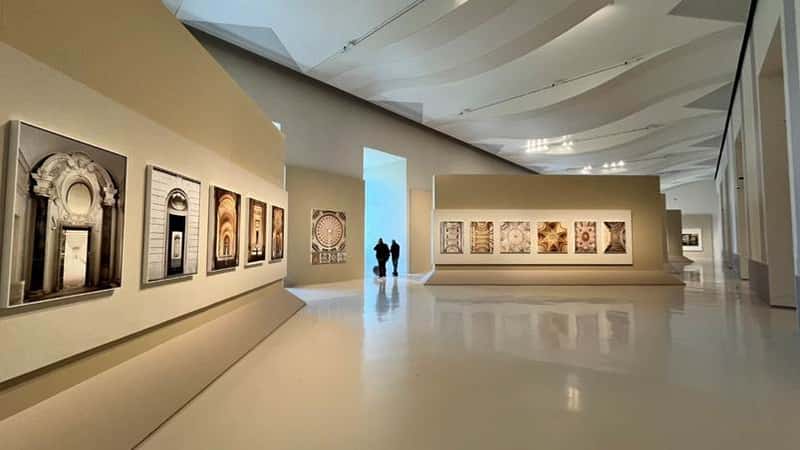
A particularly successful aspect of the Reggia that was lesser-known to me is the presence of spaces dedicated to contemporary art and high-quality temporary exhibitions, seamlessly integrated into the palace complex. Certain wings host exhibitions that engage in dialogue with the historic architecture rather than competing with it.
When I visited, a photographic exhibition focused on the villa itself—its interiors, architectural details, and garden perspectives—was genuinely striking. Rather than serving as decoration, it offered a contemporary, analytical lens on an intensely codified space, slowing the visitor’s pace and reframing what had just been experienced firsthand. It’s a smart addition that confirms the Reggia di Caserta is not simply a monument to be preserved, but an active cultural organism, capable of hosting contemporary languages without losing authority.
Star Wars at Caserta: Naboo goes Bourbon
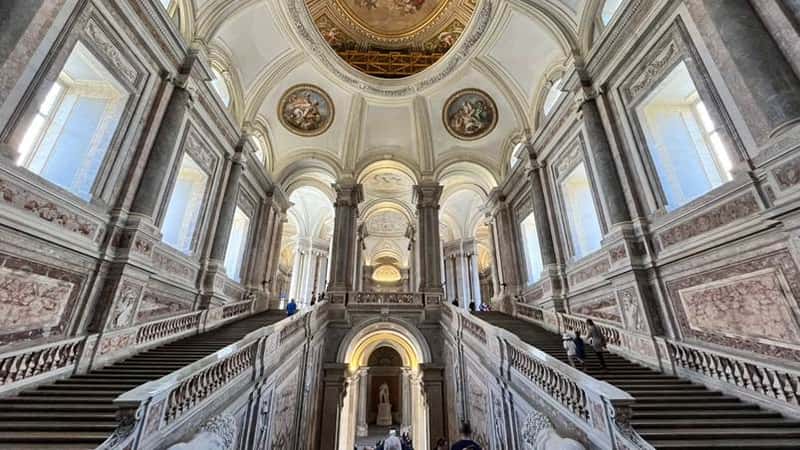
For many contemporary visitors, Caserta is also a Star Wars destination. The palace and its gardens were used as filming locations for Star Wars: Episode I – The Phantom Menace and Star Wars: Episode II – Attack of the Clones, standing in for the planet Naboo.
Specifically, parts of the palace interiors and the monumental gardens appear as royal spaces tied to Queen Padmé Amidala. The choice makes perfect sense: Caserta already looks like a cinematic exaggeration of power. Lucas didn’t need to invent much—he simply framed what was already there. What I appreciated most is that the palace never feels reduced to a film set. The Star Wars layer sits lightly on top of centuries of history, adding a contemporary reference without flattening the site.
Moving through Caserta today
Walking through the Reggia today is an exercise in scale management. The palace interiors demand time and focus; the gardens require stamina. Comfortable shoes are not optional. Electric shuttles are available for the gardens, but I recommend walking at least part of the axis to fully understand the spatial logic.
Unlike many historic palaces, Caserta doesn’t feel fragile. It was built to impress crowds, and it still handles visitors well. That said, arriving early or visiting on a weekday makes a noticeable difference, especially in high season.
How to get there and practical tips
Caserta is easily reached by train from Naples, with a journey of about 45 minutes. The palace is directly across from the train station, making it one of the most accessible monumental sites in Italy. If you’re driving, parking is available nearby, though trains remain the most straightforward option.
For food, the area around the palace, as well as the café within the palace, offers simple but satisfying options—cafés and trattorias catering to both locals and visitors. I suggest eating after your visit rather than before; once inside, Caserta tends to absorb more time than expected. Moreover, the gardes offers no food or drinks so make sure you have something in you backpack, especially during the how summer months. Tickets can be purchased on-site or online, and it’s worth checking whether combined palace-and-gardens access is available on the day of your visit.
A Place that Still Works
What struck me most about the Reggia di Caserta is how well its original logic still functions. What stayed with me was the sense of stepping into a machine designed to display power—through architecture, water, and landscape—at a level that still feels almost excessive today. This was a place designed to centralize power, impress allies, intimidate rivals, and regulate daily life through architecture and infrastructure. Centuries later, it continues to operate—not politically, but spatially.
Caserta doesn’t ask to be romanticized. It asks to be understood. And whether you come for Bourbon history, hydraulic engineering, or a Star Wars connection, you leave with a clear sense that this is not just one of Italy’s great palaces. It is one of Europe’s most complete demonstrations of how architecture, technology, and power once moved together as a single, ambitious system.