Weddings are full of little rituals that guests barely question. The cake gets cut, the rings get exchanged, someone tosses something into a crowd, and everyone claps. Few people stop to ask where any of it came from, and the answers, when you dig into them, tend to be stranger and older than most couples realize.
Wearing the wedding ring on the left hand

The custom of sliding a ring onto the fourth finger of the left hand did not begin as a fashion choice. It traces back to ancient Egypt, where the circle of a ring symbolized eternity, with no beginning and no end. From there, Roman culture picked up the idea and gave it a name that still gets repeated at bridal showers today.
The Romans believed a vein ran from that specific finger straight to the heart, and they called it the vena amoris, or vein of love. The tradition of placing wedding rings on the left ring finger emerged prominently in Western marriage rites during the Middle Ages, where the ring symbolized an unbreakable bond to the heart via the supposed vena amoris. Modern anatomy has long since disproven the vein theory, yet the placement stuck. Interestingly, not everyone follows it the same way. Not everyone in the world follows the left-hand rule. In many Eastern European and Orthodox Christian countries, the wedding ring is worn on the right hand, a practice with roots in the Roman Catholic tradition where the right hand was considered more spiritually significant.
The bridal veil

Long before veils meant anything romantic, they were a form of protection against forces nobody could see. The practice of wearing veils can be traced back to ancient Rome and Greece, where veils were worn to protect brides from evil spirits, with Roman brides often wearing a red or flame-colored veil called a flammeum, thought to shield them from envious eyes and misfortune. The color choice alone shows how different early wedding fashion looked from today’s all-white expectation.
Over time the meaning shifted from superstition to something more social. As time went on and veils began to spread outside of Rome, they became symbols of the bride’s chastity and purity, especially in religious circles, and in medieval Europe, veils showed not only the bride’s modesty but also her social status. The style most people picture today, sheer, flowing, and white, only became standard after Queen Victoria wore one at her 1840 wedding, and brides all over the world have kept the white veil tradition alive ever since.
The garter toss
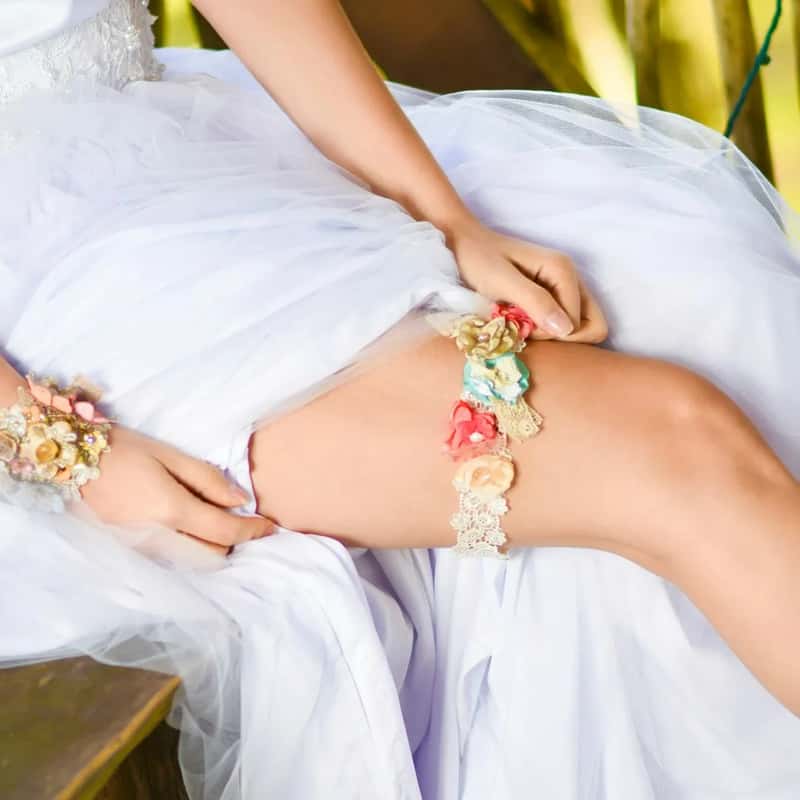
Of all the traditions on this list, the garter toss has the most uncomfortable backstory. The most common story behind the garter toss is that it comes from all the way back in the Middle Ages, when medieval marriages were expected to be consummated immediately after the wedding celebration, with crowds of guests waiting outside or even watching as the deed was done, so giving the bride’s garter to those in attendance may have been a way to confirm the consummation. A second theory is only slightly less dramatic.
In medieval England and France, there was a belief that obtaining a piece of the bride’s clothing would bring good luck, which led to a somewhat invasive practice where guests would try to rip off a piece of the bride’s gown. The garter reportedly became a distraction to protect the dress. These days the ritual survives mostly as light entertainment, and it is fading fast. According to The Knot’s 2023 Real Weddings Study, only 31% of newlyweds did the bouquet toss, and the garter toss is even less popular.
Carrying the bride over the threshold

This one looks sweet in photographs, but its origins are more complicated than a romantic gesture. There are two main origins of the wedding tradition of carrying the bride over the threshold: one is from Ancient Rome, where soldiers abducted women against their will, and another from Medieval England, in which grooms would carry the bride into the door entry to avoid evil spirits cursing the marriage. Either story points to a much less lighthearted history than the tradition suggests now.
A third explanation focuses on superstition rather than force. The threshold superstition actually dates back to ancient cultures, where people believed that brides were especially susceptible to evil spirits through the soles of their feet, and many of those evil spirits supposedly liked to hang out on the threshold of homes. Carrying the bride kept her feet from ever touching that dangerous spot. Whatever the true origin, the gesture has softened into something couples now treat as playful rather than protective, often swapped or reversed entirely to fit modern relationships.
Bride price and dowry payments

Unlike the other traditions here, this one is not a quaint reception moment. It is an active financial system still shaping marriages in large parts of the world. Bride price refers to a situation where the groom alone, or with his family, makes a wedding payment to the bride’s family in the form of livestock, money, commodities, or other valuables. The reverse arrangement, dowry, moves money or property from the bride’s family to the groom’s side instead.
The scale of this practice is easy to underestimate from a Western viewpoint. Marriage payments, as well as dowry or bride price, are still in use in three quarters of countries globally. China has recently tried to rein in rising bride price costs, and the Supreme People’s Court outlawed demanding money and land in exchange for marriage in 2023, with the government also issuing guidance stating the maximum bride cost should be 10,000 yuan, though this was not mandatory or enforced. In parts of East Africa, the legal picture is just as tangled. In Kenya, the use of an obligatory bride price is outlawed but still in broad use. The custom persists for reasons that go beyond sentiment, tied closely to family obligation, social status, and in some regions, ongoing debates over women’s rights.