Retirement planning used to mean picking a place with good weather and calling it a day. These days, the tax code matters just as much as the climate, and a growing number of retirees are discovering that where you live can quietly double or triple the value of a fixed pension.
Some countries tax foreign income the same way they tax local wages. Others barely touch it at all, either through territorial systems that ignore money earned abroad or through special regimes built specifically to lure pensioners. Here is a look at seven places where the tax math genuinely favors people retiring on foreign income, along with what it actually takes to qualify.
Panama: the territorial system that asks for almost nothing

Panama has built its reputation on retirees for decades, and the country’s Pensionado visa remains one of the most accessible residency programs anywhere. The visa is a permanent residency program for retirees with a guaranteed lifetime pension from a foreign government, international organization, or legally operating private company, requiring a minimum pension of USD 1,000 per month, or USD 750 if the applicant owns Panamanian real estate over USD 100,000. There’s no age minimum, which sets it apart from most retirement visas elsewhere.
Panama runs a pure territorial system, meaning foreign pensions, foreign Social Security, foreign dividends, and foreign capital gains are all exempt even for tax residents. Residency also arrives immediately, with a very minimal physical presence required to keep it active. Combine that with a dollarized economy and there’s no currency conversion to worry about when a Social Security check lands.
Costa Rica: no treaty, but no tax on foreign income either
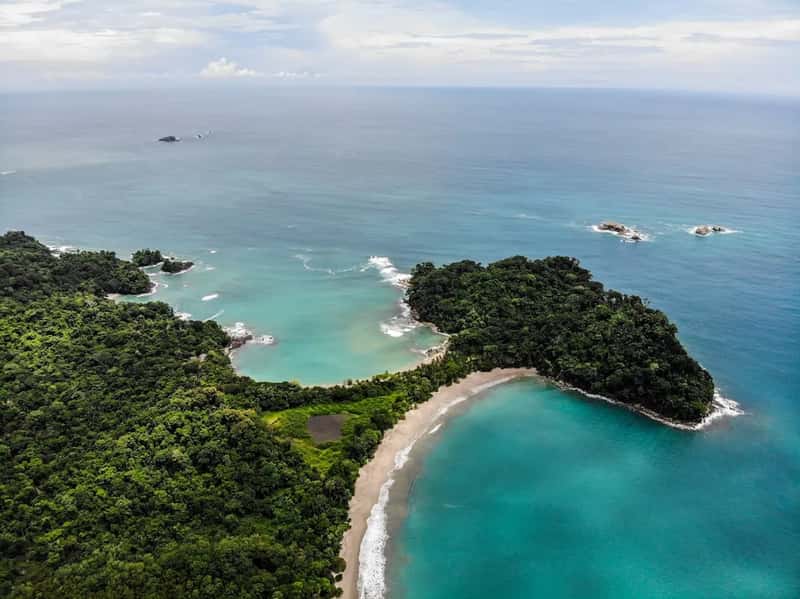
Costa Rica’s approach looks similar to Panama’s on paper, though it works a bit differently in practice. The pensionado category requires proof of $12,000 in annual income, corresponding to the $1,000 monthly lifetime pension required under Costa Rica’s General Law on Migration and Foreigners. That’s a low bar by international standards, and it has kept the country near the top of retirement rankings for years.
The United States and Costa Rica have no treaty preventing double taxation, but Costa Rica does not tax the foreign income of retirees, a function of the country’s territorial tax system rather than a benefit written specifically for pensioners. In other words, the exemption applies whether or not you hold a pensionado card, since Costa Rica operates a territorial tax system where only income generated within the country is subject to taxation, and foreign pension income, overseas investment returns, and salary paid for work performed entirely outside the country remain tax-exempt. The one catch is the lack of a bilateral tax treaty with the US, which means American retirees still need to file at home even though Costa Rica itself asks for nothing.
Cyprus: the European Union’s lowest dedicated pension rate

For retirees who want an EU passport country without EU-level tax rates on pension income, Cyprus stands out. Cyprus offers the EU’s lowest dedicated pension tax rate, with foreign pension income facing a flat 5% tax on amounts exceeding a threshold, and everything below that threshold completely exempt. The system was already generous, and it just got better.
Tax residents may elect annually between Cyprus’s standard progressive system and a flat 5% on foreign pension income above the exempt threshold, and the 2026 tax reform raised that exemption from €3,420 to €5,000, effective January 1, 2026. Retirees can switch between the flat rate and progressive rates each year, whichever works out cheaper, which gives a level of flexibility most tax regimes don’t offer. Non-domiciled residents get an extra perk on top of that: several more years without any tax on dividend or interest income.
Greece: a flat rate wrapped around a genuine lifestyle upgrade

Greece has quietly become one of Europe’s most talked-about retirement destinations, and the tax regime is a big part of the reason. The country runs a non-domicile tax system that does not require the reporting of assets around the world and imposes a flat 7% tax rate on all foreign income, including dividends, pension income, rental income, and capital gains. That single flat rate applies regardless of how large the pension is, which makes planning simple.
The residency route tends to run through the Golden Visa program, and Greece pairs the tax benefit with a notably lower cost of living than most of Western Europe. It’s a combination that has made the country a magnet for retirees who want European infrastructure and healthcare without paying continental prices for either. The 7% rate isn’t limited to a handful of income types either; it covers essentially anything earned outside Greek borders.
Italy: a flat tax that just expanded its map

Italy’s version of the pensioner tax break is more geographically specific, but it recently became far more usable. Italy offers its own 7% flat tax on all foreign income for pensioners who relocate to qualifying small towns across eight southern regions, applied for up to 10 years. The catch has always been the population cap on eligible municipalities, and that’s exactly what changed this year.
As of April 7, 2026, the population threshold for eligible southern municipalities rose from 20,000 to 30,000 inhabitants, opening 74 additional towns including Pompei, Noto, Ostuni, Manduria, and San Giovanni Rotondo. That single adjustment turned a niche regional perk into something with a much wider reach, letting retirees pick from a longer list of towns across regions like Sicily, Puglia, and Campania. For anyone drawn to southern Italy’s slower pace and lower cost of living, the flat 7% now comes with far more real estate to choose from.
Mauritius: a decade-long permit built around a monthly transfer

Mauritius doesn’t get the same attention as the Mediterranean retirement spots, but its numbers are competitive and its residency requirements are refreshingly clear. The Retired Non-Citizen Residence Permit was redesigned under the 2025 Finance Act, and applicants aged 50 or older must now transfer $2,000 per month or $24,000 annually to a Mauritius bank account, raised from the previous $1,500 and $18,000 thresholds. That’s a modest bar for anyone drawing a Western pension.
The permit is issued for ten years, renewable, with no minimum stay requirement, and a 20-year Permanent Residence Permit becomes available after five years provided cumulative transfers exceed $200,000. Mauritius’s headline personal income tax sits at 15%, and the country maintains double taxation treaties with most Western retirement-source countries. It’s not a zero-tax jurisdiction the way Panama is, but the flat structure and treaty network make it predictable, and the island’s political stability adds a layer of comfort that some tropical alternatives lack.
Malaysia: a decade of tax certainty through the MM2H program

Malaysia’s My Second Home program has gone through several redesigns over the years, but the tax treatment of foreign income has recently gained something rare: a long runway of certainty. Malaysia exempts resident individuals, including MM2H visa holders, from tax on foreign-sourced income, and as of Budget 2026 the government pushed that exemption’s expiry from 2026 out to 2036. A decade of predictability is unusual in this space, where most exemptions get renewed in short increments.
The visa itself now comes in tiers, with Silver, Gold, and Platinum tiers requiring fixed deposits of USD 150,000, USD 500,000, and USD 1,000,000, and foreign-sourced retirement income remaining tax-exempt for residents. The exemption isn’t unconditional, though. Malaysia’s broader foreign-sourced income exemption for individuals requires that the income have been “subjected to tax” in the country where it arose, so retirees drawing already-taxed Western pensions tend to benefit far more cleanly than those with untaxed offshore income streams.