The city feels different at 2 AM.
The glass towers are all glare and no guts.
But the concrete block on the corner – the one everyone hates – just sits there.
Unmoved. Undecorated. Unafraid.
And something in you responds to that. Not aesthetically. Deeper than that. Somewhere in the marrow of your identity, where the real navigation happens – the navigation between who you perform and who you actually are when every soft surface falls away.
We live in an age of the provisional. Relationships load like browser tabs. Cities are reskinned by gentrification every decade. Your apartment is a stage set that another stranger will occupy in eighteen months. Your sense of self – your identity – has learned to travel light because it has to. The Identity Gap is the distance between the curated version of you that moves through the world with a carry-on and a confident stride, and the version that sits in a brutalist plaza at dusk, back against forty tons of raw concrete, and finally, silently, exhales.
1. The Weight of the Unhideable
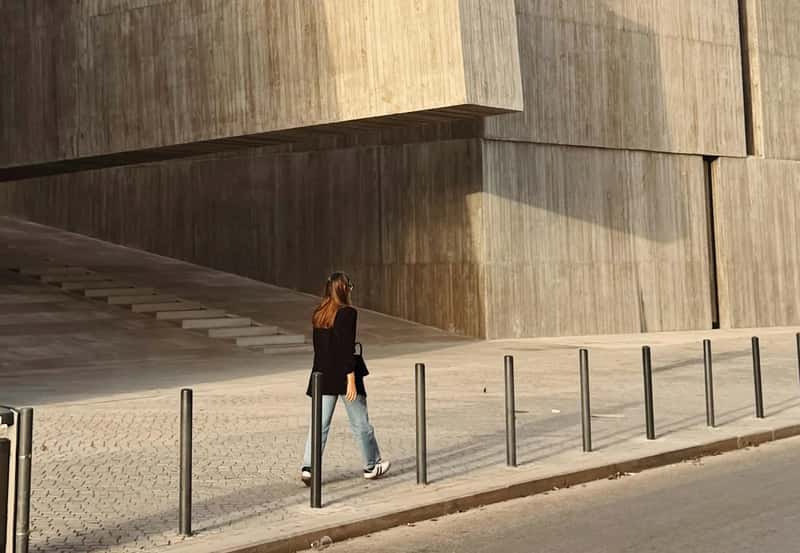
Here is the first uncomfortable truth about brutalist architecture: it cannot lie.
A defining trait of Brutalist architecture is its embrace of exposed concrete – béton brut. Rather than hiding imperfections, architects highlighted the natural texture and grain left by wooden formwork. Concrete, brick, and steel were left uncovered to showcase their authentic character. The visible roughness symbolized honesty and permanence.
That word – honesty – is doing enormous psychological work.
In a world of facades, of curated identities and filtered surfaces, the brutalist building cannot filter itself. It is what it is, down to the grain of the formwork board pressed into its skin decades ago.
You are drawn to it because you are exhausted by surfaces that lie.
You are drawn to it because some part of you wants to stop lying too.
The concrete holds the mark of its own making. It remembers. And in remembering, it offers you a strange permission: to be seen as you actually are.
2. The Sanctuary Instinct
When the world becomes precarious, the nervous system goes looking for a bunker.
Not metaphorically. Literally. Your body scans the environment for structures that could not be easily dismantled, and it settles, however briefly, into something like peace.
In a climate of fear, ambiguity, risk, and security, Brutalist structures are like sanctuaries, signifying strength, security, and permanence. Brutalist structures symbolize strength and permanence, appealing during times of instability and insecurity.
This is not a design preference. This is mammalian threat assessment translated into aesthetic desire.
The traveler who has moved through six time zones in four days, slept in three different beds, eaten in four different currencies – that traveler is not looking for beauty. They are looking for a wall that will not move. A ceiling that will not flex. A ground that will hold.
The brutalist city gives them that.
It says: I was here before you arrived. I will be here when you leave. Nothing about your transit disturbs me.
And that – that indifference – is the most calming thing in the world.
3. The Ontological Security Complex
There is a term in sociology – ontological security – that describes the fundamental human need to feel that the world is stable, continuous, and knowable.
Modern travel destroys it, systematically and cheerfully.
New language. New currency. New mattress. New light through a new window. The self becomes slightly blurry at the edges. You are you, but refracted.
By 2019, renewed interest in Brutalism correlated with a desire for ontological security amid global risks.
The brutalist city offers a correction. Its blocks do not bend. Its forms do not negotiate with trends. Brutalist durability, material presence, and monumentality serve as a bulwark against the evanescence of everyday life.
When your identity is in flux, the last thing you need is a building that is also in flux.
You need architecture that has already decided what it is.
Because in standing next to it, you remember what you are.
4. The Anti-Nostalgia Machine
Here is what the brutalist city does not do: it does not seduce you with sentimentality.
It makes no promises about a prettier past.
Brutalism is said to be a reaction against the nostalgia of architecture in the 1940s.
That refusal is psychologically significant. The modern traveler – the perpetual transient – is often fleeing something. A version of themselves they outgrew. A city that remembers a person they no longer are. A relationship pressed flat under the weight of too many shared rooms.
The brutalist city offers no cozy invitation to look backward. Its geometry is forward. Its concrete is present tense. There are no ornamental flourishes suggesting the warmth of another era.
There is only now.
The weight of now. The fact of now.
For the person who has been running from their own timeline, a city that refuses nostalgia is an unexpected mercy.
5. The Plaza at Dusk
I remember the first time Belgrade stopped me cold.
I had been on the road for eleven days. I was performing competence across every border – the easy laugh in the passport line, the confident stride out of the train station, the practiced indifference to discomfort that every long-term traveler develops like scar tissue. And then I walked into a brutalist plaza in Novi Beograd, and I just stopped. The concrete was grey and enormous and completely indifferent to my exhaustion.
I sat on a low wall for forty minutes. No destination. No performance.
Just the weight of the building and the strange relief of being in the presence of something that had survived far more than I had.
In contrast to slick, ephemeral glass towers with fragile cladding and ultralight skeletal walls, the rough concrete surface, horizontal orientation, and sheer bulk of Brutalist buildings connect them to the ground in a tangible manner. In doing so, they may symbolize a ground of existence in a world that has become precarious and terrifying.
That is the correct description of what I felt.
A ground of existence. Not beauty. Not warmth. Ground.
6. The Permanence Paradox
Here is the paradox: the traveler who commits to impermanence is the one most desperate for permanent things.
The person who owns no furniture. Who rents furnished rooms. Who has reduced their life to what fits in a bag. That person is not indifferent to permanence. They are obsessed with it. They just believe they cannot have it in their own life, so they go looking for it in structures.
Brutalist buildings are expensive to maintain and difficult to destroy. They can’t be easily remodeled or changed, so they tend to stay the way the architect intended. Maybe the movement has come roaring back into style because permanence is particularly attractive in our chaotic and crumbling world.
The brutalist building is the anti-Airbnb.
It was not designed to be liked. It was designed to last. And in that refusal to court approval, it becomes one of the most psychologically nourishing environments available to a person who has spent years optimizing for approval.
You don’t have to perform for the concrete. The concrete doesn’t care. And that is the beginning of something that resembles rest.
7. The Honest Ugliness
There is a specific psychological comfort in things that are not trying to be beautiful.
The traveler who has spent years curating a beautiful version of their own life – the carefully framed photos, the chosen narratives, the deliberate presentation – eventually burns out on beauty as performance.
For many, Brutalism represents a defiance against conventional beauty, allowing for a deeper aesthetic appreciation rooted in authenticity and integrity.
This is not the same as loving ugliness. It is something more precise.
It is loving the thing that has chosen function over flattery. The thing that says: I am what I am for reasons that have nothing to do with whether you find me attractive.
This focus on exposed materials aligned with the Brutalist philosophy: buildings should be true to their structure and construction.
The traveler who has been performing their own attractiveness across too many cities recognizes that ethos immediately. Deeply. Personally.
Because what they want – what they have wanted the whole time – is to be true to their own structure. To stop hiding the formwork marks. To let the grain show through.
8. The Trauma Architecture
Brutalism was born from rupture. That is not incidental. It is the entire psychological point.
What is not often taught is the same lesson: for many of the leading architects of this period, it was trauma from war and violence that scarred their minds. Noted luminaries in this movement Mies van der Rohe and Walter Gropius were both infantrymen for the German army during World War I – personally confronting unimaginable horrors during years of trench warfare.
Like most people impacted by trauma, they sought to allay themselves by revisiting it – they literally rebuilt the landscapes of war, devastation, and death through their built work. Psychologists now call this “reenactment,” a typical PTSD response, as the body struggles to work through its trauma and heal.
The buildings hold that grief. You can feel it in the weight of them.
And the traveler who carries their own unprocessed weight – the losses filed away under the pressure of constant movement – recognizes something in that grief-made-concrete. They are drawn to it not because it is beautiful, but because it is honest about what survival actually looks like.
Heavy. Marked. Still standing.
9. The Calming of the Overstimulated Self
The modern traveler is drowning in stimulation.
Every new city is a new assault of input – new sounds, new signage, new social codes to decode. The nervous system is perpetually at threshold. And into this overstimulation walks the brutalist building, which offers the opposite of everything else: repetition, geometry, silence in three dimensions.
One of the more calming aspects of Brutalist architecture is that it’s always simple in its design. Unlike the ornate embellishments of more classical styles, it celebrates the purity of form and function.
There’s a meditative nature to brutalist spaces, and they can allow you to really immerse yourself in the surroundings, away from the distractions and noise of everyday life, as well as the complexities of life, thanks to their simple and clear designs.
The brutalist city is the noise-canceling headphone of urban environments.
Not silent. Not warm. But structured enough that the overwhelmed brain can finally find the edges of a room, the logic of a space, the quiet predictability of a form that does exactly what it says it will do.
For the transient self – the self that has been improvising across three continents – that predictability is not boring. It is oxygen.
10. The Structure That Holds You Without Asking You to Stay
This is the deepest point. Sit with it.
The brutalist city is the only environment that will hold you completely – your full, unedited, exhausted, fragmented weight – without asking anything back. Without demanding that you belong to it. Without requiring your loyalty or your longevity.
Part of the genius of the Brutalist movement was to understand the importance of closure as security, and openness as freedom and utopia, and then to combine these elements in architectural construction.
That combination – security and freedom simultaneously – is the precise psychological formula that the identity traveler has been searching for across every border crossing, every overnight train, every 3 AM arrival into a city whose name still feels foreign in the mouth.
Drawing from attachment theory, affective bonds are thought to arise out of relationships that provide for functional needs, like security and wellbeing. The brutalist city provides both without demanding reciprocity. It does not need you to come back. It does not need you to remember it fondly. It will not be hurt when you leave.
And because it will not be hurt when you leave, you are finally, for the first time in a long time, free to stay.
Free to stop moving – just for an hour, just for a dusk – and let the ground hold you.
There is something happening right now in cities that most people are reading wrong. They see the revival of interest in brutalist architecture as an aesthetic trend. A mood board. A filter. They see the pilgrimages to Belgrade’s New Belgrade blocks, to Boston City Hall, to London’s Barbican, and they call it nostalgia, or irony, or the peculiar tastes of a certain kind of design-literate traveler.
They are missing what is actually occurring.
What is actually occurring is a generation of people – people who have made a theology of mobility, who have flattened their identities into thin, portable, adaptable versions of themselves – walking toward the only structures in the modern city that cannot be broken, cannot be renovated into something unrecognizable, cannot be softened into palatability. They are not admiring the buildings. They are pressing their backs against them and breathing. They are using forty tons of postwar concrete to locate the edges of a self that has become, through years of movement and performance and impermanence, genuinely difficult to locate.
The next time you find yourself standing in front of a brutalist block and feeling something you cannot quite name – something that is not beauty but is also not repulsion, something that sits in the chest like a low, sustained note – know this: you are not reacting to the building. You are recognizing it. You are recognizing the version of yourself that is also raw, also marked by its own making, also refusing to apologize for the weight it carries. The concrete did not choose to be this way. Neither, really, did you. And there, in that shared condition of having been built by forces larger than preference, something settles. Something in the gap between who you perform and who you are quietly, without ceremony, closes.