You found the listing at 11:47 PM.
A cabin. Three hundred square feet. Deep woods. No neighbors.
Your pulse did something unfamiliar. It slowed.
That wasn’t wanderlust. That wasn’t minimalism. That was your nervous system recognizing something it was never fully given – and has never stopped looking for. There is a version of you that the world never gets to see. The version that exists only in silence, behind a closed door, with no one watching. The version that wasn’t born anxious or performative or hypervigilant. The version that was simply – interrupted.
1. The Body Remembers What the Mind Forgives
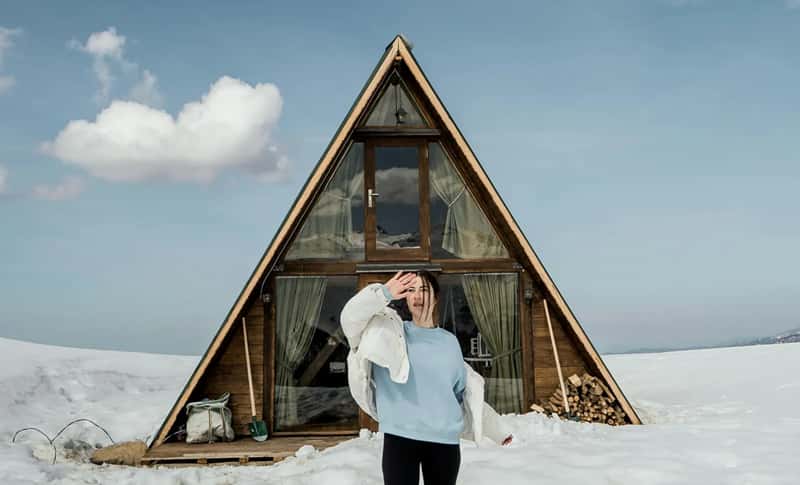
You don’t consciously remember the first time your space was entered without permission.
You probably don’t remember the bedroom door that never locked. The parent who read the diary. The house where nothing belonged to you, not fully, not safely.
But your body kept the receipt.
A privacy breach is not just a frustrating inconvenience – it is a profound psychological rupture, an identity-level injury, and a seismic shock to the nervous system that can unravel a person from the inside out.
When that rupture happens repeatedly in childhood – quietly, casually, without anyone calling it harm – it doesn’t vanish. It migrates. It moves into how you hold your shoulders in a crowded room. Into how you flinch when someone enters your kitchen unannounced. Into why you keep saving that listing for a cabin in the middle of nowhere.
The obsession with small, remote, lockable spaces is not a design preference.
It is your body asking, at long last, to finish a sentence it started decades ago.
2. The Illusion of Control You Were Never Granted
Control is not a luxury. It is a developmental requirement.
Privacy serves a deeper purpose in a child’s life than simply having a room with a closed door. It is closely tied to the development of self-identity, emotional regulation, and personal boundaries. When children are given moments alone – to think, play, daydream, or simply be – they begin processing their experiences on their own terms.
You didn’t get that. Not reliably. Not safely.
And so as an adult, you replay the fantasy in different clothes. You call it “minimalism.” You call it “off-grid living.” You call it a dream of simplicity and clean air and pine trees.
But underneath those beautiful words is something rawer: the need to be the one who decides who gets in.
People who choose tiny living feel in control of their housing experience and have more privacy – and for many, that feeling of control is the entire point. Not the square footage. Not the Instagram aesthetic. The lock on the door. The gate at the end of the drive. The absence of footsteps that aren’t yours.
3. The Nervous System Has a Long Memory
Anxiety about personal space isn’t philosophical. It’s physiological.
An individual’s personal space is like a territory, and when that territory is violated, the individual experiences psychological distress.
That distress doesn’t expire at eighteen. It doesn’t evaporate when you move out. It becomes the architecture of your adulthood – invisible load-bearing walls you didn’t choose and can’t easily tear down.
You walk into your own apartment and something in you remains on alert. You share a bed, a bathroom, a kitchen, and part of you never fully exhales. You sit in a room full of people you love and still feel, faintly and guiltily, like you want everyone to leave.
This is not misanthropy. This is the nervous system running an old program. One that was written in a house where your privacy was treated as optional. Where your internal world was public property.
The cabin in the woods is your nervous system’s screensaver. The image it defaults to when it’s finally allowed to want something.
4. What “Going Small” Is Really Asking For
The tiny home movement gets analyzed endlessly through the lens of economics and ecology.
But there’s a quieter conversation happening underneath the floor joists.
“I think tiny homes are really interesting because one of the things we’ve seen, as people design and personalize them, is that their values are reflected in their home space,” said researcher Lindsay Graham Ph.D. “The entire space is sort of a broadcast of some sort of value that you hold in relation to homes, sustainability, and how you’re living your life.”
But what if the value being broadcast isn’t minimalism?
What if it’s sovereignty?
A tiny home is a space that is entirely, undeniably yours. Every inch of it is yours. The decision about who enters is yours. There is no guest room with an implied invitation. There is no sprawling floor plan that can accommodate the people who, growing up, never asked before they arrived.
Going small isn’t about owning less. It’s about owning – fully and finally – the ground beneath your feet.
5. The Map Back to Yourself
I want to tell you something I don’t say in polished company.
I grew up in a house where the bathroom door didn’t lock. It was a small thing. Nobody called it a problem. But I developed a habit – I still have it – of listening for footsteps before I exhale. A particular quality of silence that means: no one is coming. Not yet.
It took me years to understand why I felt safest alone. Why hotel rooms with deadbolts and chain locks felt like a deep, private relief. Why I kept returning to the fantasy of a small house in a clearing, no neighbors, no ambient obligation to be visible.
As children grow from toddlerhood into school age and then adolescence, their need for privacy evolves. Younger children may simply want a corner of the room where they can play without interruption. Older children and teenagers, on the other hand, seek emotional privacy – space to reflect on their relationships, manage difficult feelings, and figure out who they are becoming.
I was seeking the room I never finished becoming myself in. Maybe you are too.
6. The Architecture of Trust You Had to Rebuild From Scratch
Here is what chronic privacy violation does quietly, over years.
It teaches you that the inside of you is not safe. That your thoughts, your body, your space, your closed door are all provisional – subject to override without warning.
Children who experience chronic privacy violations – whether through constant surveillance, reading of personal messages, or public exposure of private moments – may develop heightened anxiety, difficulty trusting others, and a weakened sense of personal agency. These effects can persist well into adulthood.
So you learn to trust architecture instead of people.
Thick walls. Remote locations. A door that closes all the way. These are not antisocial choices. They are scaffolding. They are the external structure of internal safety that was never built into you from the inside because the inside was never protected long enough to take root.
You don’t distrust people because you’re broken. You distrust open floor plans because you learned, early and quietly, that openness was something that happened to you. Not something you chose.
7. Solitude Is Not Loneliness – It’s the Original Wound Healing
There’s a word that gets misapplied constantly to people like you: lonely.
You are not lonely in the woods. You are not lonely in the 280-square-foot cabin at the end of a dirt road. You are, perhaps for the first time, simply alone. And there is a profound difference.
Artists, writers, scientists, and performers who aim at endless actualization of their possibilities attest to the need for solitude. They need it for meditation, rehearsal, and undisturbed pursuit of their ideas.
You need it for something even more foundational: the quiet act of existing without being monitored.
When a child is never allowed solitude, they never learn that their own company is sufficient. They grow into adults who are both desperate for space and afraid of what happens when they finally have it – because they never learned that silence doesn’t mean abandonment. It means rest.
The cabin is the tutorial you never got. A slow, gentle lesson in what it feels like when no one is coming through the door.
8. The Childhood Home Was Never Just a Building
Home is where the body learns what safety feels like.
Or doesn’t.
In 1930, Plant cited lack of privacy as a factor contributing to children’s emotional disorders. The research has been whispering this for nearly a century. The body has known it longer.
When the place that was supposed to be safe was the place where your boundaries were tested – quietly, daily, without drama or apology – you grow up with a complicated relationship to home itself. The word carries weight it shouldn’t have to carry. The concept feels slightly foreign, like a language you studied but never got to speak fluently.
So you seek it. Differently. In smaller, simpler, more controllable forms.
Having privacy and developing more freedom are a necessary part of growing up for teenagers to gain individuality and the skills to be a functioning adult. But what happens to those who didn’t get it? They spend their adult lives engineering it – room by room, acre by acre, wall by deliberately chosen wall.
9. The Self-Verification Loop: Why You Keep Saving Those Listings
You’ve saved seventeen listings. You know the square footage of each one. You have a folder.
This behavior has a name in environmental psychology.
Those who want to live in tiny homes exhibit two psychological mechanisms in particular: clustering and self-verification. Clustering, or self-sorting, is the idea that we tend to hang out with like-minded individuals. Clustering is further enhanced by self-verification – we want to be seen in ways that we are aligned with our identities.
But for the privacy-starved adult, the folder of cabin listings is something more specific. It is self-verification of a self that was never allowed to fully form. You are locating, over and over, the proof that a different way of existing is possible.
Every saved listing is a small act of defiance. Against the childhood home that treated your door like a suggestion. Against every space that demanded you be visible when you needed to be hidden. Against an interior life that was opened like mail addressed to someone else.
You keep saving those listings because part of you is still making the case: I deserve a room that is mine.
10. The Lock Was Always the Point
Let’s say it plainly now.
This was never about square footage.
It was never about carbon footprints, or mortgage freedom, or the romance of a wood-burning stove – though those things are real and good and worth wanting.
Not giving children privacy at the onset of and during pubescent years can affect the way they handle relationships, jobs, and themselves as adults. The wound is quiet, systemic, and almost impossible to name in the moment because the moment felt so ordinary. Someone walked in without knocking. Again. A journal was read. A body was not given the dignity of a closed door. A child learned, slowly and without ceremony, that their interior world was accessible – a common area, not a private room.
And now you are thirty-four, or forty-one, or fifty-two, and you are on a real estate website at midnight, looking at a cabin in Vermont with three deadbolts on the front door, and something in your chest releases like a breath held for decades.
The lock was always the point.
During adolescence, the need for privacy intensifies significantly. Teenagers are developing their identities, experimenting with values, and separating psychologically from their parents. When that process was interrupted – monitored, invaded, overridden – the separation never fully completed. The identity is still under construction. The tiny home, the remote cabin, the room at the end of the world, is where you plan to finish the work.
Not running away. Building inward. Going small on the outside so you can, at last, go large on the inside.
There is nothing wrong with you for wanting this. There is nothing broken about a person who craves a space that is entirely, irrevocably theirs. The craving is not a flaw in your character. It is a record of something that happened. Evidence of a need that was real and was not met – and that has been quietly waiting, all this time, for you to finally take it seriously.
The woods are not running from the world. The cabin is not a symptom. The obsession with small, quiet, lockable spaces is the most sane response imaginable to a childhood that taught you that no space – not your body, not your thoughts, not the four walls of your own room – fully belonged to you.
So go ahead. Save the listing. Study the floor plan. Count the deadbolts. Somewhere in the specificity of that fantasy lives the child you were, asking for something so simple it should never have required a fantasy at all.
Just a room. With a lock. That no one opens without asking.