The pool is perfect.
The water is warm. The sun is exact. The cocktail is cold.
You check the activity schedule anyway.
There is a name for this. It isn’t restlessness. It isn’t ingratitude. It is something older, quieter, and harder to admit: you are running from stillness itself. The gap between the person you perform for the world – productive, purposeful, always en route – and the person who surfaces when the noise stops is not a gap you can easily cross.
That crossing requires sitting with yourself. And for many people, that is the most terrifying journey on the itinerary.
The Busyness Reflex
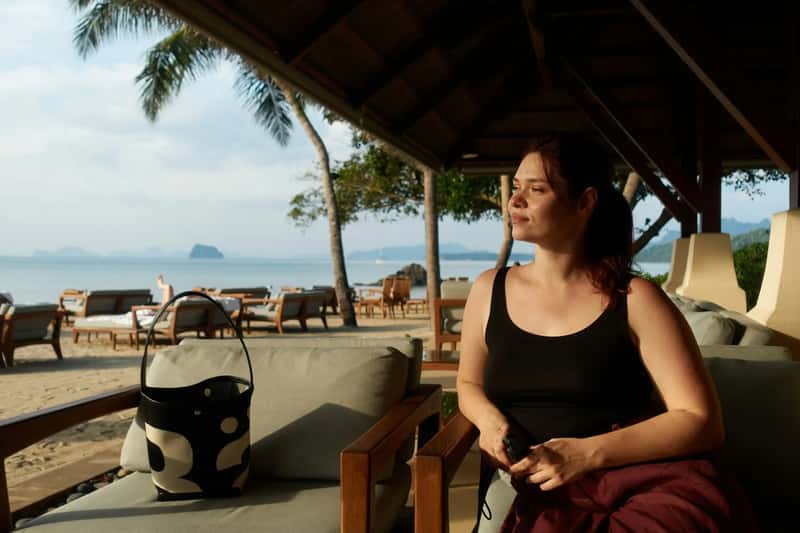
There is a single root cause hiding under all of this: the chronic inability to stop being busy, even when there is nothing left to do. Researchers have named this pattern “the Busy Effect.” The gap between wanting rest and achieving it is not a scheduling problem. It is a behavioral one.
It follows you through the departure gate.
It checks in with you.
It unpacks itself quietly in your five-star room.
Fifty-five percent of travelers say they simply do not know how to “do nothing.” For the majority, the skill of switching off has not been developed. It has been replaced by the habit of staying busy – a habit that does not pause at the departure gate.
The poolside lounge chair becomes a threat. The open afternoon becomes a void. So you scan the activity board. You book the kayak tour. You feel, briefly, like yourself again.
The Identity That Requires Motion
Vacations should be a win – gaining relaxation and a break from work. But our knee-jerk reaction may be to see them as a loss – of control, of identity, of purpose. The question underneath is: how can you go on vacation and leave behind your purpose?
This is the wound nobody Instagram-stories.
The self you’ve built is a productive self. A useful self. A self that earns its place by doing. Strip away the doing and what remains? That is the question the luxury resort accidentally asks every time it hands you a schedule of optional activities. Optional. The word alone is an existential provocation.
For high-achievers or over-workers, a blank schedule can actually be triggering. You may not know how to relax – especially if productivity has become your identity.
The next activity is not an excursion. It is an alibi.
The Dopamine Architecture
Travel activates entirely different neural networks than our day-to-day routines, making it a potent escape mechanism. The stimulation and novelty of new environments can act like a psychological reset, giving us a temporary break from the realities we don’t want to face.
That reset is seductive. Dangerously so.
From our brain’s perspective, when we enter a new environment, it becomes so preoccupied with processing novelty that the pressures from work, relationships, and other responsibilities fade into the background.
So we chase novelty. We book the next excursion to stay in that preoccupied state. The snorkeling trip ends and the silence floods back in. Book the sunset cruise. Fill the gap. Silence is the thing we are actually afraid of.
There is evidence that addictive behaviors share key neurobiological features: they intensely involve brain pathways of reward and reinforcement, which involve the neurotransmitter dopamine. The loop tightens. The resort’s activity desk becomes a dealer, and you keep going back.
The Exit Strategy Disguised as Enthusiasm
Avoidance and escape refer to behaviors where people either do not enter a situation or leave situations after they have entered. Distraction is considered to be a subtle form of avoidance behavior.
Notice that word. Subtle.
Because booking a sunrise hike at a luxury resort does not look like avoidance. It looks like enthusiasm. It photographs beautifully. It generates the story you will tell at dinner when you get home. But underneath the enthusiasm is the calculus: if I am moving, I am not having to feel whatever is waiting in the stillness.
Avoidance behaviors remove the opportunity to disconfirm negative beliefs, reduce an individual’s opportunities to obtain positive reinforcement, and may exacerbate self-focused attention and repetitive thinking.
The irony is architectural. You flew thousands of miles to escape your life. You are recreating your life’s primary defense mechanism in finer surroundings.
The Arrival Lag Nobody Talks About
When asked how long it took to fully unwind on their last vacation, only 18% of travelers said immediately. Twenty-six percent needed a few hours, 23% needed a full day, and 21% needed two to three days. For most travelers, the Busy Effect does not stop at check-in – it follows them through the door and takes time to subside.
I know this lag intimately.
I have stood at a floor-to-ceiling window overlooking the kind of ocean that should stop time. I’ve felt nothing but the to-do list still running somewhere behind my eyes. Day one of a resort stay: I opened my laptop. Day two: I reorganized my notes app. By day three, something cracked. Not dramatically. Not like the movies. Just a quiet loosening – a breath that went all the way down.
The lag is real. The lag is the distance between the body arriving and the self catching up. And most people never let the self catch up. They book a jet ski instead.
The Performance Mindset
Treating vacation as a checklist to “maximize experiences” converts leisure into another arena of productivity, removing relaxation entirely.
The resort becomes a set. You become the star of your own travel documentary.
Every meal is photographed before it is tasted. Every view is framed before it is felt. The activity isn’t experienced – it is collected. And collection is a form of control. Engaging in compulsive behavior can provide individuals with a sense of control or mastery, especially if they feel powerless or overwhelmed in other areas of their lives. The resort’s infinity pool does not give you that feeling. The structured activity does.
So you perform being on vacation. You perform rest. It is exhausting in a way that is genuinely hard to articulate.
The Nervous System That Never Got the Memo
When you remove structure and external pressure, the nervous system finally has space to show you its default setting. If it learned early on that safety is temporary, that default may be hypervigilance – so the anxiety surfaces more strongly when things are quiet.
The resort is quiet. The anxiety is loud.
The hormone cortisol tends to be higher when we’re under stress. Cortisol puts the body in a state of hypervigilance to keep us at the ready. Relaxing causes the hormone level to drop, and that switch out of fight-or-flight mode can make people more likely to get sick.
This is why some people get a cold on day two of vacation. The body, finally allowed to stop soldiering, collapses briefly. The immune system catches up. The nervous system catches up. The grief of all those months of non-stop catching up arrives, wrapped in a scratchy throat and an inexplicable sadness by the pool.
Busyness was holding all of that at bay. The resort took away the busyness. You are not ungrateful. You are just meeting yourself.
The Temporary Identity
There is a quiet layer here: the narrative you carry about what it means to be on guard, and who you are if you’re not. Many people who can’t relax on vacation carry a lifelong identity of being “the responsible one,” “the fixer,” “the watchtower.” It’s not just that their brain doesn’t know how to rest; it’s that rest feels like abandoning their post.
Read that again slowly.
Abandoning your post. As though rest is desertion. As though the self that sits still is somehow a traitor to the self that earns and produces and manages. Travel doesn’t dissolve this identity. It simply moves it to a more expensive backdrop. You are still the watchtower. You just have a better view now.
The next activity on the schedule is not leisure. It is the watchtower maintaining its shift.
The Comfort Aversion
The fear at the core of compulsive distraction is rarely addressed directly. Filling time with activities is reinforcing avoidance, and therefore reinforcing the cycle itself.
Comfort is not comfortable for everyone.
This is the paradox at the center of the luxury resort experience. The higher the thread count, the quieter the room, the more beautiful the view – the more exposed the self feels. Because there is nothing left to blame for the unease. No traffic, no deadlines, no difficult colleague. Just you, in a beautiful room, unable to stay still.
Even when you want to enjoy a break, your nervous system might resist the shift – especially if you’re used to structure or productivity as a form of safety. Safety. That is the word. The activity schedule isn’t an itinerary. It is a security system. Each booking is a lock on a door that might otherwise swing open to reveal something you’ve been moving too fast to look at.
The Quiet Below the Noise
Dealing with underlying issues – boredom included – is a major key in living a long life of fulfillment and peace in the present moment. When we are centered in the present moment and not constantly looking for the next distraction, we find a profound satisfaction with life.
That satisfaction is not loud. It does not photograph well.
It does not come from the zip line or the cooking class or the 6 AM sunrise yoga that you almost cancelled. It comes from the moment you let yourself stop. Fully stop. Without reaching for the phone. Without scanning the itinerary. Without manufacturing the next reason to move. It comes from the strange, unfamiliar weight of the present moment when you finally agree to live inside it.
The Busy Effect describes a state where busyness becomes the default mode – so ingrained that people continue to experience it even in conditions specifically designed for rest. The data reveals how deeply embedded this pattern is: 56% agree that doing nothing is genuinely difficult, not just unfamiliar. That distinction matters. Unfamiliar can be learned. Difficult means there is something underneath it – something the activity schedule was specifically designed to keep you from finding.
The resort was never the problem.
The resort is a mirror. A very beautiful, very expensive mirror. And the reason you keep booking the next activity is because you have not yet learned how to hold your own gaze.
The stillness will wait. It is patient in a way that itineraries are not. It has been waiting at the bottom of every booked excursion, every perfectly timed dinner reservation, every sunrise alarm set on a phone that never fully goes to sleep.
One day, somewhere between the checkout and the next departure, you will accidentally stay in it long enough to notice it doesn’t hurt. You will sit by the water. You will not check the time. You will feel, briefly, the particular silence of a self that has stopped performing. And in that silence, nothing will be missing.
That is the only activity that was ever worth booking.