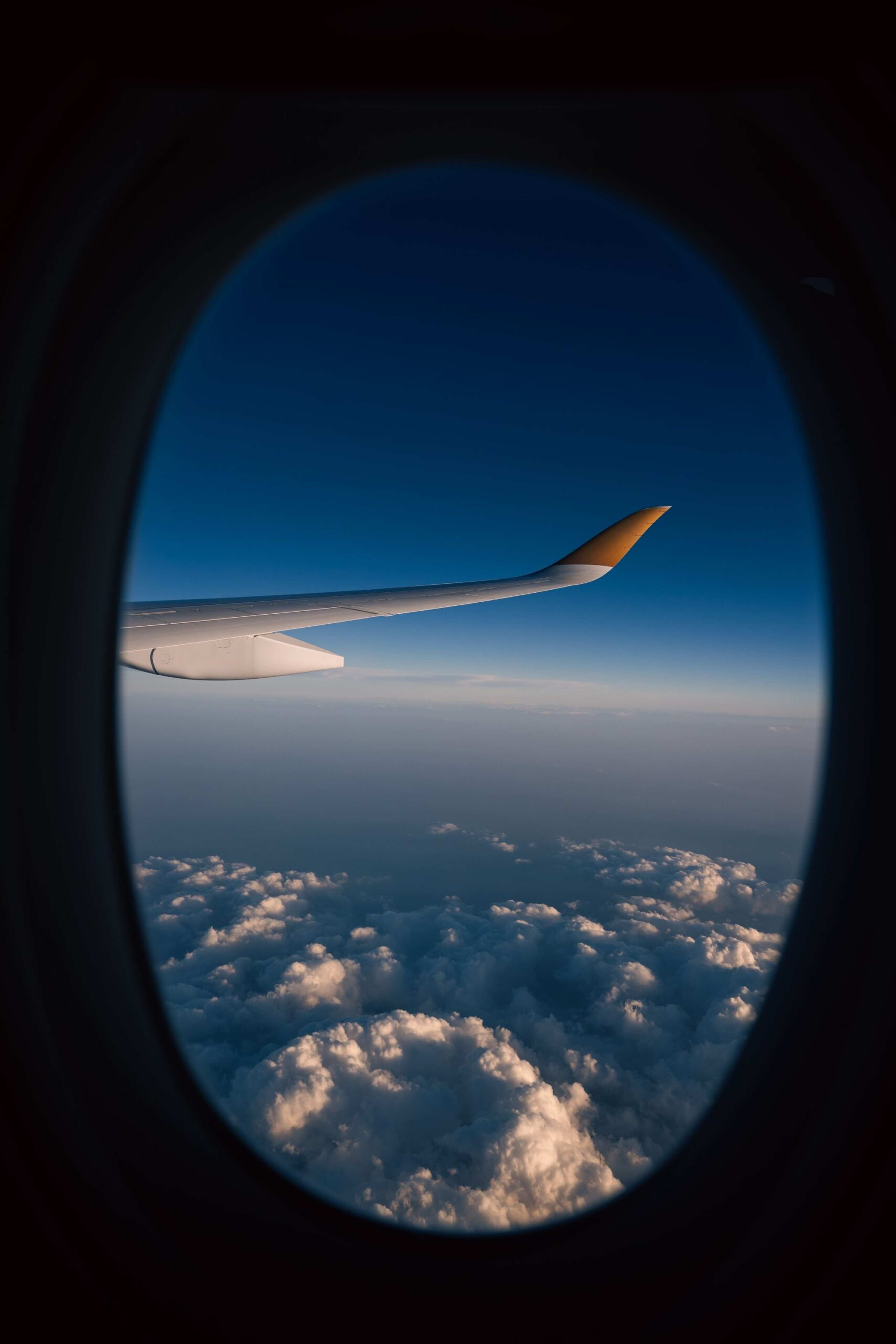
The boarding gate is half-lit at dawn.
You are wide awake.
Not from the coffee. Not from the early alarm.
From something quieter. Something older. A small, electric hum in the chest that your best friends have never once caused.
The person sitting next to you on that flight doesn’t know your last name. Doesn’t know what you do for a living. Has no archived version of you stored somewhere in their memory – no mental folder labeled who you used to be. And somewhere between the runway lights and the clouds, you exhale in a way you haven’t in months.
There’s a word for what you’re feeling. Psychologists call it identity relief. The rest of us just call it travel. The gap between who we pretend to be and who we actually are widens every year. It widens most noticeably inside our closest relationships – the ones built on memory, expectation, and the accumulated sediment of who we once were. There’s little flexibility available for reinvention when history is chiseled in stone. And history, around our best friends, is always chiseled in stone.
The Temporary Identity

Strangers offer you a blank page.
That’s not poetic. That’s neurological.
The brain thrives on exploration. When we step into unfamiliar territory, something remarkable happens – a profound neural awakening. Your brain loves novelty, and travel delivers it in abundance.
The stranger across the hostel table doesn’t know that you cried at your college graduation. They don’t know about the promotion you didn’t get. They don’t know the version of you that still shows up to Christmas dinner, performing a role written for you somewhere around age fourteen.
With them, you can be new.
Not dishonest. Just unencumbered.
The temporary identity isn’t a lie. It’s a rehearsal. It’s the self finally given enough runway to move without the weight of everyone else’s familiarity pressing down on it. The stranger doesn’t need you to be consistent. They only need you to be present. And in that simple, radical demand – presence without history – something loosens in the ribcage.
Something that was very, very tired finally rests.
The Archive Problem
Your best friends love you. That is not in question.
But love, over time, becomes archival.
They have catalogued you. Filed you. Cross-referenced you against a decade of dinners and bad decisions and inside jokes that stopped being funny three years ago but that you still perform because the performance itself is now the point. If someone strongly identifies with a group, they are more likely to act in ways that fit the group’s norms and values – because their sense of self becomes linked to their group membership.
This is the archive problem.
The closer someone is to you, the more power their internal file of you holds over who you’re allowed to become in their presence. The archive is not malicious. It’s just heavy. You can feel its weight every time you want to say something out of character and instead swallow it, because saying it would require a ten-minute explanation of why you’ve changed – and you don’t have the energy for that conversation tonight.
The semi-stranger has no archive.
You get to write the first entry.
The Permission Structure
We talk about travel as freedom of movement.
We rarely talk about it as freedom of self.
Some psychologists tell clients: “Sometimes you need distance from your world to come home to yourself.” Away from familiar roles, expectations, and the constant pressure of how you should be, people finally get to meet who they actually are.
The person you barely know doesn’t have a permission structure for you.
They haven’t decided, consciously or not, what kind of person you are. They haven’t assigned you a role in their social ecosystem – the funny one, the responsible one, the one who always orders the same thing, the one who can’t handle confrontation. All of those roles exist only in the rooms where people know you well enough to have invented them.
Abroad, with someone new, the role is unwritten.
You can be quieter than usual. Louder. You can be the one who suggests the detour. You can be the one who admits they’re afraid of something. Nobody blinks. Nobody files it away as inconsistent with the version they’ve known for years.
That is not escapism. That is oxygen.
The Performance Tax
Every long-term relationship levies a performance tax.
The tax is not paid in money. It’s paid in energy – the constant, low-grade expenditure of being legible to someone who has strong opinions about who you are. What most people actually need is enough stimulation to stay curious, enough solitude to recharge, and enough structure to feel safe without constant social performance. The problem is that constant social performance is precisely what familiar groups demand.
With your best friends, the tax is collected at dinner.
At the group chat. At the holiday gathering where you must, again, be the person from the story they keep telling about you – the one where you did the thing, back in the year, and everyone laughs on cue. You laugh too. Even though the person who did that thing feels like someone you read about once in an old journal.
The semi-stranger doesn’t collect this tax.
The transaction between you is purely present-tense. What you say now. What you do today. The relief of that – the sheer, staggering relief of being evaluated only on what you are right now, not on the accumulated residue of everything you’ve ever been – is the real reason you keep choosing the road trip with the colleague, the flight with the acquaintance, the adventure with someone whose middle name you don’t know.
The Confession You Can Only Make to a Stranger
I remember the train from Lisbon to Porto.
A woman sat across from me. We’d met the night before at a small guesthouse, the kind with dim bulbs and a communal table and wine poured without asking. We talked for seven hours across two time zones of conversation. I told her things I hadn’t told anyone in years. Not because she was a therapist. Not because she was particularly wise.
Because she had no stake in the version of me I’d spent years carefully maintaining.
She asked me questions my best friends had stopped asking – not out of cruelty, but because they assumed they already knew the answers. The stranger assumed nothing. And in the vacuum of her not-knowing, something honest crawled out of me and sat down at the table between us, blinking in the light.
Other, deeper assumptions and new perspectives can form from brief, yet powerful interactions. Even the simplest of social situations – eating a meal, chatting in a hostel – may create deeper bonds that strip away the preconceptions seated deep inside.
That is not a small thing. That is a life thing.
The Consistency Trap
We prize consistency in the people we love.
We call it reliability. Character. Trustworthiness.
But buried inside the compliment is a subtle demand: do not change in ways that inconvenience my image of you. Other persons’ behavior impacts participants’ identity strongly and lastingly. The inverse is equally true – those close to us shape and constrain what we feel permitted to become.
The consistency trap is suffocating precisely because it wears the face of love.
Your best friend doesn’t mean to hold you to an older version of yourself. They simply find it disorienting when you arrive different. When you’ve spent six days in a foreign city with people they’ve never met and returned with a new laugh, a new opinion, a new way of ordering your thoughts – they notice. They may even feel a little betrayed. Not because you’ve done anything wrong. Because you’ve moved, and they were holding a map to somewhere you no longer are.
The semi-stranger has no map.
They navigate you only in the present tense, and in that navigation, you are allowed to be exactly who you are right now – which is always, always, slightly different from who you were last year.
The Anonymity Dividend
Anonymity has been misread as loneliness.
It is not loneliness. It is latitude.
Travel strips away the roles we play in ordinary life. At home, you’re a business owner, a colleague, a neighbor – a person with a reputation and a history. On a trip to a city where nobody knows you, you’re just a person in the world. That anonymity is liberating in ways that are hard to articulate until you’ve experienced it.
The anonymity dividend compounds when you travel with someone who is also anonymous to you.
Two people who barely know each other are both free. Neither one is performing for the other’s archive. Neither one is managing the other’s expectations. The interaction has no history and no official future – it exists only in the long, golden corridor of now. That corridor is where the most honest version of you tends to live. Not in the living room. Not at the birthday dinner. In the now. In the gap. In the space between who you were last time they saw you and who you’re quietly becoming.
The Role Vacation
Roles are exhausting even when we love them.
Parent. Employee. Best friend. The Responsible One. The Funny One. The One Who Always Knows The Restaurant.
Psychologists emphasize that the need to start over is deeply linked to autonomy – the human right to self-determine one’s path in life. For some, continuing in the same environment, surrounded by familiar expectations, is emotionally draining.
The role vacation is not a rejection of those you love.
It is a maintenance shutdown. A system reboot. Every machine needs it. Even the ones that run beautifully. Even the ones that have never once failed their people. You cannot pour indefinitely from a vessel that never gets a moment to examine its own shape.
The person you barely know gives you a role vacation without even trying.
They don’t know which role you play at home, so they can’t cast you in it. And in the absence of casting – in that beautiful, disorienting blank space – you can remember what you actually enjoy. What you actually think. What you would actually order if nobody who knew you was watching and forming an opinion about it.
That is not nothing. That is everything.
The Identity Expansion
Travel with a semi-stranger doesn’t just relieve you of old identity. It builds new ones.
Psychological research has shown that the ability to engage with people from different backgrounds than yourself, and the ability to get out of your own social comfort zone, helps build a strong and cultured sense of your own self.
The semi-stranger reflects you differently.
They ask about the thing your friends take for granted. They find interesting what your inner circle finds ordinary. In the mirror of their fresh attention, you see yourself with unfamiliar clarity – not the worn, slightly distorted reflection of long familiarity, but a clean, undamaged surface that shows you something true.
Travel profoundly reshapes who we are at our core. Identity – our fundamental understanding of self – undergoes remarkable transformation when we step into unfamiliar territories.
This is why you come back from those trips different.
Not because the place changed you. Because the absence of expectation changed you. Because for five days or five weeks, you were not required to be the same. And in not being required, you quietly expanded – the way anything does when the pressure holding its shape is finally, gently, removed.
The Space Between Who You Were and Who You’re Becoming
This is the heaviest truth.
Your best friends – the ones who love you most, who know you best, who would do anything for you – are sometimes the largest obstacle to your becoming.
Not through malice. Through love, and its shadow: familiarity. If someone strongly identifies with a group, they are more likely to act in ways that fit the group’s norms and values – and the group of people who know you best has the strongest norms of all. The norm of you. The norm of who they have decided, over years of data, that you are. To deviate from that norm is to require them to update their model. And updating is work. And most people, even the ones who love you, are tired.
The semi-stranger requires no update. There is no previous model to obsolete. You arrive as you are, in this moment, and that is the only version that exists between you.
When you travel with new people, you’re quietly learning to trust yourself again. You navigate a new city, choose your own plans, handle small uncertainties – and every one of those moments becomes evidence that you can rely on yourself.
The thing nobody tells you about returning from a trip with someone you barely know is the grief of it. Not grief for the place. Grief for the version of yourself that was briefly, beautifully free. You step off the plane and feel your old roles settling back onto your shoulders like a coat you never chose but have worn so long you’ve forgotten it isn’t skin.
The question worth sitting with – the one the trip always leaves behind – is not why do I prefer strangers. It’s: what would it look like to bring a little of that freedom home? Not by becoming a stranger to your oldest friends. But by gently, consistently, insisting on being allowed to arrive at dinner as the person you actually are today – not the one they catalogued in 2018, not the character in the story they keep telling, but the one still in progress. The one still becoming. The one who has been quietly expanding in the dark, like all living things do, when given the simple mercy of enough space.
Somewhere, a boarding gate is opening. You already know how you’ll feel the moment you walk through it – lighter, somehow, before you’ve gone anywhere at all. That lightness has a name. It is not wanderlust. It is not adventure. It is the particular, ferocious relief of being, for a little while, unmapped.