You’re on a booking site at 11 PM.
The city you’re traveling to doesn’t matter yet.
You scroll past the standard room. Past the city-facing room. You stop at the one with the panoramic view.
You click it. You pay more for it. And three nights later, you pull the blackout curtains shut and sleep until noon.
You never once looked out.
This is the distance between who we tell ourselves we are – curious, open, alive to the world – and who we actually become the moment we arrive somewhere unfamiliar. Someone who just needs to know the door locks, the curtains pull, and beyond those curtains, a world still hums. Someone who craves the option of vastness without the obligation of it.
The Sentinel Brain
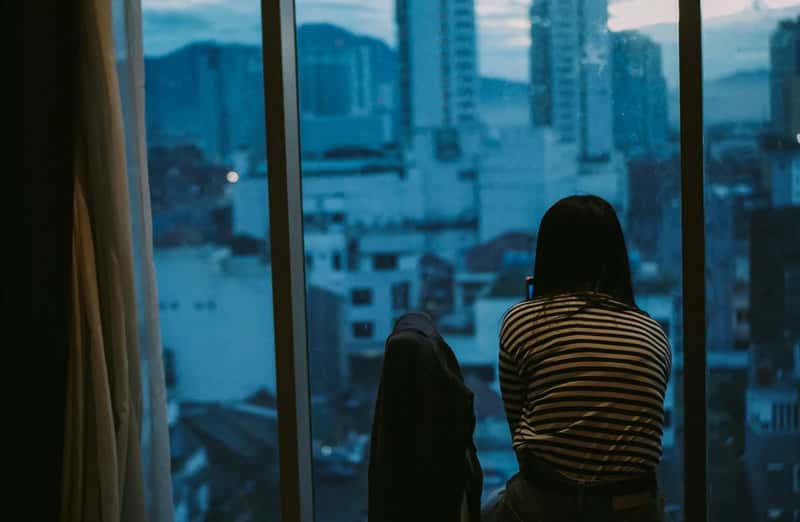
You did not evolve to relax in a sealed room.
Every nerve ending you have was tuned, over millennia, to the open horizon.
Prospect-Refuge Theory describes an evolutionary preference for environments that offer safety – refuge – while also providing the ability to survey your surroundings for resources and potential threats – prospect. Your ancient brain does not understand hotel walls. It understands sightlines. It understands the distance between you and the treeline.
When you book a room with a view, your sentinel brain exhales.
Not because you plan to stand at the window for hours. But because it knows it could. The threat-scanning function that kept your ancestors alive has been quietly retasked. It now monitors the city below from the fourteenth floor. It watches the ferry crossing the harbor. It counts the lights going on and off in the apartment block across the street.
The view is not luxury. It is threat intelligence.
And when you close the curtains, you close them knowing you’ve already run the scan. The world checked out clean. You can sleep.
The Liminal Toll
Transit does something to a person.
Something quiet and corrosive.
Perhaps one of the most profound psychological effects of airports is how they temporarily strip away our usual identity markers. In the international transit zone, national boundaries become fluid, and our usual social roles temporarily suspend. You are not your job title in the departure lounge. You are not your neighborhood, your car, your coffee order. You are a seat number and a gate assignment.
These environmental factors combine with psychological stressors to create a unique state of mind that some researchers have compared to mild dissociation – where people feel slightly disconnected from their normal sense of self and behavior.
You arrive at the hotel already partially dissolved.
The view is a reorientation tool. You find the horizon, you find the city’s geometry, you locate your place within it. The grid of streets below tells you where you are. And knowing where you are, however briefly, tells you who you are. The window is not architecture. It is a compass.
The Permission Structure
Here is what the view actually buys you.
It is not the view itself. It is the permission to not look.
In demanding situations that require concentration, the desire for mental disconnection is expected, while people who perceive their environment as monotonous seek information and stimulation through a visual connection with the outside. The window is a valve. When travel becomes monotonous – another lobby, another minibar, another ceiling – the view promises stimulation on demand. When travel becomes overwhelming, the curtains become armor.
You booked the optionality, not the view.
This is the deeper truth of it. The ability to choose one’s vantage point or retreat provides a stress-reducing sense of autonomy and control over the environment. The room with a view gives you both levers. You can survey or you can hide. You can press your forehead to the cold glass at 3 AM and watch the city breathe, or you can seal yourself inside and pretend the city doesn’t exist.
Most nights, you choose the curtains.
But you chose them. That distinction carries everything.
The Restorative Hypothesis
There is actual science behind why the window matters even when you’re not looking through it.
Kaplan suggested that windows with views of nature are “micro-restorative settings” that may provide brief views with elements of fascination, likely to reduce mental fatigue. The key word here is brief. You don’t need to sit and meditate on the cityscape. A ten-second glance on the way to the bathroom at 2 AM is enough. The brain registers the sky, the depth, the movement. It recalibrates.
A window view provides information about time and weather, decreases the feeling of claustrophobia, and can have a positive contribution to eye health by providing a distant horizon at which to gaze.
That last part lands differently when you’re traveling.
The distant horizon is confirmation. The world has not contracted to this room, this city, this version of you that doesn’t quite fit. There is still depth out there. Still distance. The horizon is a promise that there is more to move toward. Or away from. Whichever you need.
The Sealed Room’s Confession
I have to tell you something here.
I once booked a corner suite on the thirty-second floor of a hotel in a city where I knew no one and had no particular reason to be. I paid roughly twice what I should have. I told myself I was treating myself.
I spent most of the trip with the curtains closed.
But twice – once at dawn, once at the frayed edge of midnight – I pulled them back. And both times I stood there for a long time, watching the city do its quiet, indifferent work. Traffic signals cycling. A lit window going dark. A cab making the same left turn it would make a thousand more times before sunrise.
None of it was about me.
That was the gift. When we step out of our everyday environments and routines, we undergo a temporary rearrangement of our identities – one that lets us imagine other possibilities for ourselves. We can escape our at-home personas and live unbound, or widen our perspectives and make big-picture plans for future iterations of us. The view confirmed this. I was someone else in that city. Someone lighter. Someone still being written.
I needed the window for that. I needed to know the city was indifferent to my reinvention.
The Cognitive Anchor
When everything is temporary, the mind needs something to hook into.
Travel destabilizes cognition in ways we underestimate. The transition to a new space immediately reminds us that our cognitive functions are intimately connected to our built environments. When people are displaced, they risk losing powerful stories, personal memories, and access to parts of their identities because of this tightly interconnected relationship between cognition and physical materials.
The hotel room is a blank space. No history, no texture, no accumulated self.
The view imports geography. And geography imports identity. When you look out at a river, a skyline, a mountain range, you acquire a temporary address in the world’s logic. You become someone who is here, specifically here, rather than simply nowhere in particular. The view pins you to the map. The map pins you to yourself.
Without the window, you are floating.
The window is ballast.
The Evolutionary Debt
Your preference for the elevated view is older than architecture.
The savanna hypothesis argues that because modern Homo sapiens emerged and evolved on the savannahs of east Africa, which provided a relatively resource-rich and secure environment, people have an affinity for savannah-like environments. Over our evolutionary history, we developed psychological adaptations that motivate us to be drawn to and respond positively to relatively unobstructed views of undulating grasslands, scattered trees, and occasional bodies of water.
You are not booking a hotel room with a view.
You are booking your ancestral sightline. The elevated position from which your forebears could see the predator before it saw them. The vantage point. The strategic advantage dressed up in thread count and a minibar.
Thousands of years after modern humans populated the globe, we still respond positively to landscape and savannah-like settings – for example, hotels often charge more for rooms with natural scenic views. The hotel industry didn’t invent this premium. It simply noticed it. The market for views is as old as the primate fear of being caught in the open, unseen, unaware.
You are not paying extra for a prettier room.
You are paying to feel like the watcher, not the watched.
The Temporary Self
Travel forces a renegotiation of identity that most people never consciously choose.
When we are working all the time, it’s the prioritization of one identity over others. That’s not necessarily bad, especially if you like that identity, but for most people they have a range of identities that are important to them. Putting too much salience in one identity at the expense of others can lead to a more narrow experience.
The road breaks that narrow experience open.
And the view becomes the container for whoever emerges from the break. It holds the shape of a self that is not yet defined. You stand at the glass not knowing who you are here, in this city, at this hour – and the view absorbs your uncertainty without judgment. It doesn’t need you to be anyone in particular. It just hums, lit up, indifferent, continuous.
Windows don’t just let us look out – they help us connect with the rhythm of the world. Watching sunlight move across a room or observing a rainy day from the comfort of your home helps anchor your mind to the present. This connection to daily cycles and weather patterns grounds us in time and place.
The temporary self needs that grounding most of all.
The Biophilic Pull
There is a name for the pull you feel toward the window even when you don’t act on it.
This is rooted in a concept known as biophilia – our innate human tendency to seek connections with nature. Windows that frame outdoor views, no matter how small or urban, provide a mental escape and a moment of calm during busy or stressful days.
Travel is, structurally, a busy and stressful day. Extended over multiple days. The biophilic pull – that quiet tug toward the window, toward green and sky and distance – is a survival signal dressed in civilian clothes. It does not announce itself. It doesn’t ask for your attention. It simply makes the sealed room feel wrong and the windowed room feel right.
We evolved in landscapes with distant views and nearby shelters. Neuroscience confirms that our brains still respond to these conditions, and empirical research shows that spaces combining openness and shelter reduce stress, improve mood, and even speed up healing.
The hotel room with a view is, stripped of its amenities, a shelter with a distant view.
The oldest architectural concept known to the human body. You didn’t find it on a booking site. You remembered it.
The Real Transaction
This is what is actually happening when you filter hotel results by “view.”
You are not shopping for aesthetics.
You are making a contract with continuity. A guarantee that beyond the temporary walls of your temporary room, in the city you know only from a map and a thumbnail, the world will persist. Our surroundings, as viewed through the window, have a significant impact on how we feel, how we think, and how productive we are. But more than that – our surroundings confirm that we exist within a larger context. That we are not simply a body in a room. That there is a city, a sky, a horizon, and we are somewhere within all of it.
Emotions play a central role in how people choose where to stay. Research shows that travelers often make decisions based on anticipated feelings – like relaxation, adventure, or luxury – rather than purely logical factors. But the view is not about relaxation or adventure. It is about ontological safety. The quiet, wordless knowledge that you are real, the world is real, and the two of you are still in contact.
You pay the premium for that.
And it is not expensive enough.
The curtains in your room right now are probably closed. Or the room is dark, and the window is just a rectangle of grey city light leaking around the edges. You haven’t looked out since you arrived. You ordered room service, you answered three emails from the wrong time zone, you showered twice because the hot water is good and hot water is one of the few reliable things when you’re this far from everything that knows your name.
But you booked the view room. You did that quietly, deliberately, the way we make the choices that really matter to us – without ceremony, without explanation, without fully understanding what we’re asking for. You asked for the world to remain visible. You asked for a window that proves distance is real and that you are somewhere within it. You asked to be the watcher instead of the watched, the safe animal on the elevated ground, the self with enough context to at least approximate who it might be.
At some point tonight, or maybe at 4 AM when the sleep fails and the room gets too small, you will get up. You will go to the window. You will stand there for a minute, maybe two, watching a city that has no idea you exist. And that will be enough. The world is still there. You are still in it. The view confirmed what the room could not. You can go back to sleep now. You know where you are.