The airport bookshop smells like possibility.
You walk in with twenty minutes to spare.
You leave carrying something heavy, something serious, something that says: I am a person who uses time well.
You will not open it on the plane.
You already know this. You knew it the moment you handed over the money. And yet – you bought it anyway. Because in the specific theater of transit, the book is never really about reading. It is about being seen. Not by the strangers in Row 14. By someone older. Someone internal. Someone who has been watching you since you were seven years old and still hadn’t finished your homework.
The unread book is not just a failed intention. It is evidence, repeated with every trip, that there is a version of you who is being performed rather than lived. That the person you most want to be – the curious one, the intellectually alive one, the one who isn’t afraid of unstructured time – is being oppressed to receive approval from the long gone authority figure.
The Prop Purchase
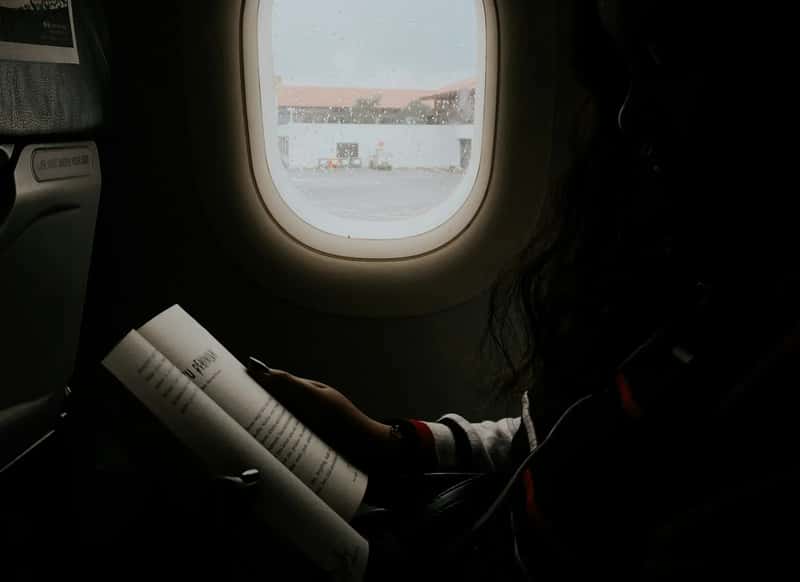
The book is not a book.
It is a credential.
The book becomes a prop in a drama about identity. This mode has less to do with deception and more to do with visibility. And nowhere is visibility more urgent than in transit – that queasy space where you have no title, no desk, no colleague to affirm your worth. You are just a body with a boarding pass. So you reach for something solid. Something that telegraphs: I am going somewhere, and I intend to arrive improved.
The prop purchase happens fast. It happens at the corner of impulse and anxiety. You don’t browse for long. The book is now a prop, part of a visual language. It is a small piece of a larger self-presentation. And beautiful objects have always had a way of making us feel that possession is equivalent to engagement.
You feel better the moment it’s in your bag. That’s the tell.
The relief you feel isn’t about the book. It’s about the image you’ve just constructed. The transaction is complete before the first page is never turned.
The Childhood Script
Go back further.
There is a child in a classroom, or at a kitchen table, or in the back seat of a car. The adults around them have a specific look – a scanning look. An evaluating look. The child learns, early, that being visibly productive is safer than being caught doing nothing.
In childhood, parental authority gives structure and direction to a child’s life. It gives the child a reference for making decisions that they can internalize and follow without having to figure out how to believe and behave entirely on their own.
The problem is what gets internalized alongside the structure.
The child doesn’t just learn to read. They learn that being seen reading earns approval. That a book in the hand is a signal of value. That idleness is dangerous. As children, we are so adept at picking up on these subtle cues – the insecurity or inauthenticity of the masks the adults in our lives wore. We become extremely adept at learning what the adults in our lives needed, and as adults, we continue the cycle of “please and appease,” equating this hypersensitivity with safety and survival.
You are forty-one years old. You are boarding a flight to a conference. And you are still trying to look busy for a parent who isn’t there.
The Aspiration Gap
There is a version of you that exists only in airport bookshops.
They read Camus on long hauls. They finish nonfiction before landing. They annotate in pencil and dog-ear pages with intention. They are rested and focused and the kind of person who uses the phrase “I’ve been thinking about” in conversation without irony.
You love this version of yourself. You invest in them regularly.
We may also genuinely believe we’ll get around to reading these books someday, but our ideal book-reading self seldom matches the reality of our lives. The gap between that aspirational self and the actual self is not laziness. It is something more tender: the persistent, optimistic belief that transit will transform you. That somewhere between departure and arrival, you will become someone more disciplined.
Many people buy books they never read because of the illusion of intellectual progress – the belief that owning books makes us smarter, even if we never open them. Books symbolize intelligence and personal growth, making us feel accomplished just by having them.
The aspirational self is real. Just not at 30,000 feet.
The Liminal Permission
The airport is not the real world.
It operates under different rules. Different lighting. Different permission structures. Perhaps one of the most profound psychological effects of airports is how they temporarily strip away our usual identity markers. In the international transit zone, national boundaries become fluid, and our usual social roles temporarily suspend.
In this suspension, you are free to be anyone.
So you choose the best version. You choose the reader. When you’re in a liminal space, you’re neither here nor there, neither this nor that. At the same time, you’re both here and there. Both this and that. You are both the person who watches four episodes of a streaming drama and the person who carries a 400-page literary novel in their carry-on. The airport makes both versions feel equally possible.
The book is the ticket to the better version.
You buy it. The better version boards the plane. And then falls asleep before the seatbelt sign goes off.
The Self-Surveillance Loop
Here is the part that keeps you stuck.
It isn’t that you don’t want to read. It’s that reading has become attached to a performance you can never quite deliver. I know this intimately. I once carried a 600-page biography through six airports across three countries. It made it home with its spine unbroken. But I felt vaguely sophisticated the entire trip. The book was doing its job. Just not the job listed on the cover.
I turned reading into a mirror. Every book I do or do not read feels in many ways as a reflection of my selfhood. Reading does not feel like a straightforward encounter with a text. It has become a referendum on who I am.
When the act of reading is also an act of self-evaluation, the pressure collapses the pleasure. You don’t pick up the book because you are afraid of what it means if you don’t finish it. Or don’t enjoy it. Or lose the thread on page forty-seven and never find it again.
The unopened book cannot disappoint you. That’s its secret power.
The Dopamine of Intention
The purchase is the reward.
The reading was never the point.
Buying books triggers dopamine, the brain’s reward chemical that makes us feel excited. The act of purchasing satisfies our intellectual hunger. The anticipation of reading brings motivation, but fades after buying. This is not a character flaw. This is neuroscience wearing a tasteful cover design.
The moment of purchase is a complete emotional transaction. You have already received the benefit: the identity hit, the self-concept boost, the brief and vivid fantasy of the person you might become somewhere over the Atlantic. What the actual reading would give you – insight, transformation, genuine intellectual engagement – requires work. Sustained, quiet, undistracted work.
The airport is the exact opposite of quiet.
The expectation to publicly exhibit one’s reading choices can stifle the unselfconscious joy of discovery, replacing curiosity with anxiety and self-censorship. And so the book goes into the bag, the bag goes into the overhead locker, and the dopamine quietly dissipates somewhere over the Irish Sea.
The Identity Armor
You are about to be crammed into a metal tube with strangers.
You are about to be reviewed, at least in your own mind, by everyone who passes your seat.
The drive to manage how we appear to others isn’t vanity. It’s deeply functional. Baumeister and Leary’s foundational work on belonging identifies the need for social acceptance as one of the most powerful human motivators, not a surface desire, but something closer to a biological imperative.
The book is armor. It says: I am not anxious. I am engaged. I have inner resources. I chose this flight deliberately. It communicates all of that without a word spoken. A paperback held at a particular angle does more identity work per square inch than almost any other object in existence.
We’ve always used books as shorthand for who we are or aspire to be. The airport bookshop is simply the most concentrated, most time-pressured version of this ancient habit. You have forty minutes before boarding and a lifetime of self-image anxiety to manage. The book is efficient. The book is portable. The book is you, summarized, at your most aspirational.
The Authority That Moved In
The original authority figure – the parent, the teacher, the person whose approval wired your nervous system – is long gone from your daily life.
But they didn’t leave.
They moved inside.
According to attachment theory, adolescents’ attitudes toward authority may derive from early interaction with primary caregivers, primarily parents. Individuals internalize these interaction experiences and form internal working models, which will be applied in later life stages when interacting with authority figures.
The internal authority figure is more demanding than the external one ever was. They never sleep. They are present at every checkout, every boarding gate, every moment of unstructured time. They have opinions about your seat-back screen choices. They note when you fall asleep before the seatbelt sign goes off. And they feel temporarily placated – just slightly, just enough – when you carry a book that looks difficult.
The airport is where the internal authority figure is loudest. Because the airport strips everything else away. No role, no routine, no context. Just you, and the silent jury of your own internalized expectations.
The Unread Library Inside You
The Japanese have a word for the unread books piling up around you.
Tsundoku.
The Japanese have a specific term for a pile of purchased but unread reading materials: tsundoku. There is something merciful in having a word for it. It means you are not alone. It means this is human enough to have been named.
Every unread book is a small monument to the person you intend to become. Buying books isn’t just about the stories inside them. It’s about the promise they hold. Each new book is a world waiting to be explored, a journey we might embark on – someday. It’s like stocking up on dreams. The airport book is the most poignant version of this. Purchased in transit. Intended for a version of yourself who exists only in transit. Never quite opened. Never quite abandoned.
It sits on the nightstand when you get home. Then the shelf. Then the box in the spare room. The whole journey, still sealed inside its spine.
The Performance That Costs You
This is the heavy one.
The performance of reading – the prop, the armor, the aspirational signal – has a cost that compounds quietly over years. You feel depleted not by the demands of life but by the effort of managing how you appear. The gap between who you perform as and who you feel yourself to be generates significant anxiety or dissociation.
When reading becomes primarily a means of projecting identity, it risks losing its generative energy. Books begin to matter for how they position the reader within a cultural hierarchy, instead of mattering for what they do to the reader.
And the childhood authority figure – still watching from inside, still scanning, still evaluating – is never actually satisfied by the purchase. You can feel that, too. You hand over the money. You feel better for exactly twelve minutes. Then the familiar low-level unease returns, and you check your phone, and the book rides quietly in the overhead compartment all the way to your destination.
The performance never lands. Because the audience – that internal, inherited, ancient audience – cannot be pleased by appearances. It was never really asking you to read more. It was asking you to need its approval less.
There is a kind of grief in the airport bookshop, if you let yourself feel it. Not grief for the books you haven’t read. Grief for the energy spent performing a version of yourself you never quite inhabit. Grief for the child who learned, somewhere around second grade, that being visibly busy was the safest thing to be.
The next time you walk past that bookshop – the one with the bright covers and the bestseller table just inside the entrance – you might try something uncomfortable. You might notice the pull. The specific, prickling pull of wanting to be seen carrying something serious. And you might ask yourself, quietly, before you reach for your wallet: Am I buying this because I want to read it, or because I want to be the kind of person who reads it?
There is no wrong answer. There is only the awareness. And maybe that awareness – that small, clear-eyed pause between the impulse and the purchase – is where the real reading begins.
The book you actually want to read is probably one you already own, somewhere in the spare room, still waiting for you to stop performing long enough to begin.