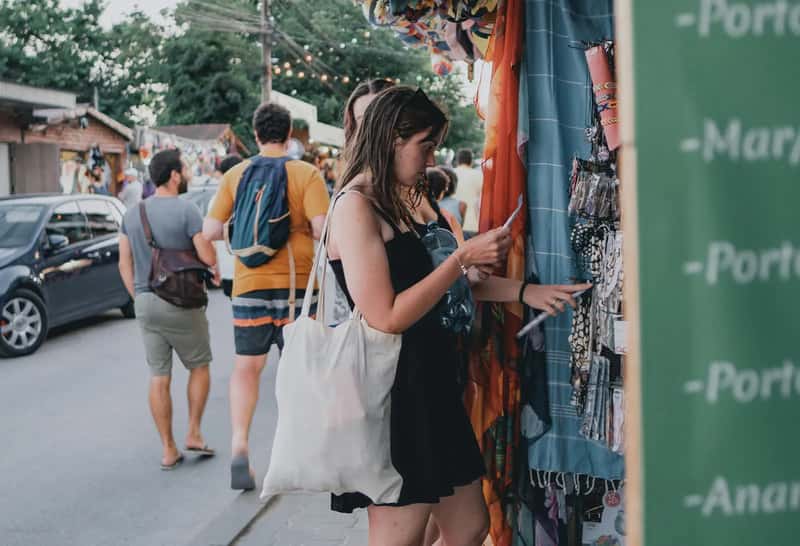
You are standing in a market stall in Lisbon at 4 PM.
The light is almost amber.
Your hands are already full.
And you are reaching for a second one anyway.
There is a gap between the traveler you perform for others and the one who stands, quietly terrified, in the souvenir aisle. The performed one collects experiences. The real one collects insurance. One buys a ceramic tile because it’s beautiful. The other buys two because beauty, alone, has never felt like enough proof.
The Vanishing Act
Memory is not a photograph. It is a painting done from memory, repainted every time you look at it.
That is the terror underneath all of this.
Travel experiences are fleeting. Memory fades. Physical anchors resist that fading. But here is the part no one says out loud: you already know, somewhere below your sternum, that even the anchor rusts.
So you buy two. One for the shelf. One for the drawer. One to display and one to hold in reserve, like an understudy waiting in the wings.
The fear is not of forgetting the place. The fear is of forgetting who you were in that place.
That is a different kind of loss entirely.
The Redundancy Ritual
Call it what it is. It is a ritual of redundancy. A hedge against the collapse of the self.
Buying a souvenir is interwoven with deep psychological motivations, from preserving memories to constructing our identities. But when you buy two, you are not constructing an identity. You are attempting to insure it against damage.
One version of the memory for the person you are now.
One version for the person you will become, who might remember it differently.
The duplicate is not excess. It is a confession: I do not trust my own mind to hold this without distortion.
And the mind, it turns out, is an unreliable narrator. It edits. It softens. It rewrites the ending.
The Evidence Anxiety
There is something rawer than nostalgia underneath the souvenir transaction.
It is the need for evidence.
One of the simplest reasons for buying souvenirs is to provide evidence of our adventures. But “evidence” is a legal word. It implies doubt. It implies a courtroom somewhere in the psyche where the trip is being cross-examined.
The souvenir is an important component of the tourist experience, with most tourists bringing back mementos and souvenirs as evidence. People like to be reminded of special moments in their lives and to hold evidence of those special moments.
Two souvenirs. Two pieces of evidence. Because single witnesses have been known to recant.
This is not paranoia. This is the reasonable anxiety of a consciousness that knows it cannot be fully trusted with its own autobiography.
The Dual Archive
Consider the architecture of it.
One object is public-facing. It lives on the bookshelf, the coffee table, the kitchen windowsill. It performs the story for guests. It says: I was there, and it was like this.
The second object is private. It lives in a box, a drawer, a closet shelf. It is not for display. It is for survival. It is the backup drive. The fireproof safe copy.
This unintentional organization reflects how we externalize memory. We build physical systems to store narrative structure. Fridge magnet collections often become personal archives without deliberate planning.
The dual archive is not clutter. It is a distributed memory system. Redundant nodes in a network designed to resist total failure.
The engineers call it fault tolerance. The travelers call it Tuesday.
The Identity Split
Here is where it gets personal.
I once bought two hand-painted postcards from a tiny shop in Oaxaca. Same image. Same vendor. Paid twice. She looked at me with a flat kind of patience that suggested she had seen this before. I told myself one was for a friend. It wasn’t. Both ended up in the same box, a box I have moved across four cities and three countries. I have never sent either one. I have never thrown either one away.
What I was really doing, I understand now, was trying to stabilize an identity that felt particularly vivid in that market, in that light, and particularly fragile everywhere else.
Displaying souvenirs can be a way for us to show other people who we are beyond the version of us that others see on a day-to-day basis. Souvenirs can also serve as evidence to ourselves that we have had exciting experiences outside of our regular lives.
The second postcard was proof for a future self who might not believe the first one was real.
The Memory Decay Panic
There is a specific, low-grade panic that sets in at the end of a trip.
It is not sadness. It is closer to pre-emptive grief.
You are still in the place and you are already mourning the version of yourself who is in the place. Because you know: the moment the wheels lift, the erosion begins.
Psychologists call souvenirs “external memory cues.” These are physical items that trigger vivid, sensory memories, like the smell of a café in Paris or the sound of waves in Maui. According to psychologist Dr. Susan Krauss Whitbourne, souvenirs help us solidify life experiences.
But “solidify” is doing a lot of heavy lifting there. What you actually want is to freeze the moment before it mutates. Two objects give you two chances at crystallization. And still, it is never quite enough. Because the thing you are truly trying to preserve is not the place. It is the feeling of being fully, undeniably alive in it.
The Symbolic Consumption Loop
We are wired for symbolic logic. Objects carry meaning that language cannot.
One aspect of souvenir psychology is the concept of “symbolic consumption.” People buy souvenirs not just for their functional use but also for the symbolic meanings they represent.
And here is the loop: the symbol is supposed to stand in for the experience. But the experience was too large and too dimensional to be held by a single object.
So you buy a second symbol. And it still falls short. So you take a hundred photographs. And still fall short.
The truth of the experience exceeds every vessel designed to contain it.
That is not a failure of the vessel. That is a testament to the scale of what it means to actually be somewhere, in a body, in a moment, awake to it.
Two souvenirs is not greed. It is a sincere, if futile, attempt at proportion.
The Transitional Object
Psychoanalysis has a name for the stuffed animal a child refuses to leave behind. The blanket taken everywhere. The object that mediates between the safe world and the terrifying one.
The most meaningful ones are tied to specific emotions: joy, awe, courage, nostalgia. These items become what psychologists call transitional objects, which are reminders of growth, love and transformation.
As adults, we do not outgrow this need. We merely upgrade the object.
The souvenir is the grown-up version of the security blanket. It mediates between the expanded self experienced during travel and the contracted self waiting at home. And buying two of them is the act of someone who knows, with excruciating self-awareness, that one transitional object has never been enough to survive the transition.
The airport is the threshold. You need something in each hand to cross it.
The Narrative Fragmentation Fear
The modern traveler is a person who is actively constructing a self-narrative in real time.
Every trip is a chapter. Every chapter needs its artifact.
A collection of souvenirs can tell the story of our lives. Each item represents a chapter, a place, or a memory. Souvenirs help us define our personal stories and identities. When we showcase a collection from our travels or experiences, it provides others a window into who we are, where we’ve been, and what we value.
But narratives fragment. Chapters get lost. Memories contradict each other, disagree on the details, argue about what the light actually looked like at 4 PM in Lisbon.
Two souvenirs for one chapter is a hedge against narrative fragmentation. It is a way of saying: even if one version of this story collapses under interrogation, I have a second draft ready. The story of me will continue. Edited, perhaps. But continuous. Unbroken.
The Proof of Life
This is the heaviest one. And it has been waiting underneath all the others.
The reason you buy two of every souvenir is not truly about memory at all.
It is about proof of life.
Not the life lived in the place – though that is part of it. The deeper proof is this: that you were once a person vivid enough, present enough, awake enough to be genuinely moved by something. That the world cracked you open at least once in that alley, on that cliff, in that market at the amber hour. And you need more than one object to testify to that crack.
As one author puts it, we acquire souvenirs “not to evaluate the world, but to narrate the self.” But the self being narrated is not the one who traveled. It is the one who is terrified of becoming someone who no longer travels. Someone flattened. Someone for whom no place cracks anything open anymore.
Holiday travel offers the opportunity for self-definition and enhancement of social prestige. Due to the growing importance of self-expressive values within the ongoing course of individualisation, tourists increasingly make use of their travel experience to self-present in a positive way. But beneath the self-presentation is the raw, unperformed need: to remain a person to whom things happen. To remain permeable. To remain moved.
The duplicate object is not insurance for the memory. It is insurance for the soul. It is a note left for a future version of yourself who might one day need to be reminded that you were here, and you felt it, and it was real, and it mattered enough that one proof was never going to be sufficient. The drawer contains the second object. The second object contains the unspoken argument. The argument says: I was fully alive here. Please do not let that get away.
You come home. You unpack. You place one on the shelf.
The other goes in the drawer, and you close it quietly, the way you close a door on a room you are not ready to leave yet.
And you stand in your living room, in the ordinary light, and you already know: next time, you will buy two again.