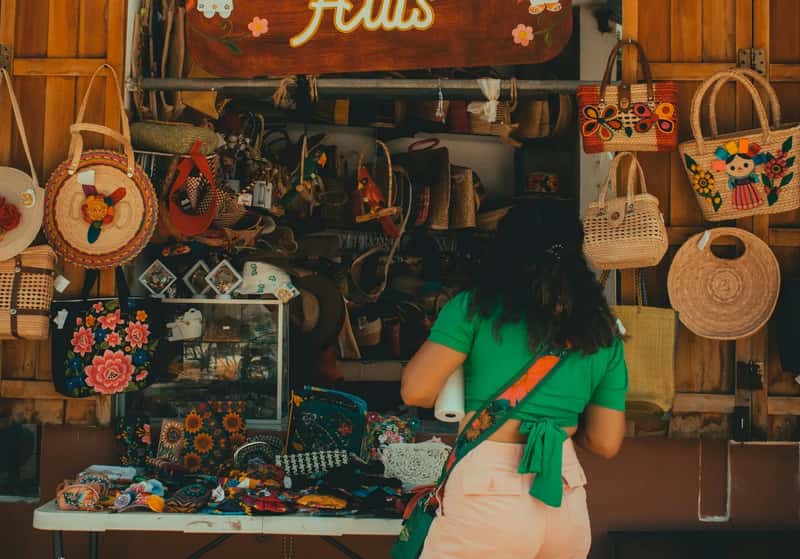
You are standing in a market stall somewhere warm.
The light is amber. The air smells like resin and salt.
You pick up one small ceramic tile. Then you pick up a second.
You tell yourself it is for a friend. You know it is not for a friend.
There is a name for the particular terror that lives in that second purchase. It is not greed. It is not sentimentality. It is the oldest, quietest fear a traveler carries in their chest – the fear that when they return home, the person they were in that amber light will not survive the crossing. That memory, left to its own devices, will lie. Will soften. Will betray the sharpest, truest edges of what actually happened. So you buy two. Because one version of your memory will not be enough to hold the truth of the trip.
1. The Memory Erosion Dread
Memory is not a recording device. It is a storyteller.
And storytellers lie in the service of a good narrative.
There is increasing debate over whether we actually forget something, or if it just becomes more difficult to remember. That distinction should terrify you more, not less. Because it means the memory is still there – just unreachable. Buried under the sediment of the ordinary days that followed.
The traveler who buys two postcards is not being irrational. They are being honest about the architecture of the human mind. They have been here before. They know what happens. They know how the sharpest afternoon of their life – the light on the water, the specific way a stranger smiled – becomes, over weeks and months, a pleasant blur.
A blur is not a memory. A blur is what memory becomes when it surrenders to time.
The second souvenir is not a backup. It is a protest.
2. The Transitional Object Trap
We do not outgrow the need for objects that hold our emotional states in place.
We simply get better at pretending we have.
The most meaningful souvenirs are tied to specific emotions: joy, awe, courage, nostalgia. These items become what psychologists call transitional objects – reminders of growth, love, and transformation. That language – transitional object – belongs to developmental psychology. It is the word we use for a child’s security blanket. For the worn-soft toy that crosses with the child from the terrifying world of sleep into the terrifying world of waking.
We are still that child.
The market tile, the printed scarf, the small glass bottle of local spice – these are your security blanket. They are what you hold in the dark between the person you were there and the person you have to be back home.
The second one is what you hold when you realize the first one isn’t working as well as it used to.
3. The Identity Anchor Effect
Travel does something specific to your sense of self.
It loosens you from your fixed narrative.
Buying a souvenir is interwoven with deep psychological motivations, from preserving memories to constructing our identities. That word – constructing – is key. You are not discovering a pre-existing identity on the road. You are building one, in real time, from the raw materials of new sensory experience. The food you ate alone at that counter. The wrong turn that became the best hour. The conversation with a stranger you’ll never find again.
Those materials are vivid while you are there. They feel load-bearing. Foundational.
Then you return home.
And the old, previous version of yourself – the fluorescent-lit, deadline-chasing, slightly-too-comfortable version – begins to reassert its gravity.
The souvenir is your attempt to anchor the constructed self. To plant a flag before the tide comes back in.
Two souvenirs means two flags. Because you know how strong the tide is.
4. The Evidence Imperative
Somewhere deeper than nostalgia, there is a harder drive at work.
You need proof.
The souvenir is an important component of the tourist experience, with most tourists bringing back mementos and souvenirs as evidence. People like to be reminded of special moments in their lives and to hold evidence of those special moments. Note the word: evidence. Not reminder. Not memento. Evidence. The language of courtrooms and crime scenes and things that require independent verification.
You are building a case. Against your own forgetting. Against the future self who might dismiss the past self’s experience as exaggerated, as romanticized, as not quite real.
Research clearly identifies the importance of evidence as the main purchase decision influencer. Although the importance of other dimensions is evident, the dimensions of memory and gift are clearly secondary to that of evidence.
The first souvenir is evidence for your memory. The second is evidence for your memory’s credibility.
You are corroborating your own testimony to yourself.
5. The Pre-Emptive Grief Purchase
I remember standing in a covered souk, a long afternoon narrowing toward its close, holding two identical hand-stamped leather journals. One for me, one “for a friend.” The friend never received it. It sat on my shelf next to the first one for three years. I understood why, eventually.
There is a specific, low-grade panic that sets in at the end of a trip. It is not sadness. It is closer to pre-emptive grief. You are still in the place and you are already mourning the version of yourself who is in the place.
That is the precise emotional weather in which the second purchase happens.
You are not shopping. You are grieving – preemptively, frantically, with your wallet – for the version of you that is about to be left behind in that alley, in that light, in that moment of feeling genuinely awake.
Grief reaches for objects. That is what grief does. It tries to make the intangible tangible. The departing, permanent.
You bought two journals because you knew one version of yourself could not hold the weight of what was ending.
6. The Narrative Self-Construction
Every trip you take is a chapter in the story you tell about who you are.
And chapters require artifacts.
As the author of the Souvenir book puts it, we acquire souvenirs “not to evaluate the world, but to narrate the self.” The self being narrated is not just the traveler. It is the person you are in conversation with on an ordinary Tuesday, when someone asks about your shelf of curious objects. It is the person you present at dinner parties. The person whose home tells a story of movement, of curiosity, of a life lived in more than one register.
Souvenirs are chapters. The second souvenir is insurance that the chapter doesn’t end on a sentence you can’t quite remember.
Because the most terrifying editorial note is this: the self you were constructing on that trip might need more than one artifact to argue its case to the self you’ll become in five years.
Two objects. Two points of triangulation. A more complete story.
7. The Sensory Trigger Architecture
What you are really buying, under everything else, is a sensory time machine.
Not a memory. A sensation.
Psychologists call souvenirs “external memory cues” – physical items that trigger vivid, sensory memories, like the smell of a café in Paris or the sound of waves in Maui. The object is not the memory. The object is the door to the memory. And doors, by their nature, can warp. Can stick. Can stop opening cleanly.
This is the unconscious fear driving the second purchase: that the first door will eventually fail.
According to psychologist Dr. Susan Krauss Whitbourne, souvenirs help us solidify life experiences. Every time you glance at that fridge magnet or sip from your travel mug, you’re reminding your brain: this trip was important. It meant something.
The second souvenir is the spare key to the same door. Hidden under a different rock. For the day – and you know the day is coming – when the first key no longer turns anything.
8. The Social Proof Compulsion
There is a quieter, more socially conscious layer to this behavior.
It is the layer that involves other people’s perception of who you are.
Displaying souvenirs can be a way for us to show other people who we are beyond the version of us that others see on a day-to-day basis. Souvenirs can also serve as evidence to ourselves that we have had exciting experiences outside of our regular lives.
The second souvenir, in this reading, is the one that migrates. That ends up in a friend’s home. That becomes a story you tell at someone else’s table, when they pick it up and ask where it came from. That is the moment you get to be, briefly, the person you were in that market. Amber light and all.
You are distributing your travel identity across multiple households. Seeding your most awake self in the lives of the people around you.
So that the version of you that felt most real survives in more than one location.
9. The Symbolic Consumption Loop
There is a clinical name for the behavior, when it becomes compulsive enough.
Memory hoarding.
It makes you want to save every single memory, every single moment. It can lead you to save up piles and piles of diaries, photos, and other mementos.
But for most travelers, the behavior never quite reaches clinical threshold. It lives instead in the normal, low-grade anxiety of a person who knows – who really knows, in the bones – that experience is irretrievably temporary.
One aspect of souvenir psychology is the concept of “symbolic consumption” – people buy souvenirs not just for their functional use but also for the symbolic meanings they represent.
The symbol being purchased, in the case of the double souvenir, is permanence. Duration. The illusion that this particular version of you – awake, cracked open, genuinely moved by a light you’ll never see again – can be kept alive by the right object.
Two objects, just to be safe.
You are not shopping. You are bargaining with time.
10. The Proof of Life Document
This is the heaviest truth. The one that sits at the bottom of every bag you ever packed.
The reason you buy two of every souvenir is not, in the end, about memory at all.
The reason you buy two of every souvenir is not truly about memory at all. It is about proof of life. Not the life lived in the place – though that is part of it. The deeper proof is this: that you were once a person vivid enough, present enough, awake enough to be genuinely moved by something.
That is the fear underneath the fear.
Not that you will forget the trip. But that you will forget the version of yourself who was capable of being fully present in it. The version who stood in amber light and felt something real move through them. The version who was, for one afternoon in a covered market, not performing life – but actually inside it.
That the world cracked you open at least once in that alley, on that cliff, in that market at the amber hour. And you need more than one object to testify to that crack.
Two small ceramic tiles. Two stamped leather journals. Two refrigerator magnets shaped like something you barely remember the name of. This is the archive of a person who is terrified, not of the world fading, but of themselves fading. Of becoming someone for whom no light moves anything.
—
The second souvenir is always for the future self who won’t believe the first one was real.
It is a letter written in objects to a version of yourself you haven’t met yet – the one who will stand in a kitchen on a grey morning, pick up a small ceramic tile, and feel the amber come back. Not clearly. Not completely. But enough. Just enough to remember that you were there. That you were moved. That the world, once, cracked something open in you that was worth this much trouble to preserve.
The trip will end. The erosion will begin. But somewhere on a shelf, in a drawer, in the corner of a room that smells like ordinary life, two small objects are standing guard over the truest version of you – waiting for the morning you finally need to be reminded that you are still, underneath everything, a person who goes toward the light.