The bag is already packed.
It has been packed for three weeks.
You tell yourself it’s efficiency. Preparedness. A kind of adult sophistication.
But the passport is not in the bag. The passport is on your body. It has been there since Tuesday. It was there on Thursday when you went to the gym. It was there – yes – folded into a waterproof pouch hanging from the shower caddy, close enough to grab in under four seconds.
Here is the truth no travel influencer will tell you: the compulsion to always be ready to vanish is not a personality quirk. It is not a lifestyle brand. It is the fingerprint of a self that learned, somewhere along the way, that safety is not a place – it is a distance you can cover between now and the next bad thing.
The Identity Gap is this: the person you present to the world is settled, rooted, maybe even thriving. The person underneath is calculating exit vectors in the middle of dinner. One version books restaurants. The other one memorizes which direction faces the door.
1. The Talisman Object
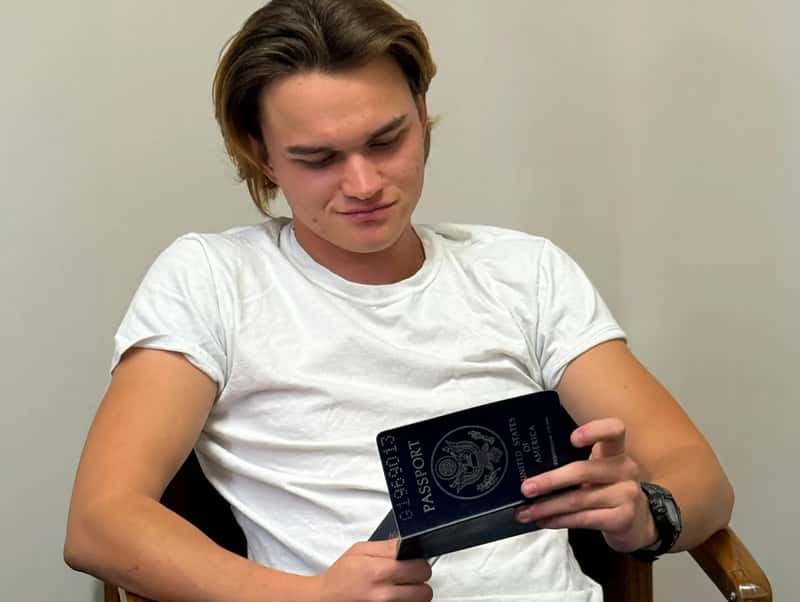
The passport is not just a document.
Psychologically, it is what therapists might call a transitional object – a physical anchor that carries the weight of selfhood when the self feels unstable. It is the one object that says: I exist. I am provable. I can be somewhere else by morning.
For the chronic vanisher, repetitive behaviors like checking for a passport are used to temporarily relieve tension – but the relief doesn’t last long. So the cycle repeats: unzip bag, check passport, exhale, rezip, doubt self, repeat.
What lives inside that cycle is not irrationality. It is a very old, very tired logic.
The object becomes a proxy for the self. Lose the passport, lose the exit. Lose the exit, lose the version of you that can still choose to disappear. The shower thing makes complete sense now. You are not paranoid. You are protecting your most fundamental option: the option to leave.
The talisman does its job. It just never gets to rest.
2. The Exit Audit
You walk into a restaurant and your eyes move before your feet do.
You find the exit. Then the secondary exit. Then you note whether the kitchen door swings inward or outward. You choose a seat with sight lines to the front. You are aware of this. You do it anyway.
Combat veterans often develop hypervigilance patterns tied to wartime experiences – you might notice someone scanning rooftops for snipers while walking through a parking lot, or positioning themselves with their back to the wall in restaurants. But you don’t have to have been to war to inherit this posture.
Emotional war counts. Family war counts. The quiet domestic kind that leaves no visible scars.
Always sitting near exits in public spaces is one of the most common behavioral signatures of a nervous system that never received the memo that the emergency ended.
The Exit Audit is not about the restaurant. It is about the body’s insistence that every room is temporary.
3. The Light Packer’s Manifesto
You can fit your life into a carry-on.
You have tested this. More than once. You know the exact cubic inches of your freedom. You know which shoes double as formal and which jacket compresses to the size of a fist. This is not minimalism. Minimalism is a philosophy. This is a trauma-adjacent survival skill wearing minimalism’s clothes.
The logic is clean and ancient: possessions are anchors. Anchors slow exits. Slow exits cost you everything.
Hypervigilance often develops after trauma, chronic stress, or environments where you had to stay alert to protect yourself. In those moments, it served a purpose: it helped you survive.
The light packer is still surviving. Still auditing weight. Still asking the unconscious question: If I had to leave tonight – right now, before the check cleared – what would I actually need?
The answer is always the same. The passport. The card. A change of clothes. The rest is negotiable. The rest was always negotiable.
4. The Emotional Buffer Zone
You do not fully unpack.
Not really. The bag gets opened. Some things come out. But there is always one layer – one stratum of clothes, of toiletries, of the small objects that mean something – that stays packed. Just in case. Just because.
This is not about travel at all. This is about intimacy. About the refusal, quiet and almost unconscious, to let any place – or any person – fully receive you.
Hypervigilance becomes a life-altering problem when it interferes with the ability for a person to form lasting intimate relationships or even to function normally in society.
The half-unpacked bag is a relationship strategy. It keeps one foot in the hallway. It maintains the fiction of impermanence even when everything around you is stable, warm, and genuinely trying to hold you.
The buffer zone protects you. It also keeps you just out of reach of the life that is standing right there, waiting for you to arrive fully.
5. The Scanner
I remember the first time I realized my eyes never stopped moving in a room.
I was sitting at a dinner party – good food, good people, candles, the whole civilized performance – and I caught myself cataloguing. The couple by the window: one of them was about to say something unkind. The host: stressed beneath the smile. The dog had gone quiet in the way dogs go quiet before something shifts. I was nowhere near the conversation. I was monitoring the perimeter of a room that had no perimeter threat.
People who experience chronic hypervigilance feel 24/7 that danger lurks around every corner. Attuned to the sights, smells, sounds, and even the location of others, those of us who are hypervigilant never rest.
The scanner reads rooms the way a passport reader reads chips. Fast. Automatic. Looking for anomalies. Looking for the shift that precedes the need to move.
The cost? You are never actually at the dinner party. You are always at the edge of it, hand on the door.
6. The Alias Economy
You have different versions of yourself for different cities.
The name stays the same – the passport insists on that – but the accent softens or sharpens. The laugh is calibrated differently. The backstory gets edited depending on what is safe to share in this particular latitude. You are not lying. You are surviving. You are doing what every person does who learned early that full visibility is full exposure.
What we yearn for is identity enhancement. Manifestly, we are people who can make our way in a “foreign” setting. But for some, the foreign setting is the only place the self feels honest. Home is the performance. Elsewhere is the relief.
The alias economy is not dishonesty. It is the management of a self that learned to present differently across different threat landscapes. The problem is that after enough time, you forget which version is the original. You start to wonder if there ever was one.
The passport knows, though. The passport always has only one name.
7. The Cortisol Commute
Your baseline is not calm. Your baseline is ready.
There is a physiological cost to all of this that the body keeps in very precise ledgers. When cortisol levels stay high for too long, they damage your ability to rest. Your body feels like it is running a marathon while you are trying to watch TV. This chemical imbalance is why you cannot simply “relax” on command. Your biology is working against your psychology.
This is the Cortisol Commute. The daily internal transit between the surface of normal life and the underground of readiness.
You are tired in a way sleep does not fix. You are alert in a way caffeine did not cause. Restless sleep compounds the problem, leaving little opportunity to recharge. This creates a vicious cycle: poor sleep and fatigue increase alertness, which fuels more reactivity, which in turn worsens exhaustion. For many, this cycle makes it hard to ever feel truly safe or relaxed.
The passport in the shower is a symptom of the commute. Not the cause of it.
8. The Impermanence Doctrine
You have a complex relationship with the word home.
It sounds beautiful when other people say it. For you, it lands with a faint internal question mark. Home implies staying. Staying implies trust. Trust implies a history of trust being honored. For many of the chronically ready to vanish, that history has at least one very loud rupture in it.
People who experienced childhood trauma often develop hypervigilance during critical developmental periods, which can shape how their nervous system responds to stress throughout life.
The Impermanence Doctrine is the philosophical skeleton beneath the restlessness. Everything is provisional. Every address is temporary. Every relationship is subject to revision. This is not cynicism. It is the grief of someone who was taught – not in a classroom but in a living room, or a car ride, or a silence that lasted too long – that nothing is guaranteed.
The doctrine keeps you safe. It also keeps you moving. And moving, at some cost, becomes the only version of staying you know how to do.
9. The Controlled Disappearance
There is a specific pleasure in booking a flight no one knows about yet.
The moment between decision and announcement. The window in which only you know. This is not secrecy for its own sake. This is the controlled disappearance – the deliberate practice of being, for one suspended moment, unknowable. Unlockable. Entirely your own.
At some point on a solo trip, you notice a subtle but profound shift: you’re not just along for the ride – you’re writing it. You’re deciding the theme of the day, the pace, the spending, and the story you’ll tell yourself later. That feeling of authorship is a close cousin of agency, and it’s magnetic.
But for the vanisher, it goes deeper than authorship. It is the recovery of a self that, in the original chaos, had no authorship at all. The controlled disappearance is the reclamation of the only power that was never taken: the power to choose where to be next.
The passport makes this possible. Of course it stays on the body. Of course it stays close. It is not a document. It is the physical form of the one sentence that survived everything: I can still go.
There is a version of readiness that is not about escape. There is a version of carrying your documents that is about confidence rather than contingency. There is a version of you that knows how to vanish – and chooses, deliberately, not to. Not because the exits have closed. But because, for the first time, the room itself finally feels like something worth staying for.
The passport can stay close. That’s fine. Let it stay close.
But maybe, tonight, it doesn’t have to go in the shower.