The room smells like someone else’s story.
The keycard sits on the nightstand like an exit permit.
You’re exhausted. The mattress is fine. The pillows are fine.
You are not fine.
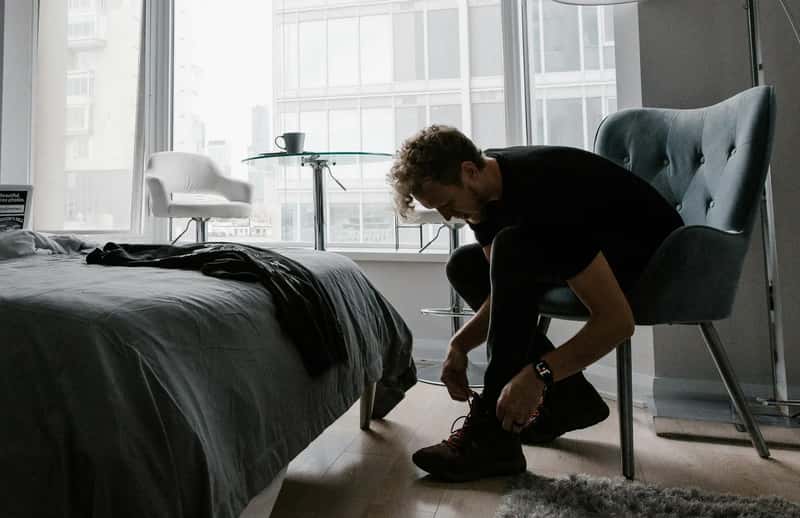
Your shoes are on the floor, right there, inches from your hand. You didn’t put them there by accident. You put them there because some older, darker version of you – the one who learned the world the hard way – quietly insisted on it.
There is the person you perform in the lobby: composed, rolling carry-on, already scanning for the elevator. And there is the person who lies in a strange bed at 2 AM, ears tuned to every creak in the corridor, mentally calculating the distance from mattress to door. The gap between those two people is where all modern travel actually happens.
1. The Ancient Nightwatch
Your brain did not evolve for a Holiday Inn.
It evolved for grasslands, for tree lines, for the specific acoustics of danger moving through dark undergrowth. When you check into a hotel room and place your shoes beside the bed, you are not being neurotic. You are being ancient.
During the first night in an unfamiliar environment, one hemisphere of the brain remains more alert than the other – a state of vigilance that may have been an adaptive response, enabling early humans to detect and respond to potential threats.
The shoes are a physical extension of that vigilance.
They are your biological contingency plan, translated into rubber soles and laces. The brain doesn’t know you’re in a four-star hotel. The brain’s threat-detection circuits are over-tuned, interpreting ambiguous or benign stimuli – a door creaking, footsteps in the hallway – as possible threats.
You are a very tired animal in an unfamiliar den.
The shoes prove it.
2. The First-Night Effect
Science has a name for what happens to you. It isn’t glamorous. It isn’t romantic.
It’s called the First-Night Effect.
We often experience troubled sleep in a novel environment. This is called the first-night effect (FNE) in human sleep research, and researchers have shown that the FNE is a manifestation of one hemisphere being more vigilant than the other – acting as a night watch to monitor unfamiliar surroundings during sleep.
Half of your brain is literally standing guard.
No wonder we don’t feel rested after a first night in a new place: half of our brain has stayed alert while the other half enjoyed deeper sleep.
You weren’t imagining the hyper-awareness. You weren’t being dramatic.
You were being surveilled – by yourself.
The shoes near the bed are the physical artifact of a brain that refused to fully surrender to rest. They are the one concession the vigilant half of you allows the sleeping half: you can close your eyes, but the exit is right there.
3. The Surveillance System
There is a watchman inside you. He never clocks out.
The first-night effect is associated with a surveillance system in one brain hemisphere during sleep, which manifests as interhemispheric asymmetry in sleep depth and increased vigilance toward monitoring external stimuli – and this surveillance system may be useful for protecting vulnerable sleepers from abnormal events in unfamiliar environments.
Think about that word: vulnerable.
Sleep is the only time you are completely defenseless. The body horizontal, the eyes closed, the conscious mind offline. Every version of you that ever lived through something difficult – the child in an unfamiliar house, the adult in a new city, the traveler in a nameless room – learned to keep one eye cracked.
Troubled sleep in an unfamiliar environment is, in accord with research evidence, an act for survival over an unfamiliar and potentially dangerous environment – keeping one hemisphere partially more vigilant than the other as a night watch, which wakes the sleeper up when unfamiliar external signals are detected.
Your shoes are parked at the edge of the bed.
The watchman put them there.
4. The Cortisol Architecture
There is chemistry running underneath all of this. It is not poetic. It is cortisol and adrenaline and a nervous system that cannot distinguish between a threat and a changed environment.
Hypervigilance is often accompanied by elevated levels of cortisol and adrenaline. These stress hormones can interfere with the body’s natural sleep-wake cycle, leading to fragmented or insufficient sleep.
Every unfamiliar hotel room is, neurochemically, a mild emergency.
Your body wasn’t designed to relax before travel – it was built for survival mode. The nervous system kicks into overdrive in a novel sleeping environment, unleashing a cocktail of stress hormones like adrenaline, dopamine, and cortisol, keeping you wired, restless, and wide awake.
This is the architecture of your midnight. Not peace. Not rest. A chemical holding pattern.
The shoes are the physical proof that your body has already run the calculation: how quickly can I move if I have to?
It has answered its own question. Eleven inches from the edge of the mattress. Laces loose.
5. The Ritual and the Self
I want to be honest about something, here, in the middle of all this theory.
I have been in more hotel rooms than I can count. Loud ones in Bangkok, silent ones in Oslo, anonymous ones in the transit zones of airports that feel like purgatory with better WiFi. And in every single one of them, I have placed my shoes beside the bed before I’ve unpacked anything else. Before the toiletry bag. Before the charger. The shoes, right there, close enough to touch.
I told myself it was habit. That it was tidiness. That it just made sense.
It wasn’t tidiness. It was a preparation ritual for an emergency that hasn’t arrived yet – but that some deep, pre-verbal part of me remains absolutely certain is coming.
Many travelers with sleeping challenges have developed particular sleeping routines or rituals which may not be feasible while they travel. The prospect of not having access to their routine can lead to heightened anxiety and apprehension about sleep while away. The lack of control over one’s sleep environment can exacerbate feelings of vulnerability and discomfort.
The shoes are the ritual. The ritual is the self, trying to feel safe.
6. The Exit Strategy Identity
There is a specific personality type that is drawn to the midnight-escape posture. They are not paranoid. They are not broken.
They are people who have learned – through experience, through accumulation, through the specific education that only real uncertainty can provide – that the door must always be findable in the dark.
Hypervigilance is a heightened state of awareness and alertness. While it’s a natural response to danger, chronic hypervigilance occurs when the mind and body remain stuck in “fight or flight” mode, even in safe environments.
For the frequent traveler, the hotel room is a mirror. It reflects back every previous room. Every previous night of light sleeping and corridor-listening.
Travel fatigue, being alone, jet lag, hygiene or safety concerns, a sterile environment – all of this can contribute to anxiety in hotel rooms. And you may come to associate a hotel room with past experiences of not being able to sleep, thus causing anxiety which then, of course, causes insomnia.
The shoes stay close because the Exit Strategy Identity never really checks out of the last room it was afraid in.
7. The Highly Attuned Traveler
Some people scan a room for threat-signals within four seconds of opening the door.
They check the lock. They clock the distance to the window. They note whether the deadbolt has a chain. They are not anxious – or rather, they are anxious in a way that has been so thoroughly practiced it now masquerades as competence.
Because highly sensitive people are hyper-observant of their environment, they are oftentimes able to perceive subtle but potential dangers not necessarily apparent to others. An HSP might detect the faint smell of a gas leak before anyone else detects it. In the case of hotel rooms, it can be something such as the faint smell of mold or a door lock that doesn’t work that signals concern.
This is not neurosis. This is an advanced perceptual system running at full power in a context that no longer requires it to.
Hypervigilance refers to a state of constant, heightened alertness – always watching, always waiting for danger – even when the environment is safe. In the context of trauma and stress, it is one of the core states that keeps the “alarm system” running, long after the threat has passed. While hypervigilance may once have felt protective, over time, it becomes exhausting, intrusive, and disruptive to daily life.
The shoes are placed with the precision of someone who has already imagined the worst.
8. The Temporary Identity
A hotel room is the most honest mirror you will ever stand in front of.
At home, you are surrounded by objects that confirm your narrative. The books you’ve curated. The photographs. The coffee mug that says something about who you are supposed to be.
A hotel room offers none of that scaffolding.
Many accommodations, especially hotels, don’t help create a sense of familiarity due to factors such as: neutral decoration, artificial lighting, temperature different from what you have at home, and unpredictable noises from the hallway or street.
Stripped of your objects, you are just a body in a rented room. And the identity that emerges in that stripped-down space – alert, provisional, ready to move – is arguably the most authentic version of you. It is the self that existed before the furniture. Before the lease. Before the story you told yourself about who you had become.
The shoes next to the bed belong to that self. The real one. The portable one.
9. The Sleepless Arithmetic
The brain, in an unfamiliar room, does its own dark math.
It runs probability tables. It assigns risk scores to sounds. The elevator arriving at your floor: low threat, logged. A door closing somewhere down the corridor: logged. Footsteps that slow, then stop: elevated.
The body stays in a state of “readiness,” even when there’s no real threat. Sleep disruption – falling asleep or staying asleep becomes difficult, with frequent awakenings, light sleep, or nightmares. Increased startle response means even minor noises or movements trigger a jolt or jump, as though danger is lurking.
This is the sleepless arithmetic. The brain tallying threat vectors in the dark, refusing to fully commit to unconsciousness.
The brain, primed for a novel environment, may struggle to transition into a restful state. This increased alertness can manifest as racing thoughts, physical restlessness, or an inability to relax fully. Individuals may find themselves mentally rehearsing or planning, making it difficult to disengage from these stimulating thoughts.
The shoes are the answer to the equation the brain keeps solving. They are the solution to a problem that no longer exists. But the brain doesn’t know that. It only knows what it was taught.
10. The Weight of Being Ready
Here is the thing nobody tells you about hyper-vigilance: it is exhausting in a way that rest cannot fix.
You can sleep eight hours in a hotel room and wake up depleted. Not because the mattress was wrong. Not because of noise or light or temperature. Because part of you never stopped working through the night. It kept its shift. It monitored the doorframe and the window gap and the unfamiliar creak of the building settling into itself.
Over time, the combination of difficulty falling asleep, frequent awakenings, and poor-quality sleep can result in chronic sleep deprivation. This exacerbates symptoms of hypervigilance, creating a vicious cycle.
When this vigilance mechanism activates, sleep loses depth. The N3 phase (deep sleep) and REM phase, key for mental and emotional rest, are reduced. Micro-awakenings increase, along with the feeling of having “slept but not rested.”
The weight of being ready – always ready – is a tax on the self that accumulates silently. You don’t notice it in a single night. You notice it in a year of single nights. In the specific fatigue of someone who has never, not once, let the whole brain go dark at the same time in a room that didn’t feel like home.
The shoes stay by the bed because there is a version of you that believes, with total sincerity, that the night is not yet finished with you.
There is something worth sitting with in all of this. The shoes are not a character flaw. They are not evidence of dysfunction or damage or a psyche in need of repair. They are evidence of a nervous system that learned its lessons well – perhaps too well, perhaps from rooms and nights that made the lesson necessary in the first place.
To place your shoes near the bed is to carry your whole history into a room that has none. It is to be, simultaneously, the person who booked the reservation and the person who still, somewhere in the wiring, doesn’t entirely trust that the room will hold. That tension – between the life you have built and the life your nervous system still thinks you’re living – is not a problem to be solved. It is simply the cost of having been awake and paying attention in a world that is not always gentle.
One day, maybe, you’ll set the shoes inside the closet. You’ll close the door and sleep all the way through, both hemispheres, both shores of consciousness, dark and quiet and unguarded. And in the morning you will not remember having done it. You will just wake up rested, which is its own kind of arrival – the kind where you finally stop bracing for the departure.