You arrive somewhere new.
The key still feels foreign in your hand.
The air smells like someone else’s life.
And your shoes – they stay on. For an hour. Maybe two. Maybe until the dark comes in and you’ve walked every corner of this place three times over, mapping it in the way only an animal that still half-believes in predators can.
We present ourselves as adaptable, fluid, citizens of the world. Passport stamps and carry-on luggage and a practiced ease at customs. But underneath the curated casualness, the nervous system runs a different programme entirely. One older than language. One that doesn’t care about your aesthetic or your affirmations.
It counts exits. It catalogues creaks. It keeps the shoes on.
1. The Threat Inventory
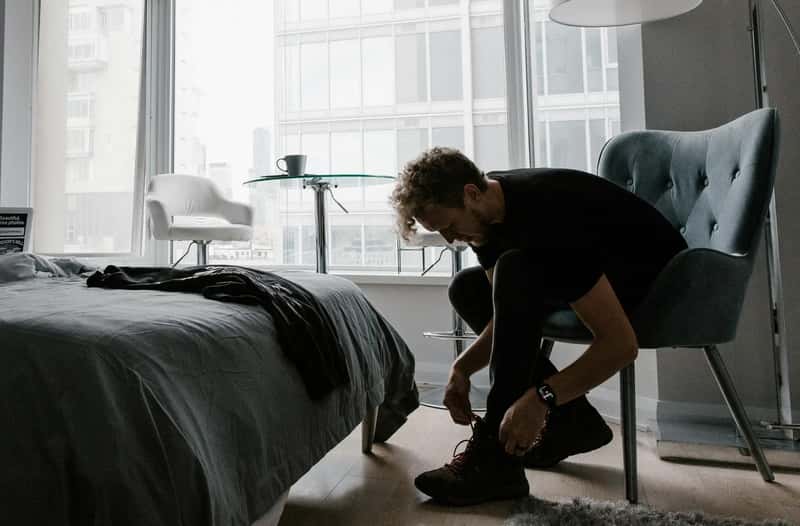
The moment you cross the threshold of a new space, your brain runs what psychologists describe as a perpetual environmental scan – a kind of silent, automatic audit of every corner, every shadow, every unfamiliar sound.
Hypervigilant symptoms are clinically described as a perpetual scanning of the environment to search for sights, sounds, people, behaviors, smells, or anything else reminiscent of activity, threat, or trauma.
The shoes are part of that inventory.
They are the body’s bookmark. A physical declaration that the threat assessment is not yet complete.
You are not being anxious. You are being thorough. There is a difference, and your nervous system knows it, even if you don’t.
The Threat Inventory isn’t paranoia. It’s architecture. It is the mind building a blueprint of a place before it agrees to be vulnerable inside of it.
It runs whether you ask it to or not. Whether you’re arriving at a four-star hotel in Lisbon or a borrowed couch in a city that doesn’t know your name yet.
The shoes stay on until the blueprint is done.
2. The Sympathetic Override
Underneath every deliberate choice you make in a new environment, a biological coup is quietly taking place.
Your sympathetic nervous system – responsible for the fight-or-flight response – overrides your parasympathetic nervous system, which promotes rest and digestion, keeping you in a state of constant readiness.
This is the Sympathetic Override. It is not subtle. Your pulse runs just a little faster. Your eyes scan wider. Your shoulders hold tension like a debt they refuse to pay off.
And your feet? They stay dressed for leaving.
The unfamiliar is not, to your nervous system, a neutral fact. It is a variable. And variables require monitoring. The shoes represent the last layer of armor still in place – the visible evidence of a body that has not yet decided this place is safe.
What makes this particularly haunting is how invisible it is to everyone around you. You look like you’re just getting comfortable slowly. In reality, your biology is running threat protocols that haven’t been updated in forty thousand years.
3. The Exit Architecture
You probably don’t notice you do it. But you do it every single time.
You note where the door is. You track the distance between the window and the street. You clock the layout before you clock anything else. You sit near exits in public spaces. You avoid large crowds or busy environments – not out of rudeness, but out of the deep, mammalian need to know where out is.
The shoes are the physical extension of Exit Architecture.
They say: I can leave in under ten seconds if I need to. They say: I have not committed to this place yet. They say: The calculation is still running.
Bare feet are an act of absolute trust. They are a body saying: I believe this ground will not require me to run. That is an enormous declaration. And for a nervous system trained by uncertainty, it is one that requires evidence – not assumption – before it will agree to it.
So the shoes stay on. Not as a choice. As a contract.
4. The Learned Scan
This wasn’t born with you. It was built into you.
Beyond overt trauma, growing up or living in consistently unpredictable environments can also foster hypervigilance. If your caregivers were inconsistent, if your home life was unstable, or if you faced constant uncertainty, your nervous system learned to be on high alert to predict and prepare for the next shift in your surroundings.
The Learned Scan is generational muscle memory wearing a contemporary face.
You are not in that childhood hallway anymore. But your feet don’t know that. Your feet remember the hallway. They remember what barefoot felt like before something shifted in the air and everything became a problem at speed.
Travel amplifies the Learned Scan because travel strips away context. At home, the scan runs quietly, in the background, manageable. In a new place, with no established baseline for normal, it surges forward.
The shoes become the only familiar thing in the room.
They become the one constant you brought with you.
5. The Identity Anchor
I once spent three weeks living out of a single bag, moving cities every few days. Madrid. Marseille. A town in Portugal whose name I still cannot pronounce correctly. And I noticed something: I was always the last person to take their shoes off. In hostels, in apartments, in houses where everyone else had already gone soft and sockfooted and horizontal on somebody’s rug.
I told myself it was habit. It wasn’t habit.
It was identity.
Think about the psychological comfort shoes provide. For many of us, shoes are part of our everyday armor. They make us feel ready to face the world. Taking them off can make us feel exposed and vulnerable.
In constant motion, the shoes were the most consistent thing about me. They were the thing I carried from context to context, city to city, self to self. Taking them off meant accepting a new floor. A new geography. A new version of “here.”
And sometimes, in the middle of all that motion, you aren’t ready to be here yet. You’re still metabolizing there. The shoes are the identity anchor – the last tether to a continuous self in a life that keeps dissolving into new coordinates.
6. The Cost-Benefit Protocol
Your nervous system is, at its core, an economist.
The cost-benefit equation governs how the nervous system functions: the immediate cost of tension and scanning is minimal in comparison to the disastrous cost of being caught off guard.
This is the Cost-Benefit Protocol in its purest form. And it explains the shoes with uncomfortable precision.
The cost of keeping them on: mild discomfort. A slight social awkwardness. A small, private self-consciousness about being the only one still wearing outdoor shoes indoors.
The benefit: a body that believes it retains the option to flee.
To the nervous system, that is not even a close calculation.
The protocol runs deeper still. Hypervigilant individuals create narratives and actions that promote readiness – checking locks, practicing dialogues, keeping an eye on tone – which seem like competence rather than an issue. The shoes, in a new place, are that competence-disguised-as-protocol. Nobody looks at someone keeping their shoes on and sees fear. They see practicality. They see someone who hasn’t quite settled in yet.
They don’t see the nervous system running the numbers.
7. The Borrowed Baseline
Every new environment hands you a foreign emotional vocabulary.
The sounds are wrong. Not bad wrong – just unverified wrong. The pipes make a noise you haven’t categorized yet. The refrigerator hums in an unfamiliar key. The street outside has a rhythm your body hasn’t learned to screen out as background.
When you live in a state of hypervigilance, your brain treats every sound as a potential danger. A floorboard creaking or a car door slamming outside triggers a physical reaction. This is because your brain has lost the ability to distinguish between a minor noise and a major threat. It chooses to be “wrong but safe” rather than “right but dead.”
This is the Borrowed Baseline problem. You have arrived in a place whose normal you do not yet possess. You are borrowing the baseline – trying to establish what “fine” sounds like here before you agree to relax into it.
The shoes stay on because the baseline hasn’t been confirmed yet. You are still in data-collection mode. You are still asking: what is the temperature of ordinary in this specific room, on this specific night, with these specific walls?
Once you know the answer, maybe then. Maybe then, the shoes can come off.
8. The Vulnerability Tax
Bare feet are physiologically, psychologically, and symbolically soft.
They touch the ground without negotiation. They receive every texture, every temperature, every signal the floor has to offer. Our feet play a crucial role in proprioception, providing us with feedback about the surface we’re standing on and how our weight is distributed. Shoes can enhance this feedback, giving us a more accurate sense of our stability.
But stability, in a new place, is precisely what has not yet been earned.
This is the Vulnerability Tax. The price of softness in an unverified space.
You keep the shoes on because taking them off is an act of complete sensory surrender. It means allowing the new place in – through the soles of your feet, through the unfamiliar cold of the tiles, through the foreign softness of a rug that belongs to someone else’s history. And until the threat assessment is done, that kind of sensory surrender feels – at the biological level – reckless.
Your nervous system learned that vigilance keeps you safe, so letting go feels like dropping your guard or “not trying hard enough.”
Rest, in a new place, is a radical act. The shoes are the tax you pay for not committing to it yet.
9. The Permanence Test
There is a specific kind of person who takes their shoes off immediately upon entering a new space. Who drops their bag, exhales loudly, and pads across the floor in socked feet before they’ve even found the light switch.
You have probably watched this person with a quiet, inexplicable envy.
What they are doing – what their nervous system is agreeing to – is called the Permanence Test. They have, in a split-second subconscious evaluation, decided: this place is real enough to be in. This floor is trustworthy. This moment is not a departure lounge.
Hypervigilance often persists because the nervous system learns through repetition, not logic. Even when you know intellectually that you are safe, your body may remain activated.
Knowing you are safe and feeling safe are two completely different countries.
The Permanence Test is the body’s way of checking which country it is actually in. Not the country on the map. Not the country your rational mind keeps pointing to. The country your feet are willing to be naked in.
Most of us, in most new places, quietly, stubbornly, fail that test for the first few hours. Sometimes longer. We sit with our shoes on at 11 PM wondering vaguely why we can’t relax. The shoes are the answer we aren’t asking about.
We spend so much energy trying to arrive – to feel present, to feel settled, to feel like the place we’re in is the place we actually are. But the nervous system operates on its own schedule, in its own timezone, following its own immigration rules. You can stamp the passport. You cannot rush the body through customs.
The shoes-on habit is not a quirk. It is not rudeness, not forgetfulness, not some minor neurotic tick you should probably work on. It is the body doing what it has always done – what it was shaped, over millennia and over a lifetime of personal history, to do. Hypervigilance develops when your nervous system has learned that staying alert is the safest option. It’s not a flaw – it’s an intelligent response to prolonged stress or trauma. The shoes, in that light, are not a symptom. They are a signature. They are proof that you have survived enough things to take new environments seriously.
The next time you find yourself in a strange room, shoes still on, watching everyone else unfurl into the furniture while you remain quietly, stubbornly upright – don’t pathologize it. Don’t perform the relaxation you don’t feel yet. Just notice the shoes. Notice what they’re doing. Notice the extraordinary, exhausting, deeply loyal work your nervous system is putting in on your behalf. And when the permission finally comes – when the room finally earns your bare feet – let that be enough. Let that small, shoeless moment mean what it actually means.
You finally decided the ground was worth trusting.