The suitcase is open on the bed.
You’ve packed everything you need.
You pack it again anyway.
There’s a folded dress near the bottom. A shirt still wearing its tags. A pair of dark trousers you haven’t worn in a year. They will not be touched on this trip. They never are. But removing them feels like a small, quiet act of self-betrayal – like canceling an insurance policy on a house that has never once burned down.
The Identity Gap is the space between the person who travels and the person who packed. One of them is confident, adaptive, at ease. The other one is still twelve years old, standing at the edge of a school cafeteria, suddenly aware they’re wearing the wrong thing.
1. The Suitcase Is Not a Suitcase
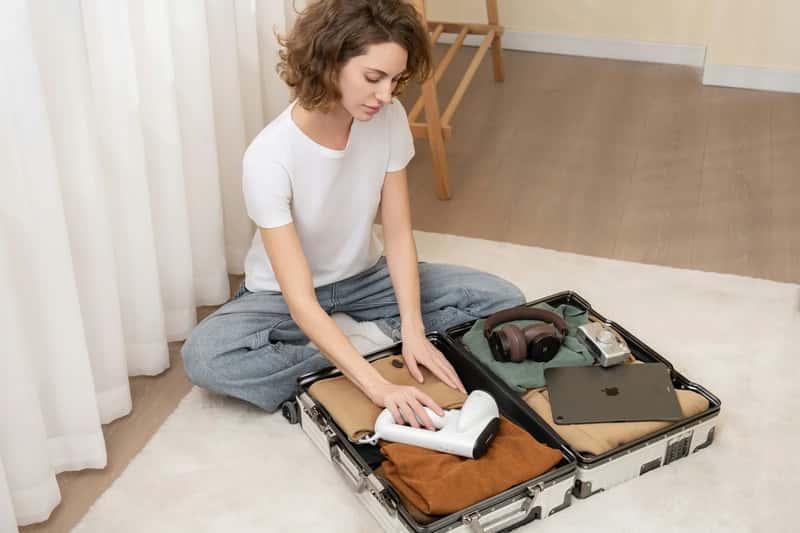
It is a portable archive of your anxieties.
Every folded item represents a negotiation between who you are and who you might need to become at short notice.
Experts agree the inclination to overpack, driven by an urge to prepare for countless “just in case” scenarios, is rooted in anxiety and the loss of control that comes with leaving one’s personal space.
That loss of control is the key phrase. Not the destination. Not the duration. The severing.
When you leave home, you leave behind the carefully constructed environment that confirms who you are. The right clothes are hanging in the right closet. The right shoes are waiting by the right door. Everything is where you left it – and it all quietly corroborates your identity.
Travel strips that away.
So you bring the archive with you. Just in case you need to prove yourself to a room full of strangers. Or, more specifically, to yourself.
2. The Catastrophe That Never Happens
The backup outfit is a preemptive apology.
An apology to a future version of yourself who might walk into a dinner, a meeting, an impromptu wedding, wearing entirely the wrong thing.
Travelers who overpack may exaggerate the ramifications of being without an item, or catastrophize.
Catastrophizing is the mind’s loudest liar. It takes a spilled coffee on a Tuesday morning and turns it into a total social annihilation by Tuesday afternoon. It takes a missing blazer and turns it into a fundamental character flaw made visible to everyone in the room.
The thing about catastrophizing is that it was learned. Somewhere. By someone. At a very specific age.
You didn’t invent it. It was handed to you – in a hallway, a classroom, at a lunch table – by the particular cruelty of being young and unprepared in public.
The backup outfit is you, still trying to make sure that never happens again.
3. The Childhood Wound Wearing a Luggage Tag
Here is the specific fear at the root of all of it.
Stressful social events in early life – being bullied, public embarrassment, or one’s mind going blank during a public performance – are commonly reported by people who carry deep social anxiety into adulthood.
One single afternoon of wearing the wrong thing. Of being the only kid who didn’t get the memo about the costume party, the spirit day, the “we’re all dressing up” moment that everyone knew about except you.
Unexpected and quickly occurring, embarrassment in youth can cut deep and be long remembered: “It turned out I was the only one dressed this way.”
That sentence. That one sentence is the entire origin story of your backup outfit.
It carved a groove into your neural architecture. It told your nervous system: being unprepared socially is a kind of danger. Dress accordingly. Or, more precisely, dress for every conceivable occasion, always, forever, just in case.
4. The Identity You Pack for Someone Else’s Emergency
Here is the strange part.
The backup outfit is not for you. Not really.
It is for the imagined audience – the crowd of witnesses at the hypothetical social crisis. The people who will look at you and decide, in a single glance, whether you are prepared or whether you are the person who clearly didn’t think ahead.
We make impressions on the people around us whether we realize it or not. We are identified visually – it’s human nature.
The suitcase becomes a theater costume department. You are packing for every possible role you might be asked to play. The sophisticated dinner guest. The casual brunch companion. The person who belongs in a room even when you’ve never been in that room before.
You are packing for performance. And the performance is: I am someone who is never caught off-guard.
5. The Moment I Understood My Own Archive
I was standing in a hotel room in a city I barely knew, three days into a five-day trip, staring at a garment bag I hadn’t unzipped once.
Inside: a blazer. A pair of dress trousers. A shirt I’d ironed before I left home with the particular solemnity of someone preparing for war.
I had worn jeans every single day. I would wear jeans every remaining day. The blazer knew this. I knew this. And yet neither of us could admit it.
What I was really looking at, I eventually understood, was a sixth-grade version of myself standing outside a school gymnasium in regular clothes on the day everyone else had worn costumes. The laughter. The sudden, fluorescent awareness of wrongness.
Such anxiety can cause people to carry a greater number of familiar items from home – a place where most people feel safe. This may be borne from a subconscious desire to bring something of yourself and your life to a new place.
I wasn’t packing clothes. I was packing proof that I’d done my homework. That I was ready. That no one would ever catch me out again.
6. The Control Mechanism Hidden in Cotton and Zip-Lock Bags
Packing is one of the few acts of travel you can fully control.
You cannot control delays, weather, the temperament of strangers, the vibe of a city. But you can control what goes in the bag. And so the bag becomes the last bastion of certainty before the great uncertain begins.
When you pack for control, you add items to reduce anxiety. When you pack for comfort, you choose items that improve your daily experience.
The distinction is razor thin but psychologically enormous.
One is an act of fear. The other is an act of care.
Travel is inherently out of control, and when we pack, we’re trying to nail down things that can’t be nailed down.
The backup outfit is the thing we’re trying to nail down. The social catastrophe we’re trying to preemptively solve. The embarrassment we’re trying to prevent before the room even knows there’s a room.
7. The Social Confidence Gap and the Mirror You Pack
There is something deeper happening when the backup outfit goes in the bag.
It is a confession. A quiet, folded admission that you do not entirely trust yourself to navigate the social terrain of wherever you’re going.
Self-doubt about our resourcefulness can lead to overpacking. Rather than trusting our ability to adapt, we opt for excess to avoid being caught off-guard.
It comes down to a lack of confidence in your own ability to figure things out and be OK.
Read that again slowly.
The backup outfit is not about the outfit. It is about the belief – stubbornly, historically held – that you will not be OK without it. That your social survival depends on material preparation. That being caught underdressed is somehow the same as being found out.
Found out as what, exactly? As someone who isn’t quite polished enough. Quite ready enough. Quite enough.
8. The Social Media Costume Department
In the age of the curated feed, the backup outfit acquired a new and exhausting dimension.
Modern travel is no longer just about the experience itself but also about how it is documented and shared. With the rise of social media platforms, travelers began planning outfits not just for comfort, but for photographs.
Now the imagined audience is not just in the room. The imagined audience is everywhere. It is scrolling. It is judging with a double-tap or the devastating silence of no engagement at all.
This trend reflects how external perception has started to influence internal decisions. Packing becomes less about adapting to the journey and more about curating an image, adding another layer of expectation that contributes to overpacking and unnecessary complexity.
The childhood fear of being caught in the wrong outfit has been industrialized. Scaled. It now has filters and geotags and story highlights.
You are no longer packing for the room you might walk into. You are packing for every room anyone might imagine you walking into. And that audience is infinite. So the suitcase never quite closes.
9. The Paradox of the Heavier Bag
Here is the cruelest irony of the backup outfit ritual.
The thing you pack to reduce anxiety actively creates more of it.
Instead of simplifying travel, overpacking can make it more stressful, reinforcing the very anxiety it aims to reduce. This cycle highlights how packing has shifted from a practical task to an emotional coping mechanism.
The heavier the bag, the more you carry. Not just through airports and up hotel staircases. But psychologically. Every item in the suitcase is a pending decision. A small emotional debt you will have to settle eventually.
Having too many choices can create decision fatigue, making it harder to quickly select what to wear or use.
The backup outfit is supposed to be the solution. But it is also part of the problem. You bring it so you never have to think about not having it. But its presence means you have to think about it. Every. Single. Morning. Until you get home and put it back in the closet, still folded, still tagged, still waiting for the catastrophe that never came.
10. The Unpacked Truth at the Bottom of Every Bag
The real thing you are always packing for is belonging.
Not warmth. Not formality. Not practicality or weather preparedness or dress codes you aren’t sure about.
Belonging.
The age of onset of social anxiety for the majority of individuals is between 8 and 15 years of age. The disorder is often associated with a history of social inhibition and shyness in early childhood. Those are the exact years when clothing stopped being fabric and became a social language you were desperately trying to become fluent in.
Driven by the fear of public humiliation, the young person may embrace shyness – that psychological refuge where they feel both safe from company and sorry to miss it.
The backup outfit is the physical manifestation of that refuge. It says: if the worst happens, I have this. I have a way out. I have a second version of myself, pressed and folded, ready to walk into the room I was afraid of.
“Travelers often pack for their fears instead of their needs, and that’s why overpacking remains so persistent.”
That is the whole story. That is the whole quiet, heavy truth.
You do not need the backup outfit. You have never needed it. The social crisis it was packed to survive has not materialized in years, perhaps decades, perhaps ever. And yet it goes in the bag. Every time. Because the child who packed it first still lives somewhere beneath the adult doing the folding – and that child genuinely believes, with perfect sincerity, that the right outfit is the difference between belonging and being left outside in the cold.
What would it mean to leave it behind? Not just the extra shirt. But the belief that you are only one wardrobe malfunction away from being found out. The belief that you are not enough, as-is, for whatever room you’re walking into. The belief that preparation is the same thing as worth.
The suitcase closes. The zipper catches. You carry it to the door and feel, for a moment, the specific comfort of a person who has thought of everything – who is ready for anything – who will not, this time, be caught off-guard.
The backup outfit stays folded, all the way there, all the way back, and you unpack it like a letter you never sent – proof of a crisis that the world, apparently, forgot to arrange for you.