


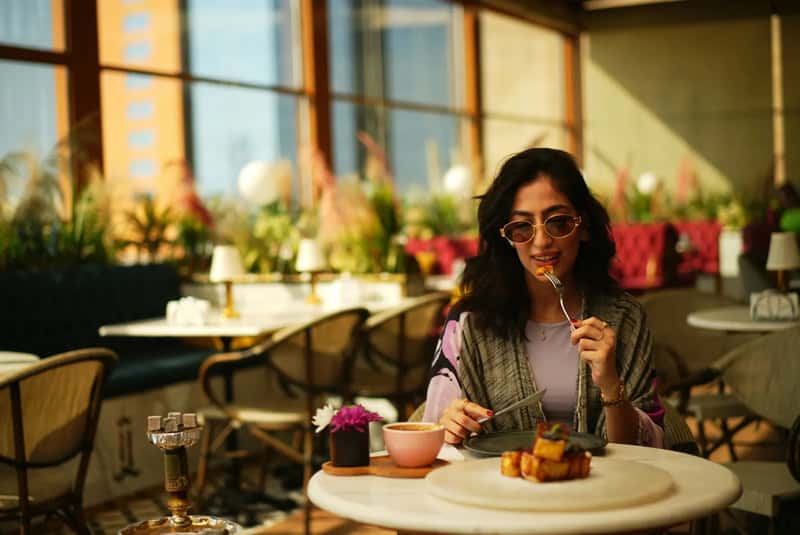
You are sitting in a café in a city that doesn’t know your name.
The menu is in front of you.
You already read it last night.
And the night before that.
You cross-referenced two food blogs, a Reddit thread, and a travel forum with a post from 2019 that may or may not still be accurate. You screenshotted the dishes. You made a note. You feel, right now, that this level of preparation is completely normal – that this is just being a smart traveler. But somewhere underneath the calm surface of your curated order, there is a wire pulled tight. The wire has a name. It is called the fear that one wrong bite will mean you failed.
The Competence Trap
There is a particular kind of traveler who moves through the world carrying a silent report card.
Every decision gets graded.
Every meal is a test.
Perfectionists are known to put a lot of pressure on themselves and feel at fault for things that aren’t actually their mistake. When you are abroad, that instinct doesn’t soften. It sharpens. Because the stakes feel higher, the unfamiliar amplifies every possible point of failure. A bad meal at home is just a Tuesday. A bad meal in Lisbon is evidence. Evidence that you didn’t research hard enough. That you trusted the wrong source. That you are, somehow, insufficient. The trap is airtight: the more you research, the higher your standard. The higher your standard, the more devastating any deviation feels. You are not protecting yourself from disappointment. You are constructing a more elaborate theatre for it.
The Spreadsheet Is Not a Shield
You open the app before the flight lands.
You have a list. A real list. Organized by neighborhood.
Color-coded.
The more you plan your trip, the more anxiety you will face. You’re going to overwhelm yourself with so much information that you’re going to do nothing but stress over it. The spreadsheet, the saved posts, the starred maps – none of them are actually about food. They are about the illusion of control in a context that is fundamentally uncontrollable. Despite decades of studying worry, the mind can trick us into a ruminative spiral by telling us we are planning or preparing rather than uselessly worrying. That is the exact architecture of your restaurant research. It disguises anxiety as diligence. It calls obsession by the name of thoroughness. The spreadsheet is not a shield. It is a wound dressed as armor.
The Moral Weight of a Mediocre Plate
Here is the thing nobody says out loud.
When the food disappoints, it doesn’t feel like bad luck.
It feels like a verdict.
Food obsession is when thoughts about food take up an outsized amount of mental real estate – characterized by repetitive thoughts, heightened anxiety, rigid rules, and difficulty shifting attention away from food-related concerns. In the traveler who over-researches, this obsession isn’t about the food itself. It’s about what the food represents: proof of good judgment. A mediocre plate becomes a referendum on your worth as a navigator of new worlds. You ate the wrong thing in the right city and now the whole trip feels slightly off-center. That is not a travel problem. That is a story you are telling yourself about what your choices mean – and it is a story that is costing you the actual experience.
The 40-Hour Rabbit Hole
It starts with one search.
Then a forum. Then a deep dive into a blogger’s archives from three years ago.
Then it is midnight and you are reading a comment section.
People will look at up to 20 websites over the course of 40 hours as they plan a two-week vacation. Forty hours. That is a working week. That is the time you could have spent learning a language, reading a novel set in the city you’re visiting, or simply sitting with the anticipation of the unknown. Information is power, but in our information-overload society, too much information leaves us conflicted and powerless. You are not becoming better prepared. You are building a cage out of browser tabs. And the cage keeps getting smaller, because there is always one more review, one more caveat, one more updated post warning that the place you saved has changed since last summer.
The Control Myth
Let’s be honest about what you’re actually trying to control.
Not the food.
Not even the experience.
You’re trying to control how you feel after.
I know this because I once spent the better part of an afternoon in Porto researching a single lunch. I had three tabs open, two saved Instagram posts, and a note from a friend who had been there in March. I walked past four places that smelled extraordinary. I didn’t stop. I was looking for the one that had been validated. I eventually ate at the researched spot, and it was fine. Not transcendent. Fine. And I sat there feeling the strange hollowness of having done everything right and gotten nothing remarkable in return. The afternoon I traded for that lunch – the wandering, the accidental discovery, the wrong turn down a narrow street – I’ll never get that back. At every turn, I was met with my overwhelming imperfections and for some reason, it seemed to be okay. The meals I remember most were never the ones I planned.
Worry Wearing a Costume
Planning and worrying are not the same thing.
But they can wear each other’s clothes.
They can be almost impossible to tell apart in the dark.
When we are able to practice compassionate awareness of our minds, we can begin to notice signs that we may be stuck in a worry loop, even if it seems like we are planning or preparing. Indications that we may be stuck include our mind looping through repetitive material, often taking the form of “What if” questions followed by imagined negative outcomes. Sound familiar? That’s the restaurant research loop in its purest form. What if it’s closed? What if the reviews lied? What if it’s not as good as it was? What if I pick wrong? The “what if” questions are endless precisely because they are not really about restaurants. They are about the deeper terror of being someone who gets things wrong in front of an audience – even if that audience is only yourself.
The Adventure Tax
Every real adventure comes with a tax.
The tax is paid in discomfort.
The bill arrives in the form of the mediocre meal, the wrong turn, the venue that closed.
For a perfectionist, travel can be stressful and anxiety-inducing. But it is the very texture of that stress – the grit of the unexpected – that makes travel worth anything at all. Overplanning will lead to stress, and once you hit the road, all your plans will change anyway. Someone will tell you about a new destination and you’ll race off there instead. You’ll wander the streets and into unexpected restaurants. The unexpected restaurant, the one you didn’t screenshot, the one with the hand-written menu and the owner who sits at the corner table – that is the meal you will tell people about for years. You cannot pre-approve that discovery. You can only make room for it by letting go of the fantasy that every meal is a moral examination you must not fail.
The Identity You’re Protecting
There is a version of you that never gets it wrong.
That version lives only in the research phase.
It evaporates the moment you land.
There’s so much fear around not having everything perfect – the perfect reservations, the perfect plans – that it actually gets in the way of going through with those plans at all. The identity you are protecting is not the traveler. It is the planner. The planner is safe because planning happens before reality. Before the city talks back. Before the weather changes and the reservation is lost and the meal is just okay. The traveler has to live inside the consequence of the world being real. We get to where we are in spite of all our imperfections and probably as a direct result of some. The imperfect meal in the strange city is not a mark against you. It is the city being itself, which is the only reason you went there.
The Permission You’re Waiting For
You don’t need to research less.
You need to redefine what the research is for.
Research as orientation, not as insurance.
Rather than researching restaurants extensively, identify neighborhoods known for good dining and plan to explore them when hungry. That is not laziness. That is freedom with a map. It is the difference between arriving in a city with a sense of its geography and arriving with a script that the city is expected to perform. Saying yes to an unexpected dinner invitation, trying something new when you’re traveling, or having dessert just because it sounds good – flexibility actually makes you more resilient and helps you feel more in control over time, not less. The permission you’re waiting for isn’t hiding in one more five-star review. It’s in the acceptance that a bad meal is data, not failure. It’s in the understanding that getting it “wrong” is how you learn the city’s actual personality, rather than the curated version it presents to careful tourists.
The Meal You’ll Actually Remember
It won’t be the one you saved in three different apps.
It won’t be the one with the most consistent reviews across platforms.
It will be the one that surprised you.
It will be the one you stumbled into because you were tired and the street looked interesting and the smell from the kitchen hit you somewhere ancient. It will be the one where something went slightly wrong – maybe the order got confused, maybe they were out of the thing you wanted – and what arrived instead was extraordinary. Some of your trip’s most memorable moments will come from these unplanned experiences. The meal will be extraordinary not because everything was perfect, but because you were fully present for it. Because you had not pre-experienced it twelve times in preview form. Because it arrived without expectation and therefore arrived completely. Food becomes one of the things you most look forward to when traveling – trying out new flavors, getting new favorite foods, and then being inevitably upset when you can’t acquire them back home. That love affair with the unexpected table is the whole point. It was always the whole point.
There is a version of travel that happens entirely in the planning phase. It is vivid and detailed and deeply satisfying and it takes place entirely in a chair at home, in the blue light of a laptop screen, in the safety of the pre-departure. That version of travel is not travel. It is a rehearsal for a play you are too afraid to actually perform.
The city you fly toward doesn’t care about your research. It has been there for centuries, feeding people who didn’t know its name, surprising travelers who came without spreadsheets, breaking the hearts and expanding the palates of everyone who walked its streets hungry and uncertain. The city has always known that a little uncertainty is the admission price. Not a punishment. Not a reflection of your worth or your diligence. Just the cost of being somewhere real, eating something real, being a real person inside a real world that was never designed to be curated.
Put your phone in your pocket. Walk until something smells right. Sit down and order something you cannot fully pronounce. Let the meal be what it is. And if it disappoints – if the sauce is wrong and the texture is strange and you leave still slightly hungry – let that be a part of the story too. Because the story was never supposed to be perfect. It was only ever supposed to be yours.



