You book the flight in November.
Not to Lisbon. Not to Tulum.
To somewhere that will make your fingers numb by the second block.
Somewhere the wind has an agenda.
Somewhere the sky is the color of an old bruise, and somehow – somehow – that feels like home.
There’s a gap. There’s always a gap. The one between who you perform for the world – composed, capable, functional – and who you actually are when the lights go dim and the apartment gets quiet. The person who learned, early and without instruction, how to hold it all together when no one was watching. The person who built an interior climate entirely on their own: cold on the surface, but fiercely, stubbornly alive underneath. And so you travel toward weather that finally makes the outside match the inside.
1. The Mirror Effect
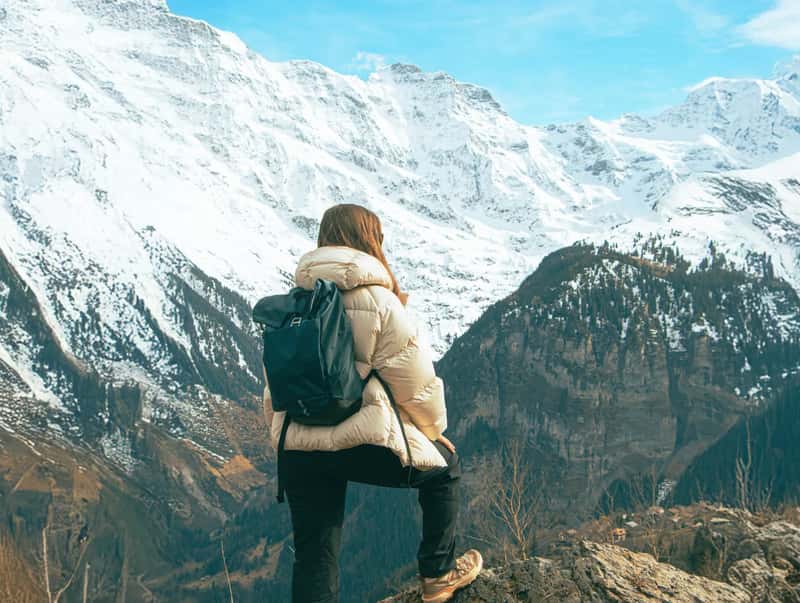
There’s a reason certain travelers feel a specific, unnameable relief when they step off a plane into a biting wind.
The outside world has finally caught up.
Cold destinations evoke calm and introspection. But it goes deeper than calm. It goes all the way down to recognition.
For people who spent years managing an inner landscape that felt too heavy, too complicated, too much – a harsh external environment isn’t punishing. It’s honest.
The wind doesn’t pretend. The grey sky doesn’t perform. The frozen lake doesn’t apologize for what it is.
There’s no gap between what the cold weather claims to be and what it actually delivers. That congruence – that brutal, beautiful congruence – is what the internally resilient traveler has been quietly starving for.
Most people build their lives around comfort. You built yours around endurance. Now you want a landscape that understands the difference.
2. The Solitude Clause
Cold weather does something that warm weather refuses to do: it clears the crowd.
The beaches empty. The cafes become quieter. The streets belong to the ones willing to stay.
Cold weather discourages outdoor social interactions, tending to foster more independent and introspective cultures. In places like Norway and Russia, harsh winter temperatures promote personal reflection, allowing for self-discovery and emotional recovery.
For someone who has long been the person others lean on – the one who holds the room together, who manages the emotional temperature of every space they enter – this enforced solitude isn’t loneliness.
It is the first silence in years that actually belongs to them.
People who love cold weather often find a sense of peace and comfort in solitude. This doesn’t necessarily mean they’re introverted or antisocial, but rather they appreciate the tranquility that comes with a frosty landscape.
You didn’t travel here to escape people. You traveled here to finally meet yourself without the noise.
3. The Productive Body
There is something almost cellular that happens when a resilient person arrives in the cold.
The body wakes up. Not in a frantic way. In a precise, deliberate way.
Research has shown that people are generally more productive when the temperature is lower. When we’re hot, we often feel sluggish and drained, but when we’re cold, our bodies have to work harder to keep us warm, thereby increasing alertness and mental agility.
This is the body of someone who already knows how to work hard under pressure. The cold doesn’t exhaust it.
The cold confirms it.
It’s a physiological echo of a psychological truth: that you were always built for conditions others find impossible. That the discomfort you’ve been tolerating internally for years has, in fact, been training you.
You walk faster in the cold. You think clearer. You feel strangely, gratefully sharp.
This is not coincidence. This is the sensation of your internal architecture finally finding its matching exterior.
4. The Noise Reduction
Warm destinations are loud. They are full of signals.
They ask you to perform leisure. To be seen relaxing. To smile in the direction of the ocean.
Cold destinations make no such demands.
Snow-covered landscapes, dim lighting, and lack of street noise create a low-stimulation environment that feels soothing. In Austria and the Czech Republic in winter, the calmness of snow-filled streets helped one traveler feel peaceful – a feeling absent in busier, warmer destinations.
For a person who has lived a high-stimulus interior life – anxiety cycling like a weather system, thoughts arriving at all hours – a low-stimulation external environment isn’t boring.
It is the first time in memory that the input matches the capacity.
You are not overwhelmed here. You are not performing here. You are simply – and this word will feel strange – enough.
The cold strips the world to its bones. And you, who have lived at the bone for years, finally feel fluent.
5. The Mettle Test
I remember the first time I landed in a city where the temperature was so low it felt personal. Like the weather was asking me something.
I had booked the trip alone, three days after a year that had quietly broken several things in me that I hadn’t yet named. I needed something that would meet me at my level.
The cold did that. Immediately. Unsentimentally.
It asked: Can you handle this? And the answer – the answer that rose up from somewhere trained and pre-loaded and bone-deep – was yes. Without hesitation.
Cold-weather adventurers love to defy natural logic of what their bodies can survive. It reminds them of who they are and what they’re made of.
That reminder. That’s the whole architecture of the cold-weather preference.
It’s not masochism. It’s confirmation. It’s standing in something that resists you and finding out, once again, that you don’t break.
6. The Identity Alignment
Travel is identity, dressed in logistics.
Where you go says something irreducible about who you believe yourself to be – or who you are finally willing to admit you are.
Travel preferences are shaped by emotional state. If you’ve felt an unexplained connection to a warm or cold destination, you’re not imagining it: your brain and body are responding to the environment in ways that influence emotions and mental health.
The person who chooses frozen fjords over crowded beaches is not choosing deprivation.
They are choosing alignment.
They are saying, quietly and without fanfare: I am not someone who needs to be coddled by my environment. I am someone who needs to be met.
The cold meets you. It doesn’t massage you. It doesn’t soothe you into a pleasant numbness. It stands across from you, eye-level, and says: Here I am. Here you are. What now?
And you, who have been answering harder questions than that since childhood, step forward.
7. The Mindset of Endurance
There is a documented phenomenon among people who live with brutal winters: the further north they live, the more positively they regard the season.
Some people – especially those who live in places with harsh winters – regard the season as a beautiful, cozy, and enjoyable time of year. In a study from 2020, the further north people lived, the more positive their wintertime mindset was.
This is not Stockholm syndrome applied to weather.
This is the psychology of earned resilience.
Northern winters may be undeniably tough, but they also offer an opportunity to develop resilience. By embracing the season and mastering strategies to reduce potential psychological effects, we can come out of it stronger and more poised.
The person drawn to cold-weather travel already understands this calculus intuitively. They have been doing it internally for years – enduring, adapting, emerging more precise. The cold destination is simply a geography that runs on the same operating system.
You don’t fear the hard thing. You organize yourself around it. That is not pathology. That is mastery.
8. The Permission of Darkness
Cold, dark destinations give you permission to be quiet.
To go inward without apology.
In warm, bright places, there is cultural pressure to be expansive – to be out, to be social, to fill the available light with evidence of living well.
Cold places lift that pressure entirely.
There’s research showing that darkness enhances creativity because it gets rid of our usual inhibitions and constraints.
For someone who has spent years performing accessibility – staying available, staying bright, staying palatable for the comfort of others – the long, dim evenings of a northern winter are not sad.
They are generous.
They say: you do not have to shine tonight. You do not have to be easy. You can simply exist in the half-light, quiet and uninterrupted, and that is entirely enough.
The darkness asks nothing of you. And for the person who has been giving everything for years, being asked for nothing feels, improbably, like grace.
9. The Earned Warmth
There is a warmth that only exists on the other side of cold.
The kind you cannot manufacture in a tropical resort. The kind that requires earning.
Being warm, snug, and cozy can be a great feeling, allowing you to forget about the world around you. Getting into a state of cosiness can be hard without first getting a little bit cold, though.
The resilient traveler understands this equation in their body long before they understand it in their mind.
The warmth of a coffee mug in a snow-dusted city. The heat of a fire after a walk that tested the edges. The weight of a coat that kept you safe when nothing else would.
These are not small comforts.
They are proportionate rewards for a proportionate effort. And for a person whose internal life has always required enormous effort to maintain – a person who has never been handed warmth, who has had to generate it from within – the cold destination offers something radical.
It makes the warmth visible. It makes it physical. It makes the work, for once, legible.
10. The Landscape That Already Knows
In the end, what the cold-weather traveler is really seeking is not a destination.
It is recognition.
The grey sky that does not apologize for its color. The wind that announces itself before it arrives. The frozen ground that has held its shape through forces most things couldn’t survive.
Cold-weather lovers have a special way of seeing the world and living in it. Their ability to find joy and comfort in chilly conditions not only defines their preferences but also enhances their sense of resilience and mindfulness.
But beneath the preference – beneath the bookings and the gear and the deliberate choice to turn away from warmth – is a person who learned, a long time ago, to be strong without being seen.
Who learned to endure without acknowledgment.
Who built an entire internal infrastructure – quiet, load-bearing, unbeautiful, necessary – and never once received a single word of recognition for having done so.
These are the moments that fill a tank with joy, a sense of resilience, and a wealth of beauty. The cold landscape provides all three, without requiring you to explain why you needed them.
The mountain doesn’t need your backstory. The frozen lake doesn’t require context. The biting wind doesn’t ask you to justify why you came.
It simply stands there – vast and difficult and alive – and lets you stand beside it.
And for the first time in a very long time, you don’t feel the gap.
You don’t feel the distance between who you are and where you are. Between the person you perform and the person who endures. Between the warmth you manufacture for others and the cold you carry alone.
The outside world has finally, mercifully, caught up to the inside one. The landscape has spoken the language you’ve been fluent in since childhood but were never allowed to speak aloud. It is the language of withstanding. Of remaining. Of being present inside difficulty without being destroyed by it.
You came here looking for weather. You found, instead, a mirror that finally told the truth.
And if you stand still long enough in the cold – if you let it settle against the parts of you that have always been exactly this temperature – you might hear, beneath the wind and the silence and the creak of frost-weighted trees, the quietest and most overdue thing: the sound of your own endurance, finally recognized.