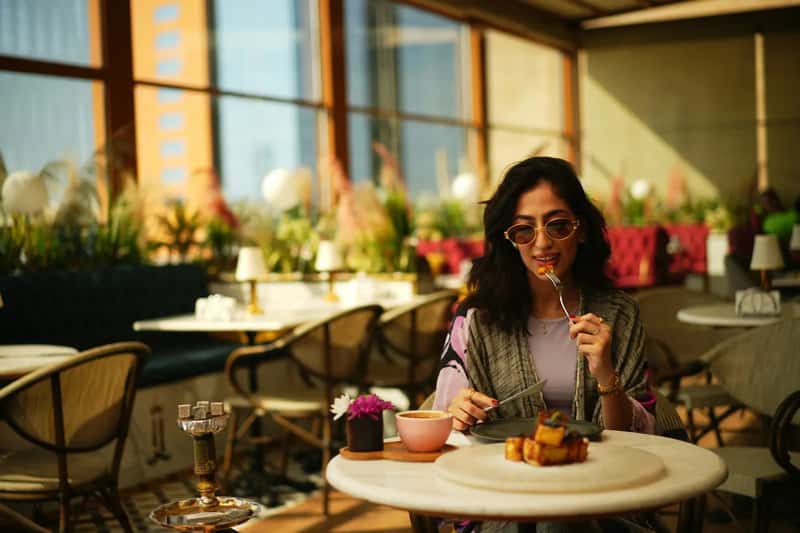
The restaurant is half-empty at 5 PM.
You chose that on purpose.
You told yourself it was practical. Efficient. Sensible.
It wasn’t. It was survival – ancient, wired, and quietly brilliant.
Here is the identity gap nobody talks about: at home, you follow the social contract. You eat at 7 PM because that is when people eat. You wait for a table in a loud room with strangers pressed shoulder-to-shoulder against you, performing contentment. But the moment you travel – the moment the city doesn’t know your name – you slip the leash. You eat when your nervous system says now. You move in the margins. You become a different person, or maybe, finally, the same one.
1. The Behavioral Immune System
There is an ancient circuit inside you that predates restaurants, cities, and the concept of a dinner reservation.
It is called the behavioral immune system.
And it is running right now, whether you invited it or not.
Research has found that feeling vulnerable activates a so-called “behavioral immune system” that makes people engage in various behaviors that helped our ancestors survive when facing disease. In a crowded restaurant at 7:30 PM, that system fires. The pressed bodies. The recycled air. The noise bouncing off every hard surface.
Your body doesn’t know you are in a tapas bar in Lisbon.
It thinks you are in a cave with too many strangers.
Generally, human crowding leads to various negative consequences, inducing avoidance motivation. Social crowding decreases satisfaction and increases negative emotions. So you eat at 5 PM. Not because you are hungry at 5 PM. Because your wiring told you the room was safer then. And it was right.
2. The Anonymity Harvest
Traveling strips your biography down to nothing.
Nobody at the corner table knows your job title. Nobody knows your history. Nobody knows what you’re carrying.
Solo travel amplifies this effect by removing the immediate presence of people who know the traveler in their typical roles. This anonymity creates psychological freedom to explore different aspects of self without social consequences.
The 5 PM meal is a direct extension of that freedom.
The room is sparse. The staff is unhurried. The other diners – the handful of them – are not performing for an audience either. For a growing number of travelers, going solo is now about privacy as much as freedom, about anonymity as much as autonomy, and about stepping outside the social identity they carry at home long enough to hear themselves think again.
The early table is not a scheduling choice.
It is a declaration of temporary invisibility.
And invisibility, for the traveler who has been watched all year, is the closest thing to rest.
3. The Control Reclamation
The noise of travel is constant and mostly involuntary.
Flight delays you didn’t choose. Hotel rooms that smelled like someone else’s decisions. Tour groups that materialized out of nowhere and swallowed the view.
Control is the one currency the traveler never stops spending.
When traveling solo, travelers remove themselves from the continual negotiation that is often difficult with group dynamics. Travelers have control of the decisions and actions – what to eat, what to do, and when to have a break. This produces confidence in one’s own intuition.
Choosing 5 PM is the quietest possible act of sovereignty.
The waitstaff doesn’t rush you. The kitchen isn’t buried under sixty simultaneous orders. Your table is yours, with wide margins around it. The psychology of choice suggests that exercising genuine autonomy over consequential decisions strengthens an internal locus of control – the belief that outcomes result from one’s own actions rather than external forces.
The early dinner is not an eccentricity.
It is the only hour of the day you are running the room.
4. The Crowd Avoidance Algorithm
There is a logic to the traveler’s movement that looks like intuition but is closer to calculus.
Most travelers follow a similar schedule, arriving at popular attractions in the late morning and staying through midday. To avoid this, the strategic traveler aims to visit landmarks either first thing in the morning or shortly before closing. The same principle applies to food.
You have reverse-engineered the social clock.
You know that the crowd arrives at 7 PM like a tide – predictable, impersonal, and loud. So you eat two hours before the tide. You are finishing your second glass of something cold while others are still fighting for a parking space.
Research suggests that individuals can substitute place and timing – like going on weekdays instead of weekends to avoid crowds – when performing an activity if the experience is likely to be accomplished elsewhere with more convenience and safety. Timing substitution is a survival algorithm. You didn’t learn it. You inherited it.
The empty restaurant at 5 PM is a calculated position.
You are not early. Everyone else is dangerously, exhaustingly late.
5. The Nervous System Recalibration
I remember a Tuesday evening in Porto. The cobblestones were still warm from the day. I sat outside a small restaurant on a street that did not appear on any list, at a table with four chairs and only one occupied. My food arrived in twelve minutes. The waiter spoke quietly. A dog slept under the table next to mine.
I did not realize until I got back to the hotel that my shoulders had been below my ears for the first time in weeks.
That is not a metaphor. That is physiology.
The traveler is not running from people. They are running toward a state of nervous system regulation that crowd dynamics make biologically impossible. The dinner rush – with its noise, its wait times, its performance of sociability – is a physiological stressor dressed in ambient lighting.
In clinical terms, a nervous system returning to calm after dysregulation is a natural process. Both Polyvagal theory and the window of tolerance model suggest our nervous system returns to a sense of safety once the perceived threat has passed.
The 5 PM table is not a quirk of scheduling.
It is the body asking, quietly and without drama, to be allowed to return to itself.
6. The Identity Suspension Protocol
At home, the dinner ritual is social infrastructure.
Who you sit with, where you sit, what you order – all of it is read as signal. You are performing your identity at the table long before the food arrives.
Travel interrupts that performance.
Solo travel strips away the daily roles you play at home – employee, partner, parent – allowing your core identity space to breathe and be re-examined. And when nobody is there to read the signal, the performance dissolves. Solo travel strips away the roles we play in ordinary life. At home, you are a business owner, a colleague, a neighbor, a person with a reputation and a history. On a solo trip to a city where nobody knows you, you are just a person in the world. That anonymity is liberating in ways that are hard to articulate until you’ve experienced it. You get to notice what you actually think and feel when nobody’s watching.
Eating at 5 PM, alone, in a quiet room, is the purest expression of that suspension.
The role is not required. The costume is in the suitcase.
For one hour, you are simply a person eating food in a city that does not know your name.
7. The Paradox of Choice Escape
The dinner rush is not just loud. It is cognitively expensive.
The full restaurant at 7:30 PM is a system designed to overwhelm: the wait at the door, the specials recited at speed, the table too close to the kitchen, the menu that is fourteen pages long, the decision to be made while a stranger hovers.
When you are in a new place with an abundance of food options, the pressure to make the “right” choice can be overwhelming. Paradoxically, this can often lead to decision paralysis. As psychologist Barry Schwartz famously discussed in his book “The Paradox of Choice,” having too many options can lead to anxiety and stress. This stress can cause people to revert to what they know and avoid making a new choice.
The 5 PM diner sidesteps all of it.
The restaurant at 5 PM has one waiter who is unhurried. The kitchen has room to breathe. There is no line, no noise, no performance of scarcity. The traveler who eats early is not antisocial. They are cognitively efficient. They have reverse-engineered peace.
Fewer variables. Quieter decisions. Better food, tasted properly, without the static of the crowd pressing in on every side.
8. The Scrutiny Shield
There is a particular vulnerability in eating alone in a full restaurant.
Every traveler who has sat at a single table in a room of couples and groups knows the feeling. The specific self-consciousness of being the only unconjoined body in a space designed for pairs.
The dining area’s atmosphere can play a role in the anxiety some people feel while eating. A crowded restaurant may trigger underlying uneasiness for those who prefer to eat in a quiet room alone.
The Social Phobia Scale is designed to assess fear of scrutiny. Items ask about fears of being scrutinized during routine activities such as eating, drinking, or writing. Collectively, these types of fears comprise fear of scrutiny.
Eating early is the traveler’s quiet counter-move.
At 5 PM, the single table does not stand out. The room is half-populated. The social geometry is loose. Some travelers require strategy: sitting at bars, choosing smaller restaurants, eating at off-peak hours. The 5 PM choice is that strategy, executed instinctively, before the traveler can even name why it feels so exactly right.
9. The Temporary Identity Architecture
Travel builds you a new self for the duration.
It is not a false self. It is a draft. An earlier, looser version – one not yet hardened by routine and the opinions of people who have known you for too long.
One traveler put it this way: “I began to realise I wasn’t travelling to escape my life or even to see the world. I travelled to meet the parts of myself that had never been given language.”
The 5 PM meal is one of the rooms in that temporary architecture.
It exists outside the social schedule. It follows no inherited pattern. The traveler constructed it from scratch, this evening, in this city, because it felt correct. The trip belongs fully to the person taking it, free from compromise, free from constant narration, and free, at least for a little while, from the labels that wait back home. In a world where nearly everything about a person can be tracked, posted, and interpreted, that kind of temporary freedom is becoming one of the most meaningful things travel can offer.
The early dinner is one brick in the only house the traveler truly owns.
A house that exists for seventy-two hours and then is quietly, perfectly demolished.
10. The Exit Strategy
Here is what nobody names directly.
The deepest reason you eat at 5 PM while traveling is not efficiency, not hunger, not even crowd avoidance.
It is the exit.
Some travelers describe it as a fear of feeling trapped – not a physical trap, but a social one. The inability to just get up and walk away without having to explain yourself. The fear is not rational. There is no need to leave. But simply not having the option can make you feel trapped.
At 5 PM, you are never trapped. The room is sparse. The exits are obvious. The social contract is light. If you need to stand and leave – to walk back into the city, into the blue evening, into whatever is next – you can do it without explanation, without choreography, without apology.
If you’ve ever sat in a terminal at an ungodly hour and felt the specific quiet joy of being completely, utterly, and temporarily no one’s responsibility, you don’t have a problem. You just have a particular set of traits that make solo travel feel less like a luxury and more like oxygen.
The 5 PM meal is not just dinner. It is a door left open. It is proof that you can leave. And because you know you can leave, you stay. You linger over the last of your wine. You watch the street outside slowly fill with the crowd you deliberately, precisely, artfully avoided.
You are not antisocial. You are not damaged. You are not running.
What you are doing, at 5 PM, with your half-empty glass and your table for one, is something that takes most people a lifetime to learn: you are choosing the texture of your own experience. Not the experience that was handed to you by social convention, by reservation culture, by the inherited assumption that dinner belongs to 7 PM and every hour before it is just waiting.
There is a version of you that exists only in transit. Some people have described this feeling as “post-travel depression,” where you miss not a place, but a person you become while traveling. That person – the one who eats at 5 PM, who knows where every exit is, who has learned to carry just enough to move freely – is not a temporary aberration. They are a signal. A dispatch from the self that existed before the social obligations began accumulating.
The next time you find yourself in a quiet restaurant at an hour when everyone else is still in transit, don’t call it early. Don’t apologize for it. Sit with the fact that some part of you – ancient, calibrated, and wiser than the part that checks what time is socially acceptable – steered you here on purpose. To the light before the noise arrives. To the window seat that nobody else thought to want. To the one hour of the day that belongs entirely to you.
The food, when it comes, will taste better than you remember anything tasting in months. You will not know why. Now, perhaps, you do.