The plastic stool is wobbly. The broth is scalding. A stranger’s elbow is two inches from yours.
You are completely at ease.
Now picture the white tablecloth. The sommelier hovering. The menu with no prices.
Your jaw tightens.
This is not about food. It never was about food.
There is a version of you that exists only in transit – at the roadside stall in a city you’re passing through, at the counter of a noodle shop where no one knows your name. That version feels lighter. Quicker. More honest. The version who sits in the velvet booth, watching the bread basket arrive, feels like someone wearing their own face as a costume. The plastic stool, the communal sauce, the vendor who does not register your face – these things do not diminish you. They release you from the continuous labor of being a legible version of yourself. And in that release, you can finally eat. Not as a social act. Not as a performance of taste and refinement and gratitude. But as a mammal who is hungry, who found something warm, and who can leave the moment the hunger is gone.
1. The Exit Is the Whole Point
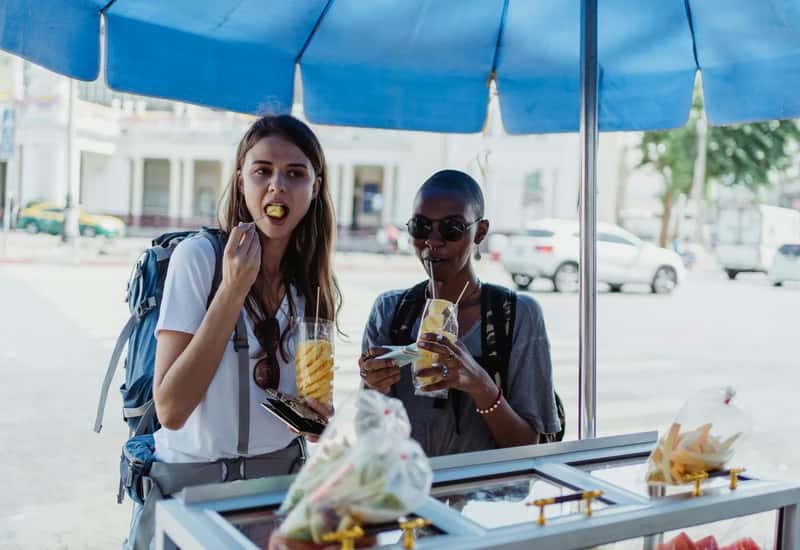
You don’t go to the street stall for the char.
You go because you can leave.
Not eventually. Not after the dessert course and the awkward moment where someone pulls out a card. Now. This second. Without explanation or negotiation.
Autonomy, as psychologists define it, refers to feeling you have choice and are willingly endorsing your own behavior. The opposite experience is feeling compelled or controlled. Fine dining doesn’t just restrict your movement. It manufactures a social contract you never consciously signed.
The plastic stool has no such contract.
You sat. You ate. You stood. The city absorbed you again.
That sequence – arrive, consume, dissolve – is not laziness. It is the operating system of a person who has learned, at some cellular level, that the ability to exit is the only real protection they have.
The exit is not the end of the meal. The exit is the meal’s entire architecture.
2. The White Tablecloth as a Trap Door
Fine dining doesn’t imprison you physically.
It imprisons you socially.
Fine dining establishments know that people don’t want to appear cheap by asking for prices. That knowledge – that you are being read, assessed, and managed – is the trap. It springs the moment you sit down.
The lighting is engineered to slow you.
The music tempo is calibrated to keep you spending longer.
The sommelier is not asking if you’d like wine. He is creating a social situation in which saying no has a cost.
Every choreographed element of fine dining is designed to remove your sense of volition and replace it with performance. You are not a person eating. You are an actor in someone else’s production.
The street stall stages nothing. It has no fourth wall because it has no walls at all. You are not performing. You are just chewing.
3. The Autonomy–Relatedness Tradeoff Nobody Talks About
Here is the uncomfortable truth about social eating.
Being with people costs you something.
Social interaction bolsters well-being and relatedness. However, less is known about costs of social interaction, such as loss of autonomy. Researchers have begun to test a potential autonomy–relatedness tradeoff. In plain language: the more tightly you are locked into a social dining situation, the less you feel like yourself.
Fine dining maximizes the social lock-in.
There is a reservation time. A fixed table. A protocol for leaving that involves summoning attention, waiting, signing something. Every exit requires permission.
The street stall minimizes that lock-in to near zero. You showed up. The transaction was fast and honest. The social cost was paid in coins, not in performance.
You didn’t have to trade your autonomy for your meal.
4. The Stranger Paradox
You will talk to the person beside you at the ramen counter.
You will not talk to the person beside you in the prix fixe restaurant.
This seems backwards. It isn’t.
Social facilitation is more likely to be observed with a familiar dining companion and social inhibition is more likely to be observed with an unfamiliar companion. The formal dining room amplifies the presence of strangers as a threat. Every unknown person at the next table is a potential witness to your awkwardness with the fish fork.
The street stall neutralizes that threat completely. Everyone there is slightly messy, slightly anonymous, slightly temporary. There is no witness stand. There is just the broth and the collective pretense that none of you are performing.
The informal space gives you permission to be observed without being judged.
That permission – small, invisible, profound – is what you are actually buying when you choose the stall.
5. The First Time I Understood What I Was Running From
I remember a dinner in a European city whose name I will not give, because the specificity would make it a postcard instead of a confession.
The restaurant had been chosen carefully. The kind of care that signals effort, obligation, the unspoken pressure of being grateful. White walls. Bread that arrived without asking. A waiter who refilled the water before the glass was half empty.
And I felt it – the tightening across the chest that I had always misread as social anxiety, as introversion, as rudeness. That night I finally read it correctly: it was the absence of an exit. Not from the room. From the version of myself I was expected to be for the next two hours.
The next morning, I ate standing at a fruit stall outside the train station. The vendor didn’t look at me. I didn’t look at him. We exchanged currency for something sweet and I walked away. I had been, for exactly four minutes, completely free.
That four minutes told me everything about the previous evening.
6. The Performance of Gratitude at the Dinner Table
Formal dining has an unwritten emotional tax.
You must be appreciative. You must be present. You must reciprocate the effort of whoever arranged the evening.
Individuals struggle to act with volition and integrity amid social forces that can make them feel controlled. The primary sources of control are not tyrannical systems, but proximal interpersonal forces in the everyday contexts of people’s lives. The dinner table is one of the most concentrated sites of those interpersonal forces. Someone chose the restaurant. Someone made the booking. Someone is now watching to see if you are enjoying yourself adequately.
The street stall owes you nothing. Expects nothing. You owe it nothing back.
The transaction is clean in a way that the dining room table never is. There is no emotional ledger being kept. No performance review at the end of the evening. You simply ate a thing that tasted of smoke and someone else’s grandmother’s recipe, and then you left.
The freedom is not in the food. It is in the absence of debt.
7. Why the Noise Feels Like Quiet
The street stall is loud. Motorcycle engines. Someone’s radio. The crack of a wok against iron.
You find it calming.
The fine dining restaurant whispers. Ambient music designed specifically to not disturb. And you find it suffocating.
This is not a contradiction. It is a precise psychological mechanism.
By establishing clear boundaries, individuals can create a sense of comfort and control in their interactions with others, ultimately reducing social anxiety. The chaos of the street stall creates invisible boundaries. The noise prevents extended conversation. The foot traffic prevents eye contact from becoming loaded. The constant movement prevents anyone from studying you too long.
The quiet of the fine dining room removes all those shields. In the silence, every fork sound is amplified. Every pause in conversation becomes a test. The ambient hush is not peace. It is a room that has been stripped of all exits disguised as sophistication.
You prefer the noise because the noise lets you hide.
8. The Identity Gap in Every Menu
There is a person who belongs in a fine dining room. You have a theory about who they are.
They are deliberate. Assured. They have opinions about natural wine. They do not check their phone. They are comfortable being watched mid-bite.
You are not always that person. Most of us are not.
In Self-Determination Theory, the need for autonomy refers to experiences of integration and freedom – a motivation to act in ways that are viewed as integrated and coherent with the sense of self. Fine dining asks you to enact an identity that may not cohere with who you actually are in that moment. Tired. Distracted. Wanting to eat fast and think slow.
The street stall has no identity requirement.
You can arrive as anyone. You can eat as no one in particular. The gap between who you are and who the environment demands you be collapses to nothing.
That collapse is not trivial. It is rest. Deep, structural rest that no amount of fine dining can manufacture.
9. Autonomy Is Not Antisocial. It Is Survival.
People misread the preference for informal eating as a rejection of intimacy.
It is the opposite.
Autonomy support has generally been associated with more intrinsic motivation, greater interest, less pressure and tension, more creativity, a more positive emotional tone, higher self-esteem, and more trust. When you eat at the stall, you are not withdrawing from connection. You are creating the conditions under which genuine connection becomes possible.
The best conversations of your life probably did not happen in restaurants with amuse-bouches.
They happened somewhere cheap, bright, and slightly chaotic. Somewhere that did not ask either of you to perform. Somewhere where both of you could, at any moment, stand up and go.
Eating solo – or on your own terms – can be a small way to reclaim agency. You choose where to go, what to eat, and how long to linger. And in that reclamation, something opens. Not a wall going up, but a door that was always already there.
The exit option creates the intimacy. Not despite itself. Because of itself.
10. The Heaviest Truth About Temporary Tables
You have been searching for a kind of eating that feels the way airports feel at 4 AM.
No one who belongs to you knows where you are. The obligation clock has been paused. You exist in a pocket of pure present tense.
When people lack social or environmental support for their three basic needs, their behavior becomes passive, detached, and inauthentic. But flip that equation. When those needs are met – when autonomy is present, when the social contract is light enough to breathe in – something happens that fine dining can never manufacture: you become actual. Not the representative of yourself. The thing itself.
The street stall does not make you anonymous. It makes you real.
That freedom sounds small until you map all the ways it has been systematically removed from your daily life. The scheduled meeting you couldn’t exit. The dinner party where leaving early required a lie. The restaurant where the bill took twenty minutes to arrive because the architecture of the evening demanded that you stay. Every one of those moments was a small subtraction from the account of your autonomy. You feel the deficit without naming it. You spend years not understanding why certain rooms make you want to disappear.
The street stall is not a preference. It is a correction. It is the body saying: here is a place that will not hold me against my will. Here is a place where I am a guest, not a captive. Here is a place where the exit is not a negotiation but a right – built into the architecture, written into the price, honored by everyone present without anyone having to ask.
You will find this correction wherever people eat in the open air, in the noise, in the glorious impermanence of plastic and steam. And when you do, something inside you – that thing that has been quietly counting the cost of every room that would not let you leave – will put down its pen, pick up the bowl, and finally, briefly, rest.
The meal ends when you decide it ends. That, in the end, is all you ever wanted to be able to say.