The trailhead is empty at dawn.
You chose that on purpose.
The map is folded wrong. The boots are already muddy from last time. Your chest is doing that thing again – tight, purposeful, weirdly calm.
Most people call it a hobby. You know it’s something older than that. Something with teeth. You keep signing up for terrain that could kill you, and you keep telling everyone it’s because you love nature. That’s not a lie. But it’s not the whole truth either.
The wilderness didn’t find you. You found it. And you found it for reasons that live several floors below your conscious awareness – in a basement your childhood built and your adulthood forgot to renovate.
1. The Controlled Danger
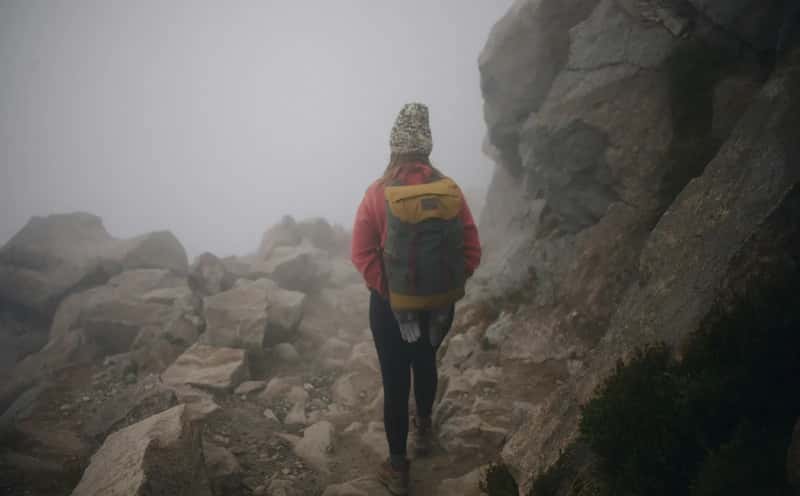
Here is the first thing no one tells you about dangerous terrain: it is the only place where the threat is honest.
A loose scree field doesn’t pretend to like you. A fast-moving stream doesn’t tell you one thing and mean another. The danger is visible, nameable, and – crucially – something you chose to walk toward.
The personal risks in outdoor adventure have a particular set of characteristics: they are voluntary, the sources of risk are generally known, and personal knowledge and skill can be used to control the risk, at least to a certain degree. That last part is the key. Control. A child made to feel small rarely had it. The adults were unpredictable. The emotional weather inside the house changed without warning.
Out here, you are the one who chose the storm.
That distinction is everything. The mountain doesn’t humiliate you – it simply tests you. And a test, unlike a childhood wound, has a clear outcome. You either summit or you don’t. You live or you learn. There is no ambiguity. No one moving the goalposts at 9 PM over dinner.
The dangerous trail is the first place, maybe in your whole life, where the rules haven’t changed on you.
2. The Proof of Existence
There are people in this world who grew up being told – with words, or with silence – that they didn’t matter much.
Not in a dramatic way. In the quiet way. The way a parent looks through you instead of at you. The way your achievements got smaller when spoken aloud by someone who needed you to stay small so they could feel large.
A trauma therapist suggested that childhood experiences could have played a part, prompting an unease with loneliness and a need to prove oneself tough and capable. That sentence should live rent-free in every solo hiker’s head. The need to prove oneself tough and capable. Not to a boss. Not to a partner. To a memory.
When you crest a ridge that nearly broke you – lungs burning, thighs screaming, wind trying to peel your face off – you exist. Fully. Undeniably.
The mountain didn’t look through you. It looked right at you. And you looked back.
That’s not adrenaline. That’s proof of life in a body that was once told it wasn’t enough.
3. The Silence Contract
People who were made to feel small are often also people who learned to be very loud inside their own heads.
The internal monologue of someone raised in emotional chaos is a 24-hour talk show with no commercial breaks. Anxiety. Replaying. Rehearsing. Anticipating the next disappointment before it arrives.
Studies have found that people who spend time walking in nature are less anxious and suffer less rumination – thinking about the same worries or regrets over and over again. That’s the scientific language for something you already know in your legs: the trail goes quiet inside you.
Not at first. At first, you carry every worry up the switchbacks like extra weight in your pack.
But somewhere around mile four, when the terrain demands your whole attention, the noise-machine cuts out. Facing danger requires intense concentration and focus on the present moment. Activities that demand your full attention, such as backcountry hiking, promote mindfulness and alleviate worries about past or future events.
The mountain enforces the silence that no one in your childhood ever gave you.
And in that silence, strangely, you finally hear yourself.
4. The Autonomy Reclamation
Someone controlled you once. Maybe many someones. Maybe for a very long time.
They controlled where you sat, what you said, how loudly you laughed, whether your feelings were valid today or an inconvenience. The body remembers being managed. The nervous system holds that memory like a bruise you can’t see in the mirror.
Intrinsic motivations for solo hiking align with self-determination theory, including autonomy, competence, and relatedness, while the drive to move emerges as an additional factor in movement regulation. Autonomy first. Always autonomy first. Because for some people, choosing which trail to walk – with no one’s opinion involved – is a revolutionary act.
The biggest advantage of solo hiking is that you can create the experience that you want to have. You don’t have to negotiate the details with your hiking companions.
You don’t have to negotiate at all.
Every solo step is a small reclamation. A quiet, boot-to-earth insistence that this body belongs to you now. That the decisions are yours. That no one else’s fear of your power gets to set your elevation limit.
5. The Identity Rehearsal
I need to tell you something about the first time I went out alone on genuinely dangerous ground.
I wasn’t brave. I was desperate. There had been years – the kind of years that pile up in a person without their permission – of being the one in every room who shrank. Who calibrated. Who made themselves palatable to people who were, in retrospect, not worth the palating.
I chose a trail that was too much for my fitness level. I chose it specifically because it was too much. Because I needed to meet a version of myself who didn’t flinch.
During solo travel, we are free from all kinds of expectations. The self is relational, so it is formed by our relations with others. Who we are is not only who we decide we are, but how others formulate that conception. Out there, with no one else’s conception of me within cell range, I got to try on a different self. Capable. Unwitnessed. Real.
That is the identity rehearsal. You go out as the person you were told to be. You come back as the one you actually are.
The mountain doesn’t know your history. That is its greatest gift.
6. The Exit Strategy
There is a particular kind of person who always knows where the exits are.
In restaurants. In conversations. In relationships. They’re not paranoid – they’re practiced. They grew up in environments where the ability to leave, even mentally, was a survival skill. The body learned: know your outs.
Solo hiking in dangerous terrain is, among other things, the most elaborate exit strategy ever constructed.
You leave everything. The apartment. The expectations. The version of yourself assembled for public consumption. These studies emphasize the significance of the wilderness, far from daily demands and devoid of technological stimuli, allowing silence, time, and space for self-reflection and contemplation on the sacredness and meaning of life.
But here is the dark and honest part: sometimes the exit isn’t from your life. It’s toward it. The person who leaves every weekend for the ridge isn’t running away – they’re running toward the only place where they feel entirely, uncomplicatedly present.
The exit strategy is also an entrance.
Every trailhead is a door in both directions, and the bravest people are the ones who keep walking back through it.
7. The Self-Efficacy Engine
Being made to feel small does specific damage to a very specific thing: your belief in your own competence.
When someone – a parent, a teacher, a partner, a system – repeatedly demonstrates that your judgment cannot be trusted, something calcifies. You stop making big decisions. You second-guess the small ones. You ask permission for things that are yours by right.
Reframing risk as a pathway to resilience and self-efficacy emerged as a central theme, suggesting that solo hiking can empower when navigated with support and representation.
When you’re alone, every choice rests on your shoulders. Which trail to take, when to turn back, how to respond to unexpected weather – there’s no committee to weigh in. Over time, this strengthens your ability to make clear, confident decisions under pressure.
Every good decision you make on a dangerous trail is a small act of therapy. You chose right. You survived. You were, in fact, competent. The body files that away somewhere deeper than memory.
The mountain gives you back the evidence. Slowly, trip by trip, your dossier of self-trust grows thick enough to trust.
8. The Emotional Permission Slip
You weren’t always allowed to feel things the size they actually were.
Grief had to be quiet. Rage had to be swallowed. Joy, even – sometimes especially joy – had to be contained, because someone else in the room couldn’t hold it, and their fragility became your job to manage.
The trail doesn’t have that problem. This is one of the most profound benefits of hiking alone: it gives you permission to feel – something our fast, noisy world rarely allows.
Out on exposed ridgeline, with wind hitting your face like a verdict, you can cry without explaining it. You can feel terror and not perform calm for someone else’s comfort. You can feel triumph at a scale that would embarrass you at a dinner party.
A psychotherapist who uses nature therapy says: “We want to learn to welcome all the feelings – whether that’s the joy, the hope, the shame, the pain, or the rage. The more we increase our emotional understanding, the more we’re increasing our emotional landscape. By getting out in different weather, by reminding ourselves that nature is beautiful whatever it’s doing, it can help us accept our own varied emotions.”
The mountain is the first audience that never asks you to perform.
9. The Awe Antidote
Here is a paradox. You go to the wilderness to feel big. To prove yourself. To exist loudly in a body that was once quieted.
And then something happens that you didn’t plan for: the landscape makes you feel beautifully, gently small.
Not the smallness of humiliation. Not the smallness someone else assigned you. The smallness of scale – of being one conscious creature on a ridge that existed ten million years before your particular wound, and will exist ten million years after it heals.
Researcher Craig Anderson and others have found that being in nature encourages feelings of awe – a state of wonder coupled with a sense of being small in the presence of something bigger than yourself.
Psychological benefits included cognitive restoration, emotional self-regulation, and awe-induced shifts in perspective.
The difference between the smallness you were given and the smallness you choose on a mountaintop is the difference between a wound and a window.
One was inflicted. One is chosen. And choosing to be small – choosing it, on your terms, in the face of something genuinely magnificent – is one of the most quietly powerful things a human being can do.
10. The Return
This is the heaviest one. This is the one no one talks about on hiking forums.
The dangerous solo hike is not just about the going. It is about the coming back.
Because every time you return from terrain that could have taken you – every time you descend muddy and intact and quietly amazed – you bring something home that the child who was made to feel small never had: evidence. Empirical, body-held, undeniable evidence that you are still here. That you endured. That when left alone with only your own resources, you were enough.
To go on an extended-period expeditionary adventure could be perceived as a selfish or risky undertaking, whereas research has revealed more layered and penetrating purposes and benefits. The answer to “why adventure” is complex and phenomenological; principal implications suggest resilience, post-adventure growth, and self-actualisation, even transcendence.
As each step propels the solo hiker forward, the experience manifests resilience, self-reliance, and personal growth. But the return is where the integration happens. The trail doesn’t heal you. The return does. The moment you walk back through an ordinary door, carrying an extraordinary interior, is when the reconciliation begins.
You went out to prove something to the past. You came back and found the present waiting for you instead.
There is a particular kind of grief that belongs to people who were made to feel small. It doesn’t announce itself. It doesn’t arrive in a recognizable shape. It shows up as a preference for ridgelines over living rooms. As a restlessness that only quiets when the terrain is steep enough to require every last bit of attention. As a strange, bone-deep comfort in exposure – in places where the wind is too loud for the old voices to reach you.
The wilderness did not cause any of this. But it holds space for all of it. And that is not a small thing. In a world that rarely permits the full, unedited weight of a person’s interior, to find one landscape – however vertical, however cold, however far from a cell signal – that simply does not require you to perform wellness or smallness or anything at all, is a form of medicine. Not a cure. Not a substitute for the real work. But medicine, still.
The trail will be there next weekend. The ridge will be indifferent and honest and cold. You will go back. And maybe, somewhere around mile five, when the noise inside you finally concedes to the noise outside you, you will catch a glimpse of the person you were before anyone told you to be less of them – and you will realize, quietly, that they never actually left.