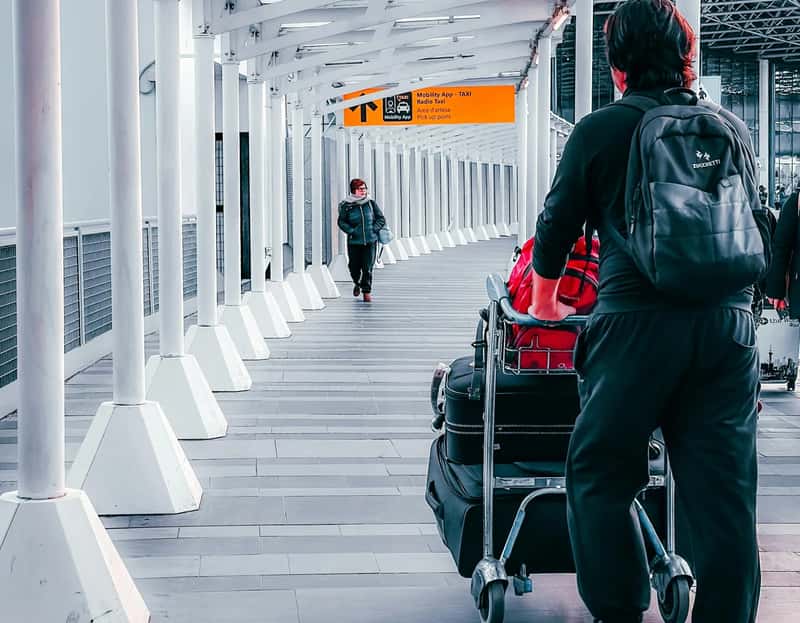
The terminal is long and gray and humming with recycled air.
Your gate is a mile away.
The moving walkway is right there.
You step around it.
You always do.
Here is the identity gap: on the outside, you are a reasonable traveler with a roller bag and a boarding pass. On the inside, you are a person in the middle of a quiet negotiation – between surrender and agency, between being moved and moving yourself. Every single time you bypass that slow, humming belt and put your own feet to the floor, you are casting a vote for something the self-help books call autonomy and the rest of us just call survival.
The moving walkway offers efficiency. You offer resistance. And the gap between those two facts is where your whole identity lives.
1. The Autonomy Imperative
There is a word for what you are protecting when you step off the belt.
That word is volition.
Autonomy refers to feeling one has choice and is willingly endorsing one’s own behavior. The moving walkway removes that endorsement. It does not ask. It simply carries. And some part of your nervous system – the oldest, most animal part – registers this as a quiet emergency.
You are a person who chooses.
Even when the choice is trivial. Even when both paths lead to Gate B17.
Self-determination theory identifies a basic psychological need for autonomy as a central feature for understanding effective self-regulation and well-being. This isn’t a theory about airports. But it might as well be.
The machine offers to carry your body.
Your psyche declines.
Because being carried is not the same as arriving. Not for you. Not in this skin.
2. The Competence Contract
You are good at walking. You have been doing it for decades.
That sounds absurd until you understand what competence actually means in the architecture of the self.
Competence is the feeling that you can be effective in the activity. It is quiet and constant and you are so accustomed to it that you only notice it when it is threatened.
The walkway threatens it.
Not because it is dangerous. But because it replaces your effectiveness with a machine’s. It outsources the one simple, dignified act you have been doing correctly since you were fourteen months old.
Your stride is yours. Your pace is yours. The angle of your lean into a departure hall – that is yours too.
Competence refers to the experience of mastery and being effective in one’s activity. And mastery, even over something as humble as a terminal corridor, registers in the body as a form of worth.
The walkway doesn’t know your worth.
So you remind the hallway. One step at a time.
3. The Pace Is the Point
You walk at your own speed. Not the walkway’s speed.
This matters more than it should, and also exactly as much as it should.
The standard walking speed in an airport is approximately 3 mph, compared to the 2.24 mph travelers tend to take when on the walkway. Combined with the walkway’s 1.4 mph, travelers are on average moving at a speed of 3.66 mph – only a minor spurt from the normal speed without the system.
The machine barely helps. You already knew this. Your body knew this before the research confirmed it.
But the deeper truth is not about speed. It is about rhythm.
Your pace is your heartbeat made external. It is the cadence of your current emotional state expressed through the soles of your shoes. Walking fast when you are anxious. Slowing down when you are processing something heavy. Stopping entirely when you need to feel the ground.
The walkway has one speed. You have infinite variations. That is not a small difference. That is the entire difference.
4. The Surveillance of the Self
You watch yourself when you travel.
Not with vanity. With a quiet, clinical interest. The airport is a mirror that strips away context. You have no title here. No reputation. No one who knows your name.
What you have is your body moving through space.
And how you move tells you who you currently are.
SDT begins with the assumption that people are active organisms, with evolved tendencies toward growing, mastering ambient challenges, and integrating new experiences into a coherent sense of self.
The walkway interrupts that self-report. It makes you passive when you are supposed to be integrating. It converts your deliberate transit into a cargo delivery. You, the package. The machine, the carrier.
Some days you need to know you are still moving under your own power.
Airports are where you remember how to do that.
5. The Body Is the Argument
I remember the first time I became conscious of this, at an airport that was all glass and gray carpet and identical gates stretching toward a vanishing point. I had a connection I was going to make comfortably. There was no urgency. The walkway was empty. And I stepped around it.
I remember thinking: why.
Then I understood. My body was the only thing in that building that was entirely mine. My time belonged to the airline. My seat belonged to the configuration of the aircraft. Even my mood belonged to whether the gate agent looked up when I approached.
But my stride. My stride was mine.
Walking the hard floor instead of the belt was a declaration. Not a loud one. A quiet, interior declaration: I am still here. I am still moving. I am still doing this myself.
Self-determination, as a psychological construct, refers to volitional actions taken by people based on their own will, and self-determined behaviour comes from intentional, conscious choice, and decision.
The walkway is none of those things. It is the opposite of all of them.
6. The Control Paradox
You are, at this moment, one of the least powerful people on earth.
You cannot make the plane leave later. You cannot widen the seat. You cannot guarantee the weather over Denver. You surrendered your control at check-in and you will not get it back until the wheels touch down.
So you walk.
Individuals can have an autonomy orientation and make choices according to their own interests and values, or they may have an impersonal orientation where they are overcome with feelings of helplessness which are accompanied by a belief that their decisions will not make a difference on the outcome of their lives.
The walkway is the impersonal orientation made physical. A rubber belt that says: your decisions don’t matter here. Let the infrastructure handle it.
You reject this.
Not politically. Viscerally.
Because the small act of walking under your own power in a space designed to make you passive is the one microsovereignty you can still exercise. And you exercise it every time, even when your feet hurt, even when you are tired, even when the belt is right there and empty and available.
7. The Rhythm of Arrival
There is a specific grief in arriving somewhere before you are ready to arrive.
The walkway does this. It collapses the corridor.
You need that corridor. You need the walk between the security checkpoint and the gate to run a particular kind of mental calculus. To rehearse what you are about to do. To let the departure become real. To say a quiet goodbye to whoever you were in the city you just left.
Transit is not dead time. Transit is processing time.
SDT researchers have proposed and demonstrated that only controlled regulation depletes energy; autonomous regulation can actually be vitalizing.
The walkway controls your regulation. It decides the speed of your arrival. It denies you the walk you need to arrive on your own terms. And so you bypass it, instinctively, because arriving is not simply about reaching the gate. It is about becoming ready to be wherever the gate leads.
8. The Identity Architecture of Motion
Who you are in motion is different from who you are at rest.
Sitting in the departure lounge, you are vulnerable. Passive. Waiting for a number to be called. But walking the terminal? You are a figure with direction. A body with intention. A person going somewhere, which is one of the most powerful feelings available to a human being.
Human motivation is not entirely externally driven, but rather may arise autonomously from within the person.
The walkway externalizes that drive. It takes the internal engine of your locomotion and replaces it with a motor and a rubber belt. And something in you resists this substitution in the same way you would resist someone finishing your sentences.
You were mid-thought. You were mid-stride. You were mid-becoming.
The walkway offers to finish that for you.
And you, being who you are, decline.
9. The Exit Strategy and Its Limits
The airport is, among other things, a theater of departure.
Every person in it is exiting something. A life. A routine. A version of themselves that only exists in one city and not another. You are surrounded by the architecture of leaving, and you are walking through it with your own legs, and that is not nothing.
When needs are satisfied, it has been shown to improve vitality, life satisfaction, and positive affect. On the other hand, need frustration can lead to more negative outcomes, such as emotional exhaustion.
The moving walkway, in its quiet mechanical way, frustrates the need. It offers a transaction where you need a ritual. It offers efficiency where you need embodiment.
There is a reason people who use the belt report no particular satisfaction, and people who walk the long corridor sometimes arrive at the gate feeling, strangely, better than when they started. The walk delivered something the machine could not. It delivered proof.
Proof that you are still capable of getting somewhere on your own.
Proof that your body still answers to you.
Proof that in a building designed to route and funnel and process you like a unit of cargo, you remain, stubbornly and specifically, a person.
None of this is dramatic. That is what makes it important. The decisions that define us are rarely loud. They happen in airports and parking garages and long supermarket aisles. They happen in the two seconds you spend deciding whether to let the machine carry you or to carry yourself.
The moving walkway is not a villain. It is useful. It was designed with mercy – for the elderly, the exhausted, the ones with connecting flights and bad knees and too much luggage and not enough time. It is especially a boon for elderly travelers with reduced mobility. There is no argument against its existence. There is only the quiet argument your body makes, every time, when it steps around the plate and onto the plain, solid floor.
What you are protecting when you walk is not really your steps. It is the story you are telling yourself about your own agency in a world that is constantly, gently, and with the best of intentions, trying to take the wheel. The airport is just the place where the story gets told most clearly, because everything else has been stripped away, and there is nothing left but you, your gate, and the choice of how to get there.
You already know which way you’re going.