The hotel room is dark at midnight.
Your suitcase is still zipped.
You know where your passport is. You have known for three days.
You haven’t touched the closet. The hangers are pristine, undisturbed, a row of empty wire witnesses to your refusal to settle in.
You don’t use the hotel closet because some part of you is still bracing for a departure you never fully recovered from. A departure that happened to you, not one you chose. A loss, a rupture, a moment when someone or something left without warning and your whole understanding of safety rearranged itself around that absence. And you learned to be prepared. Prepared to leave any place at a moment’s notice with your packed suitcase.
The Survival Algorithm
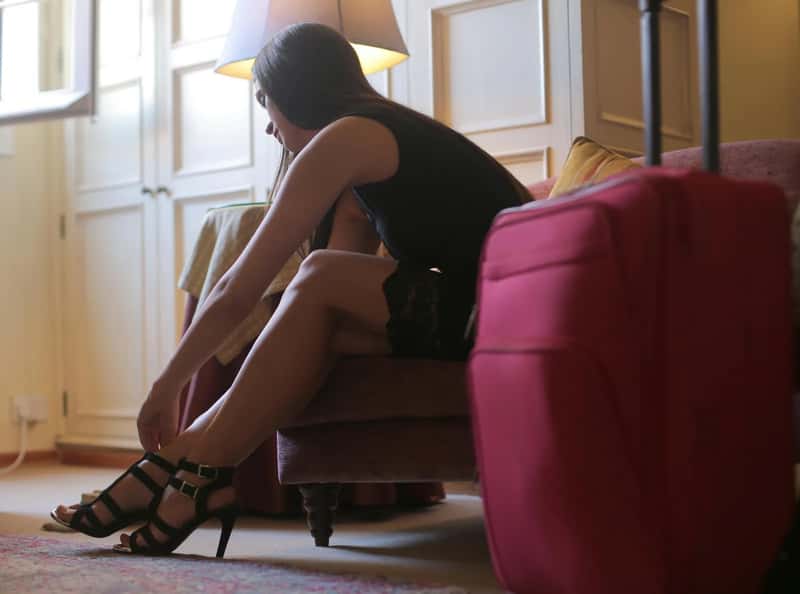
Your brain runs a constant background program. It doesn’t announce itself. It just runs.
It catalogs exits. It notes which direction the elevator is. It times how long it would take to get from the bed to the door with no lights on.
For many, this is not a personality trait or a choice. It is a learned survival response, deeply rooted in the nervous system, often shaped by trauma, chronic stress, or prolonged exposure to unsafe environments.
The suitcase stays packed because the algorithm demands it.
Unpacking feels like a system error. Like telling the software to stop protecting you, just for the weekend. The body refuses. Hypervigilance is a state of constant threat monitoring driven by the brain’s survival system – it occurs when the nervous system remains stuck in a fight-or-flight response, even in safe situations.
You aren’t being dramatic. You’re being precise.
Your precision just happens to look like a person who will never use the hotel ironing board.
The Childhood Architecture
Something happened before the first hotel room.
Something happened in a house, or a car, or a conversation that ended too abruptly. Something taught you that comfort is a setup. That the moment you exhale, the moment you hang the shirt, the moment you finally settle – that’s exactly when the floor gives way.
Hypervigilance is strongly linked to childhood trauma. That has a lot to do with the fact that, as we grow up, our brain develops in a way that’s responsive to our environment.
An unpredictable childhood doesn’t just shape behavior. It rewires architecture. Growing up in unpredictable or unsafe environments teaches the nervous system to stay alert at all times.
The hotel closet becomes the symbol of everything you were taught not to trust.
Permanence. Settling. The audacity of belonging somewhere.
You learned young that departure is not a possibility. It is a probability. You built your whole interior life around that knowledge.
The Portable Identity
You don’t need walls to know who you are.
That’s the thing people who unpack don’t understand. They think living out of a suitcase is a sign of disorder. It isn’t. It’s a sign of a very specific kind of order – one that moves with you.
You stop relying on a place to confirm identity. Skills, discipline, and awareness take that role instead. Each new environment reinforces independence through familiarity with change.
Stability becomes something you carry rather than something you occupy.
Your identity is not in the closet. It never was. It’s in the way you navigate a new city at 11 PM without fear. It’s in the muscle memory of repacking in under four minutes. It’s in the quiet confidence of someone who has been dropped into unfamiliar rooms so many times that unfamiliar has become the default setting.
The suitcase isn’t a failure to commit.
It’s a very compact monument to self-sufficiency.
The Exit Strategy
You always know the way out.
Not just of hotel rooms. Of dinner parties. Of conversations that are going somewhere uncomfortable. Of relationships that are asking you to stay longer than feels safe.
Always sitting near exits in public spaces is not a quirk. It is the body speaking a language it learned under pressure. The body remembers what the mind has tried to file away.
The unpacked suitcase is the exit strategy made physical.
It says: I can leave in twenty minutes. It says: I am not trapped here. It says: even if everything collapses, even if the phone rings with the worst news, even if the thing you’ve been bracing for finally arrives – you are ready.
Control comes from preparation rather than attachment, which reduces anxiety during change.
The closet asks you to give up that control. To spread yourself out. To commit to the fiction that you’ll be here long enough to need organized drawers.
You won’t. You never are.
The Ritual of the Packed Bag
I remember standing in a hotel room in a city I’d flown to for work. Three nights. A closet with actual wooden hangers – the good kind, the hotel’s attempt at luxury – and I stood in front of it for a full minute before turning away.
I put nothing inside it.
I ate room service with my suitcase open on the second bed, like a roommate. I knew exactly where everything was. I slept better than I had in weeks.
That moment clarified something. The ritual of the packed bag isn’t about laziness or disorder. Micro-organization isn’t about being “neat.” It’s about making friction so low you glide. Open loops – those half-finished tasks humming in the background – quietly drain you.
The packed bag closes every loop before it opens.
That clarity shortens preparation time and reduces unnecessary reconsideration. Packing alone feels manageable because the process stays familiar. Each move confirms that efficiency improves with repetition.
The ritual is the anchor. It is the only routine that travels with you without distortion.
The Intimacy Paradox
Here is the contradiction no one talks about.
The people who refuse to unpack are often the most perceptive in the room. The most attuned. The most capable of reading a situation, a person, a shift in energy, in seconds.
Hypervigilance is described as a heightened state of awareness – “it’s your brain’s way of protecting you by scanning the environment for signs of danger and being extremely aware of your surroundings.”
That same radar that keeps the suitcase packed also makes you extraordinary at connection. You notice the unspoken thing. You catch what most people miss.
But the paradox is brutal. Hypervigilance can strain relationships by fostering mistrust or misinterpretations of others’ tone and intentions. A partner’s neutral comment may feel loaded with criticism, or a friend’s delay in responding might spark suspicion.
You are wired for intimacy and wired to flee it simultaneously.
The suitcase on the floor is not just about the hotel. It’s about every room you’ve ever been in with someone you were starting to trust.
The Temporality Contract
You have made a private deal with impermanence.
You signed it quietly, somewhere in your past, and you have been honoring it ever since. The deal goes like this: nothing lasts, so don’t pretend it does. Move through spaces without marking them. Leave no trace. Travel light.
It’s not just about objects. Living light trains you to release expectations, rigid routines, and even parts of yourself that don’t serve you anymore.
The fluidity of living out of a suitcase reveals unrest. But it also reveals a kind of wisdom that settled people spend thousands on retreats trying to access.
You already know that everything is temporary. You have known it in your bones since before you had language for it.
The hotel closet represents permanence. It asks you to act as if this room is real, as if this chapter is durable, as if you are someone who stays.
The contract says otherwise.
You keep honoring it. Even here. Even now.
The Nervous System’s Geography
Your body has its own map.
It marks safe zones and unsafe zones with a precision no GPS can replicate. The body doesn’t use streets. It uses sensation. It uses the difference between a room where the door opens inward versus outward. It uses the quality of the silence at 3 AM.
When you’re hypervigilant, your muscles never fully relax. Your shoulders stay raised, your jaw clenches, and your back remains rigid as your body prepares for danger that may never arrive.
The suitcase on the floor is a landmark on that body-map. It says: you are here, and you can leave. It is the nervous system’s way of drawing a safe corridor in an unknown space.
The act of unpacking and rearranging is the nervous system’s way of trying to collapse that timeline – to achieve belonging through the placement of objects, since it cannot achieve it through time and memory.
But you’ve never needed belonging through objects.
You need belonging through readiness. The packed bag is not chaos. It is your nervous system’s architecture of safety, precise and personal and entirely yours.
The Decision Fatigue Armor
There is a cognitive efficiency in the refusal to unpack.
It looks like avoidance. It functions like strategy.
Psychologists call this decision fatigue. The fewer decisions you need to make about trivial things, the more energy you have for the stuff that matters. And yes, packing three shirts instead of ten helps.
When everything stays in the suitcase, the morning is frictionless. No searching. No choosing. No standing in front of a hotel closet at 7 AM wondering which version of yourself to present to a city that doesn’t know you yet.
People who pack everything like a pro approach relocation with calm rather than urgency. Experience removes hesitation from decisions about space and protection.
The armor isn’t the suitcase itself. The armor is the system. The predictability. The practiced, repeatable calm of someone who has done this so many times that novelty has lost its teeth.
You move through the world in a state of prepared stillness. That is not a small thing. That is, in its own dark way, a form of grace.
The Weight You’ve Learned to Carry
Here is the heaviest truth at the bottom of the bag.
When attachment to place is disrupted – through forced relocation, natural disaster, or simply movement – the psychological effects can be severe. The emotional consequences of displacement have been described as comparable to grief, with the loss of a meaningful place triggering feelings of anxiety, depression, and identity fragmentation. Even temporary displacement, it turns out, costs something real.
Hypervigilance is not weakness. It is evidence of a nervous system that once protected you well. The suitcase, always packed, always near the door – that is the monument to that protection. It is your body’s letter to its younger self: I will not be caught off guard again.
When you live with hypervigilance, your brain isn’t being dramatic. It’s operating exactly as it was designed to after experiencing threat or trauma. Understanding the neuroscience behind this response can help you recognize that hypervigilance isn’t a character flaw or weakness, but a measurable change in how your brain processes information about safety and danger.
You have been carrying this weight so long it no longer feels like weight. It feels like posture. It feels like you.
But here, in the quiet of a hotel room that smells faintly of industrial laundry and someone else’s perfume, it’s worth asking – not with judgment, but with the gentlest kind of curiosity – what it might feel like to hang one thing up.
Not everything. Not the whole suitcase. Not the whole system you’ve built with such hard-won precision.
Just one shirt. Just one act of telling this temporary room: I was here.
The closet will still be empty when you leave. The door will still lock behind you. The taxi will still come.
But maybe the departure, when it comes, will feel a little less like the only thing you ever knew how to do.