You’re standing in a room that hasn’t been touched in forty years.
Dust on the piano keys. A child’s shoe by the door. The ceiling, folding inward.
You didn’t come here by accident.
You came because something in you already knew this place.
There is a version of you that lives in the clean apartment, holds the steady job, texts back in under an hour. And then there is the version standing in the ruin – the one who drove three hours to find it, who climbed the fence, who stood very still and felt something crack open in the chest. That is the Identity Gap. The distance between the person you perform and the person who only surfaces when the world gets quiet and broken enough to hold them.
1. The Permission of Decay
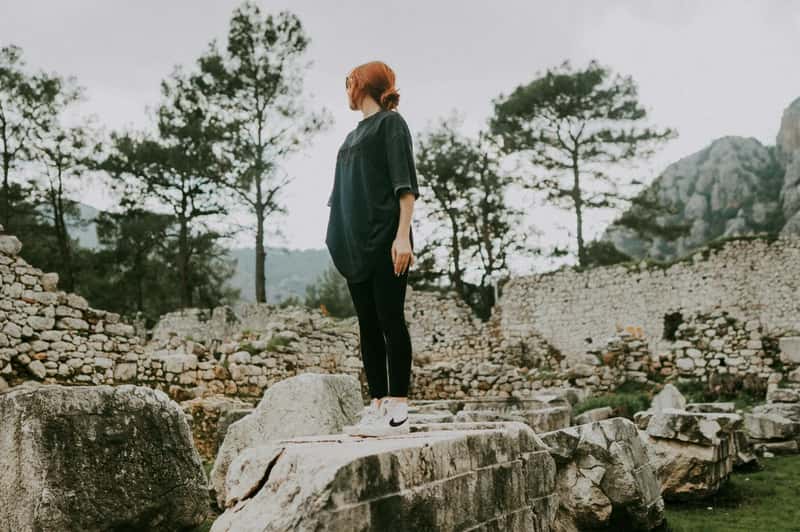
Broken places don’t ask anything of you.
They don’t require a smile. A performance. A version of yourself that’s been approved by committee.
When you walk into an abandoned factory, a decommissioned asylum, a ghost town swallowed by dust – nobody is watching. Nobody is grading you. The collapse has already happened. The worst-case scenario is already the floor plan.
And in that, there is something profoundly releasing.
Dark tourism should be understood as a postmodern leisure practice centered on the need to contemplate one’s own finitude through death. But it goes further than that. The ruin gives permission. It says: look, here is a thing that was once full of purpose, and it fell apart, and it is still standing, and it is still worth looking at. That is the subconscious bargain. If the building can collapse and still have dignity, maybe you can, too.
You’re not just observing the decay.
You’re negotiating with it.
2. The Mortality Mirror
You don’t go to these places to die.
You go to remember that you will.
There is a reason that in 2017 more than 2 million people visited the Auschwitz-Birkenau Memorial, and since its opening the Ground Zero Memorial attracted more than 37 million visitors. These numbers are not the result of morbid obsession. They are the result of a deep human need to stand inside the frame of mortality and look outward.
Philip Stone, who runs the Institute for Dark Tourism Research, articulates it precisely – “what I am interested in is the way people face their own mortality by looking at other deaths of significance – because we’ve become quite divorced from death.”
The abandoned place is the mirror.
It reflects not what you look like, but what you are made of.
And every person who has ever pressed their palm against a cold, crumbling wall and felt nothing – and then felt everything – understands exactly what this means.
3. The Curiosity That Has No Polite Name
We are taught to look away from wreckage.
Keep moving. Don’t stare. Respect the dead.
But the instinct doesn’t disappear. It just goes underground. It becomes the slow drive past the accident. The clicking on the article. The booking of the tour to Chernobyl. Researchers suggest three main reasons for visiting dark sites: curiosity about the unusual, attraction to horror, and a desire for empathy or identification with the victims of atrocity.
But curiosity is the one that doesn’t get enough credit.
Curiosity is not ghoulish. It is ancient.
Travel associated with death dates back for centuries – early examples include Roman gladiator games, guided tours to watch hangings in England, and pilgrimages to medieval executions. We have always done this. We have always craned our necks toward the dark. The question is not why we do it. The question is what we do with the answer we find when we get there.
4. The Identity That Only Survives in Ruins
There is a part of you that ordinary life is trying to sand down.
The part that is too sensitive. Too aware of time. Too obsessed with what things mean.
Safe environments don’t need that part. Safe environments need you functional, efficient, pleasant. But collapsed environments – the ones where the wallpaper is peeling, where the swimming pool is full of leaves, where the hospital beds are still made – those environments call that part of you back to the surface.
Because ruin is honest. It does not pretend.
Recent research has considered dark tourism as a type of transformative tourism, as it has the potential to contribute to tourists’ transformative processes – facilitating self-fulfillment and self-identity. That transformation doesn’t happen in the gift shop. It happens in the hallway where the clock stopped. In the classroom where the textbooks are still open.
Your truest self is the one that shows up in places that have given up pretending.
5. The Anecdote in the Cracked Glass
I remember standing in an abandoned textile mill in the north of England. Rain came in through the broken roof in a single diagonal sheet, like the building was crying at a specific angle.
I hadn’t planned to go inside. But the door was open – not metaphorically, just literally, hanging off one hinge – and something in me walked through it before I made the decision to.
Inside, the machines were still there. Enormous iron looms, frozen mid-cycle, draped in a century of silence.
I stood there for a long time. And I understood, in a way that no therapy session had managed to communicate, that things can be completely halted and still beautiful. That stopping is not the same as failing. That a loom that will never move again is still, in some irreducible way, a loom.
I wasn’t studying the place. I was studying myself, through it.
There is a contemporary cultural movement in which urban ruins have become subject matter for expensive coffee-table books and thousands of Instagram accounts – the idea being “beauty in decay.” I used to think that was aesthetic tourism. Now I understand it is something older and more urgent than that.
6. The Empathy That Requires No Living Person
Dark places teach empathy differently.
When you stand in a place of historical grief – a former prison, a bombed theater, a drowned village – there are no victims left to perform discomfort in front of. There is no one to thank you for caring. No social reward.
The empathy you feel in an abandoned place is the purest kind.
It is entirely private. It costs you something. And it asks for nothing in return.
People visit such places not only to be scared but to understand fear itself – to explore how human stories are preserved through tragedy. It’s a journey into empathy, curiosity, and mortality. But what the research does not say – what only the traveler in the ruin understands – is that empathy exercised in silence is also a form of self-recognition. You are not just feeling for the strangers who lived here. You are feeling for the parts of yourself that have also been left behind, in other rooms, in other lives.
7. The Resilience Thesis
There is something happening in the body when you stand in a collapsed place and it does not collapse you.
You walked in. The floor held. The walls – cracked, stained, half-gone – still stood. And you stood with them.
Researchers have proposed that tourism to dark places can function as a form of new psychological resilience. That makes intuitive sense. Because every time you enter a space that has survived its own disaster, you are implicitly running an experiment: What does it feel like to be in the presence of something that broke – and didn’t disappear?
The answer, every time, is the same.
It feels like proof.
Proof that breakage is not erasure. That falling apart is not the final condition. The ruin is still a building. The wound is still a body. The person who is barely holding it together is still, unambiguously, a person.
8. The Aesthetics of Honest Collapse
Modern architecture lies.
It promises permanence. Clean lines. Sealed surfaces. It says: nothing breaks here. Nothing ages. Nothing ends.
But the ruin tells the truth. It says: I was built, I was used, I was loved and then abandoned, and here is exactly what that looks like on a body of brick and mortar.
The acceleration of climate change has led to unprecedented natural disasters, while dark tourism has made devastation a criterion of attraction – directly defying the Apollonian sense of beauty that characterizes modern tourism. That defiance is the point. The collapsed ceiling, the vine coming through the window frame, the light falling through a hole in the roof – these are not ugly things. They are the most honest things in any landscape.
And for a person whose own inner life has been marked by collapse – by grief, by failure, by the slow erosion of something once solid – the beauty of honest decay is not morbid. It is, quietly, the most comforting thing in the world.
9. The Reclamation of Your Own Timeline
You live in an era that does not tolerate stillness.
Everything is progress. Iteration. Updates. Version 2.0. The culture around you is obsessed with momentum. With next. With optimized.
And then you walk into an abandoned house where time stopped in 1987, and nobody told that house to catch up, and it didn’t, and it is somehow – impossibly – fine.
Dark tourism has seen a surge in popularity in the last decade as people seek a richer travel experience, choosing to meaningfully engage with humankind’s more troubling heritage, rather than opting for merely escapist vacations. What the statistics don’t capture is the reason beneath the reason. The pilgrim to the abandoned place is not escaping time. They are reclaiming it. They are saying: here is a place that refused to keep moving, and it is still here, and it still matters, and I am allowed to stop moving too, at least for this hour, at least inside these walls.
The ruin is a radical act of permission.
It permits you to exist at your own pace.
10. The Broken Thing That Holds the Most Light
There is a Japanese concept – kintsugi – in which broken pottery is repaired with gold, the cracks made visible rather than hidden, the breakage treated as the most important part of the object’s history.
Every abandoned place, every dark tourism site, every ruin you have ever stood inside is a form of kintsugi at architectural scale.
The crack in the wall is not a flaw. It is the record. It is the honest accounting of everything the building survived.
Scholars argue that the most meaningful dark tourism sites can help visitors understand the present and be more thoughtful about the future – that “these are important sites that tell us a lot about what it is to be human.” But the thing that the academic papers struggle to say – because it is too close to the bone, too intimate for a footnote – is this: you do not go to the broken place to study humanity in the abstract. You go because you are the broken place. You are the thing that fell apart and is still, somehow, standing. You are looking for confirmation that this is enough. That you are enough. That the cracks are not evidence of failure but of having been here, having been tested, having been genuinely, irreversibly alive.
And the ruin always tells you yes.
There is a particular quality of silence in a place that has been abandoned. It is not the silence of emptiness. It is the silence of saturation – a room so full of everything that happened in it that it no longer needs sound to communicate. You feel it the moment you cross the threshold. The air is different. Thicker. More honest.
That silence is what you were looking for when you booked the ticket, when you found the coordinates, when you climbed the fence at dusk. Not the ruin itself. Not the decay, not the aesthetic of collapse, not the thrill of trespassing into the past. You were looking for the silence that only comes in places that have survived being destroyed. Because you have been destroyed, in the ways that people are destroyed without anyone being able to see it. And you needed to know that survival is still possible. That the walls can be half-gone and the structure can still hold. That beauty does not require wholeness.
The most honest thing a person can do is stand in a broken place and refuse to look away. Not out of fascination with the dark. Out of recognition. Out of the quiet, cellular understanding that falling apart is not the opposite of being beautiful – it is, sometimes, the very condition of it.