You are standing in an airport bookstore at 6 AM.
You don’t need a book.
You have a phone. A podcast. Seventeen unread articles saved since March.
And yet your hand moves toward the shelf anyway – reaching for something hardback, something serious, something that looks like a person who has their life together would carry it onto a plane.
This is the distance between who you actually are in this moment – tired, slightly anxious, running on vending machine coffee – and who you need to appear to be when you’re surrounded by strangers who might be watching. The gap is old. It precedes the airport. It precedes your job, your apartment, your adult name. It was carved into you in a classroom, at a dinner table, in the back seat of a car where someone important was watching to see if you were being productive enough.
1. The Prop, Not the Book
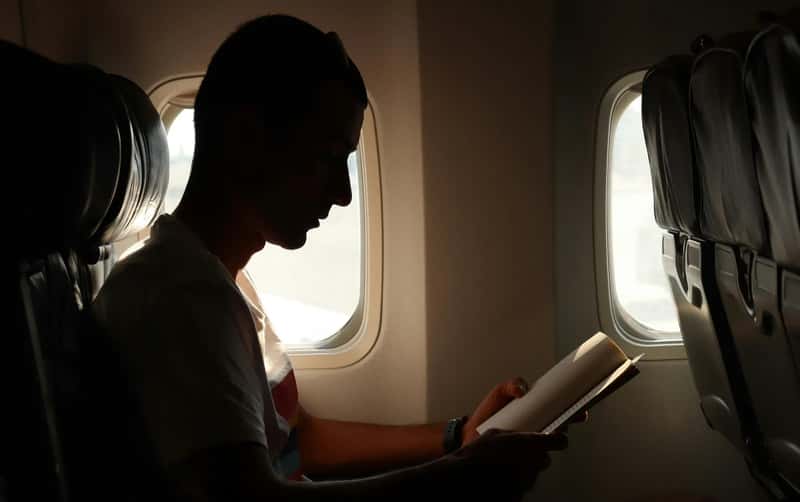
Here is what the book actually is: a prop.
Not a bad one. Not a dishonest one. But a prop nonetheless.
Many people buy books they never read because of the illusion of intellectual progress – the belief that owning books makes us smarter, even if we never open them. Books symbolize intelligence and personal growth, making us feel accomplished. But on the plane, the symbolism does double duty. It doesn’t just signal intelligence to yourself. It signals it to the row around you. The person in 14C. The flight attendant who glances down. The version of yourself watching from the outside.
You are not buying a book to read.
You are buying a costume.
And the costume has been in your wardrobe since you were seven years old, dressing for the audience of someone who had power over your sense of worth.
2. The Liminal Zone and the Unguarded Self
The airport does something strange to identity.
Due to the haziness of time and place, airports create a sense of disorientation. We define ourselves in terms of time and place. We know who we are in relation to our daily routines and our familiar environments. Strip that away – the commute, the desk, the familiar coffee order – and something floats loose.
The same applies to identity. A sense of identity is important to our psychological health but can become constricting.
So when identity becomes temporarily unmoored, we reach for anchors. We reach for objects that say something clear and legible about who we are. A serious book in hand is the fastest shorthand available. It says: I am a person of depth. I am not wasting this layover. I am not the kind of person who scrolls.
You are performing. And the audience has been inside your head for decades.
3. The Childhood Wiring
This doesn’t begin at the departure gate.
It begins much earlier, in the architecture of approval.
Childhood experiences play a significant role in shaping approval-seeking behavior. If you grew up in an environment where love and acceptance were conditional upon meeting certain expectations, you may have internalized the belief that your worth is tied to how well you please others. This early conditioning can lead to a lifelong pattern of seeking validation from external sources rather than cultivating self-acceptance.
The child who learned that being seen with a book meant being seen as good – as worthy – does not simply grow out of that equation.
They carry it into airports. Into conference rooms. Into the quiet moments when no one is really looking, and they still feel looked at.
The book is not chosen. It is remembered.
4. The Identity Shelf You Carry in Your Luggage
Every book you have ever bought but not read is a declaration of intent.
It’s closer to aspirational collecting. Buying a book becomes a declaration of intent, a signal to yourself about the person you want to become. Business books, for example, often serve less as page-turners and more as symbols of ambition. They sit on shelves like promises, reminders that you’ll master a new strategy, adopt a better habit, or gain an edge.
But the airport book is even more specific than the shelf at home.
The shelf is private. The airport is public.
When you bought those books you never got round to reading, you were the kind of person who was happy to spend a little bit of money for the short-term pleasure of being the kind of person who owned those books. On the plane, you pay a slightly higher price – airport markup – for the same emotional transaction. You are purchasing an identity you can wear for the next four hours.
5. The Intention-Behavior Gap (Personal)
I need to pause here. I need to tell you about the book I bought in the Dublin airport in 2019.
It was a dense philosophical text. Dark cover. Important-looking spine. I carried it through security with a specific kind of pride – the pride of a person who reads important texts on planes. I placed it on the tray at the scanner with practiced casualness. I settled into my window seat and opened it to page one.
I was asleep before the wheels left the ground.
The book spent the flight in the seat pocket. I transferred it to my bag at landing. It lived on my nightstand for three months before disappearing into a stack of other declarations of intent. Buying it gave me the illusion that I was already improving. Turns out, this is called the “intention-behavior gap” in psychology. The gap between who you intend to be – the person who reads Heidegger at 30,000 feet – and who you actually are – the person who needs eight hours of sleep and had two airport beers.
The gap is not a failure. It is a fingerprint. It tells you where the wound is.
6. The Dopamine of Becoming
Here is what your brain is actually doing in that bookstore.
When you buy a new book, your brain releases dopamine – the feel-good chemical. But this isn’t a reward for finishing the book. It’s a hit you get from the anticipation of learning something new or diving into an exciting story.
The purchase is the peak. Everything after is a slow, quiet comedown.
You are not paying for a book. You are paying for the version of yourself that exists only in the moment of buying it – the version that is about to become smarter, sharper, more complete. The hedonic treadmill is a concept in psychology where we quickly return to a baseline level of happiness after experiencing positive or negative events. Buying books provides a temporary boost of pleasure and excitement, but once the novelty fades, we’re back to seeking the next acquisition.
By the time you board the plane, the version of yourself you purchased is already fading.
You are already reaching for your phone.
7. The Audience That Never Left
Let’s be specific about who you are performing for.
It is not the stranger in 14C. They are not watching.
It’s about being perceived as awkward or incompetent in public settings. Airports heighten this because everything feels like a performance. You’re being watched, scanned, and assessed at every step.
But the watcher is internal. It wears the face of a teacher. A parent. A grandparent who asked what you were reading at dinner. According to attachment theory, adolescents’ attitudes toward authority may derive from early interaction with primary caregivers, primarily parents. Individuals internalize these interaction experiences and form internal working models, which will be applied in later life stages when interacting with authority figures.
The airport, with its fluorescent lights and its strange suspension of ordinary time, makes that internal watcher louder.
You reach for the book to quiet the voice that has been grading you since childhood.
8. The Signaling Economy of Intelligence
There is a name for what you are doing.
Performative intellectualism describes a mode of engagement where intelligence is displayed rather than practiced. It prioritizes the appearance of being informed through language, references, and certainty over the slower, messier work of thinking itself. Instead of inviting dialogue, it often functions as a social signal: a way to claim credibility, status, or moral authority.
The airport book is this impulse distilled to its purest form.
Intelligence is a status marker in our society. Sounding informed signals moral authority, cultural capital, and belonging to the right group. When smartness becomes something that earns visibility and respect, people naturally start optimizing for the signal, not the substance.
You learned to optimize early. You were rewarded for it. The reward became the need. The need became the habit. The habit followed you onto the plane.
9. The Weight of Unread Spines
The book lands in your carry-on. Then your nightstand. Then a box in the corner.
Books, in particular, become symbolic. Each one we keep feels like an investment in a possible self. Each one we discard feels like admitting that version of us may never exist.
This is the real cost of the airport book. Not the fourteen dollars. Not the extra weight in your bag.
It is the accumulated guilt of all the selves you bought and never became. The philosophy reader. The strategic thinker. The person who uses long-haul flights productively.
Constantly seeking validation can erode self-esteem. When a person’s sense of worth hinges on likes or online recognition – or, in this case, on how they appear to others in transit – it can create a cycle of anxiety and dissatisfaction.
The book was supposed to prove something. Instead, it quietly asks a harder question.
10. The Gap Is Not the Problem – The Gap Is the Door
This is the heaviest point.
The reason you buy the book is not vanity. It is not stupidity. It is not some shallow performance anxiety you should be ashamed of.
It is grief, wearing a dust jacket.
Approval-seeking behavior often stems from childhood. Children who grow up in environments where praise is conditional on meeting certain expectations – such as excelling in school or conforming to parental standards – may develop an intrinsic need for validation. This pattern can carry over into adulthood, with approval becoming a psychological “reward” that reinforces self-worth.
You are grieving a child who needed to prove they were enough. Who held up their reading like a shield. Who learned, very young, that appearing productive was safer than simply being present.
What troubles many about performative intellectualism is how safe it feels. It offers credibility without vulnerability, belonging without the risk of being wrong.
The book is safety. It is armor assembled in Gate B-12, from the same materials you used when you were nine.
The gap between who you are and who you need to appear to be is not a flaw in your character. It is a map of every moment someone made their love feel conditional on your productivity. Every classroom where being smart was the one currency that bought you safety. Every dinner table where idle hands made someone nervous.
You are not buying a book. You are still trying to earn your seat at the table.
And the most tender, most radical thing you could do – in that airport bookstore, under the fluorescent hum, with your carry-on at your feet – is to put the book down. Not because you don’t deserve it. But because you don’t need it to be enough.
You were already enough before the departure gate. You were already enough before the grade, the credential, the spine facing outward for someone else’s eyes. The plane will carry you regardless of what you carry onto it. The seat does not ask for proof of intellectual worth. The altitude does not care what you are reading.
Somewhere between wheels-up and cruising altitude, in the pressurized quiet above the clouds, there is a version of you that already knows this – the version that closes the unread book, leans the seat back two inches, and finally, for once, simply goes somewhere without trying to prove anything on the way.