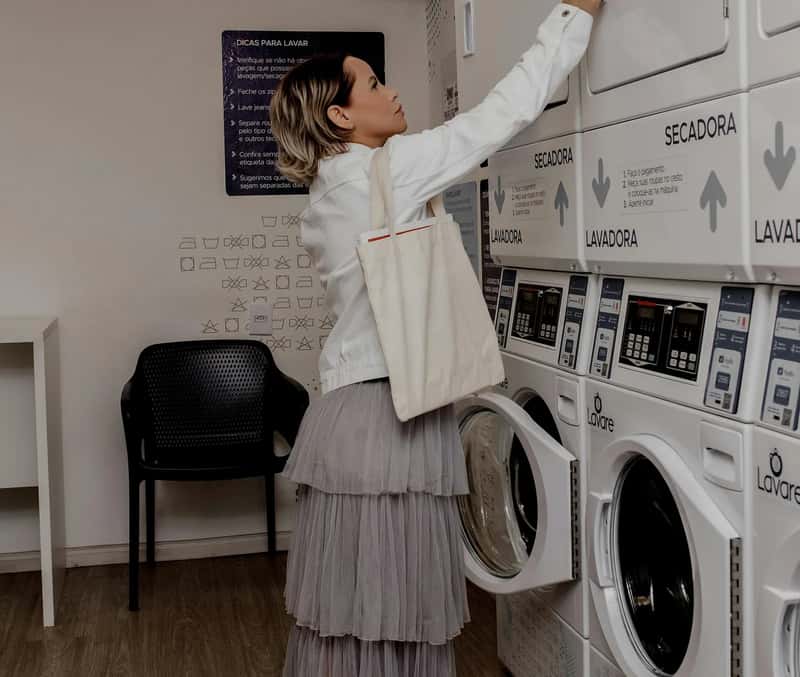
The machines are humming in a language you don’t speak.
The street outside smells like diesel and something frying.
Your clothes are spinning in a drum the color of old bone.
And you feel – against all logic – completely fine.
This is the paradox no travel writer wants to confess. You crossed an ocean to stand in a fluorescent room, watching cotton circles through a porthole, and this is the moment you finally exhale. Not at the cathedral. Not at the cliffside. Here. In the laundromat. Because underneath every trip you have ever taken, there is a quiet, unspoken negotiation between the person you perform in transit and the person who still needs to wash their own socks.
1. The Sensory Anchor
Travel is sensory overload wearing a beautiful mask.
When you are somewhere new, your senses can go into overdrive. The cobblestones. The new café smells. The unfamiliar ceiling above an unfamiliar bed. Every single input is coded as “unknown” by a brain that evolved to treat the unknown as threat.
The laundromat offers something radical: repetition.
The warm, soapy smell of detergent is the same in Lisbon as it is in Louisville. The vibration of the machine against your palm has the same low frequency everywhere on earth. These are not neutral details. They are neurological lifelines – sensory anchors that tether the floating, overstimulated mind back to a body that knows exactly what to do.
To feel grounded means to feel a sense of safety and familiarity as you prepare to fly or endeavor into the unknown. It means to take the time to remember who you are, what’s important to you, and what you want to experience in your day and life. This connection helps you stretch beyond your limits without losing your sense of self.
The drum spins. You breathe. The world makes sense again for exactly forty minutes.
2. The Competence Loop
Abroad, you are frequently incompetent.
You can’t read the menu. You took the wrong train. You paid with the wrong coin and a shopkeeper sighed at you with quiet, patient contempt. Every day of travel carries small humiliations, each one a tiny nick in your sense of self-efficacy.
Then you do your laundry. And you are suddenly, undeniably, good at something.
A sense of self-efficacy encompasses feeling not only competent but also in control of one’s life and context. You sort the darks from the lights. You choose the correct temperature. You fold a shirt with the practiced, automatic precision of someone who has been doing this their entire life. Because you have.
This is the competence loop: a small domestic win that resets the psychological ledger. Every successful wash cycle is a micro-affirmation that you are, beneath the confusion of a foreign city, still a functioning, capable adult.
The machine beeps. You’ve done it again. Identity: intact.
3. The Slow Travel Permission Slip
Modern travel culture has a velocity problem.
You are expected to consume experiences at the pace of a highlights reel – monument, meal, monument, museum, nightcap, sleep, repeat. The implicit pressure is relentless and exhausting. Slowing down feels like failure. Sitting still feels like waste.
The laundromat gives you official permission to stop.
Doing laundry while travelling forced us to slow down. And slower travel is almost always better. There is no guilt in a laundromat. You are not choosing to sit idle – you are performing a necessary domestic function. The world accepts this. Your inner critic, surprisingly, accepts this too.
And in that enforced stillness, something loosens. You look around the room. You notice the locals, their habits, the particular way a woman folds a bedsheet in this specific city. You absorb the ordinary rhythm of a place, which is almost always more honest than the extraordinary rhythm sold to tourists.
Slow down long enough, and the place comes to you.
4. The Identity Continuity Bridge
The deepest anxiety of extended travel is not about safety or language barriers.
It is about continuity. The quiet, unsettling feeling that the person you are at home and the person careening through foreign streets are not quite the same individual.
Personal identity, defined as the perceived continuity and coherence of the self over time, has been theorized to influence anxiety. When that continuity fractures – when the habits, routines, and roles that define you are stripped away by an unfamiliar environment – a particular kind of dread moves in. Nothing dramatic. Just a low, persistent hum of wrongness.
Domestic tasks are continuity bridges. They are behavioral proof that the same person who folded laundry in their apartment last Tuesday is the same person folding laundry in a Barcelonan coin-op today.
In situations involving negative or threatening stimuli, individuals with a strong sense of personal identity may be better able to synthesize information and regulate emotional responses, thereby reducing the intensity of anxiety.
The laundromat is not mundane. It is the thread that keeps you sewn together.
5. The Anonymous Witness
I remember a laundromat in Porto, on a rain-heavy Tuesday in October. I had been traveling alone for eleven days. My Portuguese was essentially zero. I had spent a week performing competence – navigating, ordering, photographing – while feeling, beneath it all, absolutely untethered.
The laundromat was on a narrow street behind a tram stop. Three machines. Two plastic chairs. An old man reading a newspaper and completely ignoring me.
I sat with my bag of dirty clothes and felt, for the first time in over a week, invisible. Not lonely-invisible. Relief-invisible. No one there needed me to be the adventurous traveler or the culturally curious foreigner. I was just a person with laundry. Like everyone else. It was, in the truest sense of the word, a rest.
When the outside world feels unpredictable, a routine provides comfort. That laundromat was not a detour from my trip. It was the most honest part of it.
6. The Cultural Microscope
You want to understand a city? Don’t go to the museum first.
Go to the laundromat.
In many cities, popping into a laundromat isn’t a chore; it’s an attraction. From neon-lit wash bars in Barcelona to Scandinavian café-laundromats in Reykjavik, doing a load of laundry can become a cultural moment, a chance to relax and even an unexpectedly memorable stop on your journey.
The way a society handles its laundry tells you everything. In Copenhagen, the laundromat is a community living room with bookshelves and a children’s playroom. In Japan, they are themed laundromats with ultra-modern touch-screen interfaces and spotless seating areas – doing laundry there feels less like a chore and more like stepping into a creative micro-experience.
These are not tourist attractions. They are genuine cultural artifacts – ordinary spaces shaped by ordinary people living ordinary lives. Sitting inside one is, paradoxically, a more intimate act of travel than any guided tour. The culture is not being performed for you. It is simply proceeding, and you are briefly, quietly inside it.
7. The Nervous System’s Long Exhale
Travel anxiety is real, underdiagnosed, and significantly underestimated.
Traveling can often be overstimulating. Stimulation or sensory issues can flare while away from home, especially for folks who live with mental health conditions. But even for the psychologically sturdy traveler, the cumulative weight of new inputs, new decisions, and new social performances creates a kind of cognitive exhaustion that feels nothing like tiredness and everything like dread.
The nervous system needs tasks with known outcomes.
“Grounding helps with keeping us anchored in the present moment while also helping to soothe our physiological responses to anxiety and calming down the body.”
Laundry is a known outcome. You put clothes in dirty. They come out clean. The universe, in this one small corner, is entirely predictable. That predictability – that microscopic certainty – is not nothing. For an overstimulated nervous system, it is everything. It is the reset button disguised as a chore.
8. The Possession Ritual
Travel dislocates you from your objects.
Suitcase living reduces your possessions to a clinical minimum. Everything you own – for the duration of the trip – fits in a bag you can carry. This is liberating, yes. It is also quietly destabilizing. Objects are identity anchors. Your worn-in jacket, your preferred coffee cup, the specific arrangement of things on your bathroom shelf – these are not mere possessions. They are externalized fragments of self.
When you handle your own clothes – sort them, wash them, fold them – you are performing a ritual of possession. You are tending to the physical materials of your life. Every seasoned globetrotter eventually realizes one thing: the less you bring, the freer you feel. True. But freedom has a cost, and part of that cost is an estrangement from the objects that quietly sustain your sense of self.
The laundromat is where you pay that cost back, in warm fabric and the particular folded geometry of your own shirts. You hold a clean shirt you packed from home. You are, briefly, home again.
9. The Social Aperture
In tourist spaces, interaction is transactional. You buy. They sell. You admire. They perform.
In the laundromat, the transaction is simply: human being in the presence of another human being, waiting for the same machine to finish.
Visiting a laundromat can be an interesting cultural experience – you’ve interacted with other travelers and locals during your wash-ups. These micro-interactions carry a weight that a scripted museum audio guide never will. Someone tells you which machine runs hot. Someone’s child touches your bag with the frank curiosity of a person who hasn’t yet learned that strangers are suspicious. An old woman laughs at something on her phone and briefly, involuntarily, shows you the screen.
None of these moments are “travel experiences” in the Instagram sense. All of them are far more real than most of what you’ll photograph. When you travel abroad, you might find the cultural approach to several daily tasks contrasts what you were familiar with, and that is one of the most valuable and beautiful aspects of traveling. Exploring alternative techniques to do basic activities is a lesson that not only humbles, but encourages the mind to grow and stretch.
The laundromat is where the aperture opens.
10. The Weight of Clean Clothes
There is a specific, unremarkable moment that every laundromat traveler knows.
The dryer stops. You open the door. You reach in and pull out clothes that are warm and clean and folded into something you recognize as yours. And there is a weight to this that has nothing to do with cotton. It is the weight of having taken care of yourself. Quietly. Without an audience. In an alien city, in a room lit by tubes of fluorescent light, you took something dirty and made it clean.
This is the act that cuts through the noise of modern travel. Identity resilience refers to the extent to which an individual possesses an identity structure that facilitates adaptive coping in the face of threat or uncertainty, can absorb change while retaining its subjective meaning and value. And nothing tests identity resilience quite like sustained displacement – the slow, cumulative erosion of the familiar that long travel eventually delivers. The laundromat does not fight this erosion. It simply, reliably, quietly repairs it.
The findings suggest that a stable and coherent sense of personal identity may protect against anxiety. The stable, coherent thing you carry into every laundromat in every foreign city is not your passport. It is the simple, unbroken knowledge that you are the same person who has always done this – who has always sorted, washed, folded, and carried on. That knowledge is worth more than any landmark you will ever stand in front of.
We talk endlessly about the transformative power of travel – the ways that new places reshape the self, crack it open, rebuild it into something larger and more interesting. And this is true. But what we don’t say is that transformation requires a stable ground to return to. You cannot be remade if there is nothing solid enough to remake. The domestic ritual, the unglamorous task, the humming machine in a fluorescent room – these are the ballast that keep the ship upright while the storm does its necessary work on the hull.
The traveler who seeks out the laundromat is not avoiding adventure. They are financing it. Every twenty minutes of clean, quiet, ordinary domesticity is what makes the next plunge into the extraordinary survivable. The self that stands at the cathedral, genuinely moved and genuinely present, is the self that was rebuilt, quietly and without ceremony, among the spinning machines.
Somewhere right now, in a city whose name you’d have to look up on a map, a traveler is sitting on a plastic chair, watching their clothes spin. They are not thinking about the monuments they haven’t seen yet or the restaurants they might miss. They are thinking about nothing, or something close to nothing – the specific, generous blankness that a warm room and a predictable machine can provide. They look, to anyone passing the window, like a person doing laundry. They are, in fact, a person doing the most private and important work of any long journey: finding themselves, one wash cycle at a time, still here.