You booked the underground tour three months in advance.
You told yourself it was just something to do.
You lied.
There is a reason you keep gravitating toward the subterranean. Toward the dim-lit staircase that descends beneath the city’s manicured surface. Toward walls of skulls arranged with an almost bureaucratic precision. It isn’t morbidity. It isn’t trend-chasing. It is something far older and far more personal – a quiet gravitational pull toward the parts of yourself you have spent years carefully not looking at.
1. The Descent as Decision
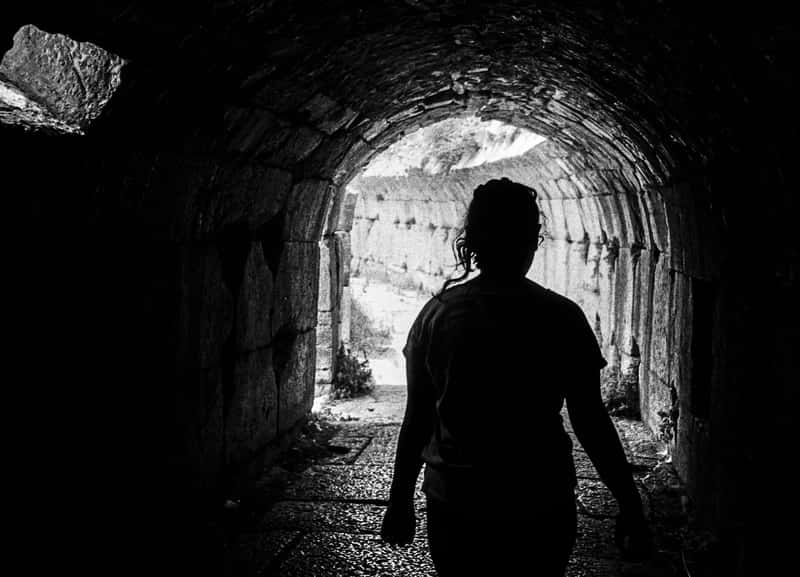
Going underground is not passive. It is chosen.
You walk past the souvenir shops. Past the postcard racks. Past the above-ground version of history that’s been sanitized for comfort. And then you choose the stairs going down.
That choice is the first act of self-honesty most people perform all year.
The hidden city offers individuals somewhere to experiment, to transcend categorization, and to explore new ways of being. Underground places have always been primed for subversion – even Lewis Carroll’s Alice entered an entirely illogical world via a hole in the ground.
The descent is a metaphor your nervous system understands before your brain does. You are not just walking down stairs. You are agreeing to go somewhere uncomfortable. You are saying yes to depth. And most of us spend entire decades refusing exactly that.
The underground tour begins the moment you make that decision. Everything after is just confirmation of what you already know.
2. The Familiar and the Disturbing
There is something you recognize down here. And it unsettles you.
The bones are organized. Stacked with care. Arranged into patterns that someone, at some point, considered beautiful. This is not chaos. This is history made tidy. And yet it terrifies you.
Ask yourself why.
Dark tourism evokes a sense of unease rooted in the Freudian concept of the uncanny. These places are closely connected to our history and yet charged with a potential that is as confusing as it is attractive: they are, in short, both familiar and disturbing.
That dual pull – toward and away – is not about the bones. It is about your own buried material. The grief you organized neatly into a corner. The failure you stacked like limestone. The version of yourself you decided, one quiet Tuesday, to simply entomb and never revisit.
Familiarity and disturbance are the twin signatures of buried identity. The catacombs just happen to wear both on the outside.
3. The Permission Structure of Distance
You would never lie on a therapist’s couch in your hometown and say what you really feel.
But you will stand in a foreign tunnel, surrounded by six million strangers’ remains, and let something in you quietly crack open.
Distance gives permission. Travel creates a temporary self – one who doesn’t have to be consistent with the person who empties the dishwasher and sends professional emails. Dark places are often unruly networks in which identity is performed and contested. That contestation is exactly the point.
When you are somewhere unfamiliar, the architecture of your daily self-deception becomes visible. You see the scaffolding. You see what you built and why. Underground spaces accelerate this process because they strip away the ambient noise of ordinary life. There is no weather down here. No traffic. No social media signal. Just the sound of your own breathing and the weight of something you haven’t named yet.
Distance is not escapism. Distance is the only angle from which some truths become visible.
4. The Temporary Autonomous Zone
Above ground, you have a role. A title. A set of behaviors that keep other people comfortable.
Below, the rules are different.
The Anarchist theorist Hakim Bey has described the Paris Catacombs as a “temporary autonomous zone,” where individuals are able to liberate themselves from the political, gender, and social structures of the upper world.
That liberation is psychological before it is political. When the social contract temporarily lifts – when you are in a space that exists outside ordinary jurisdiction – something in your self-monitoring relaxes. The performed self loses its audience. And in that brief absence of performance, you get a glimpse of what remains.
What remains is the real inventory. The things you carry that you haven’t let yourself examine. The grief. The old anger. The abandoned version of yourself from fifteen years ago who had a completely different idea about what your life was going to look like.
The autonomous zone doesn’t last. But it doesn’t need to. A glimpse is enough. A glimpse is more than most people ever allow themselves.
5. The Weight of Other People’s History
I remember the moment I first understood what was really happening to me underground.
I was standing in a narrow corridor in a catacomb somewhere in Eastern Europe, and the guide was explaining, in measured, accented English, how the bones had been moved here from overcrowded cemeteries. How there had simply been no more room above ground for the dead. How the city had run out of space for its losses.
And I thought: same.
I wasn’t thinking about the bones. I was thinking about the things I had stopped letting myself feel because I had simply run out of space for them. The relationships I had walked away from without processing. The versions of myself I had buried in the interest of forward momentum.
Dark tourists are very interested in understanding historical events; they are psychologically moved by the need to be in contact with authentic experiences by looking at the other’s death as if it were their own. That is the mechanism. Other people’s history becomes a safe container for your own. The bones are not theirs alone. They are holding something for you.
6. The Uncanny and the Unprocessed
Freud had a name for that feeling.
The uncanny – the unheimlich – is the sensation of encountering something simultaneously foreign and deeply known. Something that should be distant but feels like a memory. Something that should be dead but feels alive in you.
This fascination with the macabre has always existed in humans. By exposing visitors to pain and suffering, dark tourism evokes a sense of unease that can be explored from the perspective of the uncanny.
Every piece of your unprocessed history is, by definition, uncanny. It belongs to you. It comes from your life. And yet you keep it at arm’s length, boxed up somewhere between the present tense and the locked room you never open. Standing in a corridor of organized remains triggers that sensation at a cellular level.
Your body recognizes the organizational system. Bury the thing. Stack it neatly. Create a structure around it so it doesn’t spill out onto the street. You have been doing exactly this with your own interior for years. The catacombs simply show you the blueprint.
7. The Identity Performed in Darkness
Watch how people behave on underground tours.
They get quieter. They get slower. They stop performing their usual social roles – the funny one, the capable one, the fine one. Something shifts in the absence of light and the presence of scale.
Dark tourism comes in a wide array of forms, all connected by an engagement with death and its representations. Tourists in dark places make sense of their travels through the overlapping, fluid, ever-changing relations of their bodies, emotions, affects, thoughts, social, cultural and spatial interactions.
Identity is not fixed. It is a performance that requires an audience and a lit stage. Remove both. Watch what’s left.
What’s left is the part of you that was there before the performance began. The child version. The pre-branded version. The one that hadn’t yet decided which things to bury and which to display. Underground spaces don’t create this version of you. They just remove everything that was covering it.
This is why you leave these places feeling something you can’t quite name. A heaviness. A tenderness. A sense of having been briefly, incompletely, honestly seen.
8. The Archaeology of Self-Knowledge
Every catacomb is an archaeological site.
Things were placed here intentionally. In 1786, the French government decided to move the remains of old cemeteries to the abandoned quarries beneath the city. This process took several years and was mainly carried out at night so as not to cause panic among the population. The bones were not placed randomly, but carefully arranged, which led to the macabre but organized ossuaries that visitors can admire today.
Read that twice. Carried out at night. So as not to cause panic.
Sound familiar?
The burial of difficult things is almost always nocturnal. Almost always quiet. Almost always done in a way that maintains the structural integrity of the city above. We are all master architects of the night operation. We move our losses underground with practiced efficiency, and we keep the streets clean and presentable for the people who need to see us functioning.
But the archaeology remains. You can go back down. You can look. The evidence is still organized, still there, still waiting for someone to bring a torch and pay attention.
9. The Relief of Confronting Mortality From a Safe Distance
There is a word for this: thanatopsis.
The contemplation of death that doesn’t destroy you. The encounter with finality that somehow makes the present tense feel more vivid and less contested.
Dark tourism can be considered a quest to experience a disaster from a safe place, or to experience thanatopsis in a familiar setting whose iconography is culturally shared and already experienced through movies, news and other media.
For some people, visiting dark tourism sites is a way to confront their fears and mortality. But the mortality they’re confronting is rarely abstract. It is the mortality of previous versions of themselves. The death of the person they were before the divorce. Before the career pivot. Before the thing they never talk about.
Standing among the actual dead gives the internal loss a context that feels proportionate. You are allowed to feel something. Because others felt something here too, and they are stacked in the wall as proof.
Grief needs a container. Catacombs are one of the oldest containers we have ever built.
10. The Emergence
You always come back up.
This is the part people don’t discuss enough. The exit. The moment you walk back into light and noise and the city’s relentless forward momentum. As you re-emerge into the light of day, something has shifted.
The tourists blink. They check their phones. They drift toward coffee and souvenir shops. But something has happened to the quality of their silence. There is a particular kind of quiet that follows an encounter with your own buried material. It is not peaceful. It is calibrated. It is the quiet of someone who has seen something and is deciding, slowly, what to do with the seeing.
Researchers have identified the motives for dark tourism as including secular pilgrimage, a desire for inner purification, a search for authentic places in a commodified world, and an interest in personal genealogy and family history. But what they don’t fully name is this: the emergence. The return to the surface carrying something you went underground to find.
The underground tour ends. The identity work has only just started. That is the point. That was always the point. You didn’t book a tour. You booked an excavation.
There is a very old human instinct at work in all of this. The pull toward the subterranean is not a quirk of the morbidly inclined. The term “dark tourism” might be modern, but people have been doing this for centuries. Human beings have always been drawn to the darker side of history – for remembrance, understanding, or simply curiosity. But underneath the historical interest, underneath the curiosity, there is something more intimate. Something that belongs not to the centuries but to the individual standing in the tunnel with a headlamp and a heartbeat.
We are drawn to buried things because we are made of buried things. The losses, the abandoned selves, the old identities we couldn’t sustain – they don’t disappear when we stop looking at them. They wait. With the patience of limestone. With the organizational precision of people who had no other options. We built the internal catacombs before we ever knew catacombs existed, and every once in a while, when we descend into a real one, we catch the faintest echo of our own architecture. The arrangement of the walls. The logic of the layout. The unmistakable sense that someone once came down here and made sense of something that had become impossible to live with above ground.
Maybe you don’t need to know exactly what you buried or when you buried it. Maybe the act of descending is enough. Maybe the willingness to walk among the stacked evidence of other people’s finitude – to let it sit against your skin in the cold tunnel air – maybe that is its own form of honesty. The kind that doesn’t require a confession. Just a presence. Just the quiet agreement to look.