You booked the flight.
You didn’t tell anyone right away.
You just sat there, screen-glow on your face, clicking “confirm” on a trip to somewhere that barely gets dark in summer and barely gets warm in winter.
Not Mykonos. Not the Algarve. Tromsø. Svalbard. The Norwegian fjords.
Here’s what nobody is saying out loud about the coolcation trend: the impulse isn’t really about escaping heat. It’s about escaping yourself – the overcrowded, over-notified, over-performed version of you that has been running on fumes since the last time you felt genuinely still. The chasm between who you perform in your daily life and who you actually are when the noise falls away – doesn’t close on a beach in Ibiza. It closes in silence. In cold. In places that don’t care about your job title.
The Thermal Shift
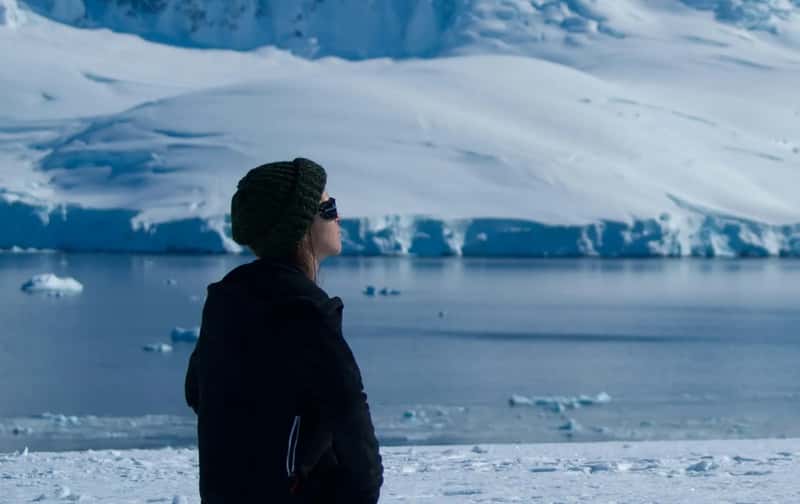
Something happens the moment cold air hits the back of your throat in a place like the Arctic.
It isn’t comfort. It’s something sharper than comfort.
Your body registers the temperature drop as a signal worth paying attention to. And that instinct is ancient. Cold exposure triggers a survival response, which forces the brain to become hypervigilant about what is happening in its immediate environment. In practical terms, this means your brain stops scrolling through its ambient anxiety – the unpaid invoice, the unsent email, the conversation you replayed seventeen times – and starts attending to right now.
This is what people are actually buying when they book a coolcation.
Not a lower mercury reading. A reset of the attentional system.
The cold, in its blunt and indifferent way, performs a kind of forced mindfulness that no app has ever replicated. It commands presence without asking permission. And for a mind that has been running in seventeen open tabs for months, that command is a relief so profound it registers as joy.
The Chemistry of Cold Clarity
There’s hard neuroscience underneath the romance of it.
When your body meets genuine cold, the brain floods itself with a cocktail of chemicals that look, from the outside, like sudden aliveness. Whole-body exposure to cold triggers a release of neurotransmitters such as serotonin, cortisol, dopamine, norepinephrine, and β-endorphin, which play a crucial role in emotion regulation, stress regulation, and reward processing.
The numbers are extraordinary when you look at them plainly.
When you immerse in cold water, your brain responds by increasing norepinephrine by up to 530% and dopamine by up to 250%. These are not marginal fluctuations. These are tidal shifts in the neurochemical weather of your mind.
Dopamine is a powerful molecule capable of elevating mood, enhancing focus, attention, and goal-directed behavior. Even short bouts of cold exposure can cause a lasting increase in dopamine and sustained elevation of mood, energy, and focus.
What the Arctic sells – what Norway’s fjords deliver – is not a postcard. It’s a biological recalibration dressed in scenery.
The Noise You Didn’t Know You Were Carrying
Modern life has a specific kind of weight that doesn’t announce itself.
It accumulates in the background. The notifications. The open-plan offices. The performance of being perpetually available and perpetually fine.
Constant noise, harsh artificial light, and crowded spaces keep the nervous system alert – a pattern opposite to healing. Most people don’t realize how deeply they’ve been living in that pattern until they step somewhere that strips it away entirely.
The Arctic strips it away with extreme efficiency.
There is no crowd noise on a glacier. There is no notification hum in a Norwegian valley at 2 AM under perpetual summer light. Silence amplifies the restorative effect. Without the constant stimulation of notifications, conversations, and urban noise, people often report deeper emotional insights, intuitive clarity, and a strengthened sense of inner calm.
The clarity you feel in the cold isn’t imagined. It’s the sound of your own mind, finally audible again.
The Identity Audit
Here is what travel really does that nobody puts in a brochure.
It removes the props.
At home, your identity is bolstered by furniture, by routines, by the carefully curated version of your life that you present to the people who know you. Strip all of that away – put yourself on a ridge in Lofoten, breath misting, boots on Arctic rock – and you get a much more unmediated experience of yourself.
We use travel to experiment with different aspects of our identity. We might try new activities, speak a different language, or find ourselves in a setting where we’re not defined by our usual roles.
The coolcation, specifically, accelerates this audit.
Because cold environments demand honesty. You cannot perform wellness in a place that will genuinely freeze you if you stop respecting it. The landscape has no interest in your personal brand. And that absence of interest – that radical indifference – is precisely what makes it therapeutic.
“Travel and vacations are a means to reshift and reorganize identities,” states Karen Stein, a sociologist studying culture and travel. In the cold, that reorganization happens faster. The environment does half the work.
The Silence Prescription
I need to tell you about a specific moment.
I was standing on the edge of a Norwegian plateau, somewhere north of Bergen, at what should have been midnight but looked like overcast dusk. Everything was grey and silver and enormously quiet. I had been anxious for months – the low-grade, persistent kind of anxious that you stop noticing because it just becomes your baseline. Standing there, the only sound was wind and my own breathing.
Within four minutes, something I can only describe as a loosening happened.
The research has a name for what I felt. Findings indicate emotional release and resting of the mind from anxiety and mental fatigue, linked to cognitive change attained through privacy and silence in the wilderness. That is the clinical language for the loosening. But the lived experience of it is more elemental than any clinical language can hold.
The silence of cold places is qualitatively different from urban quiet. Studies stress the significance of the natural environment, devoid of daily commotion, human interference, and mental and emotional demands, allowing a specific form of silence contributive to self-reflection and profound insight. This is the prescription no doctor writes but that every burned-out person instinctively seeks.
The Structural Shift
This is no longer a niche impulse.
It’s a measurable, documented, statistically significant behavioral change in how millions of people are choosing to travel. Analysis by Virtuoso reported a 44 per cent increase in travel to cooler destinations like Canada, Finland and Iceland in 2024.
Travel perks provider Dragon Pass experienced more than a 100 per cent increase in bookings for Sweden, Norway, Denmark and Finland in the last year.
These are not the numbers of a fleeting trend. As we move through early 2026, it looks much more like a structural shift in how Europeans and long-haul travellers choose their summer holidays.
People are voting with their boarding passes. And they are voting, overwhelmingly, for cold. For space. For places that offer something increasingly valuable to modern travellers: space, serenity, and sustainability.
The travel industry is catching up to what the psychology has known for years. People don’t just want a different temperature. They want a different neurological state.
The Overcrowded Mind Meets the Empty Landscape
There’s a specific kind of person drawn to coolcations.
They’re not looking for adventure in the classic sense – the adrenaline-junkie, bucket-list kind. They’re looking for subtraction. They want fewer inputs, not more. They want a landscape that is so visually honest – just rock, water, ice, sky – that the brain finally stops manufacturing its own noise to fill the gaps.
The solo experience in wilderness may serve as an antidote to the loneliness, stress, and depression on the rise in the current era, which have been linked to our overly stimulated urban environments and lifestyles.
The Arctic is the ultimate landscape of subtraction.
It gives you almost nothing in the way of stimulation. No restaurant row. No rooftop bar. No Instagram installation. Just the raw material of the world, pre-human, indifferent, and strangely generous in its emptiness.
Being in natural environments engages the senses in ways that reduce rumination and promote mindfulness. Green spaces, vistas of water or mountain ranges, and trails through forests encourage a kind of presence that can slow mental chatter and open emotional channels for processing and integration. In the Arctic, this effect is amplified by an order of magnitude.
The Stress System That Won’t Switch Off
Here is the brutal irony of modern professional life.
The same focused intensity that makes people successful also makes them terrible at stopping. The stress system stays in drive even when the car is parked. Scientific studies indicate that weather conditions such as high temperature and humidity can impair mental performance by affecting brain neurochemistry.
Hot, crowded, overstimulated environments – precisely the conditions of a peak-season Mediterranean holiday – do not interrupt this pattern. They replicate it.
Cold does something different. By forcing yourself to embrace the stress of cold exposure as a meaningful self-directed challenge, you exert ‘top-down control’ over deeper brain centers that regulate reflexive states. This top-down control process involves your prefrontal cortex – an area of your brain involved in planning and suppressing impulsivity. That ‘top-down’ control is the basis of what people refer to when they talk about “resilience and grit,” and it carries over to situations outside the deliberate cold environment.
In other words: the cold teaches your nervous system to regulate itself. You go to Norway overstimulated and return calibrated.
That is a different kind of holiday return. A different kind of self coming home.
The Values Underneath the Booking
People like to say they’re booking coolcations because of the heat.
That’s true. But only partially.
When travel researchers began studying the trend, they discovered that many visitors were looking for more than just more temperate weather.
Unlike traditional vacations that often focus on tropical beaches and bustling cities, a coolcation caters to travelers seeking tranquility, connection with nature, and meaningful experiences.
What people are searching for, encoded in the search bar at midnight, is alignment. The feeling that who they are on the inside and what surrounds them on the outside are finally, briefly, in sync. That coherence – identity and environment resonating with each other – is extraordinarily rare in modern life. We’ve engineered most of it out of our daily existence.
This process of self-discovery is one of the reasons we feel so drawn to the idea of travel. It’s a way of reconnecting with ourselves, of finding out who we really are outside the confines of our routine life.
The cold landscape doesn’t lie. And some part of us knows that. Some part of us is tired of comfortable lies.
The Heaviest Truth About the Cold
Here is what nobody really talks about when they talk about coolcations.
The cold doesn’t make you feel better because it’s pleasant. It makes you feel better because it’s honest.
It demands the truth of your body – your actual heartbeat, your actual breath, your actual capacity to sit with discomfort without reaching for your phone. Participants felt more active, alert, attentive, proud, and inspired and less distressed and nervous after having a cold-water bath. Those words – active, alert, attentive, proud – are not the words of someone who has been soothed. They are the words of someone who has been awakened.
Consistent, challenging activities that elevate norepinephrine and dopamine levels – such as cold exposure – may theoretically recalibrate the signal-to-noise ratio within fear and anxiety-related neural circuits, thereby reducing anxiety through bottom-up mechanisms.
The Arctic doesn’t care if you’re burned out. It doesn’t care if you have a mortgage or a difficult manager or a creative block that has lasted three years. It applies the same indifferent cold to everyone. And in that democratic severity, something quietly extraordinary happens: you stop pretending. You stop curating. You just exist – cold, present, and temporarily relieved of the exhausting work of being a self in public.
The clarity that people chase in cold places is not a side effect of the temperature. It is the entire point. The cold strips the signal clean. It removes what is ambient and leaves only what is essential: your breath, the sky, the sound of your own footsteps on frozen ground.
We live in an era of unprecedented psychological noise. The overstimulation is not metaphorical – it is neurochemical, measurable, and cumulative. And somewhere in us, something very old and very quiet knows that the antidote is not more warmth. It is not another curated rooftop bar with a playlist designed to make you feel something. The antidote is an environment that is more demanding and more honest than you are. One that asks nothing of your identity and everything of your presence.
The real question isn’t why you keep looking at flights to Tromsø. The real question is what you already know about yourself that only the cold will confirm.