Every autumn, university towns from Manchester to Melbourne fill up with students who packed a suitcase, said goodbye to family, and boarded a plane toward a degree that couldn’t be earned at home. It’s easy to think of international education as a one way flow toward wealthy Western campuses, but the real story is about where these students come from. A handful of nations, some obvious and some less so, account for a strikingly large share of the world’s outbound student population, and the balance between them has shifted noticeably over the past two years.
1. India

India has quietly become the single largest source of international students on the planet, a shift that surprised even some education researchers who had assumed China’s dominance would hold indefinitely. In 2024, India became the top sender of international students, a trend that was anticipated given the unprecedented rise of Indian students pursuing graduate studies alongside pandemic-related disruptions in China. The scale is enormous: more than 1.2 million Indian students were enrolled in higher education abroad in 2025, according to India’s Ministry of External Affairs, a decline from 2024, when the figure was 1.33 million.
Canada, the US, and the UK remain the primary magnets for Indian students, though the numbers moved differently across each destination. The increase in Indian students seeking higher education abroad has been driven largely by mobility to Canada, the United States, and the United Kingdom, with Canada hosting 384,965 students in 2024, a 33 percent increase from the prior year. Meanwhile, India remained the leading place of origin in the United States with 363,019 international students in 2024/25, reflecting a 10% increase from the prior year. Germany has also become a notable secondary hub, with engineering programs pulling in a large share of that flow.
2. China

For roughly two decades, China was the undisputed leader in outbound student numbers, and even with recent moderation it remains a dominant force. According to UNESCO’s most recent tally, China accounted for 37 percent of global outbound student mobility in 2023, with India following at 29 percent. The raw figures back this up too: the number of Chinese students going abroad reached roughly the same level as in 2019, after falling to only 451,000 in 2020 due to the pandemic and taking four years to recover.
What makes China’s position interesting right now is the plateau, not the peak. China’s tertiary system has been developing its own capacity for domestic and international students, alongside an overall shrinking demographic trend of tertiary-aged students, meaning undergraduate numbers going abroad may not reach past heights, though it remains to be seen whether graduate numbers will keep climbing. In the American context specifically, China was the second leading place of origin with 265,919 students, reflecting a 4% decline from the year before, a pattern echoed in several other destination countries.
3. Nigeria
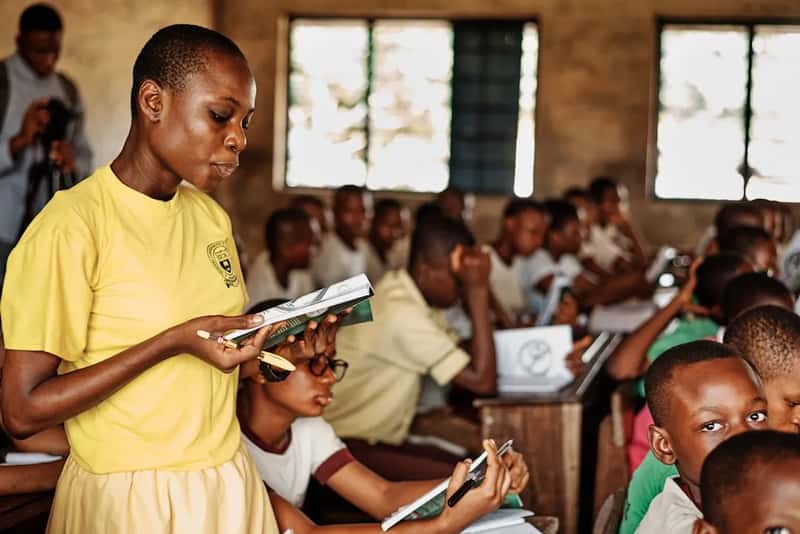
Nigeria’s rise as a major sending nation has been one of the more dramatic shifts in global student mobility over the last five years. UNESCO data places Nigeria at 5 percent of global outbound student mobility in 2023, putting it in a tie with Germany for third place worldwide. The growth trajectory has been steep and fairly recent, tied closely to broader economic and migration pressures at home.
The UK and US numbers illustrate just how fast this happened. Nigerian student enrolment in the United Kingdom rose by 64 percent between the 2019/20 and 2020/21 academic sessions, and the surge became even more pronounced in 2022, when UK student visa approvals for Nigerians increased by 686 percent compared with 2019 levels. American campuses have felt the same pull, with American institutions reporting nearly 22,000 Nigerian students during the 2024/25 academic year, a 22.2 percent increase from the previous year. Policy changes in destination countries, particularly around dependent visas in the UK, have introduced some volatility, but the underlying demand from Nigerian families remains strong.
4. Germany

Germany occupies an unusual dual role in this story. It’s one of the world’s top destinations for incoming international students, yet it also sends a significant number of its own students abroad each year, enough to place it among the top sending nations globally. UNESCO’s 2023 figures show Germany tied with Nigeria at 5 percent of global outbound student mobility, a notable share for a country its size.
German students tend to favor nearby European destinations for exchange programs and full degrees, drawn by geographic proximity, shared academic frameworks, and in many cases tuition free arrangements at home that make studying elsewhere feel like a natural extension rather than a financial leap. This pattern differs sharply from countries like India or Nigeria, where outbound study is often driven by limited domestic capacity or career advantages tied to migration. Germany’s case is a reminder that a country can be both a major host and a major source of mobile students, something that doesn’t fit neatly into the usual sending versus receiving framework used in most reporting.
5. Vietnam

Vietnam has firmly established itself as the largest source of international students in all of Southeast Asia, and the momentum shows no sign of slowing. Outbound mobility has grown steadily over the past decade, with Vietnam now the largest source of international students in the region, sending more than 137,000 students overseas across all destinations. Other estimates place the figure even higher when counting all levels of study.
South Korea has emerged as an especially popular destination for Vietnamese students in recent years, overtaking even China in some enrollment counts. The bulk of South Korea’s foreign enrolment is drawn from two key student markets, China and Vietnam, with Vietnam the leading sender in 2025 at 107,807 students, ahead of China’s 86,179. Japan, Australia, the United States, and Taiwan round out Vietnam’s other major destinations, giving the country a notably diversified outbound profile compared to some of its regional neighbors.
6. Uzbekistan

Uzbekistan is the least familiar name on this list to most Western readers, yet it has quietly become one of the largest sources of internationally mobile students in the world. Recent migration data places Uzbekistan at 150,000 outbound students, putting it ahead of Vietnam, Germany, the United States, France, Nigeria, Syria, and Nepal in absolute numbers. That’s a remarkable figure for a country with a population far smaller than India or China.
Much of this flow heads toward neighboring countries and regional hubs rather than the traditional Anglophone destinations that dominate headlines elsewhere. South Korea has become a particularly active recruiter of Uzbek students, and the trend fits a broader pattern across Central Asia where demographic growth and limited domestic university capacity are pushing more young people to look abroad. UNESCO’s global figures confirm the scale of this shift, placing Uzbekistan among the ten largest sending countries worldwide alongside far more populous nations.
Taken together, these six countries illustrate how uneven and fast moving global student mobility has become. A decade ago, this list would have looked almost entirely different, dominated more heavily by China with little room for Nigeria, Vietnam, or Uzbekistan near the top. The number of internationally mobile students has nearly tripled over the past two decades, rising from 2.5 million in 2002 to 7.3 million in 2023, with projections suggesting the figure will reach nine million by 2030. Whatever shape that growth takes next, it’s clear the balance of who sends students abroad is no longer settled, and the next surprise entrant on this list may already be building momentum somewhere off the usual radar.