I moved on for the final stretch of my two-week journey through the Azores, first to São Jorge and then to Terceira. As anticipated, it felt like stepping into an entirely different world. After the raw energy and strongly nature-driven contrasts of São Miguel, Faial, and Pico, the last two islands I visited settled into a strangely more urban rhythm for me—one that turned out to be ideal for easing back into everyday life.
Reached, once again, by ferry, they reinforced one of the clearest lessons of this journey—moving through the Azores is not about ticking destinations off a list, but about allowing contrasts to accumulate, island after island, until the archipelago starts to read as a single, complex story. Moreover, what I most loved about traveling by ferry between islands is the sense of natural pause that the transfer created. Watching one shoreline fade and another slowly take shape prepares you for a shift in rhythm, landscape, and expectations. It’s a form of travel that emphasizes continuity rather than separation, and it suits the Azores perfectly.
São Jorge: Steep Land, Low Clouds
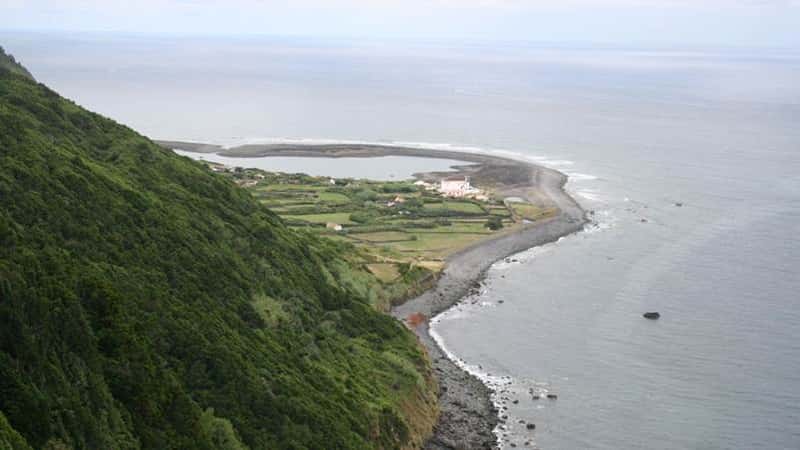
São Jorge came first. Long and narrow, with steep slopes dropping sharply toward the ocean, the island looks austere even from the water. We didn’t have much time here, and the weather didn’t help. Clouds hung low, the light was muted, and the wind made itself constantly felt. We decided to make most of our time on the island with a trek in the eastern part of the island—nothing particularly technical or long—but engaging nonetheless, enough to understand how movement works here. Paths rarely stay flat. Even short walks involve steady climbs, and the sensation of going uphill is almost constant.
What defines São Jorge more than anything else – and we could appreciate very well from above – are its fajãs. These are flat coastal platforms formed by ancient landslides or lava flows that slid down from the cliffs and settled at sea level. Over time, they became habitable pockets of land, often accessible only on foot or by steep roads, and today they host small communities, fields, churches, and harbors. We could spot both Fajã de São João and Fajã da Caldeira, both amazing, where the land drops away to reveal the wide areas of land stretching toward the Atlantic. São Jorge may be physically demanding, but it has a way of lifting the spirit, showing how life here adapts—creatively and resiliently—to a steep and uncompromising landscape.
Arrival in Terceira: Color and Order
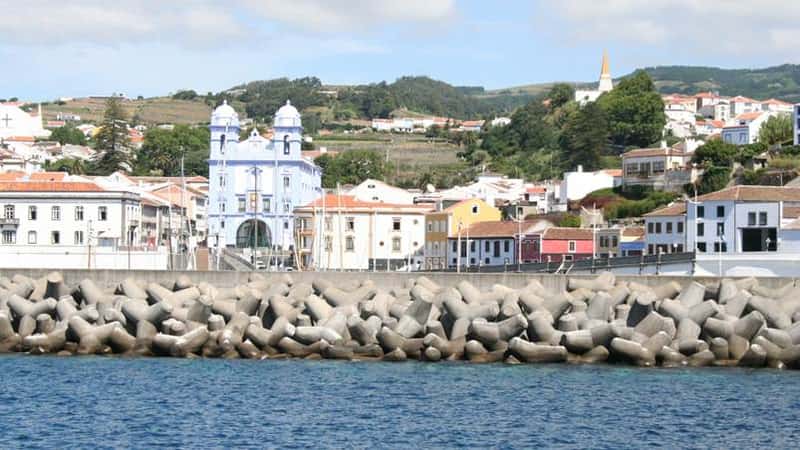
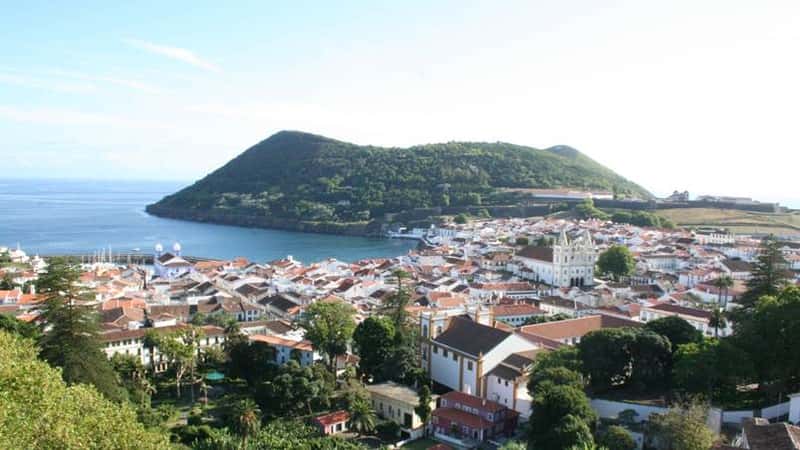
Yet another ferry crossing to Terceira marked a clear shift. Approaching Angra do Heroismo by sea, color and structure reappear almost immediately. The port area announces Terceira’s character clearly: pastel houses, churches with white façades edged in dark volcanic stone, and a sense of order that contrasts sharply with São Jorge’s ruggedness.
Terceira has a long and complex history, and it shows. The island was settled early in the Azores timeline, starting in the mid-15th century, and Angra do Heroísmo soon became a strategic Atlantic port. By the 16th century, it was one of the most important stopovers for ships traveling between Europe, Africa, and the Americas, a role that shaped the city’s urban layout and wealth. Much of the structure visible today—broad streets, fortified harbor, monumental churches—dates from the 16th to 18th centuries, when Angra consolidated its role as a political and religious center. This layered history is one of the reasons why the historic center of Angra do Heroísmo is now a UNESCO World Heritage Site.
Angra do Heroismo
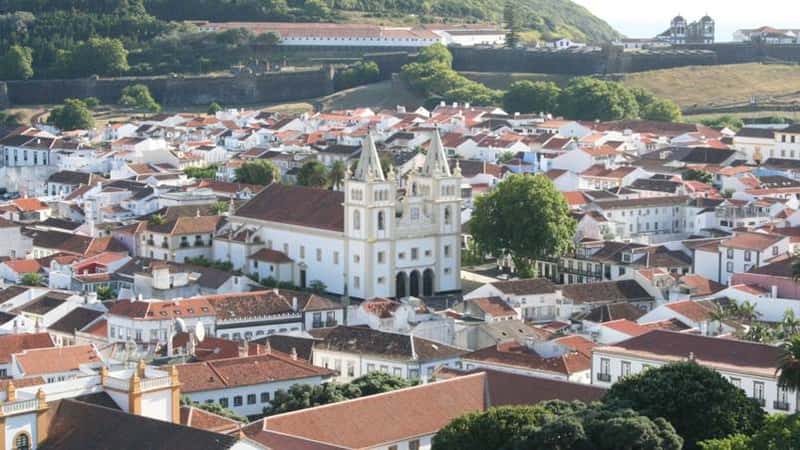
The city has a lot to offer: the Igreja da Misericórdia, the Sé Cathedral, one of the largest churches in the Azores, dominate the historic center, the Jardim Duque da Terceira as well as the Forte de São Sebastião which recall Terceira’s military importance during the age of global maritime empires.
Terceira feels like a synthesis island. It doesn’t overpower with a single defining feature; instead, it convinces through balance and gives more importance to the cities (besides Angra do herismo Praia da Vitoria is the other important centre). As a final stop in the Azores itinerary, it works almost as a conclusion—an island where the dialogue between people and landscape feels settled, legible, and deeply rooted in time.
Natural Pools and the Ocean’s Edge
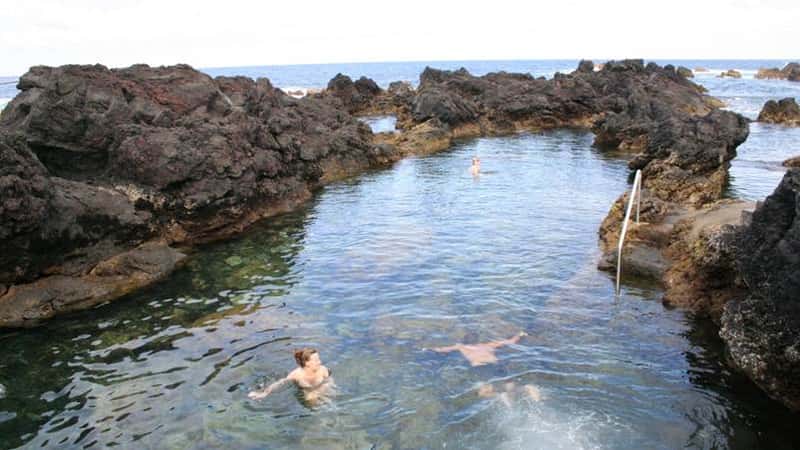
Beyond the town, Terceira opens into a varied landscape of pasture, volcanic features, and coastline. One of the most memorable experiences here was visiting the natural swimming pools formed by volcanic rock, like the ones called Piscinas naturais da Salga that I visited, on the western part of the island.
Filled directly by the Atlantic, they feel like a negotiation between human comfort and raw nature. Swimming here is immersive rather than protected. The water comes in powerful waves, is clear, the edges are irregular, and the sound of the ocean is constant. It’s a reminder that even where access is facilitated, the sea remains in control.
Getting There and Around
Terceira is easily reached by ferry from the neighboring islands or by air via Lajes Airport, but for this final leg of my Azores itinerary, I arrived by sea, continuing the slow, coherent rhythm set by the previous crossings. Once on the island, I chose not to rent a car. Instead, I focused my time on Angra do Heroísmo and its immediate surroundings, which proved to be more than enough for a rewarding stay.
Angra is compact, walkable, andwell-organizedd. Most of the city’s key sights—churches, gardens, viewpoints, museums, and the waterfront—are within easy walking distance, and the urban fabric invites exploration on foot. Short taxi rides make it simple to reach places just outside the historic center, such as Monte Brasil or nearby natural pools, without committing to full-day driving. This slower approach suited Terceira particularly well, allowing me to read the city carefully and appreciate how history, architecture, and daily life intersect. While a car is useful for exploring the island’s interior or more remote coastal areas, staying close to Angra made it clear that Terceira can also be experienced comfortably, and meaningfully, without one.
Closing the Circle
Ending the Azores itinerary with São Jorge and Terceira felt unexpectedly right. Together, they closed the journey not with a climax, but with balance. After geothermal intensity, epic ascents, and wide-open calderas, these final islands grounded the experience. They confirmed that the Azores are not a single narrative, but a collection of voices—some quiet, some dramatic, some deeply historical—all speaking through land shaped by fire and water. Leaving the archipelago, what remained strongest was not a single highlight, but the cumulative effect of moving slowly across islands that refuse simplification. And, perhaps just as strongly, the quiet pull of the four islands I have yet to see—already reason enough to imagine coming back.