

What is it really like to volunteer with big cats in South Africa, and is it truly ethical? Back in 2014, I travelled from Ireland with a friend to spend three months working hands-on with lions, a tiger, and caracals at a privately run wildlife centre.
In this article, I share our day-to-day routine caring for the animals, what life was like on the farm, how we ended up there in the first place, and what volunteers actually did each day. I also reflect honestly on the ethical debate surrounding captive big-cat volunteering, leaving you to decide where you stand.
While most people tend to go to South Africa to volunteer with people in need, myself and my friend (who had nver flew the nest without our parents before) decided we wanted to do something a bit more unique, to say the least.
We will get to the ethical questions soon, but this article will be mostly about our day-to-day experience with the dieng hands-on approach to raising big cats in South Africa.
How we got into volunteering with big cats

Honestly, I have no real idea. Back in 2014, I was aimless in my life and was far too afraid to leave my county without my parents, let alone go to another country.
However, having built my confidence a little over the previous years, when my friend asked me if I’d be interested in joining him in flying to South Africa to volunteer with Lions, I thought it would be a great step in getting out of Ireland and doing something new and exciting, particularly with animals, which I’ve always loved.
From then on, he sorted everything, and after everything thing was locked in, we just needed to get all our vaccine shots and we were ready to go.
Arriving in South Africa

It’s safe to say that, as novice adventurers, my friend and I were completely oblivious to just about the dangers of travel and how to get around safely.
Thankfully, the company we signed up with (which I won’t name, as I’m still on good terms with the owner) was handling everything for us.
Our private car met us at the airport and took us straight to the location where we would spend the next 3 months of our lives.
After meeting the owner and other volunteers, we entered a privately owned farm of hundreds of acres, filled with local wildlife, and eventually arrived at a separate, enclosed plot of land within the farm.
From there, we were given our room and introduced to the animals that would be in our care.
The Animals
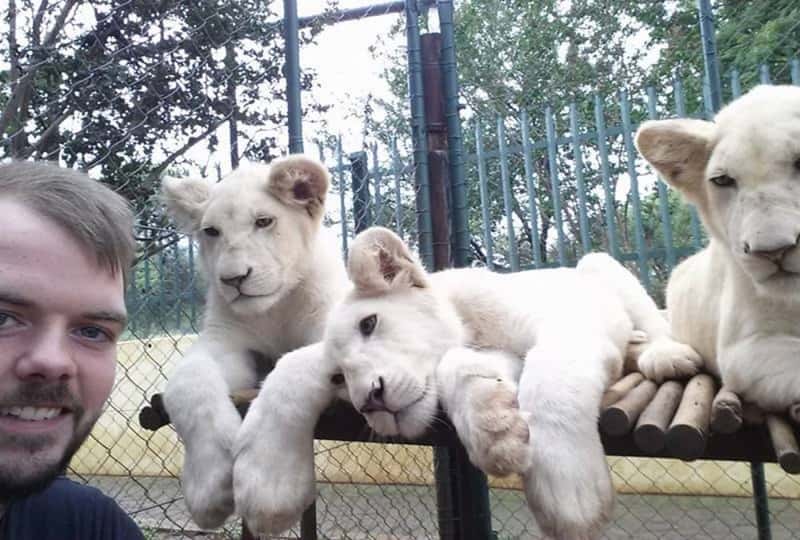
During our time at the Wildlife centre, there were 10 young Lions of differing ages, 1 Tiger, and 2 Caracals. These animals were separated into their own cages based on their ages.
The two oldest Lions (7 months +) to one large cage, Three 5 month lions and one 4 month Tiger to a cage neighbouring them, Three 3 month old cubs to a medium-sized cage, and lastly 2 cubs to a small nursery.
The two Caraclas were the owner’s personal pets and lived inside when the bigger cats were allowed out of their cages to roam free.
What Did We Do Each Day?

Every day revolved around letting the lions out of their cages regularly to play and stretch their legs, and returning them for their feeding times.
Particularly, the cubs got the most attention, as they needed to be fed every 2 hours with special formula that needed to be prepared by designated volunteers on rotation each day.
But taking care of the cats wasn’t the only thing we did. Milking cows, fertilising areas of the larger farm, cleaning the cages, painting, trimming the bush trials, preparing the carcasses for the larger cats, and feeding the wilder animals on the farm were all a part of the job. The work was never difficult, and felt more like a holiday…… which some people may have taken advantage of…..
While the animals were always taken care of, the work was always done, when the sun set, things did tend to get a little rowdy. While we were there, the majority of the volunteers were a mix of Scandinavians who were always rather quiet, but when you added some alcohol into the mix, they quickly started to lighten up.
I don’t drink, and never have, but my friend certainly carries his traditional Irish blood in his veins. After a few drinks, he quickly broke the ice and, cultural differences aside, he quickly helped bring everyone together and lighten up.
However, all being young and boisterous, things would get out of hand quite often. I can’t mention a lot of the things that happened here, but it was usually teenage melodrama, and thankfully, the animals were always spared from the chaos of the night’s activities.
Days Off

There were days off, which rotated between the volunteers, and usually involved going out to do activities off the farm. This involved everything from going into the city to skydiving, concerts, and on-the-field veterinary work on other local farms.
Was It Ethical

This question I can’t really answer as it’s subjective. All the animals we volunteered with were always well cared for. They were fed well, had regular veterinary check-ups, space to move, toys to play with, and were loved by the staff who worked there.
But what happened once they left the compound, I don’t have that answer. I asked, and was told that they would go to private owners as they could never go back to the wild.
The question you need to ask is, what is the right way to keep an endangered species alive? Pick your poison, either
- You let all endangered animals in captivity out into the wild and hope they have the basic instincts to survive without human assistance.
- Neuter every captive animal and have no fallback plan if the species declines in the wild
- Keep breeding animals in captivity, whether in private collections, zoos, wildlife sanctuaries, etc., until the day the species is no longer endangered.
It’s an unfortunate reality that every place that has big cats in captivity doesn’t have the best resources, but if we limit who can have big cats and who can’t based solely on the strictest regulations, we will decrease the gene pool, leading to more and more inbreeding.
I’m no advocate for keeping big cats as pets, but we do need places that keep the species alive outside the wild until the day animals thrive again.
So was my voluntary work ethical? Maybe not; perhaps it should have been more hands-off, but the animals were always treated well, and we did get updates years later on how some of the cats were doing in their new homes and thriving, so you’ll have to decide for yourselves.
Respect in the Moment
Looking back, volunteering with big cats in South Africa was one of the most formative experiences of my early adult life. It pushed me far beyond my comfort zone, taught me responsibility, and gave me daily, up-close exposure to animals I had only ever seen in documentaries.
While I can’t give a definitive answer on whether the experience was entirely ethical, I do know that the animals we cared for were treated with respect, attention, and genuine affection while they were with us.
The bigger questions around captivity, conservation, and long-term outcomes aren’t simple, and they rarely have perfect solutions. All I can offer is my experience, and ultimately, it’s up to each reader to decide where they stand.