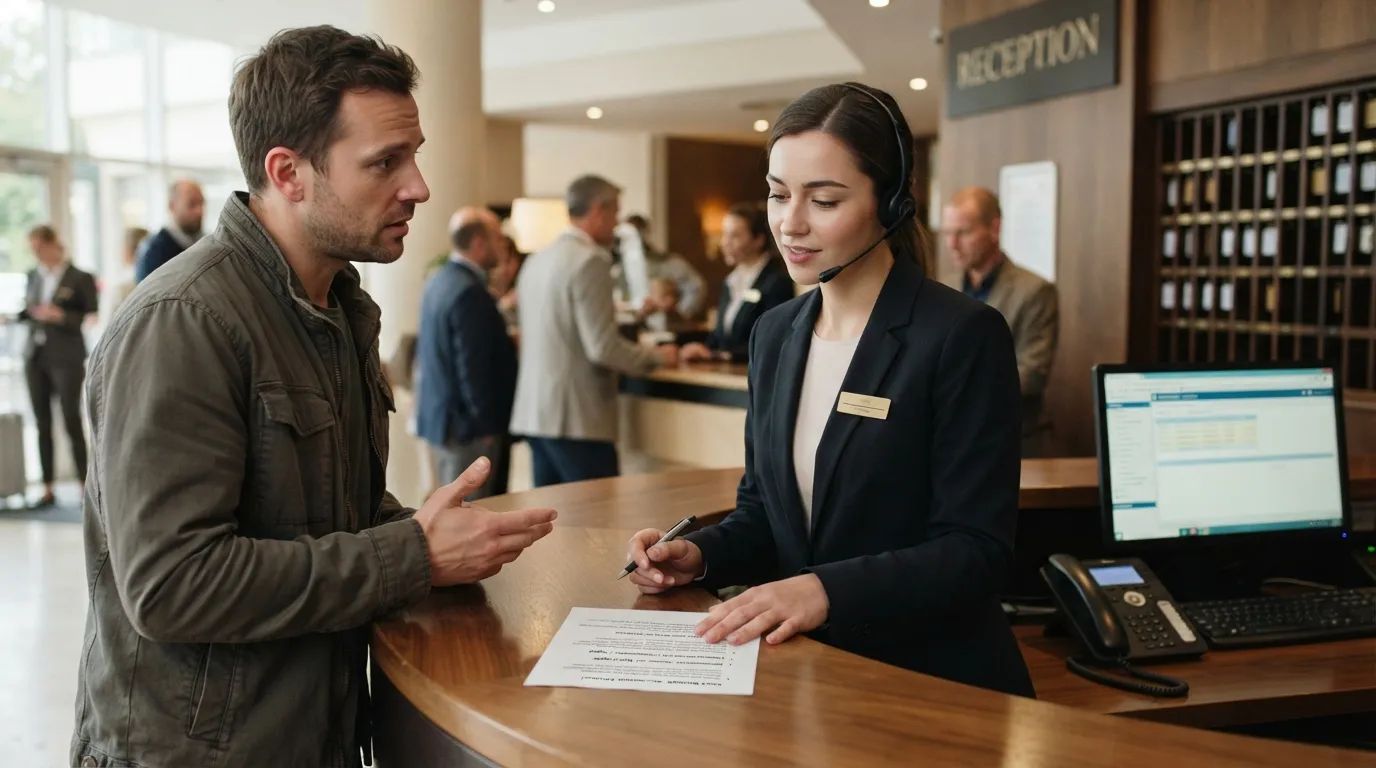
You call it a reservation. The hotel calls it a probability bet.
Behind every confirmed booking sits a quiet system of math, priority lists, and rehearsed scripts that decide who gets a room tonight – and who gets sent somewhere else.
The agent smiling at you when you check in already knows things you don’t. Here’s what’s actually happening on the other side of that counter when a booking turns into a problem.
#10 – The Booking Was Never the Guarantee You Thought

You got a confirmation email. You saved it. You felt safe.
That email is an agreement – but it’s one the hotel can legally break under certain conditions.
Overbooking happens when a hotel deliberately sells more rooms than it physically has, betting on cancellations and no-shows to even things out. Hotels typically see a no-show rate between 5 and 15 percent, so many overbook by roughly that same margin just to protect their occupancy numbers.
That math gets locked in weeks before you ever check in. Your odds of being displaced were set the moment you hit “confirm” – not the moment you walked in exhausted at 11 p.m.
Fast Facts
- Business hotels run about 10-15% overbooking during weekdays, while leisure properties stay closer to 5-10% during peak seasons.
- Airport hotels overbook the hardest, often 15-20%, because flight disruptions drive higher cancellation risk.
- City hotels record cancellation rates close to 40%, compared with 28% for resorts.
But that’s nothing compared to what we found about #9 – who actually pulls the trigger on that decision.
#9 – The Person Who Decides Isn’t Standing at the Desk

Most guests blame the person at reception. That’s the wrong target.
The call to overbook usually comes from a reservation manager or revenue manager, working off spreadsheets days in advance. The receptionist is just the one stuck delivering the news in person.
Staff sometimes describe it as playing a round of “overbooking roulette” – betting a guest won’t show, and hoping they’re right. It’s rarely fun, and it can get tense fast depending on how the guest reacts.
The agent in front of you is executing someone else’s revenue strategy. Most of the time, they didn’t get a vote.
But that’s nothing compared to what we found about #8 – the first move the front desk makes when a booking looks broken.
#8 – Step One: Check Whether the Problem Even Exists

Before anyone gets moved, the front desk does something most guests never see.
The first move isn’t relocating a guest – it’s double-checking the arrival list for mistakes. A guest can get flagged for relocation over nothing more than a duplicated reservation or a spelling error.
Sometimes a “full” hotel is full because of clerical slip-ups, late checkouts, or rooms pulled for repairs. None of it has anything to do with you.
A full hotel isn’t always actually full. Half the time, the front desk is solving a data problem before it ever becomes your problem.
But that’s nothing compared to what we found about #7 – how the hotel decides whose night gets ruined.
#7 – There’s a Secret Priority List, and Your Name May Not Be Near the Top
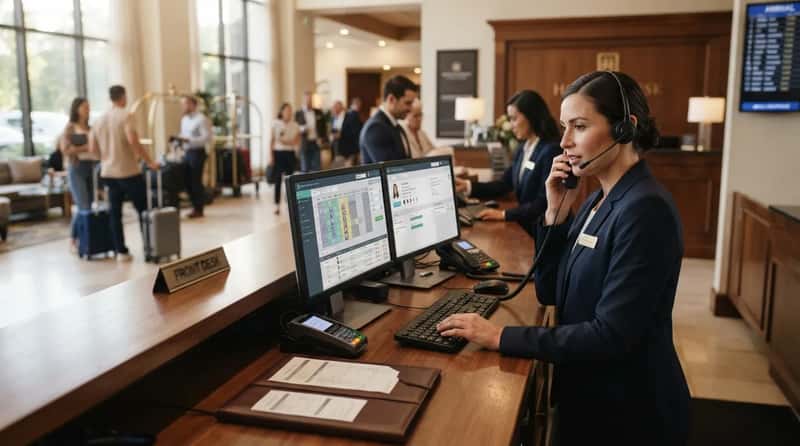
When someone has to be moved, the front desk doesn’t pick randomly. There’s a hierarchy, and it’s built to protect the hotel’s best customers first.
Longer stays get priority, so guests aren’t relocated more than once. Loyalty members and elite repeat guests sit at the top of the protected list.
Direct bookings usually outrank third-party reservations, and full-rate guests usually outrank discount bookers. If someone has to get “walked,” the person who booked through a discount site is almost always first in line.
Booked through Expedia at a bargain rate? You’re closer to the front of the displacement queue than you’d like to think.
But that’s nothing compared to what we found about #6 – what “being walked” actually involves once it happens.
#6 – “Walking” a Guest Is an Entire Operation, Not Just a Redirect

The term sounds casual. The process is anything but.
Getting “walked” means the hotel arranges a comparable room at a nearby property, usually at no extra cost. Behind the scenes, the front desk is juggling transportation, phone calls, and an upset guest – often during the busiest check-in rush of the day.
Industry standard typically covers one night’s room and tax, transportation to and from the backup hotel, one phone call, and internet access. You’re then expected to return to the original hotel for the rest of your stay.
Quick Compare
- IHG’s standard includes the first night at a comparable hotel paid in full including tax, free transportation, and a refund of any advance deposit.
- Marriott’s walked guests get the first night at a comparable property, plus $200 cash and 90,000 points at luxury brands or $100 cash at mid-tier brands.
- Hyatt provides a free night at a comparable hotel and free transportation to and from it, but only if the stay was prepaid directly on hyatt.com.
The displaced guest is supposed to come back. That single detail is why hotels work so hard to keep you from going nuclear on TripAdvisor.
But that’s nothing compared to what we found about #5 – why a single phone call can decide the entire outcome.
#5 – Hotels That Call You First Win. Hotels That Don’t, Lose.

The difference between a furious guest and a manageable situation often comes down to timing.
Guests relocated before they even arrive tend to be far less angry than guests who find out at the front desk, bags in hand. A heads-up changes everything.
Some hotels call the receiving property ahead of time so staff there can greet the guest by name and make them feel expected, not dumped. It’s a small move with a big payoff.
A guest greeted by name at the backup hotel is far less likely to leave a one-star review. The phone call is damage control disguised as hospitality.
But that’s nothing compared to what we found about #4 – the conversation the agent is trained to have with you.
#4 – The Agent Is Reading From a Script You’ve Never Seen
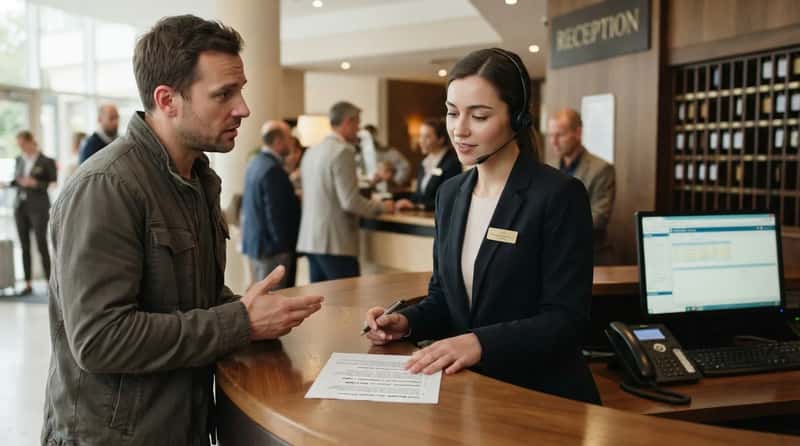
That calm, empathetic tone at the front desk? It was rehearsed long before you showed up.
Front desk teams are trained on exactly how to explain an overbooking and what compensation to offer, whether that’s a free night or a room upgrade. The opening line matters – it sets the tone for whether the guest calms down or escalates.
The agent isn’t just being nice. They’re running a de-escalation protocol designed to protect the hotel’s reputation, not just soothe your mood.
What feels like a personal apology is usually a standardized recovery sequence. That doesn’t make it insincere – it just means it’s deliberate.
But that’s nothing compared to what we found about #3 – the compensation most guests never think to ask for.
#3 – Compensation Exists. Most Guests Don’t Know to Ask for It.
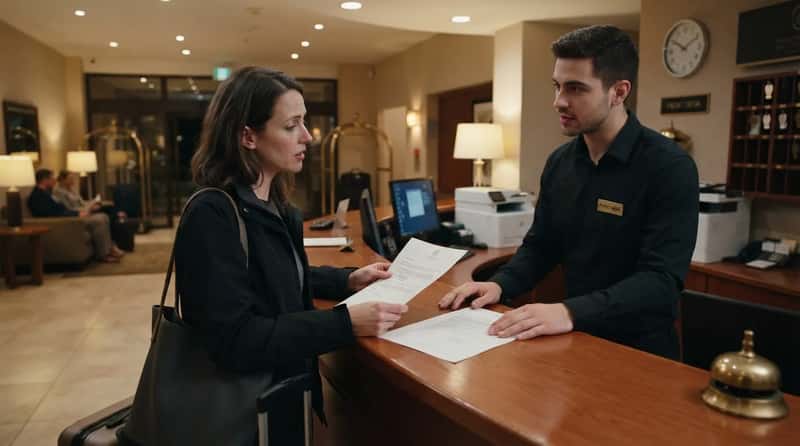
Hotels rarely volunteer the full picture of what you’re actually owed.
Beyond a comparable room elsewhere, hotels can offer meal vouchers or amenity credits at the original property. If the backup hotel is a downgrade, or you’re being relocated late at night, the compensation is supposed to increase accordingly.
Ask for any offer in writing – hotel letterhead or a signed note, including the name of the property you’re being sent to and confirmation of who’s covering the cost. It changes the entire negotiation.
Worth Knowing
- Hotels are under no legal obligation to rebook you if they’re overbooked – the only thing they’re required to do is refund prepaid fees.
- A handful of states, notably Florida and New Jersey, do require hotels to provide alternative accommodations or pay a fine.
- Outside of those states, what you actually receive is governed almost entirely by brand policy, not statute.
Most guests accept the first offer verbally and walk away leaving money on the table. Getting it in writing shifts the power back to you.
But that’s nothing compared to what we found about #2 – the follow-up call that decides whether you ever come back.
#2 – The 24-Hour Follow-Up Call Is Where Loyalty Is Won or Lost

Most guests think the story ends the moment they reach the backup hotel. It doesn’t.
A well-run hotel calls the walked guest within 24 hours to confirm everything worked out, then offers a future-stay credit or a free night. That single call is often what separates a repeat guest from a scathing review.
Displaced guests who feel forgotten don’t just complain quietly – they post reviews, warn friends, and never book again. In a hyper-connected world, that’s real damage to a brand.
The follow-up call is the hotel’s last line of defense. It’s also your best window to negotiate a real recovery if the first offer fell short.
But that’s nothing compared to what we found about #1 – the factor that was quietly running your entire stay before you even arrived.
#1 – Your Loyalty Status Was Running the Show Before You Walked In

This is the uncomfortable truth that changes how you should book every hotel from now on.
A property management system stores your contact info, past stays, room preferences, and loyalty tier. The moment a repeat guest books, that profile flags their preferences automatically for the front desk to act on.
Front desk agents have real discretion over room assignments, and your attitude during check-in shapes how they use it. Staff consistently say kind guests are the ones who get spontaneous upgrades, waived fees, and quiet perks.
Once the hotel confirms someone must be walked, it starts eliminating who can’t be touched – VIPs, families, multi-night stays. Corporate hotels are far more likely to protect a guest they perceive as loyal.
Your loyalty number quietly decides how much you matter on a sold-out night. Most guests never realize it’s happening at all.
The Front Desk Was Never Just a Counter

It’s the last visible layer of a system built to protect revenue first and your mood second. Overbooking math, tiered priority lists, rehearsed scripts, and a 24-hour follow-up call all exist for the same reason – to keep a bad night from becoming a permanent grudge.
The guests least likely to ever get walked are loyalty members who book direct and stay calm under pressure. The guests most likely to be left standing at the desk are third-party bargain bookers who never joined the program.
Next time you get that confirmation email, remember – it was never really a guarantee. It was a seat in line, and the line has a hierarchy you just learned about.