You walk up to the counter thinking the hardest part of this whole errand was finding your confirmation number in your email. In reality, by the time you’ve said your last name out loud, the agent has already quietly filed you into one of two categories – easy return or potential headache – and you had no idea the sorting even happened.
None of it shows up on the contract, and almost none of it gets said out loud. It’s buried in the license scan, the card you hand over, the birth year on your ID, and the way you answer three fast questions. Here’s what actually gets worked out before a single line gets signed.
The License Scan Checks More Than Just a Photo Match
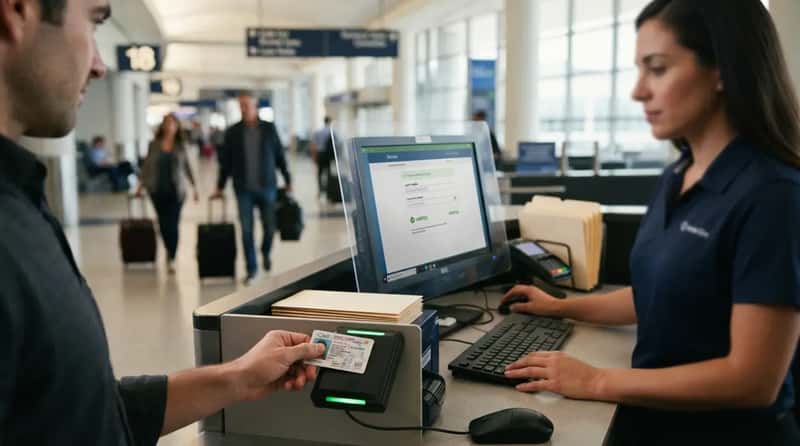
When an agent slides your license through the reader, they’re not simply confirming your face matches the photo. That scan pulls your license number and calls up your record straight from the state’s Department of Motor Vehicles system, checking whether it’s valid, expired, or quietly suspended. If it comes back flagged, the system can stop the entire transaction before the agent even has to explain why.
Here’s the twist most renters never hear about: some companies let their own affiliate brands skip this step entirely. Rent from an Avis-owned brand like Fox, for example, and it may treat the DMV check as already done, with no second look required. It’s a loophole that surprises almost everyone the first time they learn it exists.
The Payment Card You Hand Over Tells Its Own Financial Story

A credit card and a debit card look nearly identical in your wallet, but to a rental agent they represent two completely different risk profiles. A credit card renter is treated like a vetted identity – someone a bank already trusted with real, unsecured credit. A debit card carries none of that built-in vouching, and the agent knows it instantly.
That single swipe can quietly change the rest of your visit. Paying with debit can trigger an on-the-spot credit check, a bigger deposit, or a request for extra documentation you weren’t expecting to produce. Most renters have no clue that swapping a debit card for a credit card at the counter can be the entire difference between a five-minute pickup and a twenty-minute manager conversation.
Your Age Silently Rewrites the Price Before You Even Speak

The agent glances at your birth date, and if you’re under 25, the math starts before you’ve said a word. A young driver surcharge gets tacked on automatically, framed as covering the statistically higher insurance risk of younger renters – not as any judgment on how you personally drive.
The number attached is bigger than most people expect. These “under 25” fees can range from around $20 to $84 per rental day depending on the location and company, and in some cases they nearly double the total cost of the rental. Younger travelers rarely find this out at booking – they discover it staring back at them on the final receipt.
Fast Facts
- Surcharges typically apply to any renter younger than 25.
- Daily fees can run roughly $20 to $84, depending on the company and location.
- In some cases, the added charge nearly doubles the total rental cost.
- Companies frame the fee as an insurance-risk cost, not a driving-skill judgment.
A Driving Record Check May Already Be Running in the Background

Long before you reach the counter, some companies have already quietly pulled your history. Many rental agencies routinely screen drivers in vacation-heavy destinations, running the license number through a system tied directly to state DMV records. It isn’t rare paranoia – at busy tourist hubs, it’s standard practice.
The disqualifying list is more specific than most people assume. A driver can be denied a vehicle for things like a suspended license, a single DUI or hit-and-run, three moving violations, or being at fault in two accidents, all within the past three years. Major brands like Avis, Budget, and Payless specifically won’t rent to anyone with a DUI or DWI inside the last four years, and even after that window closes, a fresh violation can still shut the door. A clean-looking license doesn’t always mean a clean file.
Local ID at an Airport Counter Sets Off a Quiet Alarm

If your driver’s license lists a local address at an airport rental desk, agents get suspicious in a very specific way. Renters without a credit card are often asked to produce a ticketed return itinerary that lines up with the rental dates, essentially proving they’re a traveler and not a local trying to dodge a credit check.
The logic behind it comes down almost entirely to accountability. A local resident with no flight home is, statistically, far more likely to simply vanish with the vehicle than someone scheduled to board a plane in three days. Airport counters lean on this pattern constantly, even if they never say it directly to your face.
The Deposit Number Reveals Exactly How Much They Trust You

Watch the deposit amount closely, because it’s basically a trust score expressed in dollars. Credit card renters typically see a temporary hold of $200 to $500 that never touches their real spending money – it just sits there, untouched, until the return.
Debit renters don’t get that cushion. The hold often covers the full estimated rental cost plus an added $200 to $500 on top of it, pulled straight from real, spendable cash, sometimes taking several business days to release after the car comes back. Most renters never connect the size of that hold to how much risk the counter agent silently assigned them.
Quick Compare
- Credit card: Temporary hold of $200-$500, never touches real spending money.
- Debit card: Hold covers the full rental estimate plus an extra $200-$500, pulled from actual cash.
- Release time: Credit holds vanish almost instantly; debit holds can take several business days.
The Car Class You Request Sends a Signal of Its Own

Ask for a convertible or a luxury SUV, and the agent instantly runs a second mental checklist. Premium and specialty vehicles are almost always restricted to renters 25 and older, since insurance requirements on those cars simply don’t extend to younger drivers no matter how clean their record looks.
Payment type narrows the field even further. Debit card renters generally can’t access a premium vehicle at all, regardless of age or driving history. It’s a quiet filter most travelers never notice – until the car they wanted is suddenly “not available today,” with no further explanation offered.
A Name Mismatch Between Your Card, License, and Booking Stalls Everything

Agents are trained to line up three names in seconds: the one on the driver’s license, the one on the payment card, and the one on the reservation. They’re supposed to match exactly, and even a small discrepancy – a maiden name, a nickname, a simple typo – can freeze the whole transaction cold.
This is one of the most common, least explained holdups at any rental counter. It looks like a minor clerical detail, but to the company it’s a built-in fraud checkpoint disguised as paperwork. A booking made under a spouse’s name for a solo pickup can turn a quick counter visit into a much longer, more frustrating conversation.
An Undisclosed Extra Driver Becomes a Ticking Liability Question

Agents always ask who else might be driving, and it’s not idle small talk. Any second driver has to be formally added to the contract, usually meeting the same age and license requirements as the main renter, often for an added daily fee. Skip that step, and coverage on the entire agreement can quietly become worthless the moment someone else slides behind the wheel.
Most people answer this question too fast, treating it like a formality. In reality, agents are testing whether the story holds together – a solo business traveler suddenly mentioning “my partner might drive some” is exactly the kind of detail that changes how carefully the rest of the contract gets explained before you sign.
Worth Knowing
- Every additional driver must be formally added to the rental contract.
- Extra drivers usually face the same age and license requirements as the primary renter.
- Adding a driver often comes with its own daily fee.
- Skipping this step can void coverage entirely if that person ends up driving.
The Walkaround Inspection Starts Before You Even Notice

By the time you’re walking toward the car, the agent has already started reading how you move around it – how close you stand, whether you check the bumpers, whether you seem rushed or careless. None of this is written policy anywhere, but counter staff quietly build a sense of who’s likely to bring a vehicle back scratched, over on mileage, or smelling like cigarette smoke.
That read shapes small decisions you’ll never see spelled out: which row of the lot your car comes from, whether the tank is topped exactly to full or left a hair short, whether the toll transponder policy gets mentioned upfront or only if you happen to ask. None of it is dramatic on its own, but all of it is deliberate.
Your Body Language at the Counter Isn’t Ignored

The biggest factor most renters never consider is the human read happening in the first thirty seconds of conversation. Agents talk to hundreds of people a week, and they build a fast instinct for who’s going to be an easy return versus who’s going to argue over every line item. Confidence, eye contact, and having your documents ready before being asked all quietly shift the tone of the entire interaction.
This is the payoff most people never expect: the paperwork is standardized, but the experience never really is. Two renters with identical licenses, identical cards, and identical ages can walk away from the exact same counter with two very different levels of scrutiny, simply because one of them felt, to the agent, like more trouble than the other.
So the next time you slide your license across that counter, remember it’s not a formality – it’s the fastest background check you’ll ever go through without realizing it happened. The paperwork was never really the main event; it was just the part they let you see.