You picture your missing suitcase sitting in some forgotten airport basement forever. That image is almost entirely wrong.
What actually happens involves a strict legal process, an actual transfer of ownership, and a final destination most travelers have never heard of: a single store in rural Alabama that pulls in more than a million shoppers a year. Here’s exactly how a checked bag turns into someone else’s bargain find.
#7 – Your Bag Is Almost Never Truly “Lost” (At First)
Most people assume a missing suitcase is gone for good. That’s rarely true.
About 75-80% of mishandled bags are eventually reunited with their owners. The system tracking them is more sophisticated than most passengers ever realize.
Fast Facts
- Global mishandling rate in 2024: just 6.3 bags per 1,000 passengers
- U.S. airlines mishandled only about 0.55% of checked bags in 2024
- Roughly 74% of “lost” bags are simply delayed, not gone for good
- Only about 8% of mishandled bags are ever classified as truly lost
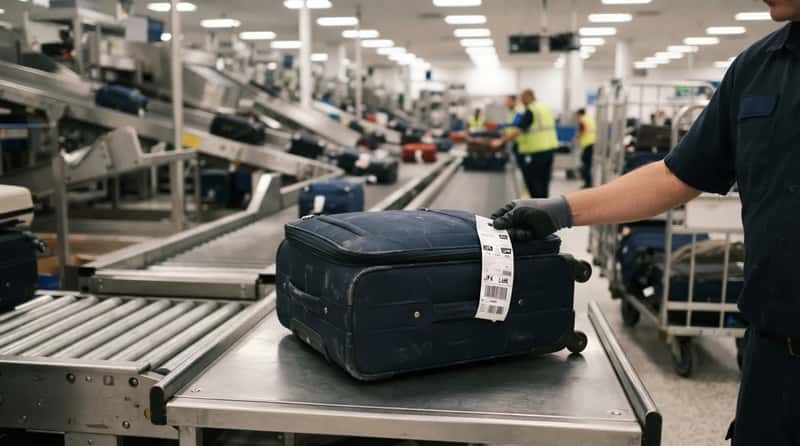
Every checked bag gets a barcode sticker listing your destination, flight number, and full name. That tiny tag is the only thing keeping your bag tethered to you across thousands of miles.
Airlines actually reunite over 99.5% of bags with passengers the same day, thanks to tracking technology most travelers never see in action.
The real trouble starts when a tag rips, smudges, or never gets scanned properly. A damaged or missing tag is one of the most common reasons a bag goes untraceable.
Once that link breaks, a clock starts ticking – and what happens next explains a lot.
#6 – Airlines Are Running a Legal Clock You Never See
Once your bag goes missing, airlines don’t just shrug and forget about it. There’s an actual legal timeline ticking in the background.
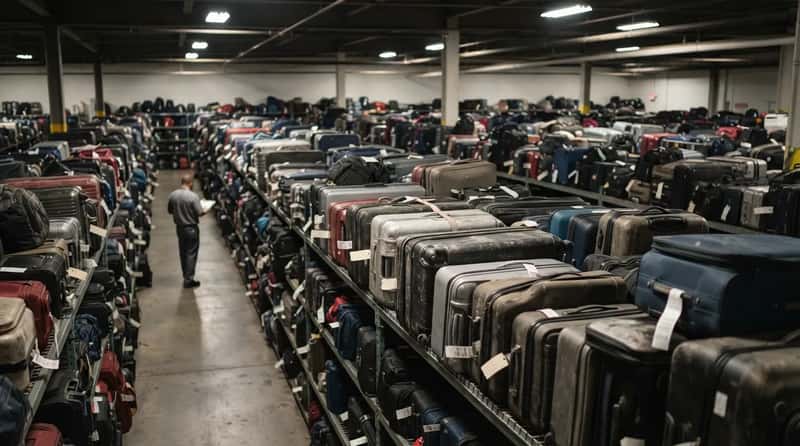
The airline typically holds a bag at the airport for about five days before shipping it to storage, where IATA rules require it to sit for at least 60 days.
If the airline still can’t locate your bag within 5 to 14 days, the Department of Transportation requires them to reimburse you for its contents. That reimbursement doesn’t mean the bag disappears, though.
If nothing turns up after three months, airlines stop searching and typically pay out up to $3,800. The moment they pay you, the airline legally owns whatever they eventually find.
Your old suitcase doesn’t vanish – it just changes hands. And the next hand it lands in is one you’ve probably never heard of.
#5 – There’s Exactly One Store in America Built to Buy These Bags
After the search window closes, U.S. airlines don’t destroy unclaimed luggage. They sell it – and almost all of it goes to the same place.
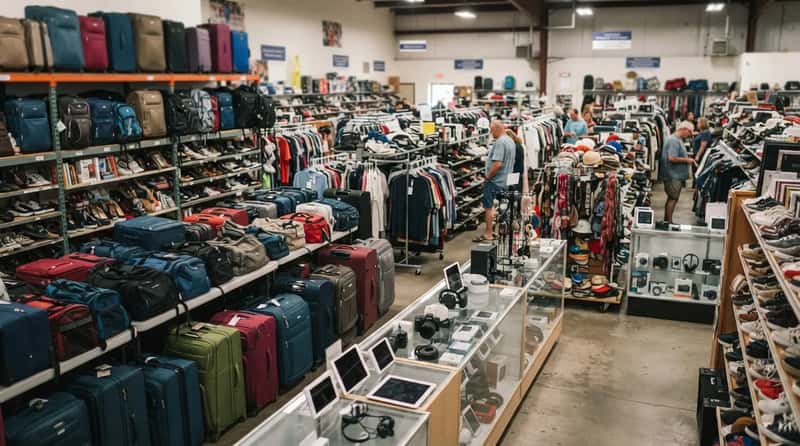
After 60 to 90 days, bags can be sold off, and for most U.S. carriers that means the Unclaimed Baggage Center in Scottsboro, Alabama. Founded in 1970 by Doyle Owens, it bills itself as the only store in the country that resells the contents of lost luggage.
United and Southwest have both confirmed they send unclaimed bags there – United after 90 days, Southwest after 120.
The store buys every single bag completely sight unseen, with zero idea what’s inside. No inventory, no preview – just a blind purchase, every single time.
That gamble is exactly what makes this place unlike anything else in retail. And once those bags arrive, the scale of what happens next is hard to picture.
#4 – Behind the Scenes, 7,000 New Items Land Every Day
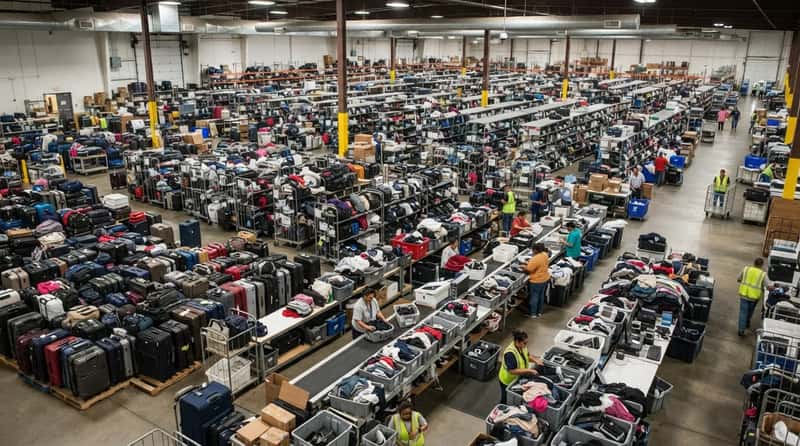
This isn’t a quirky little thrift shop. The Unclaimed Baggage Center runs at a scale that’s genuinely hard to picture.
Over a million shoppers walk through the 50,000-square-foot store each year, sorting through roughly 7,000 new items added daily. That’s a bigger annual crowd than some national parks pull in.
At a Glance
- 1,000,000+ shoppers walk through the store’s doors every year
- 50,000 square feet of retail space, restocked daily
- More than 90% of the store’s inventory comes straight from unclaimed luggage
- Most items are priced 20-80% below retail
Every bag gets taken to a warehouse, sorted, and cleaned. Only new, tagged undergarments make it to the floor, and technicians wipe personal data from every phone, laptop, and camera before confirming it still works.
Roughly 60% of the merchandise is clothing, with the rest split between electronics, jewelry, sporting goods, and books. Most items sell for 20-80% below retail – meaning someone can walk out with a working laptop or a designer coat for a fraction of what it once cost.
But inventory numbers aren’t the wildest part of this story. Not even close.
#3 – The Strangest Things Ever Pulled From an Unclaimed Bag
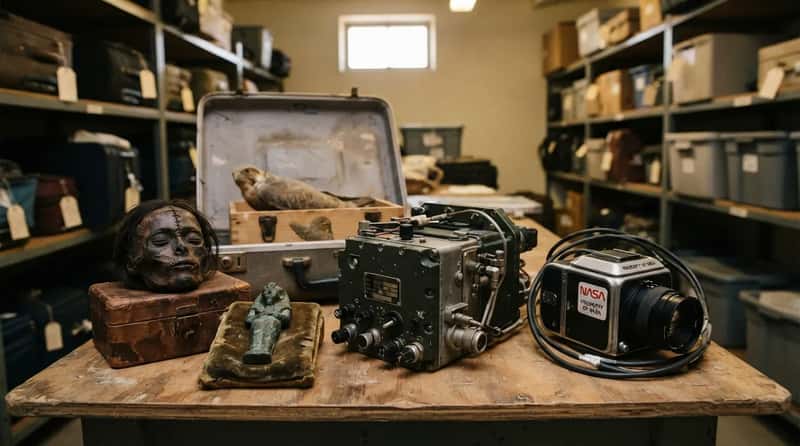
This is where the story stops being about logistics and starts sounding made up.
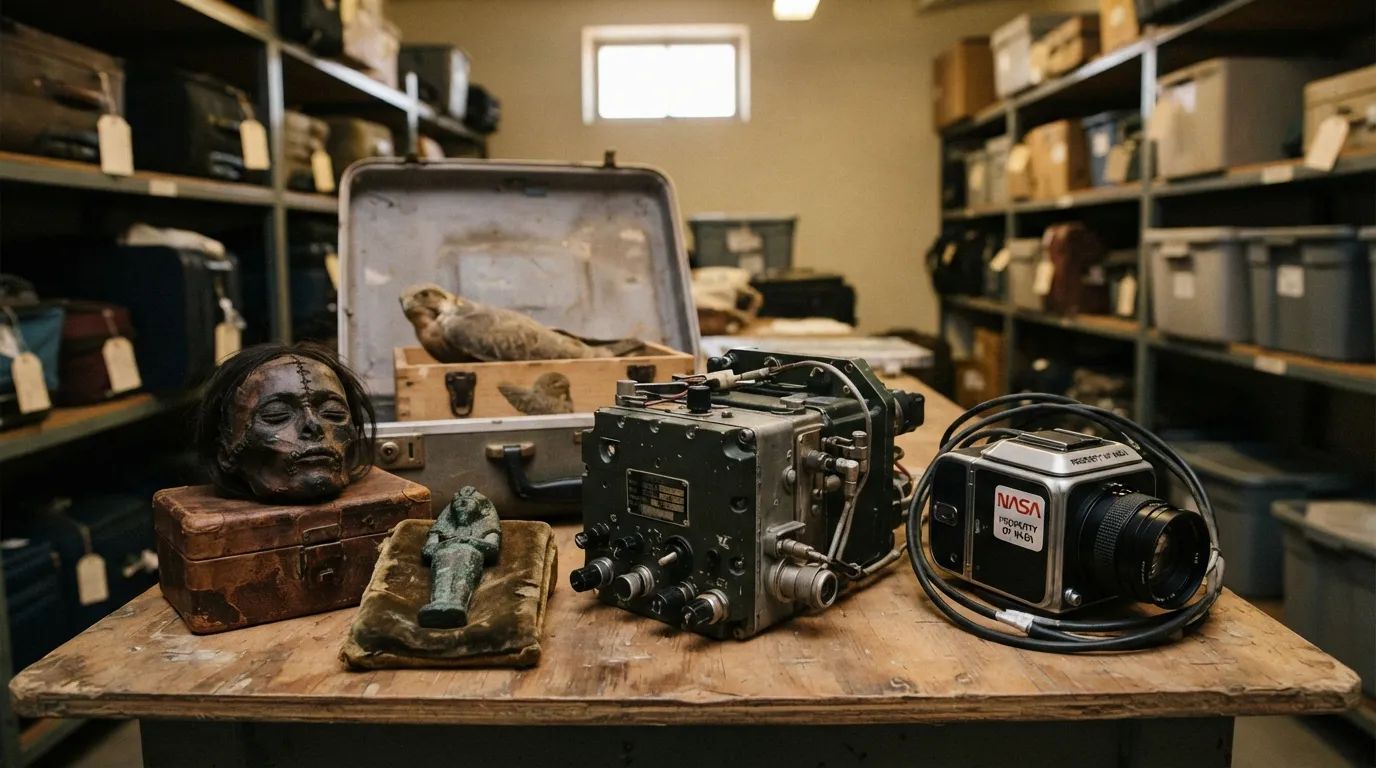
The store has handed over an F-16 guidance system to the U.S. Navy and a space shuttle camera to NASA. Somewhere out there, someone checked military hardware as luggage and simply never came back for it.
Workers have also unpacked a mummified falcon, a shrunken head, and artifacts dating back to 1500 B.C. One team even found a live rattlesnake loose among the incoming bags – it never made it anywhere near the sales floor.
The single most valuable item ever found was an 18-karat white gold diamond solitaire ring worth roughly $39,000, alongside a gold President Oyster Rolex worth about $20,000. Someone lost a $39,000 ring and never once filed a claim for it.
Nobody has ever explained why. And even that isn’t the most surprising part of the operation.
#2 – Some of It Gets Donated, Recycled, or Locked in a Museum

Not everything that lands in Scottsboro gets a price tag. This operation has a surprisingly generous side.
Less than half of one percent of luggage in the U.S. ever goes unclaimed, and more than half of what does arrive is too worn, damaged, or used to resell. That share gets donated or recycled instead.
Through its Reclaimed for Good foundation, the company has funneled millions of dollars in goods and funding toward charitable relief efforts – a side of the business almost nobody associates with “the lost luggage store.”
The strangest finds aren’t sold or donated at all – they’re displayed. The store’s small on-site museum has held a 3,000-year-old Egyptian burial mask, a taxidermied rattlesnake, and yes, that shrunken human head.
A real shrunken human head, sitting in a display case in small-town Alabama, pulled out of an abandoned suitcase. Even that isn’t the strangest truth in this whole story.
#1 – The Real Reason Most Unclaimed Bags Never Get Claimed
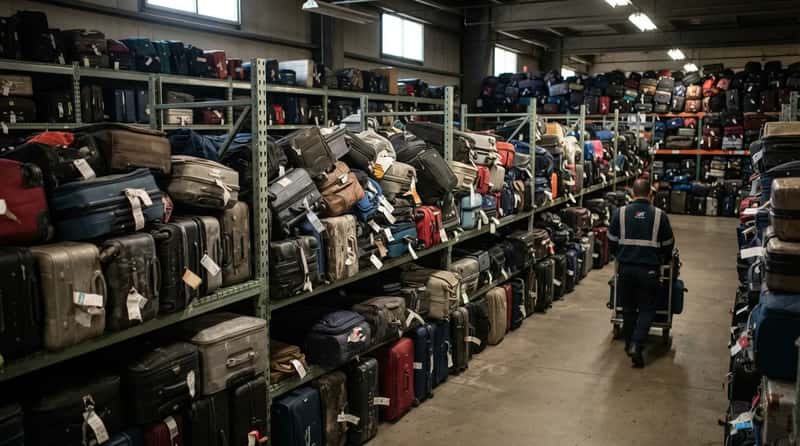
Here’s the twist almost nobody expects: many bags stay unclaimed not because the airline failed, but because the owner vanished from the process.
About 7% of mishandled bags – close to 1.8 million every year worldwide – are never recovered at all. That happens from ripped tags, technology glitches, or an agent mistyping an airport code.
Worth Knowing
- Mishandled baggage cost airlines an estimated $5 billion industry-wide in 2024
- Each mishandled bag adds roughly $150 in costs for the airline to resolve
- 41% of all mishandling happens during transfers at connecting airports
- Just 8% of mishandled bags are ever permanently lost
But a real chunk of these bags belong to people who simply never followed up. Mishandled luggage already costs airlines roughly $150 per bag in added expenses, so they’re genuinely motivated to track owners down.
When they can’t, it’s usually because there was no ID inside, the phone number on file was outdated, or the traveler gave up after getting reimbursed. The single most effective fix costs nothing: slip a piece of paper with your name, phone number, and email inside the bag – not just on the outer tag.
External tags rip off. That inside slip of paper survives everything else.
The Bottom Line
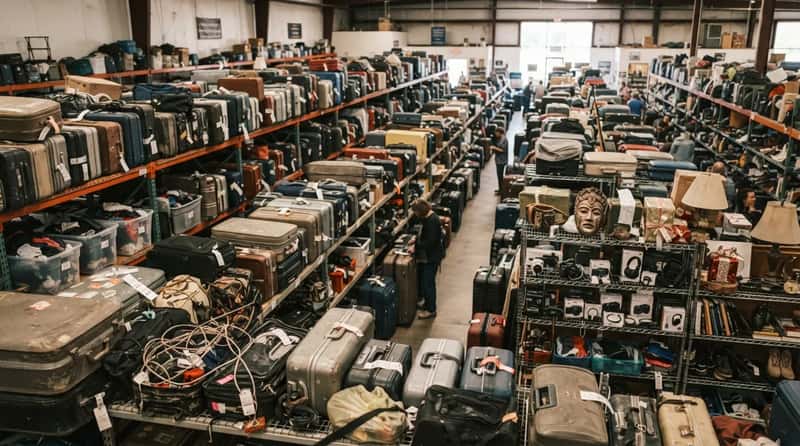
Less than 0.03% of checked bags are ever truly orphaned – but multiply that sliver by the billions of bags checked worldwide, and you get a genuinely staggering pile of unclaimed property.
Airlines search for months, pay out claims, and eventually hand off whatever’s left to one store in small-town Alabama that moves 7,000 items a day and draws over a million visitors a year.
Inside those bags: rattlesnakes, fighter jet hardware, ancient burial masks, and a $39,000 ring nobody ever came back for. The system is stranger, and far more organized, than anyone gives it credit for.
The only thing standing between your suitcase and that shelf in Alabama is a slip of paper with your name on it.
Bonus: The Claim-Window Trick That Beats Every Tip Above
Almost nobody reads the fine print on delayed-bag compensation, and that single oversight is why so many travelers end up with nothing.
Under the Montreal Convention, which covers international flights, you generally have to file your written delay claim within 21 days of finally getting your bag back – miss that window and your right to compensation can disappear completely, even if the airline was clearly at fault.
- File a Property Irregularity Report (PIR) at the airport counter before you leave – most airlines only honor claims reported within 24 hours of arrival.
- Photograph your bag’s exterior and its contents before you check in, so you have proof of condition and value if it’s delayed or damaged.
- Save every receipt for anything you buy while waiting (clothes, toiletries); airlines often reimburse these “interim expenses” separately from the final settlement.
- Mark your 21-day international deadline (or your airline’s stated domestic deadline) on your calendar the moment you file the PIR – don’t wait to see if the bag turns up on its own.
Most travelers assume they have unlimited time to sort things out with an airline. In reality, the clock starts the moment your bag doesn’t show up, and knowing that exact deadline is often the difference between a full payout and a permanent write-off.