
Before going to Bolivia, I thought that the salt flats were just one giant photo stop that you turn up to, take a few perspective shots, and move on. However, the reality is very different. A three-day salt desert tour from Uyuni takes you across some of the most extreme landscapes I’ve ever seen.
However, despite its sheer scale and solitude, is a 3-day tour worth the price, or is it better to just book a single day to see that salt and make your way out?
Journeys Start

Most tours start in Uyuni, a small, dusty town that feels like a gateway to the desert. It is highly recommended not to stay here for more than one day, as there is little to do.
The second you get off the bus, you’re probably going to be harassed by local tour guides asking you to take their tour, so do your due diligence and compare prices and locations visited to find the best prices.
Once you’ve decided on your tour, you’re crammed into a 4×4 with a handful of strangers, a driver who can navigate the vast emptiness of the landscape, and enough supplies to survive the few days you’ll be forgotten to the world. Once you leave town, you can already feel like you’re heading somewhere remote in a way that few places still feel today.
The Train Cemetery

The first stop in your 3-day trip is the train cemetery, just outside Uyuni. Here, old steam trains sit abandoned, slowly decaying under the sun and wind. These locomotives once carried minerals across Bolivia but are now artefacts left behind from a forgotten era.
You can climb inside, stand on collapsed frames, and frame photos with nothing but sky behind you, setting the tone for the trip perfectly.
Salar de Uyuni: Entering the Salt Desert
Not long after leaving the train cemetery, the landscape opens up completely. The Salar de Uyuni stretches endlessly in every direction, a perfectly flat white surface that immediately messes with your depth perception. Here, there are no reference points, shadows, or a sense of distance.
However, this is a crucial piece of information. Timing is EVERYTHING!!! When I set out for the salt desert, I filled my head with all the amazing pictures I was about to take of what looked like walking on glass… unfortunately, we arrived during the dry season, naively thinking the desert had a lake that looked the same year-round.
During the dry season, generally from May to October, the salt forms cracked geometric patterns that still looks incredible, and almost like you’re walking on another planet, but after a couple of minutes, the novelty tends to wear off, and the pictures you take will look nothing close to the images you see online of the water reflecting 4×4’s like a mirror.
During the wet season, usually between January and March, the experience can be completely different. A thin layer of water settles on top of the salt, transforming the flats into the largest natural mirror on Earth. On the right day, the sky reflects perfectly beneath your feet, and the horizon vanishes entirely.
This mirror effect isn’t guaranteed. Too much rain and parts of the flats become inaccessible, and too little water means the reflection never fully forms. Catching it at its best comes down to timing, weather, and a bit of luck. When it happens, though, it should be unforgettable, I don’t know, as I’ve never seen it.
However, even though we didn’t time it correctly, you can still take some comedic images, as the sheer distance messes with your sense of scale, making big things seem small, and small things seem big when you angle your camera correctly.
Lunch on the Salt and the Dakar Rally Route

You’ll be given your first lunch on the salt plains, where you can either eat inside or enjoy the views of the oxymoronic emptiness that surrounds you.
Later in the day, you pass through areas once used during the Dakar Rally, which raced across Bolivia’s Salar de Uyuni salt flats for several years, starting in 2014 and continuing through at least 2017. Here you can take a picture in front of the flags from various countries and a Salt-built plaque of the rally’s emblem.
By the time the sun begins to drop, the temperature begins to drop drastically, so be sure to bring plenty of warm clothes, and not just a single hoodie for warmth, as I did.
Your first night’s accommodation is basic and partly built from salt blocks. This place offers no luxury and is merely a shelter from the cold and a shared meal. Worst of all, when you want to take a shower, an old Bolivian woman sits right beside the door, ready to knock to tell you to finish up mere seconds after the water starts running.
Volcanoes and the High-Altitude Altiplano

On day two, the landscape shifts. From this point onward, the salt flats fade away as the route climbs into the Bolivian altiplano. While we were promised what sounded like an up-close view of an active volcano, it turned out to be more of a quick stop from afar, which was rather disappointing.
My memory is fuzzy with the order, but you do get to visit active geysers, as well as a natural hot spring, although the ‘cover’ they gave us to change our clothes was completely see-through…..
Flamingos in an Unlikely Landscape

As the day carries on, high-altitude lagoons appear in shades of red, green, and blue, created by minerals and algae thriving in extreme conditions. Here, flamingos feed calmly in the icy water, seemingly unaffected by the cold.
It feels surreal, almost surreal, to see any life so far from anywhere. The contrast between these delicate birds and such an unforgiving landscape is one of the most memorable parts of the tour.
Also, avoid walking in the grass. That black stuff covering your feet isn’t mud……
Isla Incahuasi: The Cactus Island
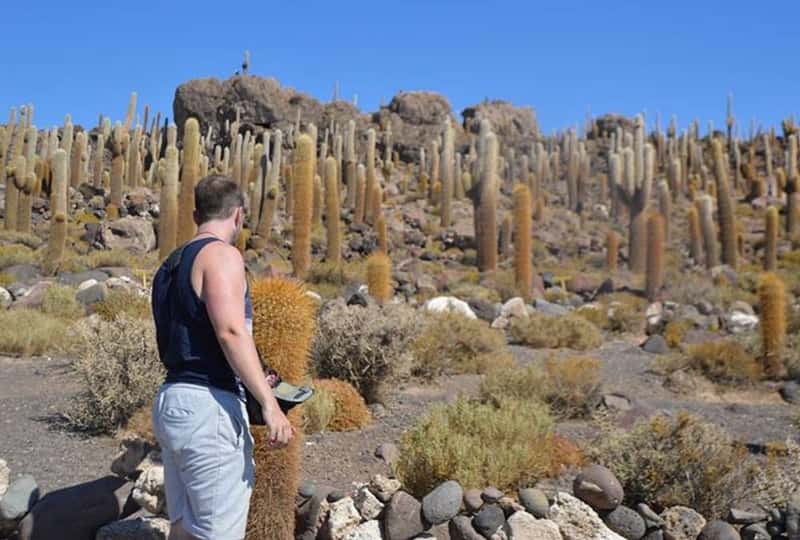
By the third day, the fatigue was really starting to creep in, and I was ready to be done. However, one of the final highlights is Isla Incahuasi, a rocky island rising unexpectedly from the salt flats, covered in cacti that have survived here for centuries.
Isla Incahuasi (or “Inca House Island”) is a cactus-covered rocky outcrop in the middle of Salar de Uyuni. These ancient cacti can be over 1,000 years old) and the island offers panoramic views of the vast white desert and sky. Once the peak of a prehistoric volcano submerged in a giant lake, it’s now an island of rock and coral-like structures, offering a unique, otherworldly landscape.
The location feels out of place, as if the island doesn’t belong in the middle of so much white space. Climbing to the top gives you a full 360-degree view of the Salar stretching endlessly in every direction, and it is one of the few places where the true scale of the salt flats becomes clear.
The Long Drive Back to Uyuni

The return journey to Uyuni is long and quiet as you watch the landscape roll past, exhausted and overwhelmed. By this point, you’re dusty, sunburnt, cold, and completely saturated with scenery.
Is the 3-Day Bolivia Salt Desert Tour Worth It?
The Bolivia salt desert tour isn’t comfortable, polished, or predictable. It’s cold, remote, physically demanding, and highly dependent on timing and weather.
Personally, I think a one-day trip is more than enough, unless you really want to feel the isolation. But cramped into a 4×4 with strangers, long drives with nothing to see or do, rushed showers, scorching sun and freezing nights, it’s really down to if you think it’s worth it or not.