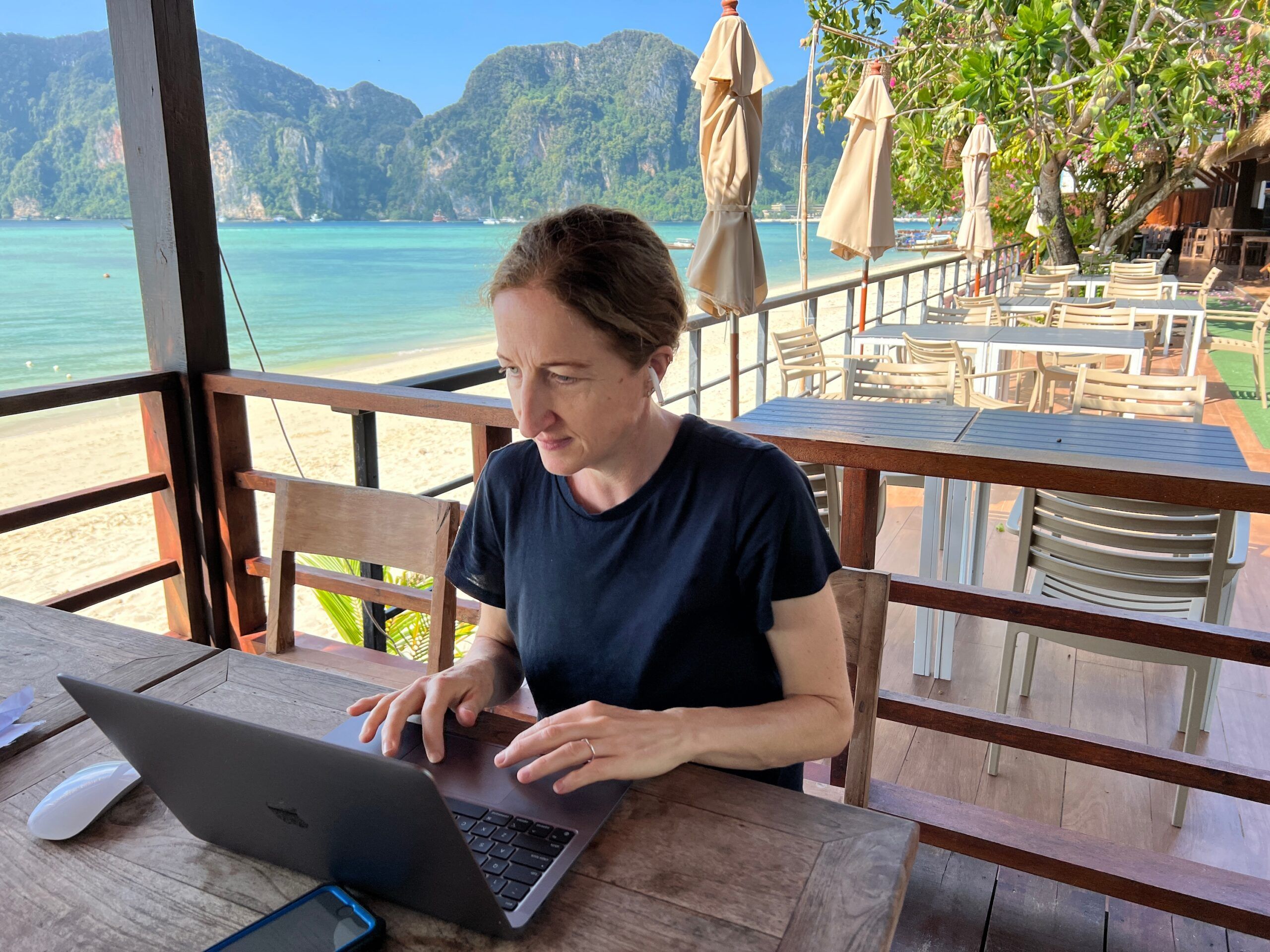
The laptop is open on a balcony in Lisbon.
The sea is right there.
You haven’t looked at it once.
The Slack notification comes in at 9:47 AM – which is, technically, your vacation hour – and your stomach tightens the same way it does at your desk in Cincinnati.
There it is. The Identity Gap.
The space between who you told yourself you’d be when you booked that flight – someone loose, sun-warmed, untethered – and who you actually are: a person whose nervous system doesn’t have a passport. We’ve been selling ourselves the workcation dream for four years now. The influencer photos. The “office with a view” captions. The quiet promise that geography could solve what psychology couldn’t. It never worked. And in 2026, the data has finally caught up with the feeling most of us have been swallowing with our overpriced airport espresso.
1. The Phantom Office
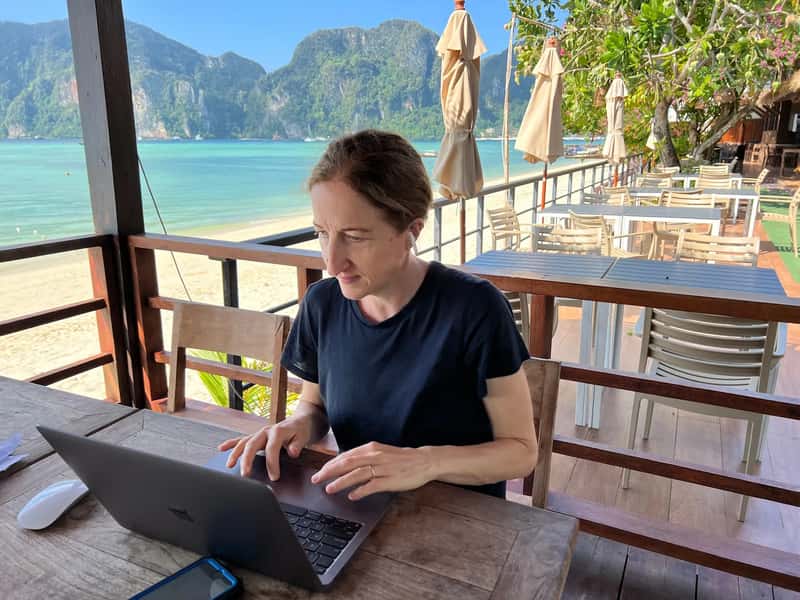
You changed the scenery. You did not change the machinery.
The brain is a pattern-recognition engine. It doesn’t see “Bali.” It sees “unread emails.” It sees the same cognitive architecture it woke up with in your apartment – the same hierarchy of demands, the same low-grade hum of accountability. The laptop is the office now. You carried it with you.
Remote work has introduced a new scenario of work-related stress in which it is not always easy to distinguish where work ends and personal life begins. When you fly that ambiguity to a different timezone, you don’t dissolve it. You amplify it. The beautiful backdrop becomes a source of guilt – you’re not working hard enough to justify the trip, and you’re not present enough to justify the view.
The workcation promises dual citizenship in two worlds. What it delivers is alienation from both. You’re a tourist who can’t stop checking the dashboard. You’re an employee whose focus has been shattered by the sound of the ocean. Your brain, caught between two identities, defaults to its most anxious state.
That is not a vacation. That is a rebranded crisis.
2. The Cognitive Load You Packed in Your Carry-on
Nobody talks about the mental weight of logistics.
New Wi-Fi. Different timezone math. The electrical adapter that doesn’t quite fit. The background noise on the video call that forces you to over-explain your whereabouts to a manager who didn’t explicitly approve anything.
Digital platforms enable collaboration but also facilitate an uninterrupted flow of messages, notifications, and virtual meetings that fragment attention and elevate mental fatigue. Now add an unfamiliar environment layered beneath all of that fragmentation. The brain’s working memory – already taxed by the baseline demands of modern knowledge work – has no bandwidth left for wonder.
You are not relaxing in a new city. You are managing a small multinational operation called your own attention. Every novel stimulus that makes travel beautiful – the unfamiliar street noise, the menu in another language, the different rhythm of daily life – is, neurologically, a demand. It costs something.
The bill comes due around day three. That’s when the “vacation” starts to feel like punishment.
3. The Boundary That Never Made the Flight
You told yourself you’d only work mornings.
You lied. Not maliciously. Hopefully.
Studies indicate that remote employees are more likely to work beyond contracted hours, often without consciously recognizing the time extension, which can intensify cognitive load and reduce recovery opportunities. A workcation removes the last structural guardrails that enforce separation. There is no commute home. There is no office building to physically exit. There is only a screen, and a room, and the soft guilt of an unfinished deliverable sitting three feet from your pillow.
Human physiology is not designed for continuous, unbroken alertness. Cortisol, the hormone responsible for our stress response and wakefulness, naturally follows a diurnal rhythm – peaking in the morning and tapering off by late evening to prepare the body for sleep. When work colonizes the hours that cortisol is supposed to be declining, your body never fully decompresses. You arrive back home more depleted than when you left.
The boundary didn’t survive the departure gate. It rarely does.
4. The Performance of Freedom
The photo goes up. Golden hour. You and your laptop on a terrace.
#WorkFromAnywhere. #RemoteLife. #Blessed.
And then you sit with the quiet, uncomfortable knowledge that you staged it. That you moved the glass of wine three inches to the left for the shot. That the next three hours will be spent in a windowless corner of the Airbnb because the terrace has glare problems and the Wi-Fi is stronger inside.
In 2025, employees placed greater value on meaningful engagement over superficial perks. The workcation is, in many ways, the ultimate superficial perk – a lifestyle performance that sells identity without delivering it. The psychic cost of maintaining that performance is real. It’s the energy spent curating evidence that your life looks a certain way, energy that could have gone toward actually living it.
Freedom that requires a photo to feel real isn’t freedom. It’s a costume. And costumes, worn too long, start to chafe.
5. The Loneliness That Travels Well
I remember sitting in a co-working space in Porto – exposed brick, excellent espresso, people typing purposefully all around me. I was technically surrounded by humans. I hadn’t had a real conversation in four days. The loneliness wasn’t loud. It was the kind that seeps in around the edges. A low-frequency ache that productivity metrics don’t measure and Instagram stories don’t show.
Physical isolation compounds burnout risk by weakening the informal interactions – hallway conversations, impromptu problem-solving sessions, and shared social rituals – that often buffer workplace stress. Strip those away and take them to a foreign city where you don’t speak the language fluently, and you haven’t solved isolation. You’ve aestheticized it.
In 2025, 52% of employees experiencing high stress report feeling disconnected from colleagues and their work, leading to reduced engagement, lower morale, and fractured teams. The workcation does nothing to address that disconnection. It relocates it to a prettier postcode.
You can be profoundly alone in the most beautiful place on earth. The algorithm won’t tell you that.
6. The Timezone Tax
The hidden arithmetic of the workcation is brutal.
You are in Tokyo. Your team is in New York. The overlap window – the narrow corridor where you can actually collaborate in real time – is somewhere between 9 PM and 1 AM your local time. So you do it. You take the calls. You tell yourself it’s fine.
The fact that both remote and hybrid workers report higher stress may indicate that flexibility comes with a cognitive burden. Timezone misalignment is one of the heaviest forms of that burden. It doesn’t just disrupt sleep – though it absolutely does that too. It disrupts identity. It places you perpetually out of sync with your environment, neither fully present in the country you’re visiting nor fully available to the team you serve.
You are a ghost in two places simultaneously.
Hybrid work models reduced some stressors yet intensified emotional strain when digital demands increased. Introduce a nine-hour timezone gap into that equation and the emotional strain doesn’t just intensify – it compounds nightly, interest accruing on a debt you didn’t consciously take out.
7. The Quiet Burnout Nobody Photographs
It doesn’t arrive like a breakdown. It arrives like a Tuesday.
You wake up in your third city in as many weeks. The light is different but the exhaustion is identical. The to-do list loaded before you opened your eyes. The enthusiasm for novelty – the thing that was supposed to make this whole arrangement worthwhile – has a half-life, and yours expired somewhere over the Atlantic.
More employees will begin masking emotional fatigue, presenting as productive while privately nearing collapse. The workcation accelerates this masking because the external environment keeps insisting you should be thrilled. Beautiful surroundings create a social pressure to perform gratitude, which is its own form of emotional labor layered on top of the work itself.
In 2026, burnout continues to be one of the most significant threats to the workforce, with 66% of U.S. employees reporting feeling burnout in some form. The workcation doesn’t treat burnout. It decorates it. There is a fundamental difference, and your nervous system knows which one you’re getting.
8. The Identity Erosion of Perpetual Impermanence
Who are you when the address is always temporary?
Identity, psychologically speaking, is partially constructed through stability – a home that knows your habits, a neighborhood that recognizes your face, routines that require no cognitive energy because they are simply known. The workcation strips that architecture away and calls it adventure.
Remote work continues to transform both organizational structures and individual work experiences, introducing new dynamics that can simultaneously enhance or undermine employees’ mental health and overall well-being. These evolving conditions influence levels of stress, resilience, and burnout within increasingly digital and flexible work environments.
When the environment is always new, the self has no stable surface to rest against. You become a version of yourself that is always orienting, always translating, always starting from scratch. That is tiring in ways that don’t show up on a blood test.
The person who craves perpetual movement is often not running toward something beautiful. They are running from the quiet that would ask them who they are when everything stops.
9. The Productivity Lie You Tell Your Manager (And Yourself)
You said you’d be just as productive.
You knew it wasn’t quite true when you said it.
Sixty-one percent of U.S. workers reported declining productivity due to mental health issues, according to a 2025 Mental Health Barometer by TELUS Health. Now factor in the additional cognitive overhead of an unfamiliar environment, disrupted sleep, timezone friction, and the emotional labor of performing a good time – and the productivity picture becomes even less flattering.
Mental fatigue was related to technostress, somatic symptoms such as anxiety and insomnia, and loss of motivation. Burnout was positively associated with work overload, high interdependence, and lower role clarity. A workcation, by design, introduces all three of those conditions: novelty-induced cognitive overload, high coordination demands across distance, and deeply blurred role boundaries. You are not a focused professional on holiday. You are a professional in a state of compound ambiguity.
The gap between the productivity you promised and the productivity you delivered lives in your chest as a low, persistent guilt. That guilt doesn’t go away when you land back home. It just finds a new airport to haunt.
10. The Homecoming That Feels Like Defeat
This is the heaviest one.
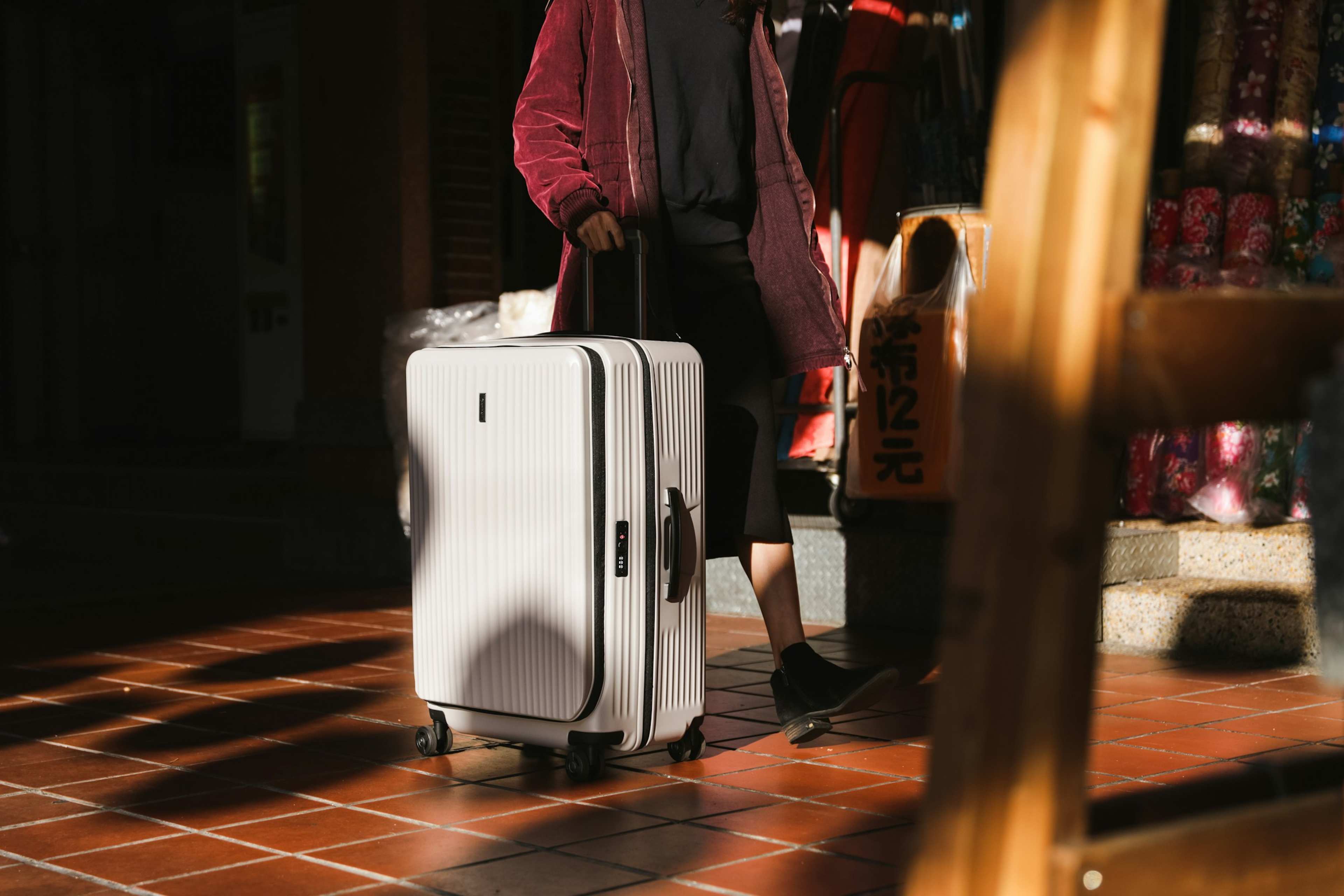
You land. Passport control. The same gray corridor. The same belt carousel. Your suitcase, when it finally arrives, feels heavier than when you packed it – and that is not about the duty-free wine.
You went looking for something. A version of yourself that could hold a job and a life and a sense of wonder all at once. A self that was simultaneously ambitious and free, productive and present. And somewhere between the co-working space and the scenic overlook, you realized that self doesn’t exist – not because you aren’t capable of it, but because the structure you built around you makes it impossible.
The U.S. workforce is undergoing unprecedented change. Whether those changes are positive or negative, uncertainty and feelings of job insecurity can harm workers’ mental health, performance, and productivity at work. The workcation didn’t resolve that uncertainty. It temporarily relocated it to a place with better light. And now you’re home, the light is ordinary again, and the uncertainty is still there – rested from the trip, ready to get back to work.
Mental health is not separate from productivity. It is built into it. The workcation fails because it tries to outsource recovery to geography rather than building it into the actual architecture of how we work. No longitude can fix a nervous system that never gets to fully power down. No new city can provide the psychological safety that only comes from genuine rest – unperformed, unposted, unremarkable rest.
There is a version of the future where we stop asking places to do what policies should do. Where companies build real recovery into work schedules rather than rebranding exhaustion as a lifestyle. Where the boundary between labor and life isn’t something you have to negotiate alone on a balcony in Lisbon.
That future requires honesty about what we’ve been doing. It requires admitting that we booked the flights not because the work worked better there, but because we were desperate for something to change – and changing location was easier than changing the system.
The sea is still there, by the way. It doesn’t need your laptop open to be beautiful. It was beautiful before you arrived, and it will be beautiful long after you’ve closed every tab.
You just have to actually stop working to see it.