Walk into a hotel room today and something feels different, even if you can’t quite put your finger on it. The bathroom counter looks emptier. The nightstand drawer is bare. That little tray of “extras” you used to dig through the second you dropped your bags? Gone, without so much as a note explaining why.
Most guests assume hotels just got cheaper or lazier, and honestly, that’s only half the story. The real reasons involve brand-new state laws, quiet guest rebellions, and a hospitality industry rewriting its own playbook one small item at a time. Here’s what actually happened to your room, and why some of these changes have travelers furious while others barely notice at all.
#11 – The Brass Key Fob That Weighed Down Every Pocket
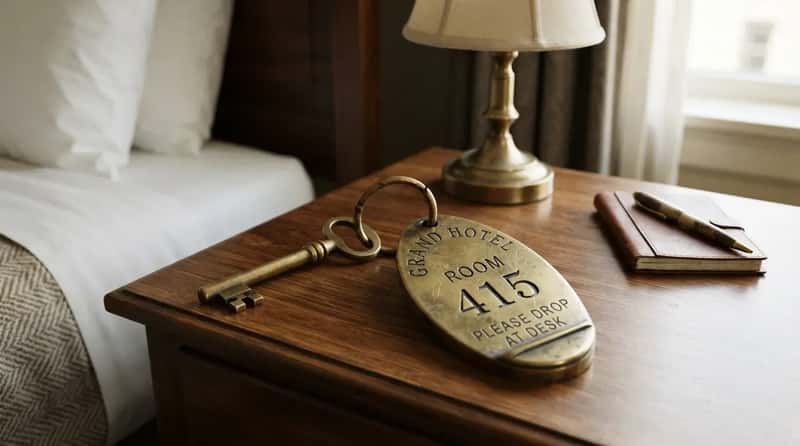
There was a time when checking into a hotel meant getting handed a real brass key attached to a fob so heavy it practically dared you to lose it. That weight was intentional. Hotels wanted guests to feel a gentle nudge to drop the key at the front desk before wandering off for the day instead of hauling a chunk of metal around town.
Electronic key cards replaced that ritual almost overnight during the 1990s and 2000s, and now even those flimsy cards are quietly getting phased out too. Several major chains have already switched to phone-based digital keys, which means an entire generation of travelers has never once felt the weight of a real hotel key in their palm. Something oddly satisfying got lost in that upgrade, even if nobody would trade convenience to get it back.
Fast Facts
- The project led to the development of the world’s first recodable card lock in 1977, replacing metal keys for the first time.
- The launch of the technology led to the establishment of VingCard A.S. in Moss, Norway, in 1979, the company that pioneered the modern key card.
- Throughout the 1980s, magnetic stripe keycards became the standard in many hotels worldwide, ending the brass-key era for good.
- Today’s newest rollouts skip the card entirely, letting guests unlock rooms straight from a smartphone app.
#10 – Branded Notepads and Pens Vanished From the Nightstand
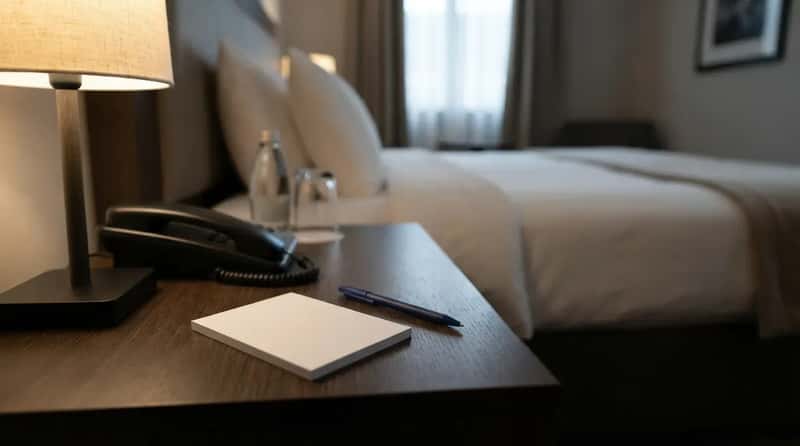
Every hotel room used to include a small pad of paper stamped with the property’s logo, sitting quietly by the phone next to a matching pen. Sometimes there was even a postcard tucked in for good measure. For decades this wasn’t treated as a perk, it was simply assumed, the same way you’d assume there would be towels waiting in the bathroom.
That basic expectation has all but disappeared, mostly because almost nobody reaches for paper when they’ve got a phone glowing in their hand. Many hotels quietly stopped restocking these sets years ago, treating them as an unnecessary expense rather than a guest necessity. Interestingly, they still survive longest in spa hotels, resorts, and colder-climate properties, where guests specifically expect a bit of old-fashioned charm. But that’s nothing compared to what we found about #9.
#9 – The Shoe Shine Kit That Solved a Very Specific Problem
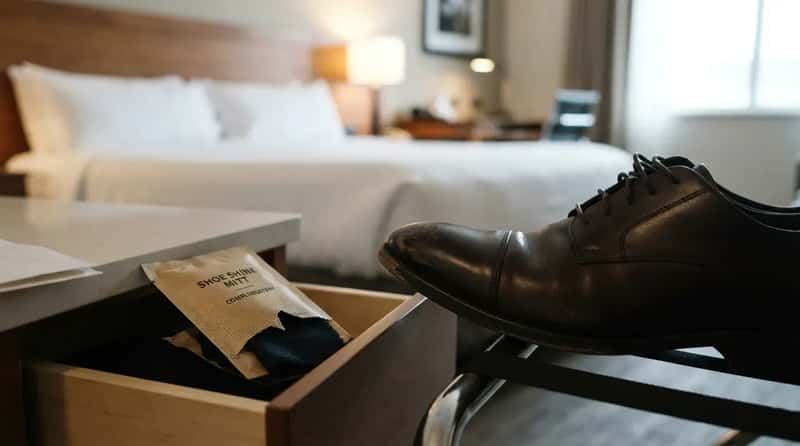
Business travelers used to count on one small drawer item more than almost anything else in the room: the shoe shine kit. It never cost hotels much, but it solved a very specific and stressful problem, scuffed shoes right before an important meeting, with no time to hunt down a shoe shine stand in an unfamiliar city.
Today that drawer is often just empty, and guests who grew up expecting one are quietly surprised to find nothing there at all. It’s a tiny detail, but it reveals something bigger about how business travel itself has changed. Fewer suits, fewer scuffed dress shoes, fewer reasons for hotels to keep restocking a kit almost nobody used anymore.
#8 – Vanity Kits Full of Cotton Balls and Emery Boards Got Gutted
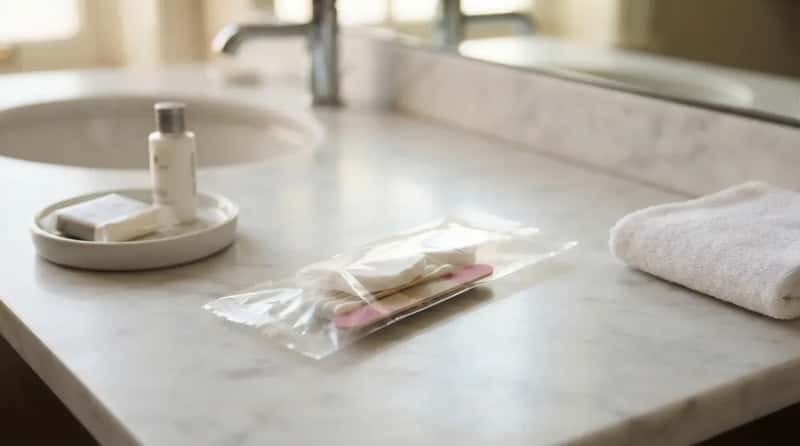
If you ever unwrapped a slim cellophane packet on a hotel bathroom counter, you know exactly what quietly saved a bad night. Inside was a surprising amount of care: cotton balls, cotton swabs, an emery board, sometimes a makeup remover pad, all bundled together for the guest who forgot the basics. It was the amenity nobody thought they needed until a broken nail or a smudged mascara moment at midnight made it feel like the hotel had somehow read your mind.
That thoughtful little kit has been quietly stripped down to almost nothing. Cost-cutting and the same plastic-reduction push reshaping shampoo bottles thinned these kits out until a bar of soap and a bottle of lotion now carry the entire load. What was once a genuine problem-solver has been reduced to the bare minimum, another line item squeezed out of the housekeeping budget.
#7 – Nightly Turndown Service Became a Luxury Instead of a Standard
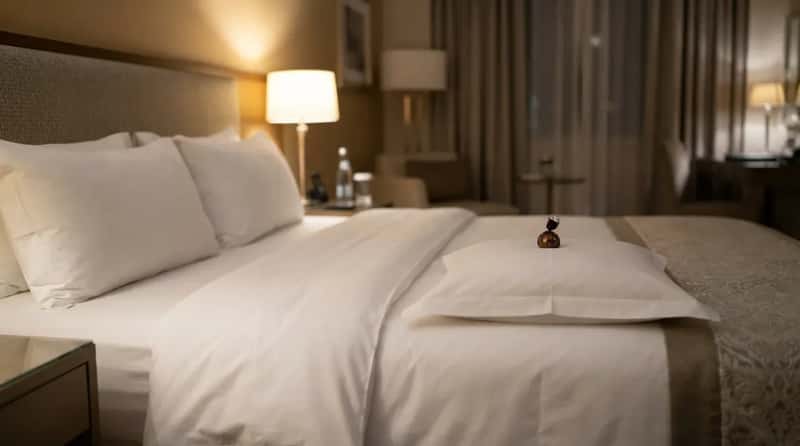
Few hotel rituals felt more special than coming back to a room where someone had already tucked you in for the night. Soft lamplight, a neatly folded duvet, a wrapped chocolate waiting on the pillow, it was equal parts service and theater, and it turned an ordinary room into something that felt genuinely cared for.
That theater has largely closed. Rising labor costs and leaner staffing turned nightly turndown into a luxury reserved for high-end properties instead of a standard offered everywhere. Plenty of travel writers actually argue guests are better off without it, since many people staying just a night or two would rather not be interrupted by a stranger fluffing pillows while they’re trying to unwind. But that’s nothing compared to what we found about #6.
#6 – Bed Scarves and Decorative Pillows Got Thrown Out for Good
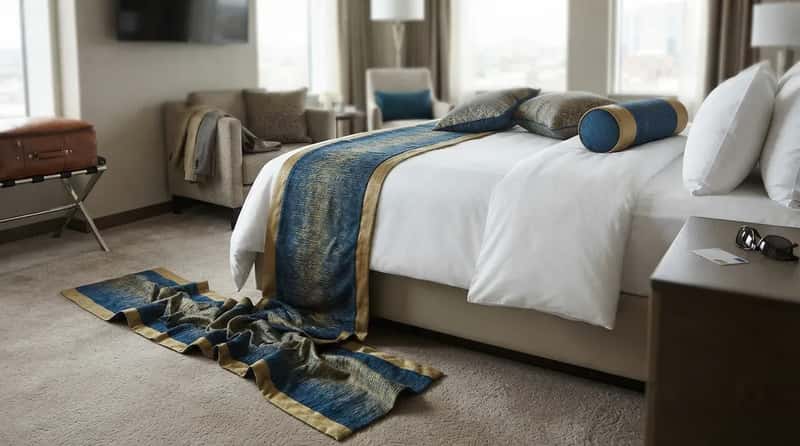
That strange strip of fabric draped across the foot of the bed had a name, and most younger travelers have never heard it. It’s called a bed scarf, and it existed for basically one purpose: looking tidy for a brochure photo, never for actual comfort.
Hotels didn’t retire it out of nostalgia for simplicity, they retired it because guests genuinely hated it. It’s usually the first thing guests fling onto the floor at check-in, doing nothing for comfort while costing hotels money to launder and irritating housekeepers who had to keep refolding it all day long. Decorative throw pillows suffered the same fate right behind it, tossed for the same blunt reason: guests who actually want pillows already have the ones on the bed.
#5 – Individually Wrapped Bar Soap Is Being Phased Out Next
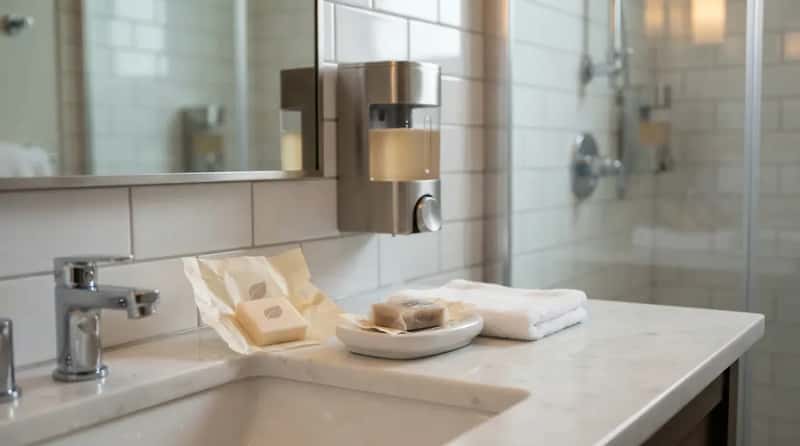
The little paper-wrapped soap bar has survived in hotel bathrooms for generations, but its days are officially numbered. It’s been a bathroom staple since long before most travelers were even born, and now the same environmental pressure reshaping shampoo bottles is quietly coming for it too.
This isn’t a rumor or some fringe policy either, it’s already state law in several places. Soap bars technically aren’t plastic bottles, but plenty of hotels are getting ahead of the trend before regulators expand the rules further, which is exactly why wall-mounted dispensers are quietly taking over showers nationwide.
Quick Compare
- California: Banned small plastic toiletry bottles in larger hotels starting in 2023.
- New York: Followed with a similar statewide ban of its own.
- Illinois: Also enacted a matching small-bottle ban.
- Washington State: Has a comparable law phasing in starting in 2027.
#4 – Mini Shampoo Bottles Are Basically Extinct in Three States
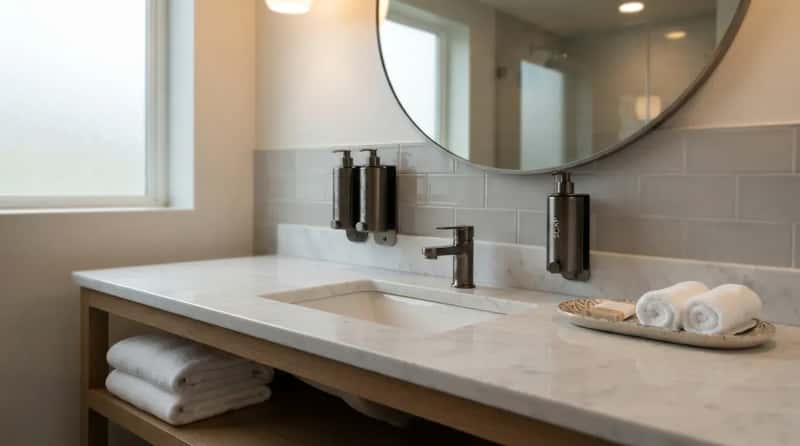
This is the change guests notice fastest, and the backstory behind it is bigger than most people realize. Illinois hotel guests won’t be collecting little bottles of shampoo and conditioner anymore, because state law now bans hotels from handing them out at all, full stop.
The law is oddly specific about it. It defines personal-care products as shampoo, hair conditioner, and bath soap, and defines a banned single-use bottle as anything under six ounces not meant for reuse. New York’s version casts an even wider net, covering any bottle under twelve ounces and folding in lotion and liquid soap alongside shampoo and conditioner. The scale of what’s disappearing is staggering: IHG alone uses an average of 200 million bathroom miniatures every single year.
#3 – Full Mini-Bars Stocked With Snacks and Booze Are Disappearing
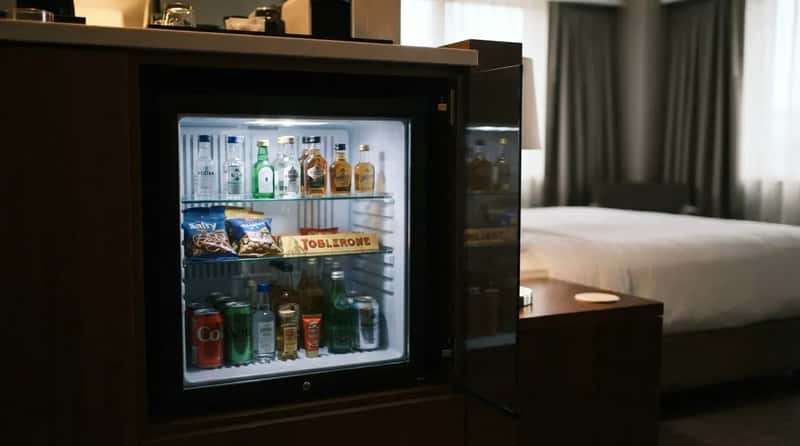
The overpriced mini-bar used to be a rite of passage for anyone who ever raided it after one too many cocktails. Six-dollar cans of Pringles, tiny bottles of vodka, a Toblerone that cost more than the entree downstairs, it was a punchline everyone knew and plenty of people paid anyway.
Cost isn’t the whole story here, guest habits genuinely shifted underneath it all. What guests actually want now looks completely different, and it says a lot about modern travel priorities.
While people have gotten away from expecting a full mini-bar, they are expecting at least a refrigerator.
Stacy Elliston, co-founder of Studio 11 Designs
Even luxury properties that once refused to install fridges are now bending to that demand, proving the mini-bar’s downfall was never really about money at all.
#2 – Gideon Bibles Are Being Pulled From Nightstand Drawers
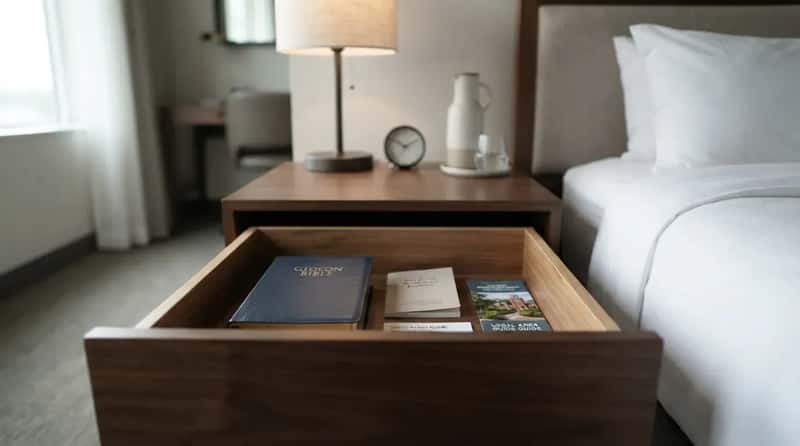
For over a century, one small book sat in nearly every American hotel room without anyone questioning it. Gideon Bibles, named after the group of missionaries and Christian businessmen who distribute them for free, have been placed in hotel rooms since 1908, with more than 1.8 billion handed out worldwide.
That near-universal presence has quietly become a flashpoint, and hotels are handling it in two very different ways. Some properties now stash a small assortment of spiritual texts in the nightstand drawer instead of just one, while others have removed them from rooms entirely and keep copies available at the front desk on request. This one sparks real arguments among travelers, some call it basic inclusivity, others call it erasing a hundred years of tradition for no good reason. Either way, the automatic Bible-in-every-room era is quietly ending at a growing number of properties. But that’s nothing compared to what we found about #1.
Worth Knowing
- Gideons International, an organization of evangelical business and professional men founded in 1899, started the whole tradition.
- The very first hotel Bible was placed at the Superior Hotel in Superior, Montana in 1908.
- The group says that it has distributed more than 2.5 billion Bibles worldwide since that day in 1908.
- The Marriott hotel chain, founded by a Mormon, places the The Book of Mormon in many of its rooms, alongside or instead of the Gideon Bible.
#1 – Daily Housekeeping Quietly Became Optional, and Guests Are Furious
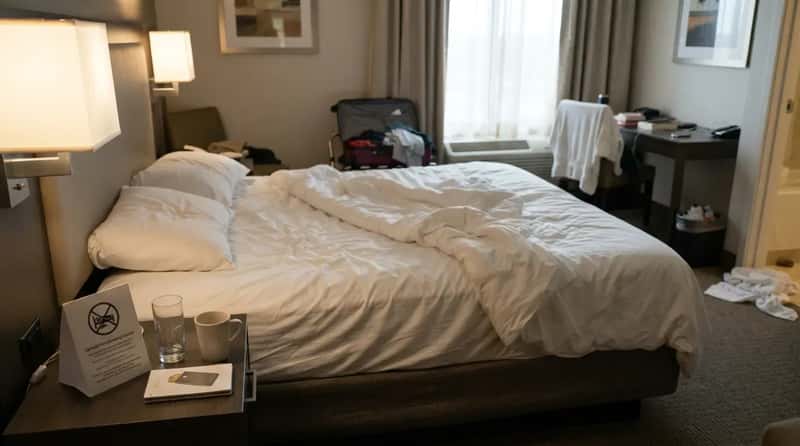
Of everything hotels have trimmed, this is the one guests actually fight back against. The pullback started as a pandemic-era cost-saving move in 2020, and at most properties it simply never reversed once things got back to normal.
The frustration shows up clearly in the numbers. J.D. Power data shows 44% of hotel guests consider daily housekeeping a “need-to-have” service rather than a “nice-to-have,” which means nearly half of all hotel guests are essentially demanding a service the industry quietly decided was optional. Not everyone agrees it’s a loss, though, and that split is exactly what makes this the most divisive item on the whole list. Older travelers tend to miss the daily linen changes as a hallmark of attentive service, while plenty of younger guests insist they’d rather just be left alone.
At a Glance
- The cutback began in 2020 as a cost-cutting, staffing-light pandemic measure.
- 44% of guests now call daily housekeeping a “need-to-have,” not a bonus.
- Most chains never fully restored the daily service once travel demand returned.
- The generational split is sharp: older guests miss it, many younger guests don’t.
The Bottom Line

Nothing on this list disappeared by accident. State laws in California, New York, Illinois, and Washington are quietly phasing out mini bottles for good, while cost-cutting, shifting guest habits, and old-fashioned annoyance killed off bed scarves, shoe shine kits, and vanity packets long before any lawmaker got involved. The most surprising twist is that guests themselves are split on nearly every one of these changes, cheering the death of bed scarves while practically begging for daily housekeeping to come back.
Which of these vanished hotel-room items do you actually miss, and which ones are you glad to see gone for good? Chances are the room you check into next year will look even emptier than the one you slept in last week, and most of us won’t notice until we go looking for something that isn’t there anymore.