Most people assume a hotel remembers them because the staff happen to have good manners. That’s not it at all – the real reason is far stranger, and far more calculated than a friendly smile.
Top hotels have been quietly building detailed files on their guests for decades, logging everything from your pillow preference to the wine you ordered on your anniversary. What follows is the hidden system behind that memory – the one most guests never see, and the reason some hotels still know your name a decade later while most don’t.
#7 – The “Guest Preference Pad” That Started It All

Most people think digital technology invented guest memory. It didn’t – one of the most powerful guest-recognition systems in the world started with a small paper notepad.
At the Ritz-Carlton, a “guest preference pad” became part of every employee’s uniform. Any preference noted on it was routed straight to the guest recognition office, and staff could also call a dedicated hotline to pass along what they’d noticed.
A waiter overhears you mention you dislike feather pillows. A bellhop notices you ask for extra hangers. Both details get written down and fed into the system.
Fast Facts
- (cite index=”11-1,11-2″>The guest preference pad is part of each employee’s uniform, and any preferences noted on it are routed to the guest recognition office.
- (cite index=”11-3″>Employees can also call a hotline to share the information.
- (cite index=”12-2″>All Ladies and Gentlemen are provided preference pads on which they are trained to jot down guest details before they’re entered into the company’s database.
- (cite index=”15-2″>That database, coined “Mystique,” tracks guest preferences, frequency of visits, and issues from previous stays.
The shocking part: this ran long before most hotels even had a website. It wasn’t technology that created the culture of remembering – it was obsessive human attention, later supercharged by software.
But that’s nothing compared to the data engine behind this process today.
#6 – The Silent Database That Knows You Better Than Your Friends
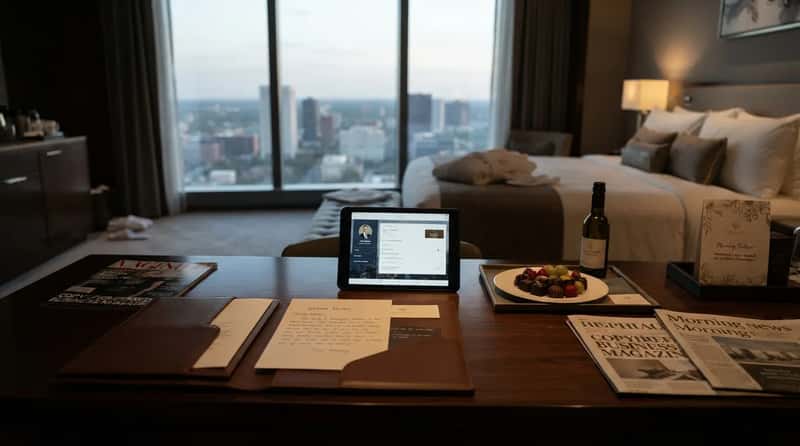
Every time you stay at a modern hotel, you’re feeding a machine – and most guests have no idea how deep those records go.
Hotel guest profiles centralize everything: contact information, stay history, booking source, spending habits, special requests, and communication preferences.
A CRM system is where this intelligence compounds over time. Room preferences, ancillary purchases, dining habits, check-in and check-out times, even your response rate to past offers – none of it disappears.
That’s not a guest profile. That’s a behavioral fingerprint.
Preference data captures details like floor level, room view, bed type, and even quiet rooms away from the lift. Most guests shrug these off as coincidences. They are not. Every “happy accident” of personalization was likely logged, stored, and queued for your next visit – even years later.
But storing the data is only half the story. The real reveal is what happens when a hotel actually deploys it against you – in the best possible way.
#5 – The Morning Briefing You Never Knew Existed

Here’s something most guests will never see: every morning, a hotel’s guest recognition team runs a report on who is arriving that day.
Hotels search their database for next-day arrivals and review preferences, past incidents, comments, and stay history for each repeat guest – before you’ve even packed a bag.
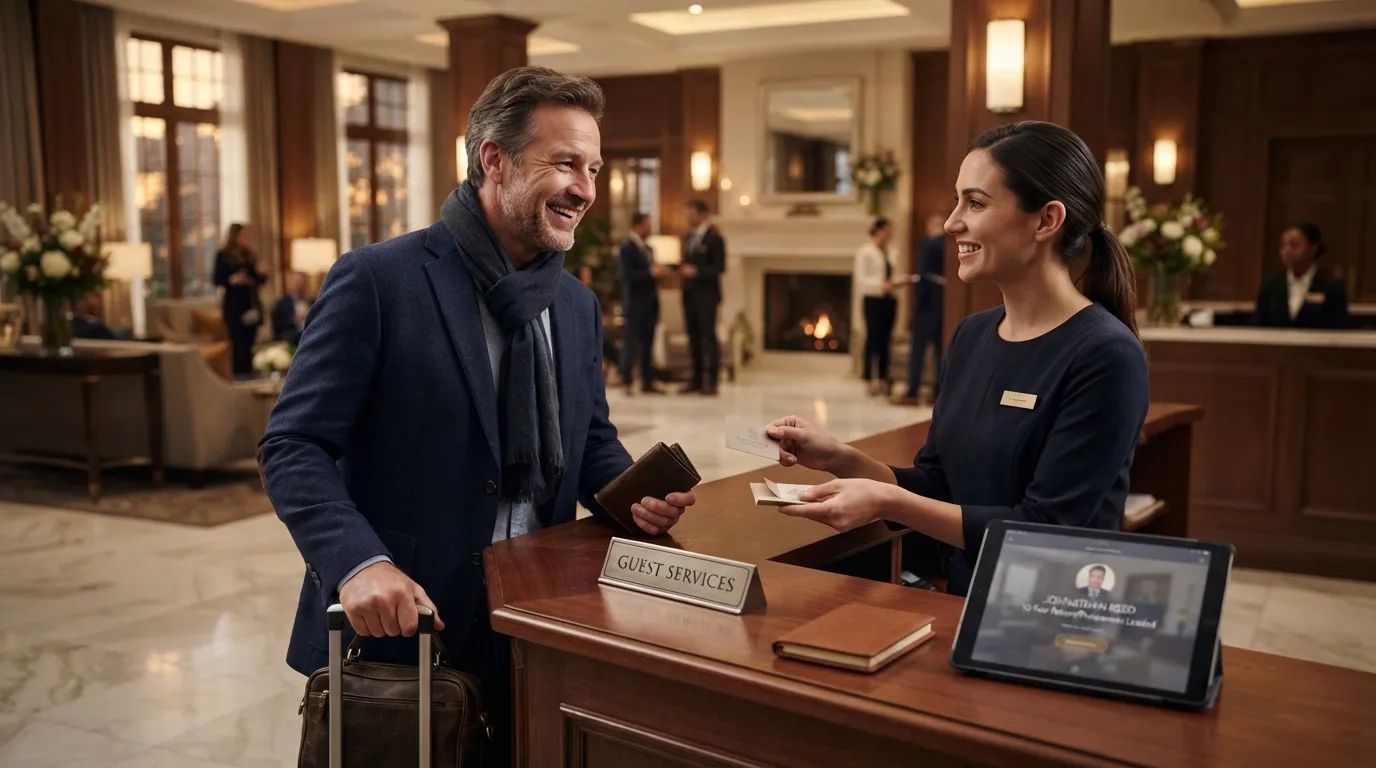
By the time you walk through the lobby, the front desk agent may already know your name, your preferred room type, and possibly what went wrong on your last visit.
Here’s the real secret: the best hotels treat a returning guest’s arrival as a rehearsed performance, not an improvisation. The warmth you feel isn’t spontaneous – it’s the result of preparation that began 24 hours before you arrived.
When loyalty status, stay history, and preferences surface automatically at check-in, staff can deliver recognition without relying on memory or manual lookups.
Knowing your preferences is one thing. What comes next is how hotels track something far more personal – and use it to manufacture loyalty on a level that’s almost unsettling.
#4 – The $2,000 Rule That Buys a Guest for Life

Here’s a fact that stops most people cold: some hotels give their staff the authority to spend serious money – on the spot, without asking anyone – to make a guest happy.
(cite index=”9-3″>Every Ritz-Carlton employee is authorized to spend up to $2,000 per guest, per incident, to resolve a problem or enhance a guest’s experience, without needing managerial approval.
At a Glance
- (cite index=”5-2″>$2,000: what any employee can spend per incident, not per year, to rescue a guest experience.
- (cite index=”9-6″>Multiple issues in one stay can each be resolved separately, with no cap on how many times the rule is used.
- (cite index=”5-5″>$250,000: the average lifetime spend of a loyal Ritz-Carlton guest, the number that reportedly justifies the policy.
- (cite index=”9-13,9-14″>Ritz-Carlton contacts say the rule is rarely used at anywhere near its full amount.
The result is moments guests carry with them for a decade. A guest who once mentioned their anniversary at check-in might find chocolate-covered strawberries and champagne waiting in their room on a return visit – in a completely different city.
That cross-property memory is the most underrated trick in luxury hospitality. Guest preference programs record details down to room temperature, favorite wine, or pillow type, and a centralized system carries that memory across every location.
You weren’t “lucky” to get that upgrade or that bottle of wine. You were remembered – on purpose.
#3 – The CRM System That Never Forgets

Most hotel loyalty programs look like simple points schemes on the surface. Underneath, they’re sophisticated behavioral tracking systems – and the data they collect doesn’t expire.
A CRM is where loyalty intelligence compounds over time, adding room preferences, dining habits, and response rates to past offers with every stay. A well-configured system uses that data to segment guests automatically and trigger the right message at the right moment.
Quick Compare
- Reactive hotel: greets a returning guest like a stranger and starts from zero.
- Proactive hotel: pulls stay history before check-in and prepares around past preferences.
- Reactive hotel: apologizes after a service slip happens.
- Proactive hotel: uses stored data to make sure the same slip never happens twice.
Today’s guests expect more than a standard interaction – they want experiences that reflect who they actually are. Advanced analytics now let hotels move past basic CRM into something closer to hyper-personalization.
The turning point came when AI entered the picture. Hotels can now anticipate what a returning guest will want before the guest consciously knows it themselves, based on patterns from stays that may be years old.
Ten years is not an exaggeration. For many properties, that’s simply the minimum lifespan of a guest file.
#2 – Why Most Hotels Still Get This Wrong

Here’s the uncomfortable truth the hospitality industry doesn’t advertise: most hotels are still failing at guest memory, even with all the tools available.
Hotels don’t struggle because they lack guests. They struggle because they forget them – a guest stays, leaves, and becomes just another record in a database.
When that same guest returns months later, the hotel treats them like a stranger. Many boutique properties still haven’t switched to a modern CRM, which pushes them into reactive problem-solving instead of proactive hospitality.
This is the single biggest differentiator in hospitality today – not the thread count, not the pool, not the view. Properties with strong guest-recognition systems consistently see better review scores and more repeat bookings than those without.
The hotels that remember you after ten years aren’t doing magic. They made a deliberate investment in systems and culture that most competitors skipped.
#1 – The Real Reason a Hotel Remembers You Ten Years Later

Technology explains the “how.” It doesn’t explain the “why.”
The hotels that still know your name a decade after your last visit made a decision most businesses never make: they decided your memory was worth protecting.
Guests tend to remember how a hotel made them feel rather than the specific services they received. The best hotels understood this first, and built their entire operating model around reversing that equation.
(cite index=”22-14″>The managers create processes and systems and measurements, but leadership creates an environment where they want to do it.
Horst Schulze, Ritz-Carlton co-founder
Staff are trained to observe and predict guest needs before they’re even spoken aloud – mention a special occasion during check-in, and a cake or a small gift may already be on its way. That instinct is what separates a property with great rooms from one with lasting loyalty.
The truth is that ten-year memory isn’t a technology problem – it’s a values problem. A CRM only becomes a hotel’s memory when someone decides that memory matters; ignored, it’s just another unused system.
The Bottom Line

Most guests assume that feeling “known” at a hotel is a coincidence, or the work of a charming front desk agent. It’s actually the output of a system that’s been running quietly since before you even checked out.
Guest preference programs record details as specific as room temperature and pillow type, and centralized systems carry that memory across every property in a chain.
The hotels that do this best – the ones that greet you by name after ten years – have built a culture where forgetting a guest is treated as a genuine failure.
Have you ever been recognized at a hotel years after your last stay? What detail did they remember – drop it in the comments, we’d love to know.
Bonus – The Insider Trick That Gets You Remembered for Life

You don’t have to wait for a hotel to notice you – you can plant the memory yourself, before you even arrive.
- Log into your loyalty account (Marriott Bonvoy, Hilton Honors, World of Hyatt, etc.) and fill out the “Guest Profile” or “Preferences” section with your exact pillow type, room floor, and any recurring occasion dates.
- Two to three days before arrival, send a short email or app message directly to the hotel mentioning one specific preference or occasion – a written note is far more likely to land in the permanent guest file than something said in passing.
- At check-in, repeat that same detail out loud to the front desk agent; verbal confirmation is usually what prompts staff to actually update the “guest preference” record on the spot.
- On checkout, ask if your preferences were noted correctly for next time – this simple question forces staff to double-check the file, which is the single biggest reason repeat guests get recognized years later.
Do this once, and you’re no longer just another record – you’re the guest the system is built to remember.