
Most people picture a crocodile as a thick-jawed, amphibious killing machine. Then there’s the gharial – and it breaks every rule you thought you knew about the species. It has a snout so long and narrow it looks like something out of a fever dream, a bizarre bulbous knob on its nose that it uses to produce a buzzing love song, and it’s so committed to water that a fully grown adult cannot even lift its own body off the ground. It is, without a doubt, the strangest crocodilian alive. It is also one of the closest to gone.
What makes this story genuinely hard to sit with is that the gharial was already pulled back from the brink once. Conservation programs in the 1970s and 80s gave the species a second chance – and it’s still not enough. New threats are piling on faster than populations can recover, and a landmark 2025 assessment now classifies the gharial as not just Critically Endangered, but “Critically Depleted.” Here’s what the latest science actually says about this ancient, baffling animal – and why right now might be the most dangerous moment in its entire history.
The Snout That Doesn’t Make Sense – Until You See It Hunt
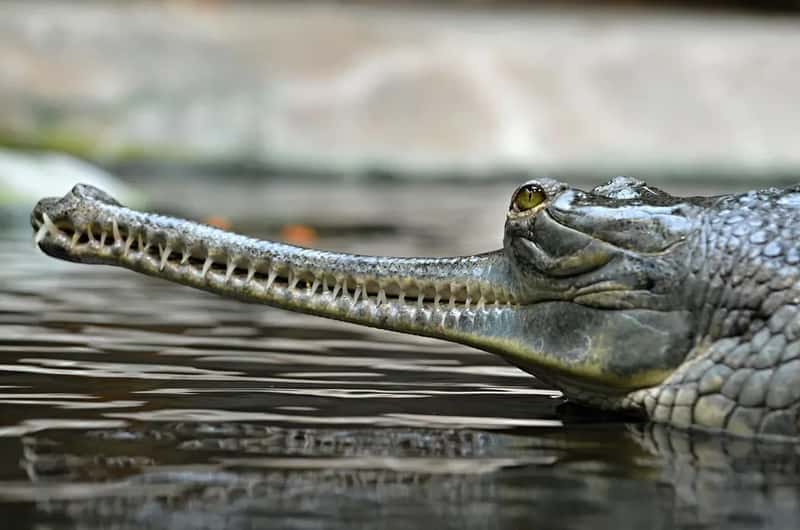
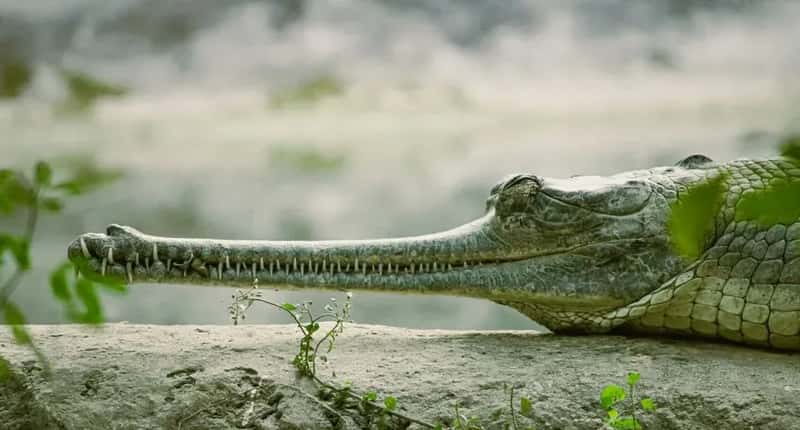
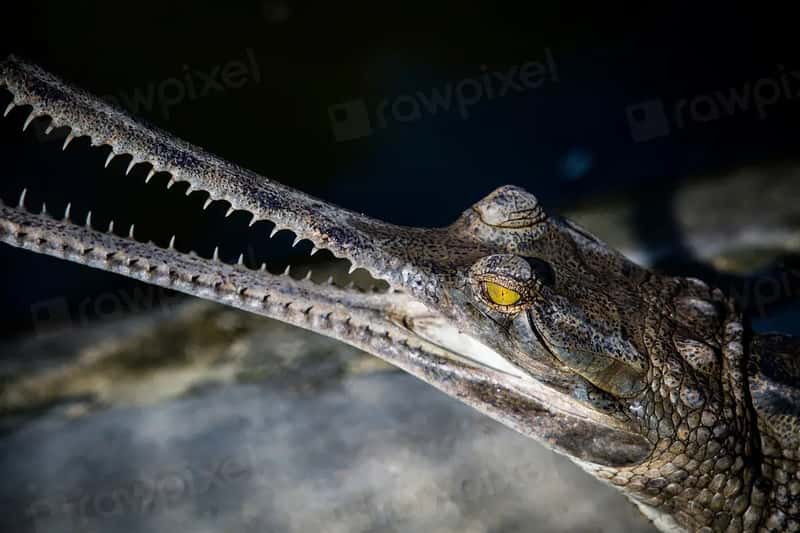
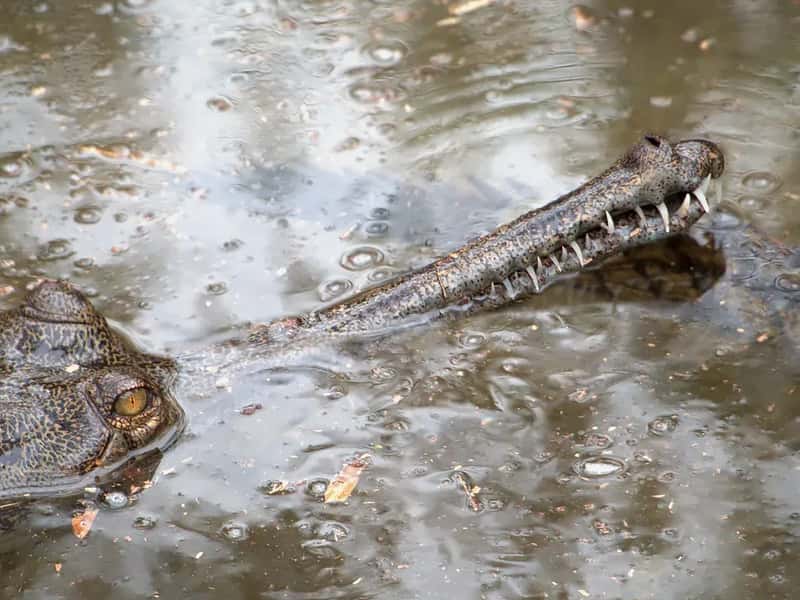
Out of the 26 species of crocodilians in the world, gharials possess the thinnest and most elongated snout, which makes them easily identifiable. It’s not just aesthetic oddity – it’s pure engineering. Gharials hunt by rapid sideways snapping of the head and jaws to seize schooling fish with minimal drag from their narrow snout. That reed-thin jaw cuts through water with almost no resistance, giving the gharial a mechanical advantage that a broad-snouted Nile croc could never match in a fast-flowing river.
Their long snouts are highly sensitive, equipped with pressure receptors that help them detect fish movements in murky water. Crocodile-like in appearance with a distinguishing long, narrow snout, gharials carry up to 110 razor-sharp interlocking teeth. The whole system – long jaw, pressure sensors, needle teeth – is tuned to one task with almost obsessive precision. Turns out that level of specialization is also exactly what makes the gharial so fragile when its river habitat is disrupted.
That Bulbous Knob on the Nose Is Actually a Built-In Speaker
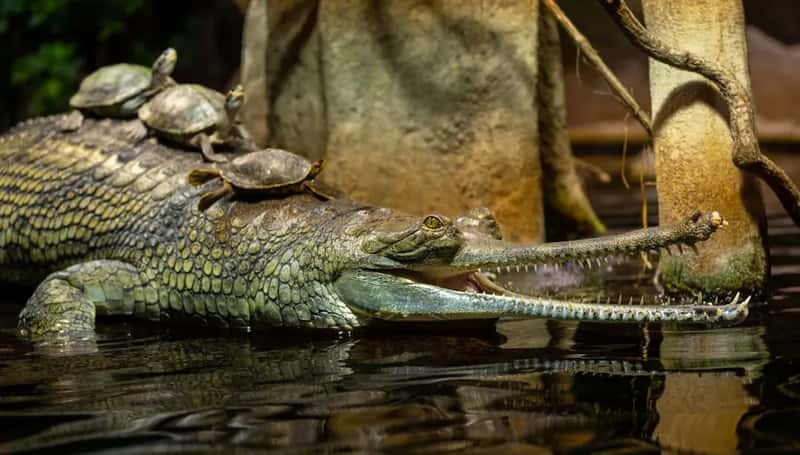
The single most alien feature on any crocodilian is the “ghara” – the fleshy, pot-shaped lump that sits at the end of an adult male gharial’s snout. The ghara has several functions: it partially covers the crocodile’s nostrils and acts as a vocal resonator, creating a loud, buzzing sound when the gharial vocalizes. It is also a visual signal for females, helping males attract a mate. Males begin to develop their gharas around 10 years of age.
The gharial has long, thin jaws which it uses to catch fish, and males have a large, bulbous growth known as a “ghara” on the tip of their snout. The “ghara” is named after a traditional Indian pot, and forms the basis of the common name of the species. Gharials are the only crocodiles with such an obvious difference between males and females. That last fact is genuinely remarkable – every other crocodilian species looks roughly the same regardless of sex. An adult male has a “ghara” at the end of its snout: a lightbulb-shaped bump. This bizarre lump looks attractive to females and helps males woo their mates by blowing bubbles and creating a strange love song. No other reptile courts a mate quite like this.
It’s Essentially Helpless the Moment It Leaves the Water
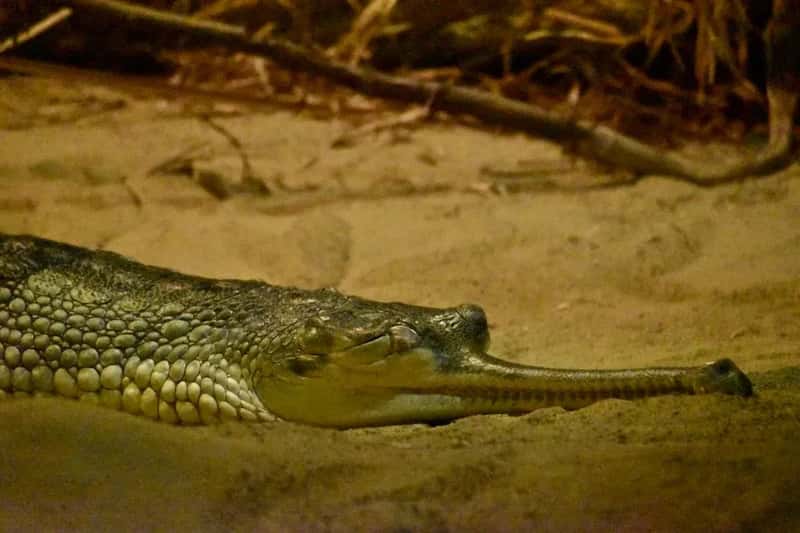
Every other large crocodilian can, when pressed, gallop across land at a surprisingly unnerving speed. The gharial cannot. Gharials have weak leg muscles, which is why they are primarily adapted to aquatic environments and have limited terrestrial capabilities. They only ever leave the water to bask in the sun or nest on sandy banks. When they do move across land, gharials push their bodies forward across the ground, a motion known as belly-sliding.
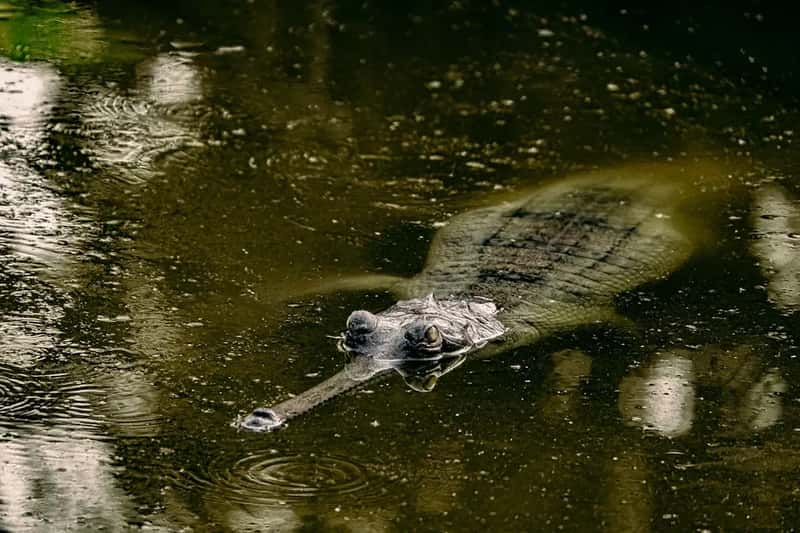
This extreme aquatic commitment makes the gharial the most water-dependent of all crocodilians – it is the most thoroughly aquatic crocodilian, and leaves the water only for basking and building nests on moist sandbanks. That’s a double-edged adaptation: it makes the gharial an elite river predator, but it also means that when a river degrades, gets dammed, or loses its sandy banks, the gharial has essentially nowhere to go. It can’t walk away from a bad situation. It’s locked in.
A 98% Population Crash in Under a Century
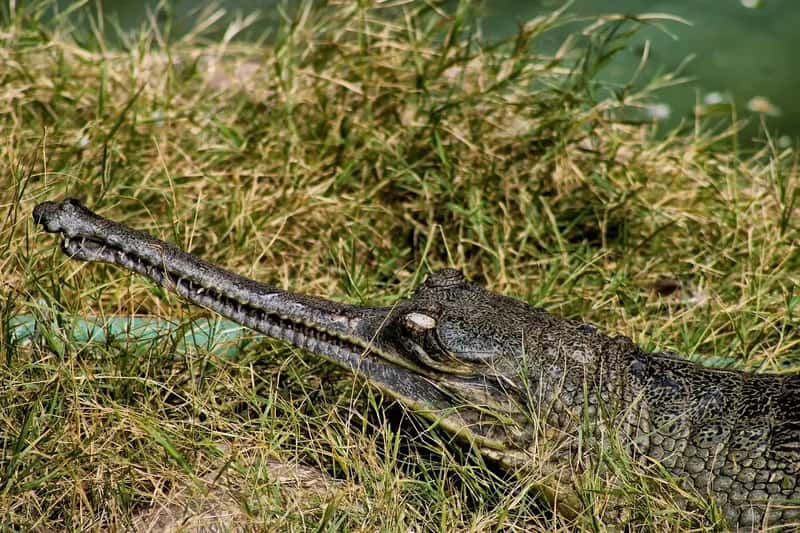
Here’s the number that stops you cold. The gharial is listed as Critically Endangered by the IUCN Red List as a result of catastrophic population declines, which have seen the population decline by up to 98% since the 1940s. Listed as Critically Endangered on the IUCN Red List, the global population of gharials, endemic to India, has been reduced from 5,000 in the 1940s to a few hundred individuals in the wild. That is a near-total wipeout within a human lifetime.
Formerly found in rivers across Nepal, Pakistan, Myanmar, India, and Bhutan, the gharial crocodile has faced significant population declines, and today is extinct in most of these areas, occupying just 2% of its historic range. Among the three crocodile species India hosts, the Chambal River is home to 68% of the world’s wild gharial population, making it the largest concentration of gharials globally. **An entire species – one of the most evolutionarily distinct animals on Earth – is now clinging to existence in fragments of one river system.** That concentration is itself a danger: one catastrophic event in the Chambal and the species could effectively collapse overnight.
The Threats Coming at It From Every Angle Right Now
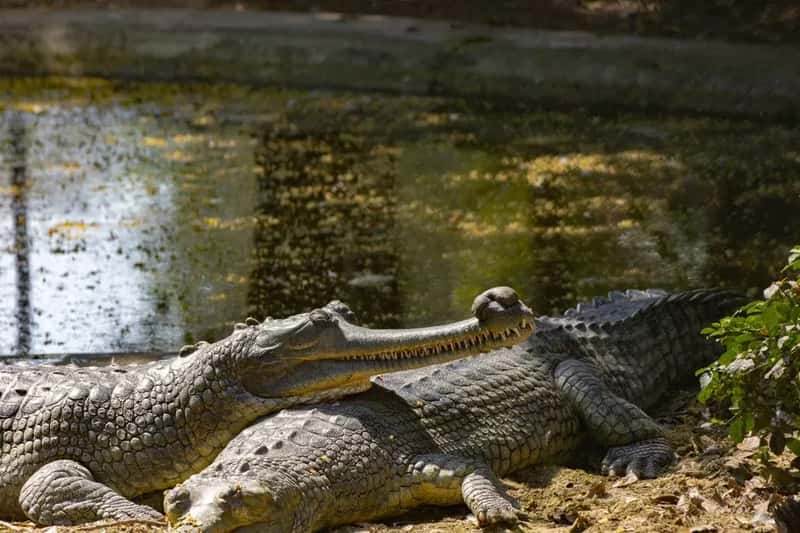
The gharial isn’t losing ground to one villain – it’s losing ground to a stacked deck. Major threats to gharials include habitat disruption from sand mining, dam construction, and getting caught in fishing nets. The gharial, with its long, toothy rostrum, is particularly vulnerable to entanglement in fishing nets, where it is frequently trapped underwater and drowns. That long, specialized snout – the same feature that makes it a brilliant fish hunter – is a liability in any net it accidentally enters.
Dams and barrages fragment river habitats, cutting off breeding grounds and migration routes. Sudden water releases during monsoons wash away eggs and hatchlings, leaving little chance for survival. Sand and boulder mining, especially in the southern tributaries of the Ganga, have been found to be disturbing the nesting patterns and sites of the species. Every nesting season, females need specific stretches of undisturbed sandy riverbank to lay their eggs – and those stretches are getting harder to find, mined away or flooded out by mismanaged dam discharges. This is a species being squeezed from every direction simultaneously.
The 2025 “Critically Depleted” Classification Changes Everything
In 2025, the gharial received a new and sobering designation that goes beyond its already-alarming Critically Endangered status. The International Union for Conservation of Nature (IUCN) has released its inaugural Green Status assessment for the gharial, classifying the species as “Critically Depleted” numbers-wise and habitats-wise, across its former range. The Green Status doesn’t just measure how close a species is to extinction – it measures how far it is from full recovery. The gharial scored as about as depleted as it gets.
Classified as Critically Depleted in the 2025 assessment, though populations are not recovering quickly, the gharial would already be extinct without past conservation efforts. Breeding adults in a substantial portion of its range could die within a decade if conservation does not continue. Gharials are listed as a critically endangered species with low genetic diversity, and this vulnerability is increasing in the face of climate change as the crocodiles are sensitive to changes in temperature, among other climate impacts. Low genetic diversity means the population has little biological resilience – a disease, a drought, a single bad monsoon could do devastating damage.
Climate Change Is Now Hitting the Gharial in a Way No One Fully Predicted
Just when you thought the pressure couldn’t build further, climate change is adding a layer that scientists are still scrambling to quantify. Gharials are listed as a critically endangered species with low genetic diversity, and this vulnerability is increasing in the face of climate change as the crocodiles are sensitive to changes in temperature, among other climate impacts. Reduced river flows due to water diversion for irrigation and urban use turns vibrant rivers into stagnant pools, unsuitable for gharials. A gharial needs fast-flowing, deep water with sandy banks – and climate-linked droughts and altered monsoon patterns are quietly erasing those conditions.
A major peer-reviewed study published in March 2025 specifically modeled what climate change means for gharial habitat going forward. The critically endangered and endemic gharial, once on the edge of extinction, has been revived in the wild through focused conservation efforts across the Indian subcontinent. Today, gharial populations are restricted to fragmented habitats in northern India and lowland Nepal. Despite extensive research on the species, a significant knowledge gap persists regarding the effects of climate change on its spatial distribution. The study found complex results – some regions may see expanded suitable habitat by 2080, but the animals still need to get there. Fragmented populations cut off by dams and degraded rivers can’t simply migrate to better ground.
It’s Also One of the Most Ecologically Irreplaceable Animals on the Planet
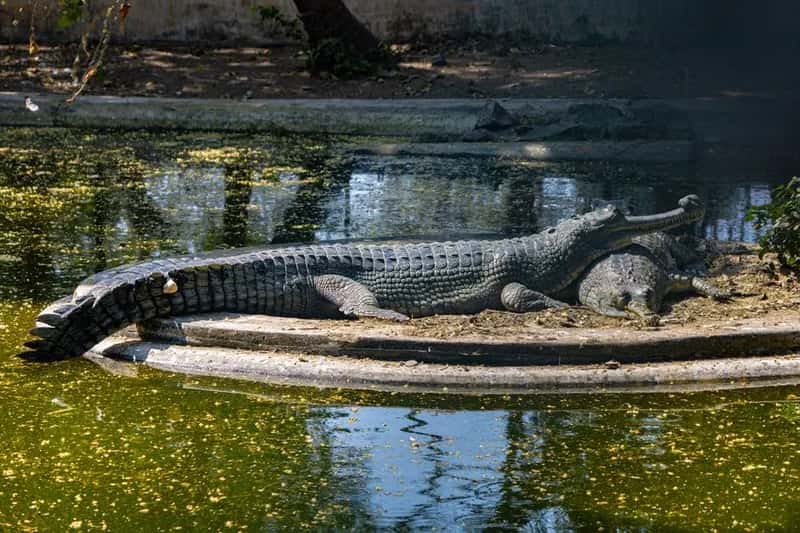
This is the part that gets genuinely underreported. The gharial isn’t just a weird-looking croc that happens to be endangered. A metric known as EcoDGE (Ecologically Distinct and Globally Endangered) revealed that gharials scored the highest in conservation priority. Gharials were identified as the most functionally distinct species of crocodilians, emphasizing that their extinction would leave an irreplaceable void in their environment. Nothing else does what the gharial does in the rivers it inhabits.
Gharials play a vital role by bringing nutrients from the riverbed to the surface and vice versa, which sustains the fish population and supports the overall health of the aquatic environment. The gharial is a unique crocodilian. It is harmless to humans and shows a remarkable sociality, including communal care of hatchlings in crèches of up to thousands of young. Gharials last shared a common ancestor with the false gharial around 20 million years ago and, together, they diverged from all other crocodilians more than 40 million years ago. That evolutionary uniqueness cannot be recovered once it’s gone. Losing the gharial isn’t just losing one species – it’s losing an entire branch of life that has no close substitute.
Conservation Is Working – But Barely, and the Window Is Narrow
Here’s the honest truth: the gharial is still here because people fought hard to save it. Thanks to the legacy of past conservation efforts, the unique gharial has not vanished completely. But without protected areas and prohibitions on gill net fishing, hunting, and egg collection, the gharial would almost certainly have disappeared already. With support from the Wildlife Adaptation Innovation Fund, WWF-Nepal and the Department of National Parks and Wildlife Conservation worked to address these challenges by translocating 10 gharials to a new and more suitable habitat: the West Rapti River in Nepal’s Banke National Park.
The problem is that recovery is painfully slow against the scale of ongoing damage. Conservation programs initiated in India and Nepal focused on reintroducing captive-bred gharials since the early 1980s. Conservation breeding programs have been established, but reintroductions have proven ineffective in many cases, because the habitat those animals are released into is still deteriorating. There is still hope for gharial. But conservation actions need to be strategically focused where they will have maximum impact, especially habitat protection and restoration, and actions to support coexistence with people. The science is clear: protecting the rivers matters just as much as protecting the animal itself.
The Bottom Line
The gharial is unlike anything else alive – 40 million years of evolution built an animal so specialized, so strange, and so ecologically essential that its disappearance would leave a gap in river ecosystems that no other creature can fill. It survived dinosaurs, Ice Ages, and geological upheaval. What it may not survive is a century of dams, nets, sand mining, and a warming climate reshaping the very rivers it was built for. The 2025 “Critically Depleted” classification isn’t a formality – scientists are warning that breeding adults could vanish from much of their range within a decade without sustained action. This is one of the most unusual animals on Earth, and it is closer to gone than most people realize. Have you ever seen a gharial in person, at a zoo or in the wild? Drop it in the comments – and share this if you think more people should know this animal exists before it doesn’t.