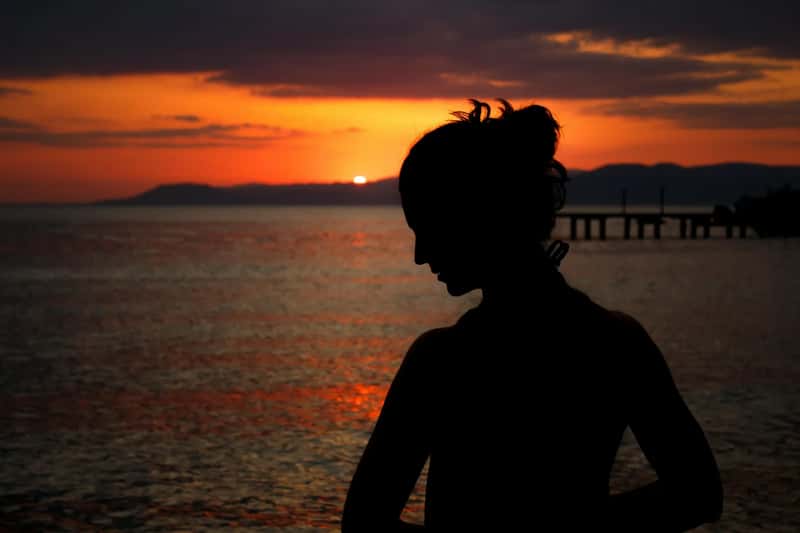
The sky turns amber over a city you can’t pronounce.
You didn’t expect this.
You’re not sad. You’re not happy. You’re something else entirely – a feeling with no name in your mother tongue.
You pull out your phone. You don’t take a photo. You just stand there.
Here’s the thing about modern travel: we spend enormous energy curating who we are at home – our job title, our routines, our carefully managed social media selves. Then we buy a plane ticket and land somewhere that doesn’t know any of that. The roles dissolve. The mask loosens. And in that gap between who we pretend to be and who we actually are when no one is watching – something raw walks in and sits down next to you at golden hour.
1. The Stripped Self
Struggling with our sense of self is a process that happens in comparing our home country with the host one. But that process isn’t purely loss. It’s excavation.
At home, identity is armor. It’s the job you explain at dinner parties. The neighborhood you live in. The opinions you’ve performed so many times you’ve forgotten they were ever choices.
Abroad, that armor gets checked at the border like overweight luggage.
You walk lighter. You also feel more. The self that emerges in foreign territory is quieter, more honest, and frankly a little frightened of what it finds when the noise goes away.
Sunset is when that stripped self stands fully in the open. The day is ending. The performance is over. And there’s no audience left to perform for.
What you feel watching that sky isn’t just beauty. It’s the sudden, disorienting recognition of your own interior – the you that doesn’t need a title or a timeline.
That recognition hits hardest at dusk. Because dusk doesn’t care who you are. It just burns.
2. The Neuroscience of Dusk
Your brain is doing something very specific when the light fades.
When we watch a sunset, our bodies respond to diminishing light. The suprachiasmatic nucleus in our brains senses these changes and signals for melatonin production. This shift doesn’t merely prepare us for rest – it alters our mood too. With lower cortisol levels and rising melatonin, we enter a state ripe for reflection and emotional openness.
Read that again. Ripe for emotional openness.
That’s not poetry. That’s biochemistry.
Your stress hormone is dropping. Your guard is physiologically lowering. Unlike bright daylight, which keeps us alert, sunset’s warm tones encourage relaxation – a perfect backdrop for introspection.
Now add a foreign country to that equation. You’re already emotionally porous from navigating the unfamiliar. You’ve been decoding body language, translating menus, recalibrating every social instinct you own.
By the time dusk arrives, you are wide open. The sunset doesn’t create the emotion. It simply walks through a door you’ve been holding ajar all day.
3. The Awe Mechanism
There’s a specific emotion at work here that most people mistake for generic sadness or beauty-induced sentimentality.
It’s awe.
One of the most powerful emotional effects of watching a sunset is awe. Awe is the feeling we get when we experience something vast, beautiful, or beyond our understanding. It temporarily shifts our attention away from ourselves and places us in a more connected, expansive state of mind.
In a foreign country, awe is doubled. The sky is vast. The unfamiliar city beneath it is vast. The gap between who you were when you woke up at home three days ago and who you are right now – that’s the vastest thing of all.
Psychologists have found that experiencing awe regularly can increase feelings of life satisfaction, generosity, and a sense of belonging. It also helps reduce stress and makes our everyday worries feel less overwhelming.
That lump in your throat watching the light die over a rooftop you’ll never see again? That’s your nervous system recalibrating. That’s awe doing its ancient, unglamorous work.
You are temporarily smaller than your own problems. That is an extraordinary gift.
4. The Ending That Is Also a Mirror
Sunsets are about endings. Always have been.
Beyond biology lies something deeper: psychological triggers associated with endings and transitions. Sunsets serve as daily markers of time passing – a visual cue prompting thoughts about how we’ve spent our day or what remains unfulfilled.
In your own city, that reflection is dull. The day is over. Another one like it comes tomorrow.
But in a foreign country, the math changes. Every day is finite and singular. No two sunsets are alike. Day in and day out, with all possible variations in weather, geography, and atmospheric conditions, the sunset remains a masterpiece – unique, therefore keeping us interested and curious about what color palette to expect from the sky the next time.
That singularity bleeds into your sense of time. This particular dusk, in this particular city, will never occur again. Not for you. Not like this.
The emotion you feel isn’t grief, exactly. It’s more like a very specific species of gratitude that arrives with teeth. It bites because it knows you’ll forget this by the time you’re home, reloading your inbox.
5. The Clarity That Only Distance Gives
I remember standing on a rooftop in Lisbon, watching the Tagus River swallow the last of a January sun. I hadn’t cried in years. Not properly. Not the kind of crying where you don’t know what the emotion is called and it doesn’t matter.
I cried then. Over nothing. Over everything.
I understood later what had happened. The distance from my ordinary life had stripped away the story I’d been telling myself about who I was. And in that gap – the research confirms what I felt in my bones – living abroad leads to a clearer sense of self because it prompts self-discerning reflections on whether parts of their identity truly define who they are or merely reflect their cultural upbringing.
The sunset was just the trigger. The real event was the clarity.
That clarity is quiet. It doesn’t arrive with instructions. It just sits with you on the rooftop and watches the light go, and you realize that most of what you’ve been so anxious about at home is structural – it’s the scaffolding, not the building.
And for one breathless evening, you can see the difference.
6. The Novelty Window
The brain has a relationship with novelty that borders on addiction.
Travel disrupts your routine and introduces novelty to your brain, which improves cognition and helps reactivate reward circuits. But that reward circuit has a side effect no travel brochure mentions: heightened emotional sensitivity.
When everything is new, nothing is filtered. You haven’t built the psychological calluses that let you walk past a beautiful thing without feeling it.
We crave novelty, excitement and challenge because these are the things that awaken us from our daily grind and remind us that life is much bigger than our usual circles. They remind us that our world is full of endless possibilities and that our everyday routine, while comfortable, is only a small part of what life has to offer.
In that awakened state, a sunset isn’t just atmospheric. It’s a revelation. Your unguarded brain processes it as something genuinely important – because in a foreign country, everything is genuinely important. Your survival instincts are politely elevated. Your senses are sharpened.
You are, neurologically, more alive. And more alive means more moved.
7. The Memory Machine
Travel rewires how experience becomes memory – and that rewiring has everything to do with emotional intensity.
Traveling fosters memory formation and retention by providing unique and emotionally rich experiences. When we explore new destinations, engage with different cultures, and participate in unfamiliar activities, our brains are stimulated in ways that enhance memory encoding. The novelty and excitement of travel experiences make them more memorable, leading to stronger recollections in the long term. The emotional intensity associated with travel, such as the joy of discovering a beautiful landscape, further reinforces memory formation.
Sunset in a foreign country carries an implicit knowledge that this moment is being permanently filed. Your brain knows it is rare. It treats it accordingly.
That urgency – the wordless sense that this matters and it’s ending and you should pay attention – is what floods you with feeling.
You aren’t crying at the sky. You’re crying at impermanence. At the radical briefness of beauty. At the fact that you drove past a thousand sunsets at home without once pulling over.
8. The Identity in Transition
Here is the psychological mechanic that most people miss entirely.
When you travel, you don’t just move through space. You move through identity states. International travellers often experience something far beyond the acquisition of new subject matter or cultural awareness – they undergo a personal paradigm shift that alters their perception of themselves and their world in such a way as to clarify areas of their lives that were previously unclear.
That paradigm shift is not comfortable. It is, in fact, a low-grade existential disruption. Discrepancies between expectations and reality can cause a loss of identity because they challenge our perceptions of ourselves and the world around us. When our expectations are not met, we may feel a sense of disappointment, frustration, and confusion, which can lead us to question our beliefs, values, and behaviours.
Sunset arrives at the exact hour when you’ve been questioning all day. The disruption is already underway. The sky just gives you a frame to feel it in.
The emotion is not about the light. It’s about who you’ve been discovering – and quietly dismantling – since you landed.
9. The Permission Structure
There is something no one talks about regarding emotional release in foreign countries, and it’s this: anonymity gives permission.
At home, you are witnessed. You are expected. You are the person who holds it together. Losing composure at a bus stop is a social event. Someone you know might see.
Abroad, you are nobody’s story. Travel serves as an external mirror that reveals internal truths. Away from familiar contexts and routines, we often see ourselves with fresh clarity.
That fresh clarity arrives without judgment. No one on this terrace knows your name. No one in this plaza knows what you carry.
So when the sunset does its thing – when the light turns the color of a feeling you can’t articulate – you let it. You let the thing happen. You don’t swallow it. You don’t make a joke. You just stand there, unwitnessed by anyone who matters, and feel it fully.
That permission is rarer than any destination you’ve ever booked. And it is precisely why the feeling arrives so cleanly, so completely, when you’re far from home.
10. The Thing You’re Really Mourning
By the tenth point, we have to tell the truth.
The emotion isn’t just about sunsets, or novelty, or neuroscience, or awe. All of that is real. All of that is operating. But underneath every sunset cry in every foreign city is a quieter, heavier recognition.
Many travelers report that their travel experiences become reference points for personal identity long after returning home – markers that divide life into “before” and “after” the transformative journey.
You feel that division happening in real time. You know, somewhere below articulation, that this version of you – the one standing here, unguarded, with a stranger’s sky overhead – will not be the version that goes back. You will repack your armor. You will re-enter the performance. You will answer emails and attend meetings and explain yourself in the shorthand your social circle accepts.
What you are mourning at sunset is the temporary you. The real you. The one that only emerges when no one is looking and the light turns gold and there is nothing left to protect.
Nostalgia often strikes during moments tied to beauty or calmness. When faced with a stunning sunset, memories flood back – perhaps recalling laughter shared under similar skies or bittersweet goodbyes at dusk. But in a foreign country, the nostalgia is stranger than that. It is nostalgia for a present moment. Nostalgia for right now, before it becomes the past.
That is the most disorienting grief a human being can experience. And the most strangely beautiful.
The sunset doesn’t make you emotional. The foreign country doesn’t make you emotional. The combination of the two simply removes, one by one, every layer between you and the thing underneath – until you are standing there at dusk, breathing air you don’t own, watching a light source that predates every story you’ve ever told yourself about who you are.
Most people go home and call it “a moment.” They post the photograph. They move on. But somewhere in the body, something has shifted. The calibration is slightly different. The thing that opened, out there at golden hour over an unfamiliar skyline, doesn’t close all the way back. It can’t. While the immediate impacts of travel may not last long-term, the perspective-shifting aspects can. Immersing yourself in a new and unfamiliar place can produce effects that help improve mental health beyond your return flight. You carry the aperture home with you, even if you never speak of it.
So the next time you find yourself undone by a sky in a city that doesn’t know your name – don’t reach for an explanation. Don’t blame the colors. Don’t post the photo and scroll away. Just stay with it for one more minute. Let it be the fullest, strangest, most honest thing you feel all year.
The light is leaving. You already know how it feels. You’ve always known.