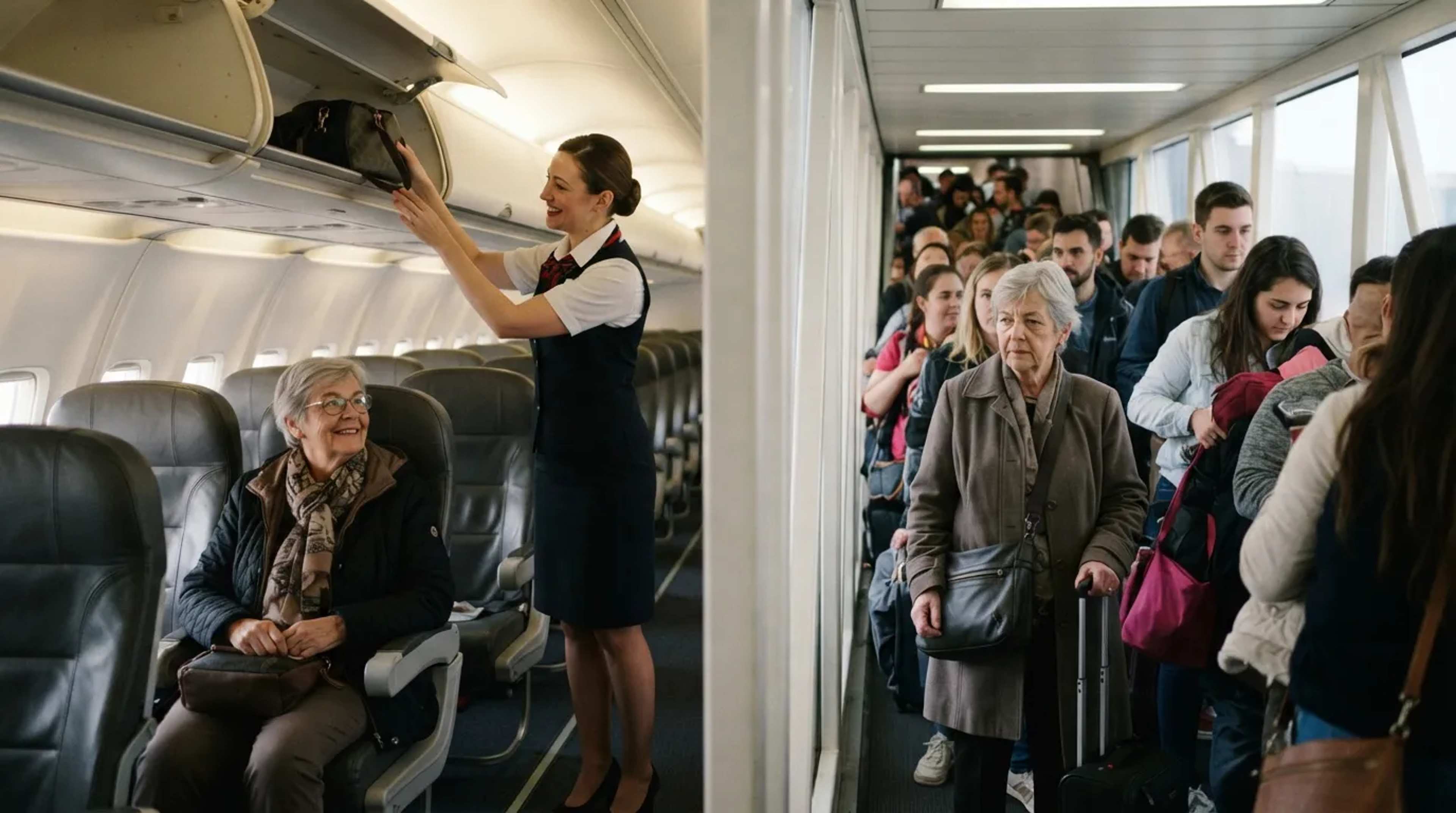
You open the app at midnight.
Not because you’re ready to go anywhere. Because you can’t be here anymore.
The flights are cheap. The problem isn’t.
There is a version of you that exists only in transit – passport in hand, no return address on your soul, identity reshuffled like a deck of cards between departure gates. That version feels lighter. Easier. More interesting. The tragedy is not that this version is a lie. The tragedy is that it keeps you from investigating what’s true.
The gap between the person you are at 11 PM scrolling through Airbnb listings and the person you’d need to become to fix the actual problem – that is the identity gap. It doesn’t close when you land in Lisbon. It waits for you at baggage claim.
1. The Dopamine Departure
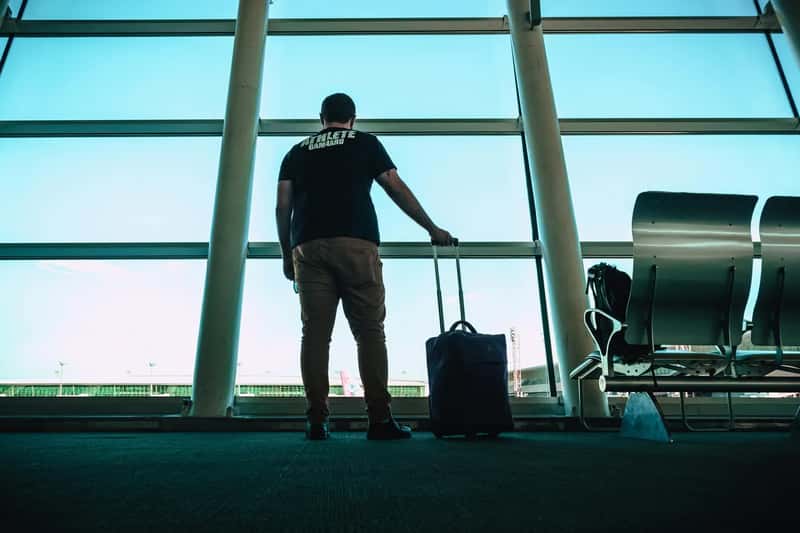
Before the wheels leave the ground, your brain is already celebrating.
Even as you put on your new outfit – tags still attached – your brain starts to release anticipatory dopamine, the brain’s reward chemical.
This is the trick. The reward comes before the experience. The booking itself is the high.
Travel activates entirely different neural networks than our day-to-day routines, making it a potent escape mechanism. The stimulation and novelty of new environments can act like a psychological reset, giving us a temporary break from the realities we don’t want to face.
And here’s the dark poetry of it: you haven’t solved anything. You’ve just relocated your nervous system temporarily.
The bucket list is not a map of the world. It’s a map of every moment you chose sensation over confrontation. Every destination is a dopamine deposit. Every check mark is the brain saying: not yet. Not here. Not this.
The escape feels earned. It always does. That’s why it works so well.
2. The Temporary Identity
There is something dangerously seductive about being a stranger somewhere.
Nobody knows your job title. Nobody knows your failed relationship. Nobody knows the version of you that goes quiet at family dinners.
Sociologist Karen Stein, who studies culture and travel, notes that travel and vacations are a means to reshift and reorganize identities – a way to reexamine priorities and devote time to identities we’ve had to put in the background.
But there is a fine, dangerous line between reorganizing an identity and abandoning one.
The traveler who keeps moving is also the person who keeps reinventing without ever integrating. A new city becomes a new costume. The soul inside it remains unchanged, unexamined, still carrying the same weight it carried at the departure gate.
The temporary identity is addictive because it’s consequence-free. You don’t have to be consistent. You don’t have to be known. You get to perform the best version of yourself for a finite audience, then board another plane before they notice the cracks.
3. The Exit Strategy
Watch someone’s face when life gets hard. Really watch it.
Some people go still. Some go toward it. And some – immediately, instinctively – begin to imagine being somewhere else entirely.
Like other escapist behaviors, when something stressful occurs, a habitual pattern sets in. This might be immediately looking up flights and planning trips. The travel-to-escape feeling is like a fight-or-flight reaction.
This is the exit strategy. Not a plane ticket. A psychological reflex.
The bucket list becomes a coping mechanism disguised as an aspiration list. Each destination is a pre-loaded emergency exit. Relationship trouble? Book Bali. Career confusion? Book Barcelona. Existential dread at 3 AM? Book literally anywhere with an ocean view.
Chronic reliance on escapism to avoid responsibilities or emotions may worsen anxiety, depression, or feelings of emptiness. Escapism can also fuel addictions, damage relationships, and reduce motivation to address challenges.
The exit strategy always has a return flight. The problem always gets back before you do.
4. The Novelty Addiction
New is a drug. And like all drugs, tolerance builds fast.
This connects to the hedonic treadmill, where the pursuit of novelty becomes a never-ending cycle. You check one country off the list and the dopamine fades within days. You need another. Then another. The list doesn’t shrink. It grows.
Much like relying on hallucinogens to experience a euphoric or altered state, constantly seeking the next trip can create an unhealthy dependence, even resembling the cycle of substance dependence.
This is the part nobody puts on their travel Instagram.
The creeping numbness. The way a beach in Thailand stops feeling like wonder and starts feeling like a screensaver. The moment you realize you’re not present in the postcard – you’re already planning the next one.
With overexposure to pleasure-producing stimuli, the reward circuitry in the brain adapts and becomes less sensitive to dopamine. Because of this increased tolerance, more of the addictive substance or behavior is needed to achieve similar, pleasurable results.
The bucket list is never finished. That’s by design.
5. The Passport as a Mirror
I will tell you something I don’t usually say out loud.
There was a year I traveled almost constantly. Different cities, different time zones, different beds. I told myself I was curious. I told myself I was free. I told myself that collecting experiences was the same as collecting self-knowledge.
It wasn’t. I was deeply, quietly unhappy about something specific at home. And every flight I booked was another week I didn’t have to sit in that unhappiness and look at it directly.
There are many occasions when projecting dissatisfaction onto one’s environment can be a way of avoiding the true causes of that distress. These causes may include existential crises, major losses, feelings of loneliness or disconnection, unfulfilling work, or chronic stress. Restlessness may require changes to the internal environment, not the external one.
The passport had stamps. The mirror had none.
I was collecting places the way some people collect arguments – as proof that the problem lived somewhere else. It didn’t. It lived in me, traveling light, never checking luggage.
6. The Social Performance of Wanderlust
The bucket list has an audience. Don’t pretend otherwise.
Every photo posted from a rooftop in Marrakech, every story tagged at an airport gate, every caption about “collecting moments not things” – it is a performance. A curated broadcast of a self that has opted out of the ordinary.
If we examine the way travel is marketed, it’s no surprise that many people associate happiness with getting away. Think about the commercials for Caribbean vacations, the glossy ads promoting tropical resorts, or the influencer culture that makes global travel look like the ultimate achievement.
The wanderlust identity has status. It signals freedom. It signals depth. It says: I am not like the people who stay.
But staying requires its own kind of courage. Building something in one place. Being known over time. Allowing the slow, unglamorous work of actually constructing a life.
The bucket list never celebrates that. There are no passport stamps for a difficult conversation you didn’t run from. No travel badge for the year you stayed and healed.
7. The Returning Problem
The flight home is always the hardest part of the trip nobody talks about.
The descent into familiar grey. The luggage carousel. The same notifications on your phone. The same version of reality that was waiting for you, patient, unmoved.
Over time, avoidance can lead to even greater dissatisfaction – because no matter how far you go, the challenges you’re running from will still be waiting for you when you return.
This is the cruelty of travel as avoidance. It is temporary by definition. The world moves with you and the problems do too.
Repeatedly booking trips to temporarily alleviate feelings of stress, anxiety, or depression stemming from an unhappy home or work life can lead to a cycle of temporary relief followed by intensified post-vacation blues. In such cases, the travel isn’t the problem, but rather a symptom of an individual’s struggle to connect with themselves or find contentment in their current environment.
The returning problem is the truest test. Not of where you went. But of why you had to leave.
8. The Unresolved Interior
Geography is not therapy. A change of scenery is not a change of psychology.
As Dr. Carla Marie Manly, a clinical psychologist, states: “In psychology, escapism is generally defined as a desire or behavior to ignore, evade, or avoid reality.”
The unresolved interior is the thing that packs itself into your carry-on without asking. It’s the anxiety that survives the altitude. The grief that still speaks your language even when no one around you does. The loneliness that somehow finds you in the most crowded souks on earth.
The persistent use of avoidant forms of coping, including escapism, is often present in mental health conditions including anxiety disorders and depression.
This is not an indictment of travel. It is an indictment of using movement to stand still emotionally.
The interior work – the part where you sit with discomfort and don’t immediately book a flight – is the work that actually reorganizes identity. It is slower than a plane. It is less photogenic. It is the most important journey on any honest bucket list.
9. The Identity Gap in Action
The identity gap is the space between who you perform on the road and who you actually are at home, at rest, without an audience or a view.
Joseph Troiani, a professor of psychology at Adler University, notes that travel can turn into a compulsive behavior for people who are looking to escape reality or use it as an avoidance strategy.
The gap widens every time you choose the trip over the reckoning.
You return from Kyoto more interesting but no more resolved. You return from Patagonia with better photographs and the same unfinished sentences. The gap doesn’t close with mileage points. It closes with honesty.
Virtually any activity can become an outlet for reality, and many of these behaviors may even seem positive. The key lies in asking ourselves if it is an excuse to avoid the necessary self-reflection.
The identity gap is not a failure. It is a signal. It points – with surprising accuracy – directly at what most needs your attention. The bucket list never points there. It always points outward. Away. Elsewhere.
10. The Hardest Destination
There is one place that never appears on a bucket list.
Your actual life, as it currently stands – unfiltered, unedited, without a golden hour Instagram filter softening the difficult edges.
The drive to escape often begins with a need to avoid discomfort – stress, monotony, or emotional burdens from daily life. Travel promises freedom, but the reality of escape without purpose can leave you feeling aimless. This is where escapism can intersect with anxiety or restlessness, turning avoidance into a habit rather than a solution.
The hardest destination has no boarding pass.
It requires you to sit down – inside the life you have, not the life you’re planning – and ask the question the bucket list was specifically designed to prevent you from asking: What, exactly, am I not dealing with?
Relying on travel to reset your brain or avoid stress can prevent you from developing emotional resilience. If you’re constantly running away from discomfort, you may never learn to sit with it, process it, and grow through it.
The hardest destination is also the most transformative. Not because it is beautiful. Because it is real. Because it does not give you a story to tell at dinner parties. Because it demands everything the open road never asks of you: stillness, honesty, and the willingness to be found.
There is nothing wrong with travel. There is something worth examining in the speed of the reach – the reflexive, almost desperate lunge toward the next place before you’ve finished unpacking from the last one. That speed is information. It has a shape. It rhymes with something you haven’t looked at yet.
The bucket list will keep growing. It is designed to. Every checked box reveals three new ones, an infinite scrolling feed of elsewhere. This is not wanderlust. This is architecture – a carefully constructed structure that keeps you moving fast enough that the quiet can’t catch you. And the quiet, as it turns out, is the only place where the real work gets done.
The most radical act of travel, in the end, might be to go nowhere at all – to sit inside the coordinates of your ordinary days, in the specific and unglamorous geography of your actual life, and decide that this, right here, is worth the journey.