The gate has closed.
Your name is still on the board.
The next flight is six hours away.
And you are standing at the departure terminal, coffee going cold in your hand, and you notice something strange. Something new. You are not unraveling.
There’s a version of you that existed not long ago – the one who would have turned a delayed departure into evidence of personal failure. The missed connection wasn’t just a logistical inconvenience. It was a verdict. A sign that the universe had something against you specifically. That you were, in some essential way, not built for a world that keeps moving without asking permission. It is the moment you notice the spiral beginning – and choose not to follow it all the way down. It is the moment the gate closes and your first thought is not of course this happened to me but simply okay, what now. It is the slow, private accumulation of evidence that you can be inside chaos and remain, somehow, yourself.
1. The Spiral Was Never About the Suitcase
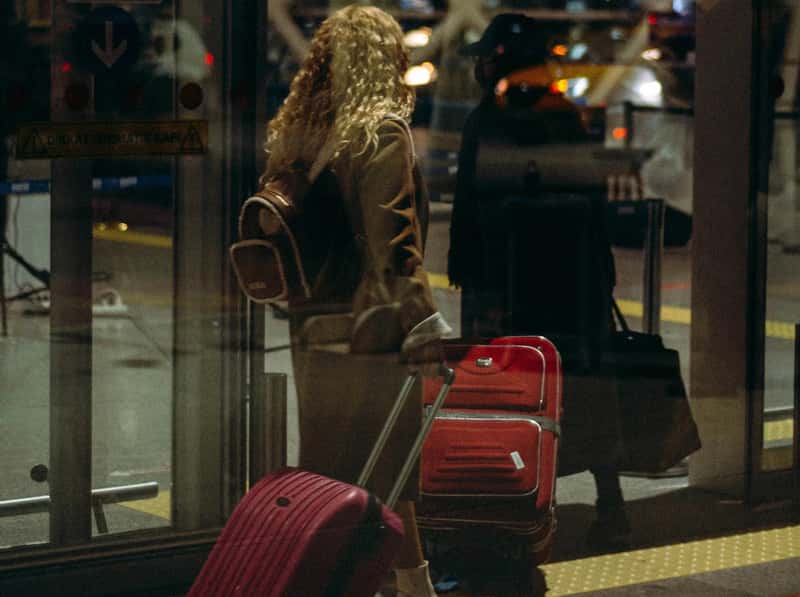
Here is the truth the carousel of lost luggage will never tell you: the panic was never about the bag.
One of the biggest triggers of travel anxiety is uncertainty – flight delays, lost luggage, unfamiliar transport systems, or being far from home support systems. But uncertainty is just the surface layer.
Underneath it is something rawer.
When your suitcase disappears into an airport’s shadow economy, what you actually lose – briefly, violently – is the illusion of control. The feeling that you had it together. That you planned well enough. That the world would honour your preparation.
It won’t. It never does.
The spiral wasn’t a response to lost clothes. It was a response to the sudden exposure of how fragile your sense of self becomes the moment the choreography breaks down. Healing begins when you can stand at that baggage claim, empty-handed, and feel inconvenienced rather than demolished.
That is a different kind of arriving.
2. The Temporary Identity
Travel does something no therapist’s office can fully replicate. It strips the costume.
This form of independent travel strips away the daily roles you play at home – employee, partner, parent – allowing your core identity space to breathe and be re-examined.
The temporary identity is who you become between roles.
In transit, no one knows your job title. No one knows your history. You are simply a body with a boarding pass, negotiating the same fluorescent corridors as every other body. There is a profound democratizing quality to that anonymity. And also a terror in it.
Because without the roles, who are you?
The anxious traveler clings to the roles even while moving. The healing traveler begins to find out.
They discover that the core self – the one that remains when the luggage is lost and the connection is missed – is more durable than they imagined. More quiet. More tolerant of ambiguity.
That’s not emptiness. That’s spaciousness.
3. The Nervous System in the Terminal
There is something particular about what airports do to the nervous system.
The lights are too bright. The announcements are too loud. The time zones have already begun their quiet war on your circadian rhythm. Crowded airports can overwhelm someone with high sensory sensitivity, and uncertainty challenges those prone to obsessive worry.
For someone who is still mid-wound, an airport is a stress laboratory.
Everything that dysregulates a nervous system lives here: noise, delay, crowds, loss of control, disconnection from the familiar. The old version of you activated in every terminal like a fire alarm. Heart rate up. Jaw tight. Eyes scanning for the exit that never actually leads out.
But here is what changes as you heal.
The dysregulation becomes information instead of emergency. You notice your breath shortening. You notice the familiar clench. And instead of fusing with it – instead of becoming the panic – you observe it from one millimeter of distance. That millimeter is everything. That millimeter is the whole of the work.
4. The Exit Strategy
Some people use travel as escape. That is not a dirty secret. It is a very human strategy.
The trouble is that the self buys a ticket too. It sits in the middle seat. It queues at the same passport control. You land somewhere new and within forty-eight hours the same low hum is back. The same restlessness. The same unease that has nothing to do with geography.
Even local explorations can provide the psychological distance needed to gain perspective on your life and identity. The key lies not in the distance traveled but in the mental space created for self-discovery.
Healing is the moment you stop using movement as avoidance and start using it as inquiry.
You stop running from. You start moving toward – even if you aren’t sure what the destination is yet.
The exit strategy collapses. What replaces it is something quieter and more honest. Presence. The radical, uncomfortable decision to be where you are, even when where you are is a gate B12 with a broken Wi-Fi connection and a three-hour delay.
5. The Pivot Point
I remember a particular January in an airport I will not name – because airports at 2 AM look identical everywhere, which is its own kind of poetry. My connection had been cancelled. My bag had been routed to a city I was not going to. I had a phone at eleven percent and a granola bar that had been in my coat pocket since an October I barely remembered.
The old version of me would have opened every app simultaneously. Would have called someone just to narrate the catastrophe. Would have spent the next three hours perfecting the story of how the world had done this to me.
Instead, I sat down. On the floor, back against the wall, under the departure board. And I watched the board flip. Flight after flight. Gate after gate. Hundreds of small disruptions occurring to hundreds of other people, none of whom the universe had targeted specifically.
Something settled.
Plans during travel rarely unfold perfectly. Accepting change and going with the flow develops emotional flexibility. Letting go of control reduces stress and helps you enjoy the present moment, leading to emotional growth.
That night I didn’t solve anything. I just stopped fighting the mess. And that, it turned out, was the pivot.
6. The Architecture of Resilience
Resilience is not a personality trait you either have or don’t have. It is a structure. And it gets built one small surrender at a time.
Your brain registers these successes, building a reservoir of resilience. When challenges arise – lost luggage, language barriers, bad weather – you have no choice but to cope.
Each time you cope and survive, the brain updates its threat model.
The missed connection that once felt fatal becomes an inconvenience. The lost suitcase that once felt like a crisis becomes a mildly irritating Tuesday. The architecture of your resilience does not announce itself. It is not dramatic. It simply means the collapse that used to last three days now lasts three hours. Then one hour. Then ten minutes of frustration followed by a shrug and a search for the nearest coffee.
This constant exposure to micro-stressors in a novel environment forces you to practice emotional regulation. Over time, travel changes your personality away from reactivity. You learn to embrace obstacles rather than getting deterred by them, building a profound resilience that translates directly into your personal and professional life back home.
That is what built looks like.
7. The Curated Self vs. The Real One
Modern travel carries a peculiar burden that older generations of travelers never had.
The curated self. The one that posts the arrival lounge and filters out the breakdown in the bathroom stall. The one that exists to be witnessed in motion.
Consciously limiting social media scrolling is crucial. Comparing your real, raw journey to others’ curated highlights can distort your experience and trigger feelings of inadequacy.
The identity gap widens every time you reach for the phone instead of sitting inside the experience. Every scroll is a small betrayal of the actual moment – the delayed, inconvenient, coffee-stained, beautiful actual moment.
Healing, in this context, means lowering the camera. Letting the mess exist undocumented. Letting the missed connection be just that – a missed connection – without turning it into content, without performing equanimity for an audience, without the caption that makes it seem like you’ve already arrived at your wisdom.
The real you doesn’t need to be framed.
The real you is already there, standing in the rain outside arrivals, recalibrating without an audience.
8. The Language of Disruption
When a flight is cancelled, the airline calls it a “disruption.” The word is clinical. Bloodless. But psychologically, it is precise.
Disruption is exactly what growth requires.
Travel disrupts our routines and challenges our preconceptions about how the world works. This disruption serves as a catalyst for personal growth. Traveling requires us to step outside our comfort zones and directly confront our biases. These moments of discomfort aren’t just incidental – they’re essential to the transformation process.
The person who heals is not the one who avoids disruption. They are the one who stops treating it as evidence of damage.
You are not cursed when the train leaves without you. You are not broken when the hotel gives away your room. You are not a failure when the best-laid plan dissolves like sugar in rain. You are simply in the world. The actual world. The one that was always this way, that was always this indifferent and this alive and this indifferent to your itinerary.
The language of disruption, relearned, sounds like this: That happened. I’m still here. What’s next?
9. The Return
Nobody talks enough about what comes after.
The return is its own kind of travel. You come back from somewhere and find that your living room is the same and you are not. “Reverse culture shock” is a well-documented psychological phenomenon where your newly evolved mindset clashes with your old, static environment. While initially uncomfortable, this friction is a catalyst for profound personal transformation. It forces you to consciously apply the open-mindedness, adaptability, and psychological freedom you gained on the road into your everyday life with intent and purpose.
The healed traveler carries the airport with them.
Not the anxiety of it. The lesson of it. The lesson that things get rerouted. That bags get lost. That connections get missed. That the world will not accommodate your plan and that this is not a personal attack. That you can sit on the floor under the departure board with eleven percent battery and a stale granola bar and still – still – be fundamentally okay.
You bring that knowing home. You let it sit in your kitchen. In your office. In the quiet moments when life also doesn’t go to plan.
The return is where the travel becomes permanent.
10. The Soft Landing
This is the heaviest truth, and it deserves to be said plainly.
Healing is not the absence of difficulty. It is not reaching a level of enlightenment where lost luggage no longer registers. It is not performing calm. It is not the Instagram version of a person who has done the work, serene in every terminal, undisturbed by delay.
Without companions to immediately share frustrations with, you learn to sit with discomfort, process setbacks like missed trains calmly, and find your own emotional equilibrium – a skill that reduces anxiety in other life areas.
Healing is quieter than that. More incremental. More honest.
The psychology of travel reveals that stepping outside your comfort zone creates opportunities to build mental toughness and emotional growth. When you face unexpected challenges abroad, you learn resilience, patience, and adaptability. These lessons last long after the trip ends, becoming part of your personal development journey.
The world is messy. It has always been messy. Airports are messy. Transit is messy. Connection – the human kind, the flight kind – is unreliable and gorgeous and often late.
And somewhere in all of that noise and fluorescence and recirculated air, you find the quietest, most radical thing you’ve ever managed to find.
You find that you are still okay within it.
Not because the world got tidier. Not because the flights stopped being delayed or the bags stopped disappearing into the system. But because something in you – something slow and private and built over time, over many small surrenders, over many floors of many airports at many hours – stopped needing the world to behave before you could feel safe inside your own skin.
That’s the landing you were always trying to make.
The one where you touch down – not in a city, not on a runway – but back inside yourself, right on time.