Ask a first-timer what makes a great RV trip and you’ll hear about the rig, the route, and the view. Ask someone who’s been on the road for twenty years and you’ll hear about a $20 brass fitting, a roll of tape, and a piece of paper taped by the door. The gear that saves a trip is almost never the gear anyone brags about.
Most of it costs less than a tank of gas, and none of it looks impressive in a showroom. Every item here earned its spot the hard way, usually at dusk, in the rain, at a site with no cell signal. And the one waiting at #1 isn’t a gadget at all.
#12 – Wheel Chocks and Leveling Blocks: The Cheap Gear That Stops a Rolling Disaster
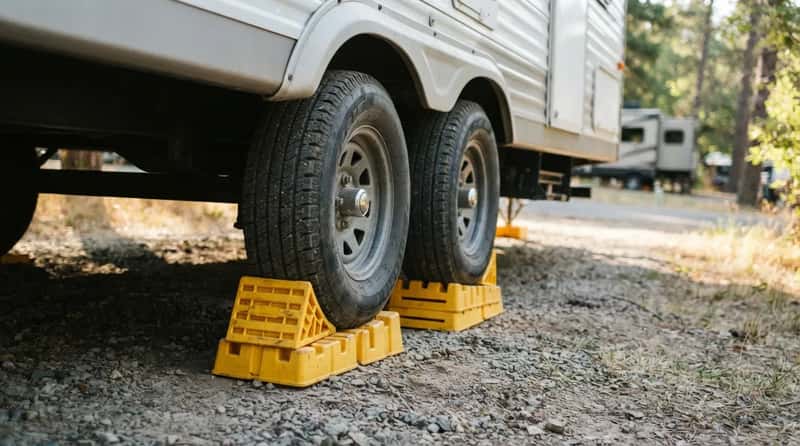
A parked RV is never as parked as you think. Parking brakes and transmissions help, but veterans don’t trust them alone. Chocks add a physical stop right at the tires, which matters most when you unhitch a trailer or park on a slope you barely noticed.
A trailer can shift the moment the weight comes off the hitch. That’s why experienced campers chock first, then unhitch. Leveling blocks ride in the same bin, and an unlevel rig is more than an annoyance. Absorption refrigerators generally need to sit close to level to cool properly, and cabinet doors can swing open on their own. A few stackable blocks cost far less than a repair bill.
- Chock both sides of at least one axle.
- Carry blocks even if your rig has automatic levelers.
The next item is smaller than your thumb, and it quietly decides whether your plumbing survives the weekend…
#11 – A Water Pressure Regulator: The $20 Part That Protects Hidden Pipes
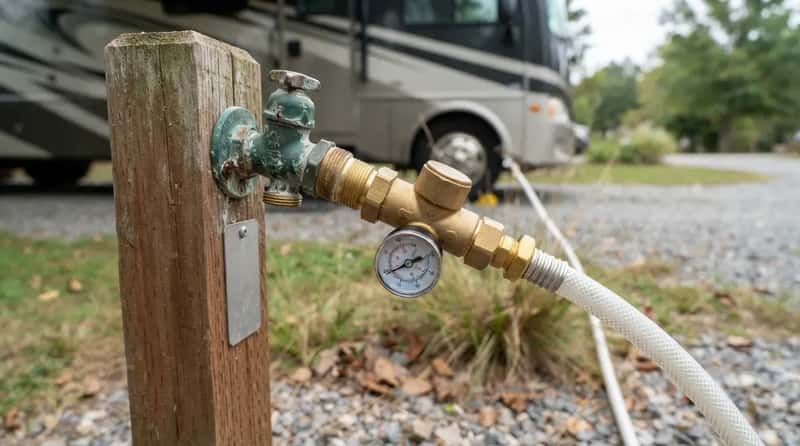
The spigot at your campsite may be far stronger than your RV was built to handle. Campground water pressure isn’t standardized. Some sites deliver a gentle trickle, and others deliver a blast.
RV plumbing is lighter-duty than the pipes in a house, and a pressure spike can split a fitting or blow a line you can’t even see. The damage often shows up behind a wall, after you’ve already left. That’s why longtime RVers screw a regulator onto the spigot before anything else, and the hose goes on after it. Many experts suggest choosing one that holds pressure within the range your manufacturer recommends, so check your owner’s manual for the exact number.
- Connect the regulator at the spigot, not at the RV.
- Replace it if you notice leaks or odd pressure swings.
Here’s something most beginners grab from the garage, and it turns out to be a mistake…
#10 – A Drinking-Water-Safe Hose: Why Your Garden Hose Doesn’t Belong Here
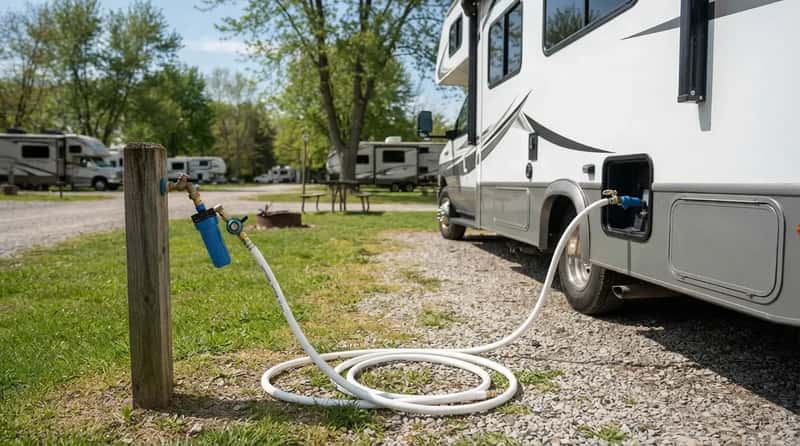
The hose you water your tomatoes with is not the one you should drink from. Standard garden hoses aren’t necessarily made for potable water. Hoses sold for RVs are typically labeled drinking-water-safe and often come in white or blue.
A hose can change the taste and safety of everything that flows through it. That’s before it spends a hot afternoon baking in the sun. Experienced RVers usually add an inline filter too. It catches sediment and improves taste, though a basic filter doesn’t make questionable water safe, so check what yours is actually rated to remove. Many keep a spare hose as well, since one cracked line can drain a tank fast.
- Store the fresh-water hose separately from every other hose.
- Drain it before storing so it doesn’t sour.
Worth Knowing
- Look for a “drinking water safe” or lead-free label right on the packaging.
- Many ordinary garden hoses carry a warning not to drink from them.
- Water that sits in a sun-baked hose can taste off, so let the tap run a few seconds first.
- A bright white or blue hose is easy to spot and hard to confuse with a waste line.
Now for a gadget some veterans call the best insurance they own…
#9 – A Surge Protector or EMS: The Shield Between You and a Bad Pedestal
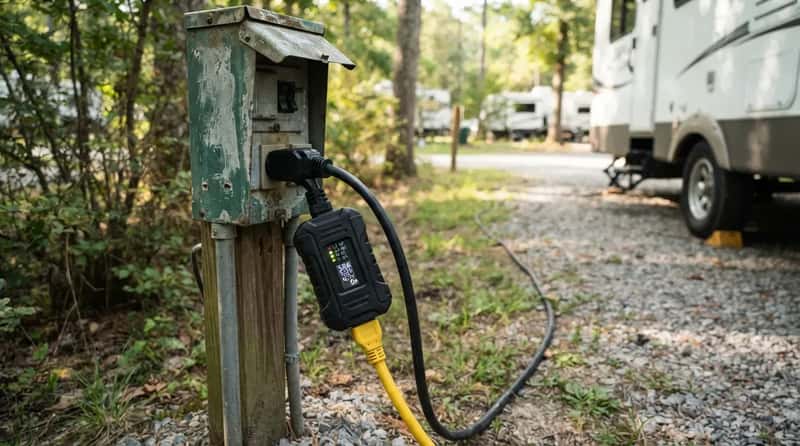
The power pedestal next to your RV is a mystery box, and veterans treat it like one. Campground wiring varies widely. Pedestals can be worn out, miswired, or straining under heavy summer demand.
A bad connection can quietly cook air conditioners, converters, and electronics. The damage often builds up over time, so a rig can seem fine until the day it isn’t. A basic surge protector handles spikes. A full electrical management system, or EMS, also watches for low voltage and wiring faults.
Here’s the part that sparks arguments. Many seasoned RVers call a cheap surge strip false comfort and say a proper EMS is the only version worth buying.
Next comes an odd-looking cord that gets you into sites that otherwise wouldn’t work…
#8 – Dogbone Adapters: The Pigtail That Rescues Mismatched Sites
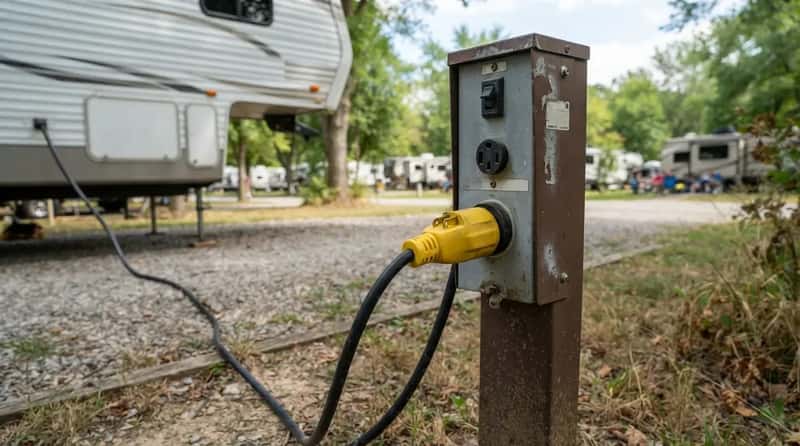
Showing up with the wrong plug is a rite of passage, and a preventable one. RV sites commonly offer 30-amp or 50-amp service, and some older sites offer less. Your rig is built for one, but the pedestal may offer another.
A short adapter, nicknamed a dogbone, bridges the gap. The catch is that an adapter doesn’t create extra power. A 30-amp connection provides roughly 3,600 watts, while 50-amp service can deliver up to about 12,000. Plug a big rig into a smaller outlet and you’ll have to juggle. Run the air conditioner and the microwave together, and the breaker will let you know. Experienced RVers carry the adapters and the patience.
- Know your rig’s amp rating before you arrive.
- Stagger heavy appliances on smaller circuits.
Quick Compare
- Household 15-amp outlet: 120 volts, about 1,800 watts at most.
- 30-amp RV service: 120 volts, about 3,600 watts.
- 50-amp RV service: 120/240 volts, up to about 12,000 watts.
The next item is the least glamorous on this list, and the one veterans refuse to skip…
#7 – Dedicated Sewer Gloves and a Sturdy Hose Kit: The Unglamorous Truth
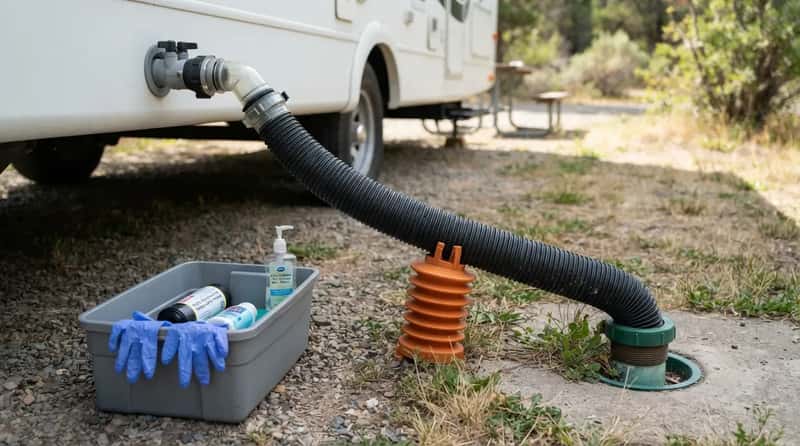
Nobody posts photos of this, yet every veteran RVer owns it. Dumping the tanks is part of the lifestyle, and it goes much better with the right setup. Experienced campers keep disposable gloves, a sewer hose with solid fittings, and a clear elbow so they can see what’s flowing.
Many keep a separate bin just for waste gear so it never touches anything else. That separation is the whole point. A support or hose slope helps too, because waste drains better downhill than through a sag. Beginners often skip it and wonder why things drain poorly. And wash your hands afterward, every single time.
- Never use fresh-water gear for waste.
- Keep gloves and a hand-cleaning option within reach.
Now we get to the part of your rig behind some of the costliest roadside surprises…
#6 – A Tire Pressure Monitor and Torque Wrench: The Blowout Early-Warning Duo
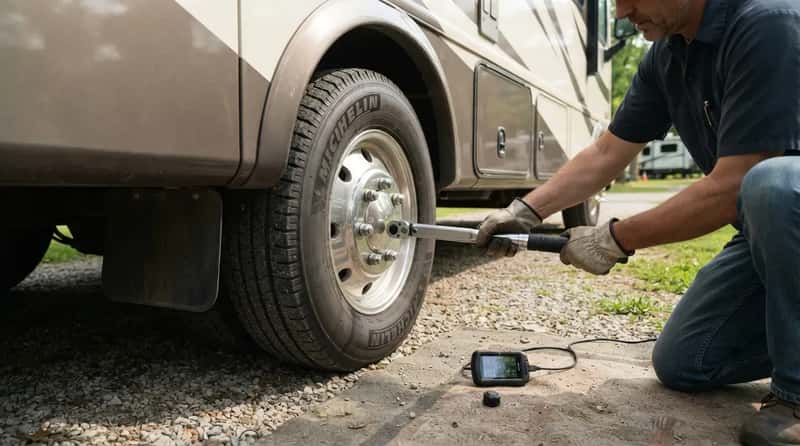
A single tire failure can do far more damage than a flat. On an RV, a blowout can rip through fiberglass, wiring, and plumbing in the wheel well. The repair can cost far more than the tire itself.
That’s why many longtime RVers run a tire pressure monitoring system. It flags a slow leak before a small problem becomes a roadside nightmare. The torque wrench is the quieter hero. Lug nuts should be tightened to the manufacturer’s specification, and many veterans recheck them after a wheel has been removed. Tire age matters too, because rubber can degrade even when the tread looks fine.
Next up is a tiny light that keeps the peace at every campsite…
#5 – A Headlamp With a Red Light Mode: The Courtesy Veterans Swear By
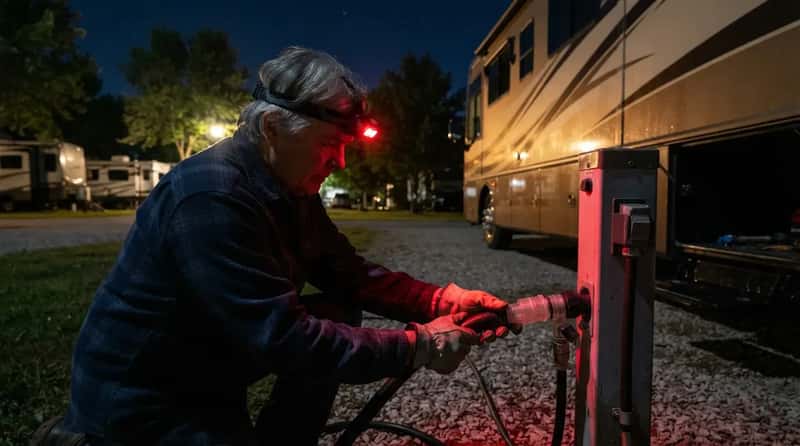
The fastest way to annoy a campground is a bright white flashlight at 10 p.m. Experienced RVers carry a headlamp instead, which keeps both hands free for hookups and hitches after dark. Many pick models with a red light mode.
Red light is gentler on neighbors and on your own eyes. It doesn’t wreck your night vision the way white light does, and it’s less likely to light up the windows next door. Here’s an opinion that starts debates: some veterans insist a headlamp beats a lantern for almost every campsite job. Plenty of campers disagree, loudly.
- Carry spare batteries or a rechargeable model.
- Keep one inside the rig where you can find it in the dark.
Now for the item nobody wants to use and everybody wants to have…
#4 – Fire Extinguisher and Detectors: The Gear You Hope Collects Dust
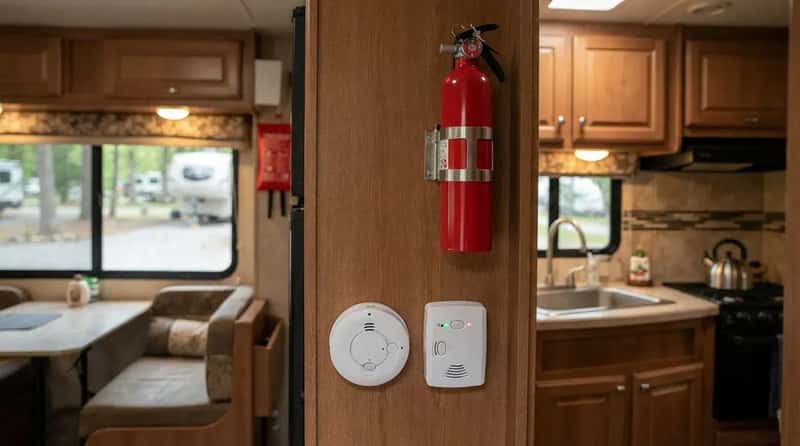
An RV can fill with smoke faster than most people expect. Living spaces are small, and many of the materials inside burn. Propane, cooking, and electrical systems all add risk.
Detectors have expiration dates, and plenty of owners never check them. A smoke or carbon monoxide alarm can look perfectly fine and still be past its service life. Veterans test their alarms at the start of every trip, and they know exactly where the extinguisher is and how it works. Carbon monoxide deserves extra respect for anyone running a generator or heater, since the gas has no smell. Check the label on each device for its replacement date.
- Test smoke, CO, and propane alarms before you travel.
- Keep an extinguisher near the door, not buried in storage.
Fast Facts
- Fire safety groups generally advise replacing smoke alarms about every 10 years.
- CO alarms often have shorter lifespans, so the date printed on the unit is the one to trust.
- Propane has a rotten-egg-style odor added on purpose, but carbon monoxide has no smell at all.
- A rechargeable extinguisher’s gauge should sit in the green zone.
Then there’s a junk-drawer kit that has saved more trips than any high-tech gadget…
#3 – The Repair Kit: Tape, Fuses, and Zip Ties That Save the Trip
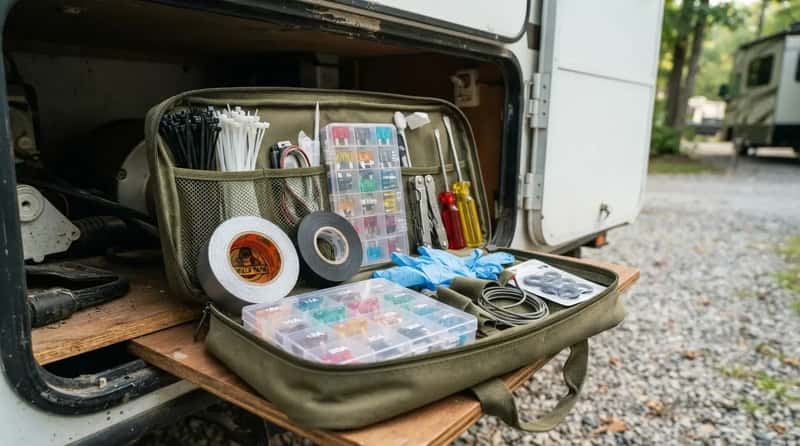
Veterans don’t expect problems, but they pack as if problems are guaranteed. The kit is simple. Heavy-duty tape, zip ties, spare fuses, a multi-tool, and a few common screwdrivers handle a surprising number of failures.
A single blown 12-volt fuse can knock out lights or a water pump until it’s replaced. A spare turns a ruined evening into a two-minute fix. Add disposable gloves, a small roll of wire, and a few extra hose washers. It’s all cheap, small, and boring, and it’s often the only thing standing between a camper and a clean departure from a loose panel or dangling cable.
- Match the spare fuses to your rig’s actual ratings.
- Store the kit where you can reach it without unpacking the bay.
The next item can decide whether you reach the campground at all…
#2 – Offline Maps and an RV-Specific GPS: The Truth About “Just Follow the Phone”
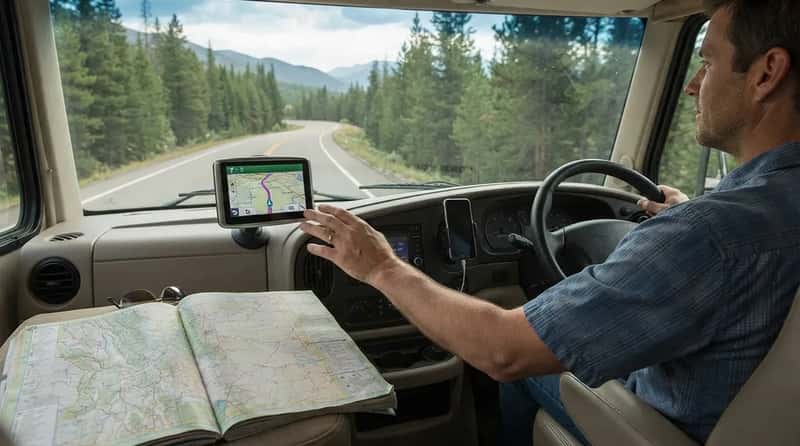
Your phone’s route doesn’t know how tall your rig is. Standard navigation apps are built for cars, so they may send you under a low bridge or down a tight road with no way to turn around. Low-clearance strikes are a known danger for tall vehicles, and they can wreck a roof in seconds.
RV-specific GPS units and apps let you enter your height, weight, and length. Cell service also vanishes in many of the most scenic places, so veterans download offline maps before they leave and keep a paper atlas as backup. Some call that atlas the most underrated tool in the rig. Others call it a nostalgic relic. Either way, the backup plan matters.
- Enter your rig’s height and length into the app.
- Download maps before you lose signal.
At a Glance
- Measure to the highest point on the roof, including air conditioners and vents.
- Write your rig’s height on a sticky note and put it on the dash.
- Download maps over Wi-Fi at home, not at the last gas station.
- Remote scenic areas are exactly where signal tends to drop.
And the item at #1 prevents some of the most expensive mistakes of all, even though it costs about a penny…
#1 – A Printed Departure Checklist: The Secret Behind Every Smooth Exit
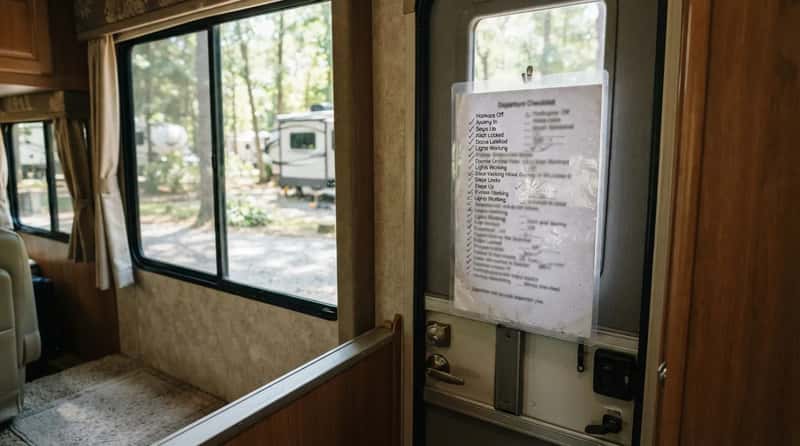
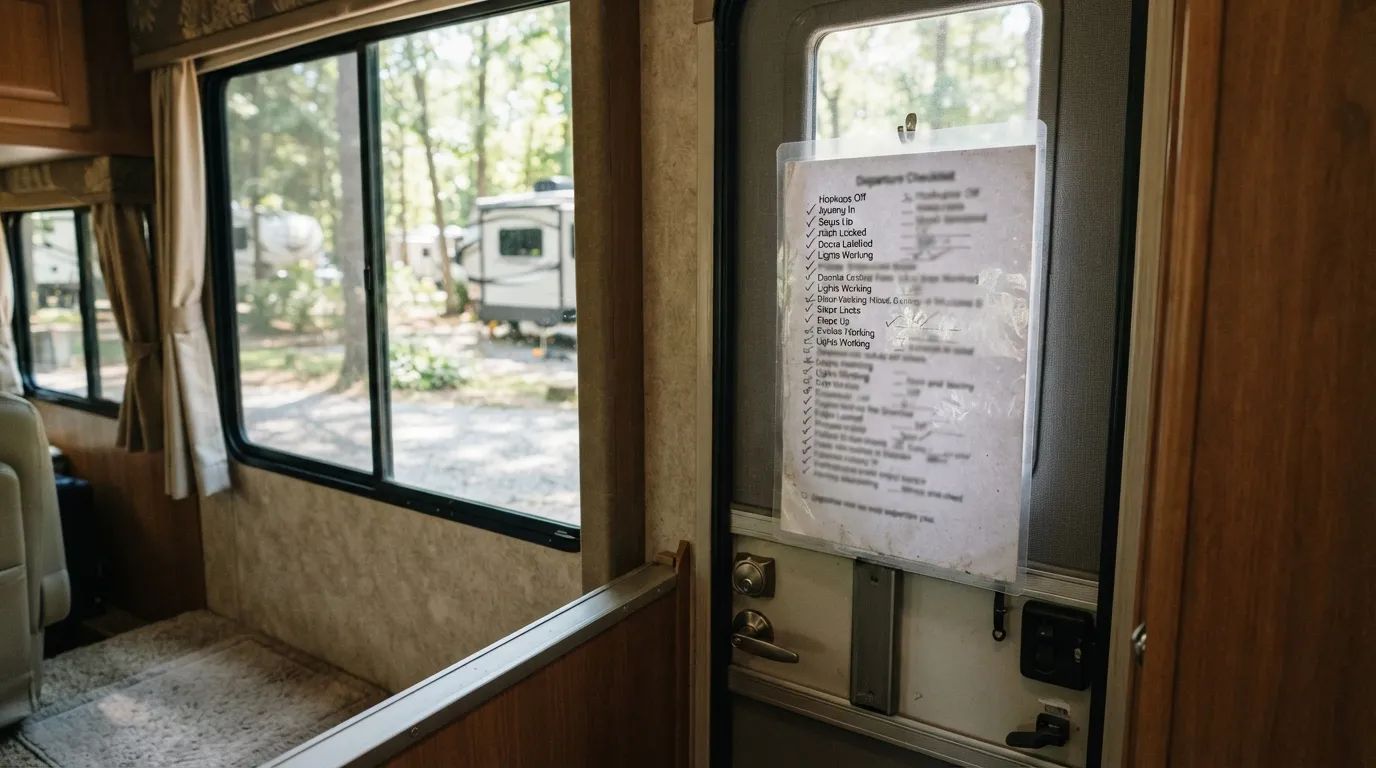
The most valuable thing in a veteran’s rig isn’t a gadget. It’s a piece of paper. Longtime campers swap the same horror stories again and again: driving off with the power cord still plugged in, forgetting to retract the steps, leaving the roof vents open.
Many of the most costly campground mistakes happen in the final five minutes before leaving. A checklist beats memory when you’re tired, distracted, or rushing to beat checkout. Veterans walk the same loop every time: hookups off, awning in, steps up, hitch locked, doors latched, lights working. Many laminate it and hang it by the door, because it removes the need to remember.
- Do a full walk-around before you roll.
- Check the hitch and lights with a second person if you can.
Line the twelve items up and a pattern jumps out. A regulator, a surge guard, a tire monitor, and a laminated checklist aren’t exciting, but each one blocks a problem that costs far more than the gear itself. Most of them cost less than a single tank of gas.
That’s the quiet secret of people who’ve lived on the road for decades. They don’t have better luck, they just packed for the day things go wrong, and it makes the good days look effortless.