A steam train ticket on the Durango & Silverton can run from about $108 to $313, depending on the seat. That’s a lot to pay for a ride, so the view had better earn it. For many travelers in their 60s and beyond, these 13 rides do, for three simple reasons: no driving, no parking hunt, and scenery that slides past at a pace you can actually enjoy.
The surprise is how few of them are the famous names you’d guess. One was just voted the nation’s best scenic train, then pushed back its own opening day over wildfire danger. Another is a short ride whose charter is older than the Civil War. And one climbs a mountain famous for a wind record you won’t believe.
#13: Strasburg Rail Road, the Amish-Country Steam Ride Running on 1832 Paperwork

The shortest ride on this list may be the biggest history lesson. Strasburg Rail Road in Lancaster County, Pennsylvania, was chartered in 1832, which makes it one of the oldest short-line railroads in the country. The trip runs about nine miles round trip to a village that’s actually named Paradise. It takes roughly 45 minutes, with steam locomotives pulling wooden coaches through farm country where Amish farmers often work the fields with horse-drawn equipment.
So why do older travelers rave about it? It asks for almost nothing. There’s no all-day commitment and no hotel stay required, and the Railroad Museum of Pennsylvania sits just across the road. Plenty of riders say the best seat is a window on the farm side. Rail purists sneer that 45 minutes isn’t a “real” train trip, but fans reply that it’s the easiest first step into steam railroading anywhere in the East.
But the next ride turns a national park into a window seat…
#12: Cuyahoga Valley Scenic Railroad, the Ohio Train That Rolls Through a National Park

Most people think national parks demand hiking boots and steep trails. In Ohio, a train does the heavy lifting. The Cuyahoga Valley Scenic Railroad runs through Cuyahoga Valley National Park, between the Cleveland and Akron areas. Riders watch forests, farmland and the Cuyahoga River drift by from a comfortable seat.
You can ride one way, step off, and walk or bike a stretch of the Towpath Trail before riding back, thanks to the railroad’s bike-aboard option. That flexibility is the real draw. You decide how much of the park to see on foot, and the train handles the rest. Some Rocky Mountain loyalists argue that gentle Ohio hills aren’t “scenic” at all, but regulars say that’s exactly the point. Schedules and special trains change by season, so check the current calendar before you plan.
Worth Knowing
- Setting: a national park between the Cleveland and Akron areas
- Best for: park scenery without steep trails
- Mix and match: ride one way, walk or bike the Towpath Trail, ride back
- Before you go: check the seasonal calendar for special trains
Wait until you hear how the next railroad got its smelly nickname…
#11: The Skunk Train, a Redwood Ride Named After a Smell

The nickname isn’t a joke about the scenery. The Skunk Train in Fort Bragg, California, got its name from early gas-powered motorcars whose fumes reportedly announced them before they arrived. The line dates to the 1880s and began as a logging railroad. Its tracks wind inland from the Mendocino coast into dense redwood forest.
Today the trip is all about slow, shaded scenery. Light filters down through enormous trees, and creeks and canyons slip past the windows. Routes and trip lengths can change with the season and track conditions, so confirm the current schedule first. Some travelers call it the most relaxing ride on the West Coast, and others say the coast itself is the bigger star. Plenty agree that doing both in one Fort Bragg day is the real win.
Next, a gorge where the river plays tour guide…
#10: Great Smoky Mountains Railroad, Where Rafters Wave at Your Train

This one comes with its own built-in crowd. The Great Smoky Mountains Railroad leaves from Bryson City, North Carolina, and its popular Nantahala Gorge excursion follows rivers and lake shoreline into a deep, forested canyon. Whitewater rafters often wave from the river below, so the ride feels more social than most. The name Nantahala is often translated from Cherokee as “land of the noonday sun,” because the gorge is so deep that direct sun reaches the bottom mainly around midday.
The excursion takes a little over four hours, with a layover at the gorge’s turnaround point. Open-air seating is available on many trips. October is the headline season for foliage, and that’s when crowds peak. Some riders say spring is the secret time to go, with fewer people and fresh green hillsides. Either way, it’s a day trip that asks you to do nothing but look.
At a Glance
- Departs from: Bryson City, North Carolina
- Headliner: the Nantahala Gorge excursion
- Time: a little over four hours, with a layover
- Seating: open-air options on many trips
- Season: October for foliage crowds, spring for quieter green
The next ride sneaks through country that cars can’t reach…
#9: Verde Canyon Railroad, the Arizona Ride Through Canyon Country With No Road Access

Ask people to picture scenic Arizona and they’ll say the Grand Canyon. Few expect a red-rock canyon that cars can’t get into. The Verde Canyon Railroad leaves from Clarkdale and follows the Verde River through backcountry with no road access. The line was built in the early 1900s to serve a copper-mining operation, not tourists. Today it carries passengers on a trip of about four hours round trip.
Along the way, the train passes through a tunnel, crosses trestles and glides beside cliffs and cottonwoods. In winter, riders often watch for bald eagles along the river, and ruins left by the ancient Sinagua people can be spotted from the train. Fans love how quiet it is compared with Arizona’s busiest sights. Critics counter that the scale doesn’t compare with the Grand Canyon. Both camps agree you never need to touch a steering wheel.
Up next: a Victorian station and a trestle named for a painter, not a monster…
#8: Conway Scenic Railroad, the New Hampshire Ride Through Crawford Notch

The Conway Scenic Railroad starts in North Conway, New Hampshire, at a Victorian station built in 1874. The headline trip is the Notch Train, which climbs through Crawford Notch in the White Mountains past dramatic ledges and bridges. The famous Frankenstein Trestle is named after a landscape painter, Godfrey Frankenstein, not a monster. The round trip takes about five hours, so it’s a full outing with plenty of time to soak in the mountains.
This is a leaf-peeper’s favorite for a reason. New England foliage has a big reputation, and the Notch Train earns it. Spring and summer are quieter, with green, cool mountain views. Some New England travelers think this beats driving the White Mountains by car. You get the view without watching the road.
The next stop is a canyon so narrow that railroads once fought over it…
#7: Royal Gorge Route Railroad, the Colorado Ride Beneath a Famous Bridge

The Royal Gorge Route Railroad in Cañon City, Colorado, rolls along the Arkansas River at the bottom of a steep granite canyon. The walls rise roughly 1,000 feet. The train passes beneath the Royal Gorge Bridge, which was once the world’s highest suspension bridge. It’s about a two-hour round trip over roughly 24 miles. The canyon’s history includes the “Royal Gorge War” of the 1870s, a bitter fight between rival railroads over who could use the narrow route.
That story adds weight to what now looks like a quiet ride. Many travelers favor the open-air or glass-roofed cars for photos. Colorado’s heritage railroads are clearly having a moment, too. Four Colorado railroads ranked among the 2026 USA TODAY 10Best winners for Best Scenic Train Ride. The ride is short, but it gives you a big-canyon feel without a full-day commitment.
But even that canyon can’t match the next climb, which tops out near 6,300 feet…
#6: Mount Washington Cog Railway, the 1869 Climb Up the World’s Windiest Peak
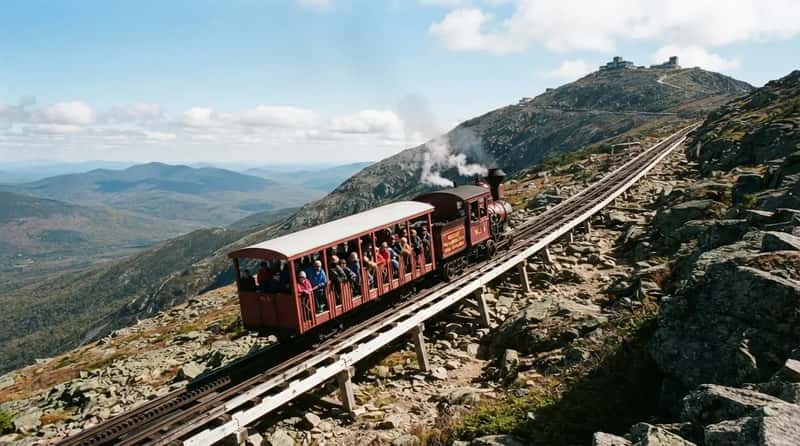
This is a train that climbs a mountain by gripping a toothed rail. The Mount Washington Cog Railway in New Hampshire opened in 1869 and is widely described as the world’s first mountain-climbing cog railway. Its steepest section, Jacob’s Ladder, has a grade of about 37 percent, which makes it one of the steepest rack railways anywhere. The summit holds a record wind gust of 231 mph, measured in 1934.
Fast Facts
- Opened: 1869, as the first mountain-climbing cog railway
- Summit: 6,288 feet, the highest point in the Northeast
- Trip length: roughly three hours round trip, with time at the top
- Big variable: the weather, which can mean huge views or fog
Weather decides everything. Clear days deliver huge views, and fog can wipe them out. Some travelers call it overpriced for a gamble on the sky, while others say the engineering alone is worth it. Check current operations and trip options before you book.
The next train does something the interstate never could…
#5: Grand Canyon Railway, the Train That Came Back From the Dead

The Grand Canyon Railway runs 65 miles from Williams, Arizona, to the South Rim. It opened in 1901 and carried visitors for decades. Passenger service ended in 1968, then returned in 1989 after the line was revived. The ride takes a bit over two hours each way. Williams has its own twist, too. It’s famously the last Route 66 town to be bypassed by the interstate, in 1984.
For older travelers, the appeal is practical. You skip a long drive, and you skip the stress of finding parking at a very busy park. Most itineraries give you a few hours at the rim before the return trip. Critics say that’s not enough time to really see the canyon. Fans answer that arriving by train feels more like a pilgrimage than a pit stop.
Our next ride is a full-day mountain adventure, and it’s the one many riders call a bucket-list trip…
#4: Durango & Silverton, the Steam Train That Climbs Nearly 3,000 Feet

This Colorado classic has been running since the early 1880s. The line was built by the Denver & Rio Grande in 1881–82, and it is a National Historic Landmark. Trains climb nearly 3,000 feet and arrive in Silverton for a layover of about two hours. Along the High Line, the train clings to a narrow shelf high above the Animas River. The scenery is continuous, with almost no modern development in sight.
The full day is long. The round trip takes about 9.25 hours, including the layover. Prefer less? The Silverton Express offers a 5.5-hour trip with a motorcoach up and the steam train back. Riders also argue about seating. Some swear by the open-air gondola, cinders and all, while others pick a closed coach and a cleaner shirt. The full Silverton route is scheduled to run through November 1 in 2026.
But the next ride is a different kind of trip, one measured in sunsets…
#3: Amtrak’s Coast Starlight, the 35-Hour Ride That Loses Money but Wins Fans

Here’s the twist. The Coast Starlight is beloved, and it also doesn’t pay for itself. In fiscal year 2024 it carried 359,432 passengers, but its revenue of $49.5 million fell well short of its $93.9 million in operating expenses. The route covers 1,377 miles between Los Angeles and Seattle in 34 to 35 hours. That means a full night aboard.
The best-known stretch is the Pacific coast. Between Santa Barbara and San Luis Obispo, the train rolls along the ocean and passes through a section of Vandenberg Space Force Base. That means you can ride right through a working space launch base. Superliner equipment includes Sightseer Lounge cars with big windows. Some riders say the northern stretch through the Cascades and the Sacramento River Canyon is every bit as good as the coast.
Next up is a railroad where locals can flag down a train like a taxi…
#2: Alaska Railroad, the Dome-Car Ride Where You Can Flag Down a Train

Alaska’s trains are the splurge on this list, and travelers often say they’re worth it. The Denali Star covers the 356-mile stretch between Anchorage and Fairbanks, a journey of about 12 hours. On a clear day, the route offers views of Denali, the tallest mountain in North America. The Coastal Classic, often called the most scenic route, runs from Anchorage to Seward.
Quick Compare
- Denali Star: Anchorage to Fairbanks, 356 miles, about 12 hours, with Denali views on clear days
- Coastal Classic: Anchorage to Seward, often called the most scenic route
The Hurricane Turn is a flagstop train that locals love for backcountry access. Riders can wave it down along the tracks, like a bus. Upgrading to GoldStar service gets you dome seating, meals, soft beverages and two complimentary adult beverages per trip. One 2026 planning guide warns of a catch, though. The Denali Park Road is closed past mile 43, with bus service to Eielson and Wonder Lake not expected until 2027.
But the top-ranked ride has a story that includes a wildfire scare…
#1: Cumbres & Toltec Scenic Railroad, the Nation’s Top-Voted Ride That Almost Didn’t Open

In 2026, readers voted the Cumbres & Toltec “Best Scenic Train Ride” in the USA TODAY 10Best Readers’ Choice awards. Then came the plot twist. The railroad postponed its 2026 season because of severe drought and elevated wildfire danger. It had been set to open May 23, but the commission voted to push the start to June 9.
The railroad stretches 64 miles between Chama, New Mexico, and Antonito, Colorado, and crosses the state line 11 times along the way. Full-line trips include a hot lunch at Osier Station and a motorcoach back. An open-air gondola is available to all passengers. The 2026 season runs through October 25, so it’s still rolling as autumn peaks.
The best scenic train rides aren’t really about speed or luxury. Strasburg proves a 45-minute trip can hold nearly two centuries of history. The Coast Starlight loses money, yet more people keep riding it. Alaska lets you flag down a train, and Colorado’s Cumbres & Toltec took the national crown even after a wildfire delay.
These trains can cost real money. For many travelers over 60, the trade is simple: no driving, no stress and a front-row seat to the country going by. Which of these 13 would you ride first, and which one did we miss?