You’ve pictured it for years: a hammock, a mai tai and a calendar with nothing on it. The 2026 version of that trip runs on timed tickets, stacked taxes, a long flight and a volcano that refuses to keep a schedule. None of it ruins Hawaii. Any one of these surprises can ruin a morning, a budget or a whole day if it catches you off guard.
The travelers who come home frustrated usually missed just one of the 13 things below. A few are about money, a few are about your body, and one is about something that can’t be booked at any price. Start at the bottom of the list, because the surprise that matters most is waiting at #1.
#13 – Your Hotel Bill Now Carries One of the Heaviest Tax Loads in America

On January 1, 2026, the new Green Fee raised Hawaii’s state accommodations tax from 10.25 percent to 11 percent. That sounds small until the rest of the stack shows up. County surcharges of up to 3 percent and the General Excise Tax of roughly 4 percent push the total past 18 percent of your bill, before any resort fee.
Hawai‘i became the first U.S. state to pass a statewide visitor-impact fee dedicated to environmental conservation. On a $400 hotel room, the increase works out to about $3 a night. The state expects it to raise around $100 million a year. It applies to hotels, vacation rentals and timeshares in all four counties, and the cruise-ship portion of the law has faced legal challenges.
Quick Compare
- Before 2026: state accommodations tax of 10.25 percent
- Since January 1, 2026: state accommodations tax of 11 percent
- On a $400 room: roughly $3 more per night
- Still on top: county surcharges, General Excise Tax and any resort fee
But the next surprise has nothing to do with money, and it can cost you an entire morning.
#12 – Diamond Head Is Now a Timed-Ticket Attraction

Showing up and hiking Diamond Head is over for out-of-state visitors. Since May 12, 2022, non-residents need an advance reservation, and walk-ups are turned away. Plenty of people only find out when they’re standing at the gate with sunscreen on and nowhere to go.
The costs are small. Non-residents pay $5 per person, plus $10 per vehicle for parking, and reservations open up to 30 days ahead. The late-arrival rule is the one that bites. Show up outside the first 30 minutes of your reservation window and you risk being turned away. The state built the system because years of crowds overwhelmed the parking lot and trail, and the gate lines grew painfully long.
Diamond Head is only the warm-up, though. Another famous Oahu spot has even stranger rules.
#11 – Hanauma Bay Makes You Watch a Video Before You Snorkel, Even on Visit Ten

The most famous snorkeling bay on Oahu comes with homework. Every visitor must watch a short educational video before entering, even if you’ve been ten times before. It’s a reef-protection rule, and nobody gets out of it.
Non-residents over 13 pay a $25 entry fee, plus $3 for parking. Reservations open two days ahead at 7 a.m. HST, and slots are limited because the bay caps daily visitors to protect the reef. The bay is also closed two days a week. Recent guides list Mondays and Tuesdays, but confirm the current calendar before you build a day around it.
Fast Facts
- Entry for non-residents over 13: $25 per person
- Parking: $3 per vehicle
- Reservations open two days ahead at 7 a.m. HST
- The educational video is required for every visitor, every time
And that’s only Oahu. The bigger shock is waiting on the Neighbor Islands.
#10 – The “Reservation Wall” Around Hawaii’s Best Views

Some of the islands’ most photographed places now sit behind a booking screen. Non-residents need advance reservations for Diamond Head, Hāʻena on Kauai, Waiʻānapanapa on Maui’s Road to Hana and ʻĪao Valley on Maui. That’s a long list of postcard stops, and none of them can be done on a whim anymore.
Then there’s the sunrise. Haleakalā sunrise requires one reservation per vehicle, covering the hours of 3 to 7 a.m. Fees add up in separate pieces, and an admission ticket doesn’t always include a parking space. Peak-season advice is blunt: book at least two weeks out, because morning slots go first. Pack a warm layer too. The summit sits above 10,000 feet and gets cold before dawn.
The fees go well past those headline spots, and the list may surprise you.
#9 – Sixteen State Parks Now Charge Tourists, and Locals Park Free

Hawaii has quietly built a two-tier system for its public lands. One 2026 roundup was titled “16 Hawaii State Parks Now Charge Tourists.” The fees are modest, but they pop up in places you wouldn’t expect.
Kauai’s Wailua River State Park now charges non-residents $5 per person and $10 per vehicle, while residents park free. Even a lookout is on the list: a $7-per-vehicle charge has been planned for Puʻu ʻUalakaʻa, though the start date was still unannounced as of early 2026. Camping costs more for visitors too. Non-residents pay $30 per campsite, compared with $20 for residents. Some travelers call that fair. Others call it a tourist toll. Where do you land?
The next surprise hits long before you reach any park, and it hits your body clock.
#8 – Hawaii Never “Springs Forward,” and Your Body Clock Pays for It

Hawaii doesn’t observe daylight saving time, so the gap with the mainland shifts during the year. The islands run five hours behind the East Coast in winter and six hours behind in summer. Plenty of retirees plan for the flight and forget about the clock.
Here’s where it bites. A 3 a.m. sunrise alarm in Hawaii feels like 8 or 9 a.m. at home, so the morning isn’t the hard part. The trap is the evening, when your body insists it’s close to midnight at 6 p.m. That’s why the first two days produce so many bad decisions. Visitors overbook, skip meals and push through the heat on too little sleep.
Speaking of strong sun, there’s a rule about what you put on your skin.
#7 – The Sunscreen in Your Suitcase May Not Be the Kind Hawaii Sells

Hawaii has restricted certain sunscreens for years. State law bans the sale of sunscreens containing oxybenzone and octinoxate, a rule that took effect in 2021. Lawmakers aimed it at ingredients linked to coral reef concerns. Many visitors never hear about it until they’re standing in a drugstore aisle with part of the usual shelf missing.
The rule covers sales in the state. It doesn’t police what’s already in your bag. Still, the sunscreen you’ve used for decades may not be the one on Hawaii’s shelves. Mineral formulas with zinc oxide or titanium dioxide are the common alternative. Read the active-ingredient label before you pack, or before you buy in Waikiki at resort prices.
Worth Knowing
- The sales ban targets oxybenzone and octinoxate
- It took effect in 2021 and covers retail sales in the state
- Mineral options list zinc oxide or titanium dioxide as active ingredients
- The label’s active-ingredient list tells you everything you need
Next, a popular opinion that’s starting to split travelers right down the middle.
#6 – Waikiki: Must-Stay or Most Overrated Stop?
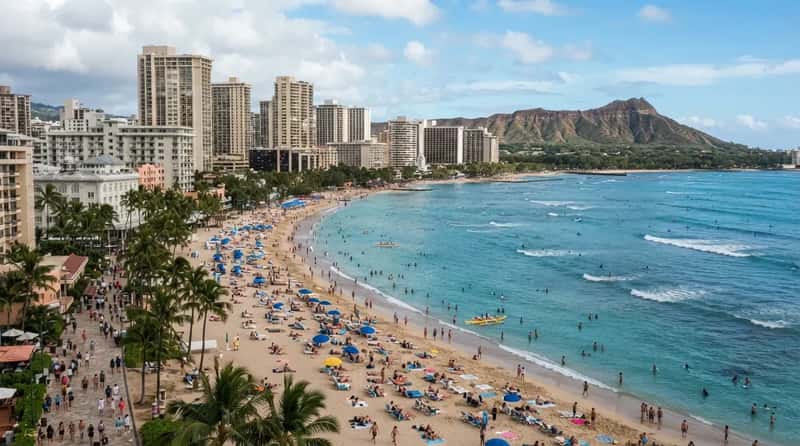
First-timers often rank Waikiki as a must-stay. Plenty of repeat visitors now argue it’s the priciest way to see Hawaii, pointing to crowds, stacked taxes and constant noise. That’s an opinion, but a popular one. Hawaii draws roughly 10 million visitors a year, and a lot of them end up in the same few square miles.
Waikiki does have real strengths. Diamond Head sits just east of it, and walkability matters a lot after 60, especially if you’d rather skip a rental car. The Green Fee adds only a couple of dollars a night to most stays. The real cost is the crowd, not the tax. Some travelers book one night there for the view and spend the rest of the week somewhere quieter.
Choosing a base is one thing. Getting between islands is where plans start to fall apart.
#5 – Some Islands Depend on a Single Airline

Island-hopping sounds breezy until you look at how thin the connections are. There’s no road between islands, so every hop is a flight. On smaller islands, you may have exactly one choice. On Molokaʻi, commercial air service runs through Mokulele Airlines.
That matters for travelers over 60, who often build trips around fixed dates, medical appointments and family events. A University of Hawaiʻi research report on rural health describes unreliable airline service as a barrier for rural residents seeking care. A canceled flight is an annoyance for you, and it can be a much bigger problem on a small island. Build in a buffer day before any international connection or major event.
The next stop isn’t a scenic one, and it shouldn’t be treated like a sightseeing spot.
#4 – Maui Is Still Rebuilding, and the Green Fee Traces Back to It

The 2023 Maui wildfires changed how Hawaii thinks about tourism. The Green Fee is meant to fund climate resilience in the wake of those devastating fires. Governor Josh Green has pitched it as a matter of urgency, arguing the state shouldn’t wait for the next disaster before acting.
The money has a specific job. It’s expected to go toward efforts ranging from coral reef rehabilitation to fire-prevention projects. For visitors, the practical lesson is different. West Maui is a place where people are still living through recovery. Treat it as a community first and a destination second.
Now the item that matters most if you travel with a pill organizer.
#3 – Hawaii Has a Doctor Shortage, and Medicare Pay Doesn’t Fix It

Hawaii’s medical system is more stretched than a hotel website will ever tell you. Patients often have to travel to Oʻahu for specialty care and, increasingly, even basic primary care. Insurance doesn’t always cover those costs.
The reimbursement problem runs deeper. Dr. Jack Lewin, who leads the state’s Health Planning and Development Agency, has said Medicare reimbursement rates don’t account for Hawaiʻi’s high cost of living. In practice, a doctor in pricey San Francisco gets a financial edge over a peer in equally expensive Honolulu when treating Medicare patients. That doesn’t mean you’ll be turned away in an emergency. It does mean routine care can be harder to find on short notice.
And what happens when care means leaving the island? That’s the part nobody budgets for.
#2 – Getting Sick on a Small Island Can Mean a Flight

On the Neighbor Islands, the right specialist may be on another island. Even on Maui, a shortage of physicians and specialized treatment often forces residents to fly off island for care. On Molokaʻi, services like MRI screenings aren’t available on-island. Locals plan around this every day, and visitors usually don’t.
The cost is the catch. Senator Mazie Hirono has said Hawaii residents are sometimes forced to spend thousands of dollars to fly to Oahu or the mainland for a specialist. Outside Medicaid, most insurers don’t fully cover transportation to medical care, so patients are often left to pay it themselves. Before you go, check what your own plan covers away from home. Ask about emergency transport, and consider a travel policy that includes medical evacuation.
But the single biggest surprise on this list can’t be booked, scheduled or predicted.
#1 – The Volcano Erupts on Its Own Schedule, and It’s Breaking Records

Kīlauea has been putting on a show scientists have rarely seen. Since December 2024, it has erupted in repeated episodes, with lava fountains shooting up from the summit crater and then going quiet again. By USGS counts, it has now passed the long-running Puʻu ʻŌʻō eruption of the 1980s for the most fountaining episodes ever documented in a single Kīlauea eruption.
The timing is the tricky part. Individual episodes have often lasted only hours, and scientists can forecast a window of days or weeks, not a single date. Hawaiʻi Volcanoes National Park stays open, and excellent viewing is available from safe, open areas along the caldera rim. Free USGS Volcano Notification alerts are available online if you want a heads-up.
Why It Stands Out
- The eruption began in December 2024 and has come in repeated episodes
- Each fountaining burst can be over in hours
- Forecasts point to windows of days or weeks, never an exact date
- Free USGS alerts can tell you when the next one is close
Plan for the downsides too. During eruptions traffic is heavy and parking is limited. Ash and volcanic debris can force closures, and at one episode visitors at Uēkahuna were dusted with Pele’s hair, the thin glassy strands that fountains throw into the air. If you have respiratory sensitivities, check air quality before you go. You may not catch a fountain on your dates, but the glow of the crater rim is still worth the drive.
Hawaii after 60 isn’t harder. It’s just different from the postcard. The costs stack, the best spots need tickets, the clock is off, and the medical system is thinner than most visitors assume. Meanwhile the volcano is putting on one of the best shows in decades, with no set start time.
The travelers who enjoy Hawaii most seem to do the same few things: book early, pad the schedule and check their coverage before they leave. Which of these would have changed your plans, and what did we miss?