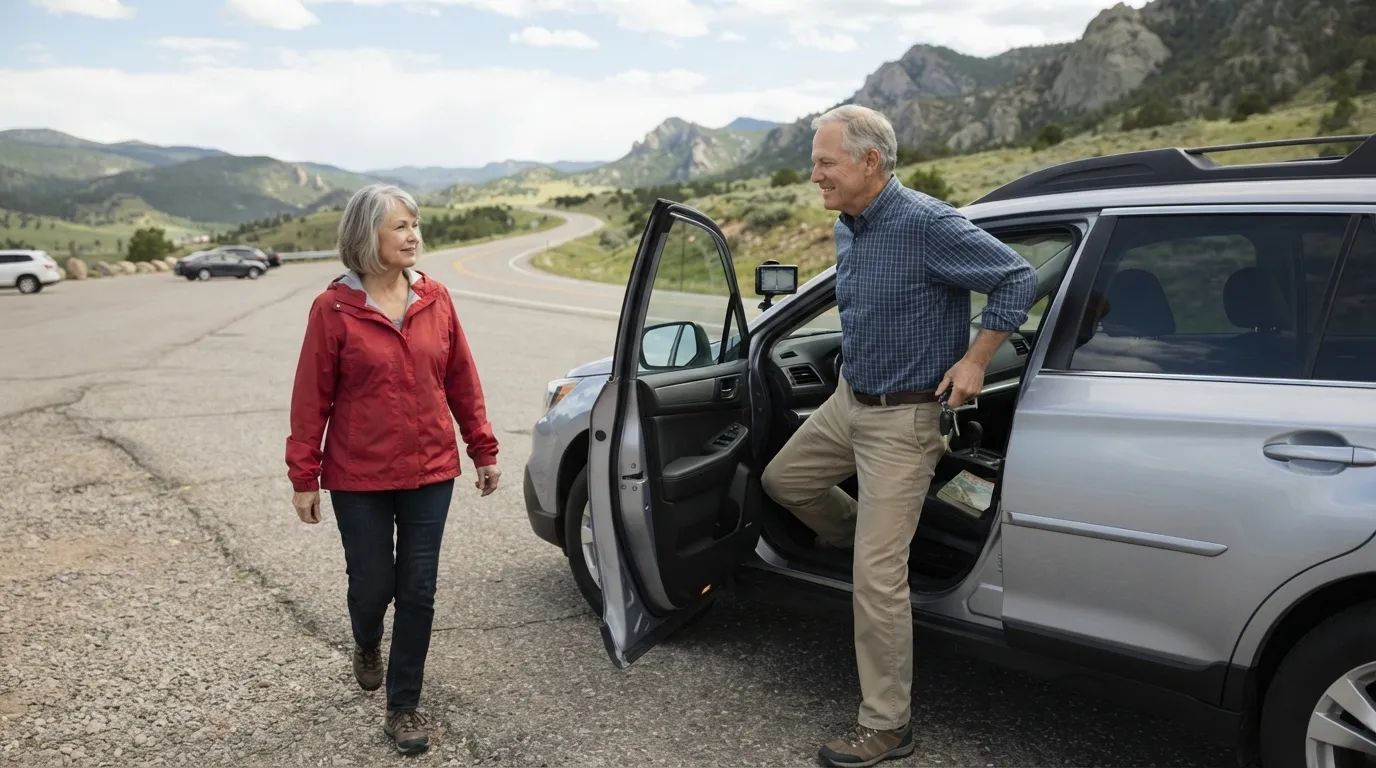
Picture it: the cooler is packed, the playlist is ready, and you’ve told everyone you’ll send postcards. Then day two arrives with a dead battery, a motel 90 miles past where you wanted to stop, or a pharmacy that won’t fill your prescription. Those are the real first-trip mistakes, and they have little to do with how well you drive.
The good news is that almost every one of them can be fixed with a phone call or a small change of plan, if you spot it early. Some are about money, some are about health, and a couple are about the person sitting next to you. One of them is hiding at the park gate, and another is sitting in your trunk right now.
#14 – The “Nine Hours by Sunset” Itinerary That Quietly Ruins Day Two

Your map app says the next hotel is nine hours away, so you book it and call the day planned. But that number is a best-case guess. It leaves out gas stops, restroom breaks, construction zones and the lunch that quietly becomes an hour. Add it all up and nine hours can easily stretch to ten or more.
The result is a driver who rolls in after dark, too wrung out to enjoy the town they paid to see. A vacation turns into a commute, and the next morning starts already behind. Free spirits will tell you to toss the schedule entirely, but on a first big trip a loose plan with room to breathe beats both extremes.
But the next mistake happens before you even leave the driveway.
#13 – The Oil-Change Sticker That Doesn’t Mean Your Car Is Road-Ready

A recent oil change doesn’t mean the car can handle 2,000 miles. Long trips stress the parts that short errands never test: tires, brakes, the battery and the cooling system. A battery that starts fine in your garage can quit after a long day of heat and constant electrical load.
Have a trusted mechanic inspect the tires, brakes, fluids, belts, wipers and battery before you go. Then check the spare. Many newer vehicles don’t carry a full-size spare at all, only a sealant kit that can’t fix a sidewall gash. Discovering that on a desert shoulder is a miserable way to learn it.
Worth Knowing
- Car batteries typically last about three to five years, so an older one deserves a test before a big trip.
- Tires wear out. The classic penny test checks tread depth: if you can see all of Lincoln’s head, it’s time for new tires.
- Check the air pressure in every tire, including the spare, while the tires are cold.
- Ask the shop to look at brake pads and coolant. Mountain descents and summer heat put both to work.
Yet the thing people forget to protect in the car isn’t mechanical at all.
#12 – The Pill Bottles Cooking in the Trunk

The riskiest bag in your car might be the one you tossed in the trunk. Many medications are labeled for room-temperature storage, and a closed car on a sunny day gets far hotter than the air outside. Insulin and other temperature-sensitive drugs are even less forgiving.
Keep medications in the cabin, in their original labeled bottles, and carry a written list of what you take. Pack a few extra days’ worth in case a storm or a breakdown stretches the trip. Ask your pharmacist whether your plan allows an early refill for travel, since many offer a vacation supply override.
And if you do need a refill on the road, your insurance may surprise you.
#11 – The Insurance Card That Doesn’t Work Like You Think

“Medicare covers me everywhere” is only half true. Original Medicare works across the U.S. with any provider that accepts Medicare. Medicare Advantage is a different story, and plenty of people on those plans don’t realize it until they’re holding a bill.
Every Medicare Advantage plan must cover emergency care anywhere in the U.S. at in-network cost-sharing. But HMO-style plans generally don’t cover routine care outside their service area, so a clinic visit or prescription refill could come out of your pocket. Call your plan before you leave and ask about travel benefits. Some plans include one that lets members pay in-network costs away from home.
At a Glance
- Original Medicare: accepted nationwide by any provider that takes Medicare.
- Medicare Advantage emergencies: covered anywhere in the U.S. at in-network cost-sharing.
- Medicare Advantage routine care: HMO-style plans generally limit it to the service area.
- Best move: call the number on your card and ask about travel benefits before you leave.
That’s a paperwork problem, though. The next one is in your legs.
#10 – The Four-Hour Sit That Few Drivers Treat as a Medical Risk

Sitting still behind the wheel feels harmless, but it isn’t. The CDC says anyone traveling more than four hours, by air, car, bus or train, can be at risk for blood clots. The danger is deep vein thrombosis, a clot that forms in the legs when blood flow slows down.
The CDC’s advice is simple: move your legs often, and stop to walk around during long drives. Risk goes up with other factors, and older age is one of them. If you’ve had a clot before or it runs in your family, talk to your doctor before you go. On the road, pull over, stretch your calves and drink water.
But one of the best deals in travel is waiting at the park gate.
#9 – The $80 Pass Plenty of Travelers Never Buy

Paying full price at every national park gate is a quiet money leak. U.S. citizens and permanent residents ages 62 and older can buy a lifetime America the Beautiful Senior Pass for $80, or an annual one for $20. It covers more than 2,000 federal recreation sites. At per-vehicle fee sites, it admits the pass holder and everyone riding in the same vehicle.
There’s a perk many people miss. The Senior Pass can also earn you a 50% discount on some amenity fees, such as camping and boat launching. With park entrance fees often running $20 to $35 per vehicle, the lifetime pass can pay for itself after just a few big-park stops. Carry a photo ID, because you’ll need it every time you show the pass.
Still, the biggest savings won’t matter if you’re driving when the light fades.
#8 – The Dusk Drive That Looks Fine Until It Doesn’t

Sunset is when a comfortable drive can turn stressful in minutes. Older eyes generally need more time to adjust to darkness and are more bothered by glare from oncoming headlights. On an unfamiliar road, that’s a real handicap.
Dusk and dawn are also prime time for deer and other wildlife near roads, especially in rural areas. Plan to be parked and checked in before dark, particularly on the first few days. Get your eyes checked before the trip, and clean the windshield inside and out, because a hazy film makes glare much worse.
Of course, avoiding trouble gets harder when your phone can’t find the road.
#7 – The Blank Screen in the Middle of Nowhere

Your phone’s GPS is only as good as your signal. Rural stretches and mountain passes often have gaps, and a lost connection can leave you without turn-by-turn directions at the worst possible moment. It’s one of those problems nobody thinks about until the little blue dot starts spinning.
Download offline maps for your whole route before you leave. Keep a paper atlas in the glove box, and write down hotel addresses and phone numbers. Bring a car charger and a backup power bank. Plenty of travelers call paper maps a relic, but dead zones disagree.
Quick Compare
- Offline phone maps: give turn-by-turn directions with no signal, but they need battery.
- Paper atlas: never runs out of power, but it can’t reroute around a closure.
- Power bank: keeps the other two options alive, so charge it before every drive day.
And what happens when the problem is the car itself?
#6 – The Roadside Plan That Only Tows You a Few Miles

Having roadside assistance isn’t the same as being covered. Many plans, whether from an auto club, an insurer or a credit card, limit how far they’ll tow and how many service calls you get. Basic tiers often cap towing at a short distance, while higher tiers extend it.
Out on a rural highway, the nearest repair shop might be much farther than your plan will go. Find out what’s included, and whether it applies to a rental or an RV. Save the number in your phone and write it down on paper too, because a dead phone makes a digital-only plan useless.
Then there’s the mistake that fills your trunk and drains your energy.
#5 – The Suitcase That Ate the Trip

Packing for every possible scenario is the classic first-timer move. The bill comes due every evening, when you haul heavy bags across a motel lot and up a flight of stairs. That’s a recipe for a strained back, and nobody puts that on the itinerary.
A trunk stuffed with visible luggage is also an invitation to thieves at rest stops and hotel lots. Pack an overnight bag with a day or two of essentials, and keep the rest out of sight. Seasoned travelers argue that doing a load of laundry on the road beats carrying two weeks of clothes, and they have a point.
Light bags help, but they can’t fix the problem we’re heading into.
#4 – Pushing Through Fatigue Because the Hotel Is “Only an Hour Away”

Drowsy driving is easy to underestimate. The CDC has reported that about 1 in 25 adults say they fell asleep while driving in the previous 30 days. Early warning signs include yawning, drifting within the lane, missing exits and not remembering the last few miles.
Many first-timers sleep badly in that first strange hotel bed, then start early anyway. Caffeine is only a short-term patch. If you feel foggy, pull over somewhere safe and rest, or call it a night if you need to. Also check the labels on any medication that can cause drowsiness, including some allergy medicines.
Fast Facts
- About 1 in 25 U.S. adults report nodding off at the wheel in a 30-day span, according to the CDC.
- AAA Foundation research found that sleeping only five to six hours roughly doubles crash risk compared with seven or more.
- Red flags: yawning, lane drift, missed exits and “blank” miles you can’t remember.
- Caffeine buys minutes. A safe place to rest is the real fix.
The next mistake is one where saving a few dollars can cost you far more.
#3 – The Nonrefundable Bookings That Lock You In

The cheapest rate can turn into the most expensive one. Prepaying every night on a nonrefundable basis feels organized, until a storm, a sore knee or a repair-shop visit wrecks the schedule. Then you’re out the money for rooms you can’t reach.
Book the first night and any must-have stops, such as popular park lodges that tend to fill up well in advance. Leave the rest flexible with free cancellation. Some travel hackers swear by prepaying for the discount, but on a first big trip, flexibility is worth the extra few dollars.
But the quietest mistake only shows itself when something goes wrong far from home.
#2 – The Emergency That Starts With Strangers Knowing Nothing About You

If you land in an emergency room in another state, the staff has none of your records. They don’t know your medications, your allergies or who to call. That gap can slow down care at exactly the wrong time.
Carry a card with your medical conditions, medication list, allergies, doctors’ phone numbers, insurance information and an emergency contact. Keep one in your wallet and one in the glove box. Set up the Medical ID feature on your phone’s lock screen too. Then tell a family member your route, and check in every evening.
And the final mistake is the one couples argue about most.
#1 – One Driver, Every Single Mile

The most overlooked mistake is sitting in the passenger seat. On many first big trips, one person drives every mile while the other navigates. It sounds efficient, but fatigue piles up on one person, and resentment can build for both.
The bigger risk is what happens if the driver gets sick or hurt. A partner who hasn’t driven this vehicle, or hasn’t been on a highway in years, is suddenly in charge at the worst moment. Swap seats every couple of hours, and make sure both people know how to use the hazard lights, the jack and the emergency kit. A short practice drive close to home helps.
Look back over the list and a pattern shows up. Almost every mistake comes from planning for the perfect version of the trip, the one with clear skies, full signal and nobody feeling tired.
The real trip is messier, and that’s fine. Build in slack, check what your coverage really includes, move often and share the driving, and the open road gets to be what you pictured all those years.