Flight attendants see everything at 35,000 feet, and the passengers they remember are rarely the loud ones. They are the ones who treat a shared cabin like a private bedroom, bathroom or bar. Some of these habits are just rude, and a few break federal rules.
One item carries the biggest number in this piece, a possible fine of more than $40,000, and it starts with something that costs nothing to do. First, though, the list opens with an offender who shows up before anyone has found a seat.
#14 – Boarding Without a Shower or Deodorant
Travel + Leisure’s rundown of the rudest passenger habits, drawn from flight attendants, puts bad hygiene on the list. One anonymous American Airlines flight attendant asked passengers to shower and put on deodorant before heading to the airport.
On a ten-hour flight, you sit within arm’s reach of strangers who cannot move to another room. A smell that is mild at the gate can become the whole row’s problem by the second meal.
The fix is cheap. A clean shirt in your carry-on and a pack of unscented wipes handle most of it, and heavy perfume or cologne bothers a seatmate about as much as the odor it covers.
Freshening up mid-flight is a good habit, as long as it happens somewhere other than your seat.
#13 – Ringing the Call Button Over and Over
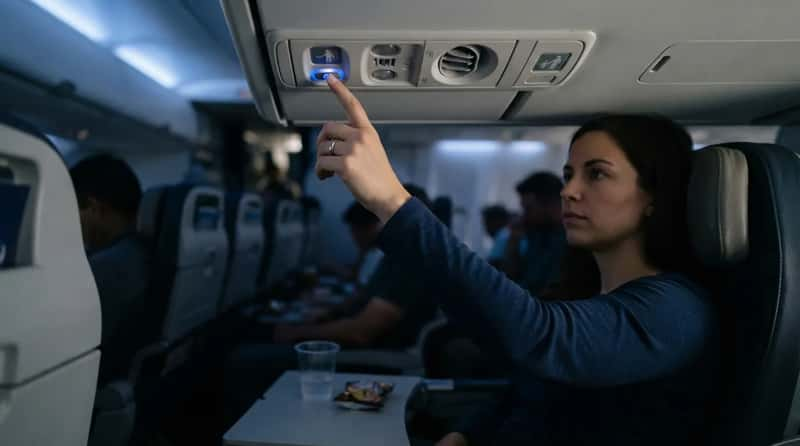
The call button is for needs you cannot meet yourself, such as a medical problem, a spill, or a request only crew can fill. One press is the normal use.
The attendant sees which seat lit up, so pressing again every few minutes does not move you up the line. It only pulls a crew member away from a cabin of other passengers, some of whom may need something more urgent.
The most avoidable calls are for water refills and small snacks. On many long-haul flights the galley is happy to hand those over if you walk back and ask.
#12 – Grooming at Your Seat
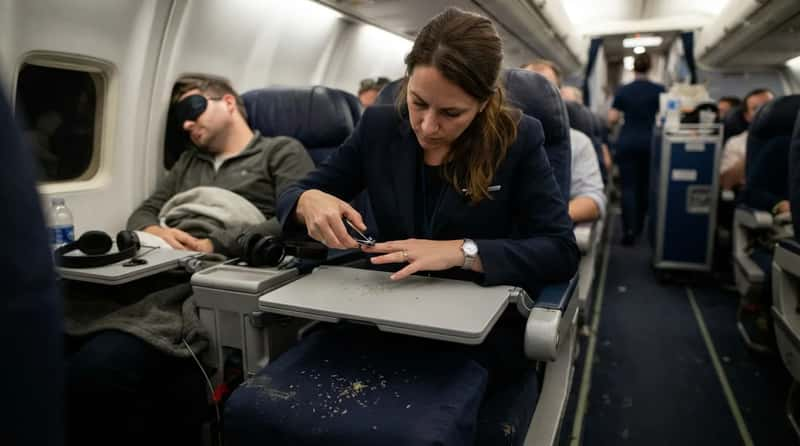
Fox News put together a list of 12 behaviors that should get passengers banned, with help from Shawn Kathleen of Passenger Shaming, a social media campaign that posts pictures of bad flyers. She says she understands that people on long-haul flights like to get themselves together, but she wants it done in the lavatory.
She calls hair removal of any sort on an airplane a big no-no. The logic holds for tweezing, nail clipping and shaving alike.
The trimmings land on seat cloth and carpet that the next passenger will sit on, and your seatmates have to watch. If you want to freshen up, go during a quiet stretch in the middle of the flight, when the lavatory line is shortest.
The lavatory is also where the next complaint starts, and it starts at the door.
#11 – Ripping the Ashtray Off the Lavatory Door
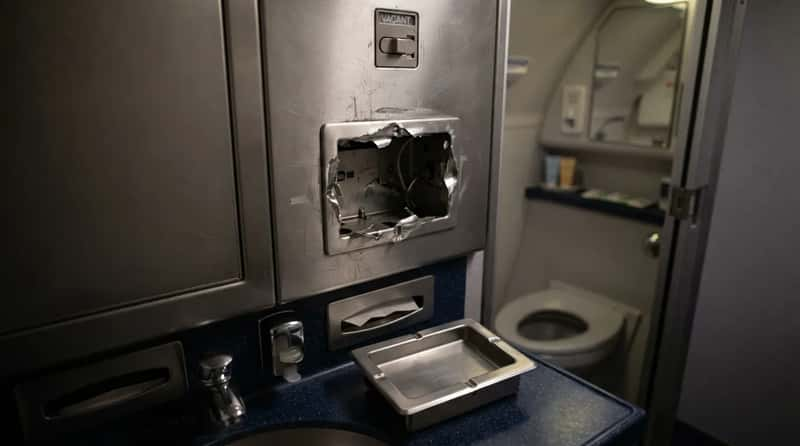
Flight attendants cited in one roundup of bathroom pet peeves say passengers sometimes rip the ashtray off the lavatory door while trying to get in. Airplanes still have those ashtrays even though smoking is banned, because crew need somewhere to put out a cigarette if someone lights up.
Doors differ between aircraft, so a stubborn one is a reason to check the occupied sign, not to yank on the trim. If the sign says vacant and the door still will not open, ask a crew member.
Crew can unlock lavatory doors from the outside, so no one who is ill or stuck needs to force anything.
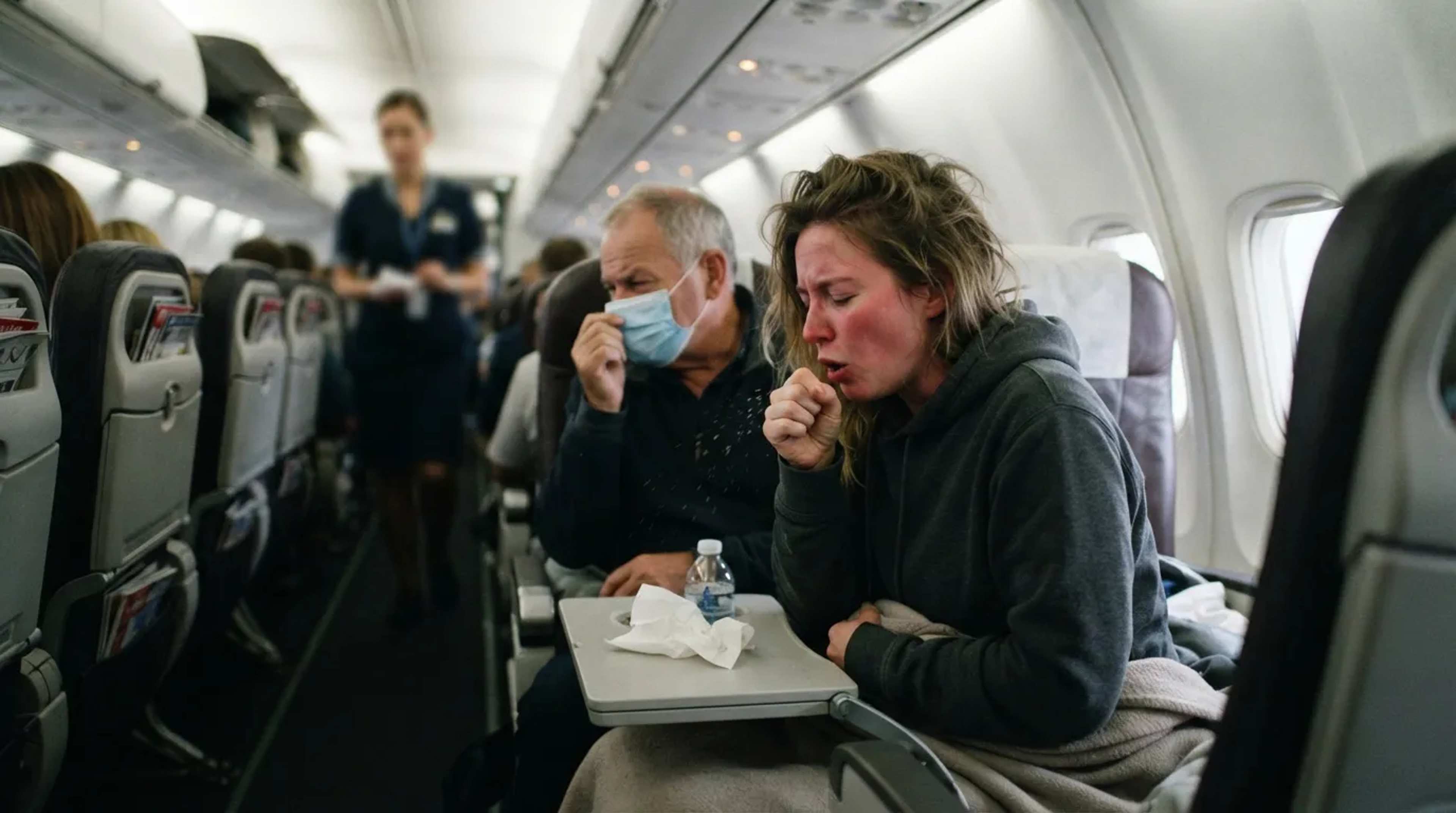
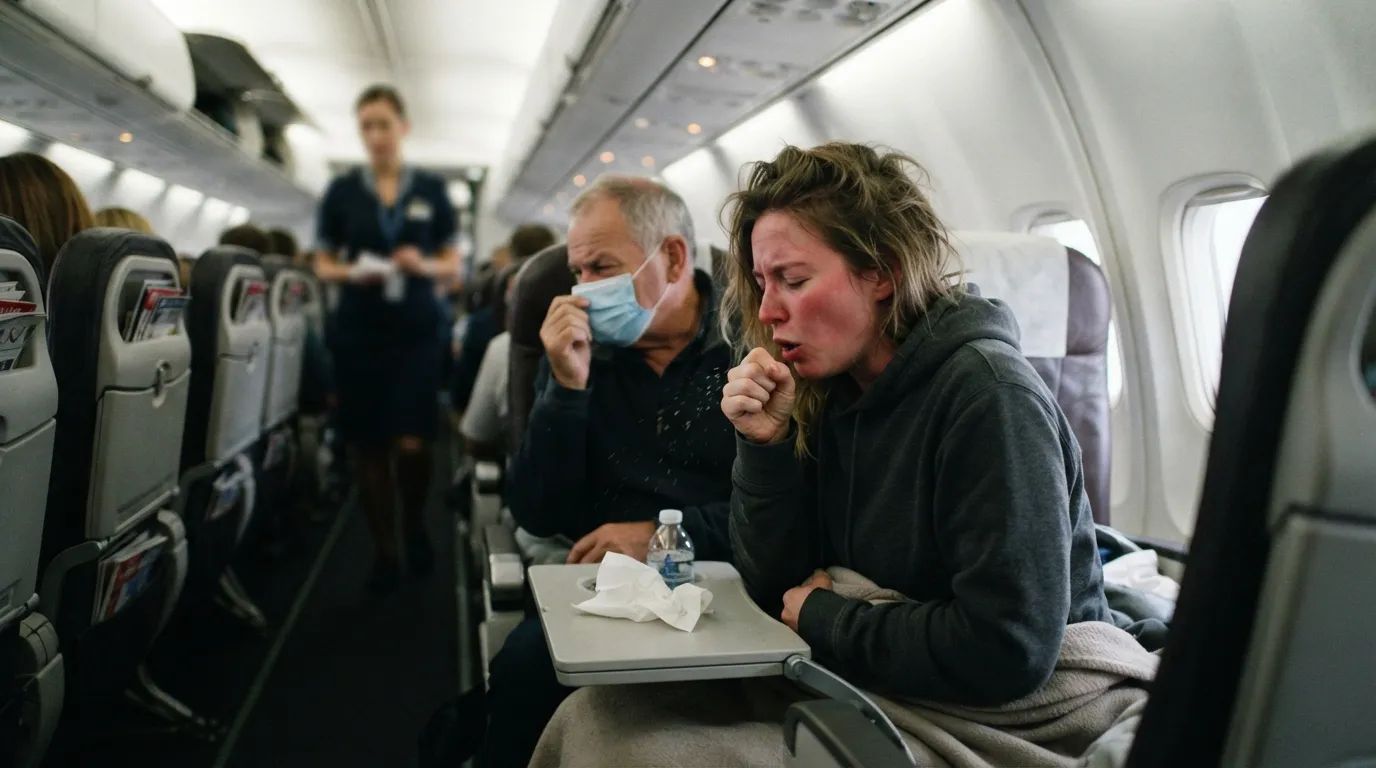
#10 – Flying Sick and Not Covering Up
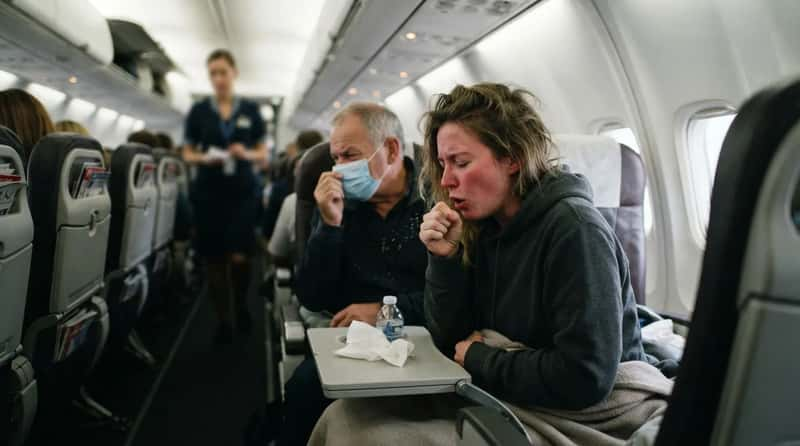
Outside magazine reports that experts see the real concern as respiratory viruses floating in the air, more than bacterial germs on surfaces. A 2004 study in the Journal of Environmental Health Research found people far more likely to catch a cold from airborne transmission during a flight than in the airport or the supermarket, 113 times more by one of the study’s measures.
If you are coughing, a mask or a sleeve over your mouth protects the rows around you. If your trip is flexible, ask the airline what changing it would cost before you board.
A seatmate’s cough is a bigger risk than the tray table you wipe down, and the passenger who boards sick controls that risk.
At a Glance
- The bigger worry is respiratory viruses in the air, not germs on surfaces.
- A 2004 study found far higher cold risk in flight than in the airport or supermarket.
- By one of that study’s measures, the gap was 113 times.
- A mask or a sleeve over a cough protects the rows around you.
Space is the other thing a long flight makes you share, and the seat back in front of you decides how much of it you have.
#9 – Reclining Into a Meal Service
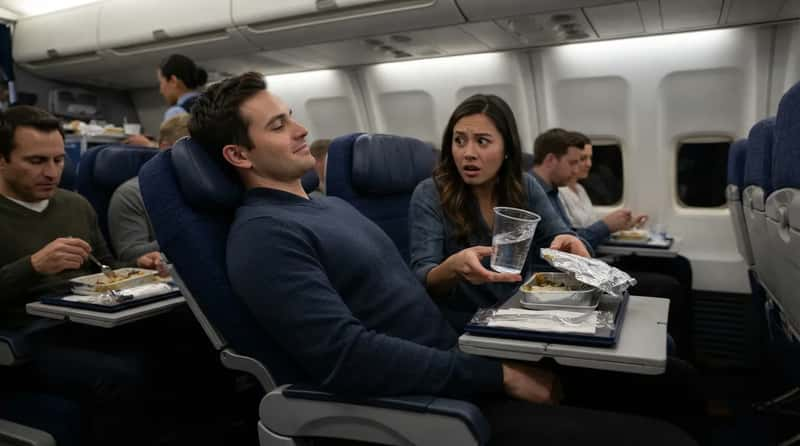
Reclining is allowed, and on a ten-hour flight it is reasonable. The trouble is timing.
A retired United flight attendant told Travel + Leisure that bringing your seat up during drinks and meals is appreciated, and that sudden movements can spill what is on a tray table. A seat slammed back onto a hot coffee is how a small habit turns into a stranger’s ruined shirt.
Recline is fair game once the trays are cleared and the cabin lights are down. Before then, look behind you and ease the seat back slowly.
A spilled coffee wipes up, which is more than can be said for what some passengers put on the tray itself.
#8 – Putting Bare Feet on the Tray Table
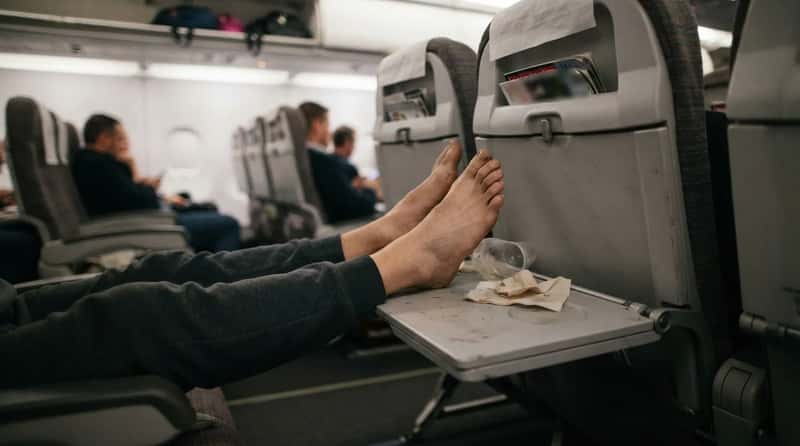
A flight attendant who posts on TikTok says she has seen passengers rub bare feet on the tray table. Her point is that no one is so uncomfortable that they must do that to a table someone will eat on within hours.
Her reply when she sees it is, “This is not your house, put your feet down.” Fox News also lists putting feet on tray tables among the worst offenses.
Cleaning crews often lack the time to wipe down tray tables between flights. Whatever your feet leave behind may still be there when the next passenger sets down a dinner roll.
Cramped legs on a long flight are real, and a walk down the aisle every hour or two does more for them than propping them up.
Worth Knowing
- The tray table is the same surface where someone’s meal will land within hours.
- Fox News ranks feet on tray tables among the worst in-flight offenses.
- Quick turnarounds mean tray tables do not always get a full wipe-down.
- A short aisle walk every hour or two beats propping your feet up.
Feet are one way to misuse the table. Resting a head on it is another, and that surface has been swabbed in several studies.
#7 – Sleeping With Your Head on the Tray Table
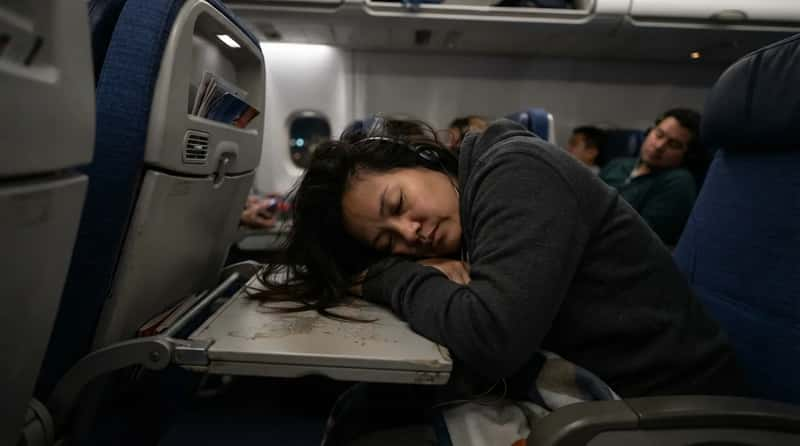
Using the tray table as a pillow annoys flight attendants and is unsanitary, according to Explore. The germ numbers show why.
In a Travelmath study, a microbiologist swabbed areas around five airports and four planes. Tray tables came back at 2,155 colony-forming units per square inch, while the National Science Foundation gives 127 as the standard for a toilet seat at home.1
Lab work on aircraft materials points the same way. Auburn University researchers found that MRSA and E. coli can survive for days on common cabin surfaces.2
That is a reason to wipe the table with a disinfectant wipe before your meal and to bring a neck pillow for sleeping. It is not a reason to skip the table altogether, because a sick seatmate who coughs for ten hours is the larger risk.
A wipe handles ordinary use, though it was never meant for the other thing some passengers do on that table.
#6 – Changing a Diaper on the Tray Table
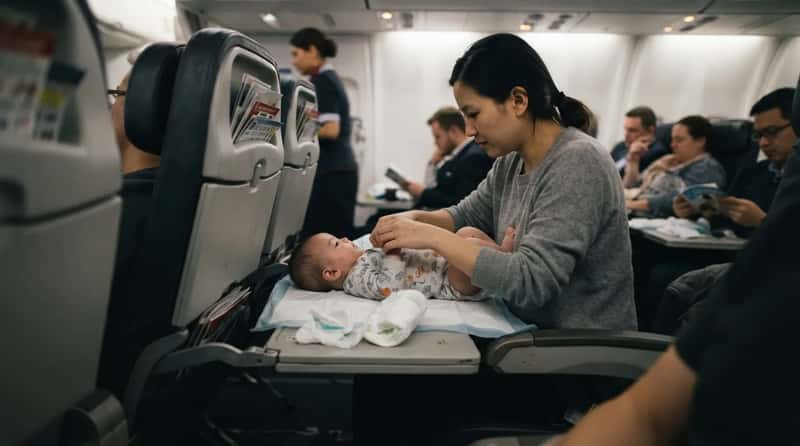
TODAY reports that flight attendants have seen people change a baby’s diaper on the tray table. One attendant says that is why she never eats off a tray table or sets her own things on one.
The table is where the next passenger’s meal will sit, and a quick wipe-down afterward does not make that a fair trade.
Parents of infants have a hard job on a long flight, so this one is less shameless than avoidable. Many aircraft have a fold-down changing table in at least one lavatory, and crew can point you to it.
Keep a disposable changing pad in the diaper bag so the lavatory counter is not your only surface.
Lavatory floors are a problem of their own, and the people who work the aisles have views on them.
#5 – Walking to the Lavatory Barefoot
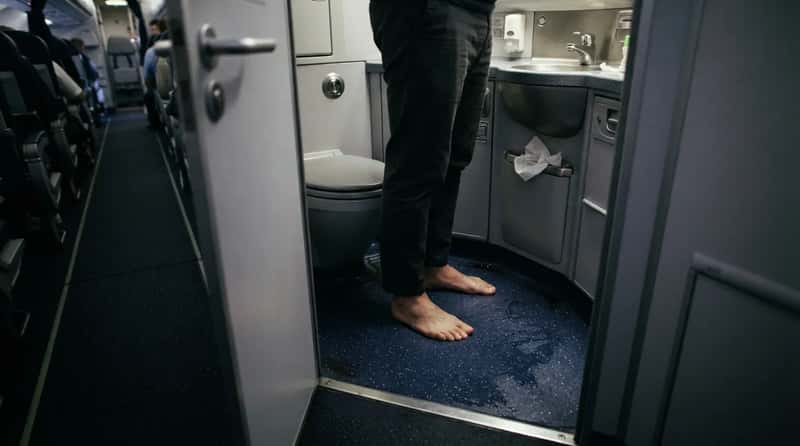
Flight attendants wince at passengers who head to the lavatory in bare feet or in socks alone. The retired United attendant who spoke to Travel + Leisure said passengers should wear some barrier between their skin and the floor.
A thick sock with sole grips can do the job, though shoes are always recommended for lavatory trips.
The reason is the floor. Former attendants posting on Reddit, as collected by The Points Guy, say the liquid on lavatory floors is not water.
A slip-on shoe you can step into without tying laces removes the whole objection. And a foot that touched that floor goes straight back to your seat, your blanket and the aisle.
Quick Compare
- Best: slip-on shoes you can step into without tying laces
- Acceptable: thick socks with sole grips
- Avoid: bare feet or thin socks alone
Shoes matter for more than the lavatory floor, since a cabin that has to be emptied in a hurry is no time to start looking for them.
#4 – Grabbing Carry-On Bags in an Evacuation
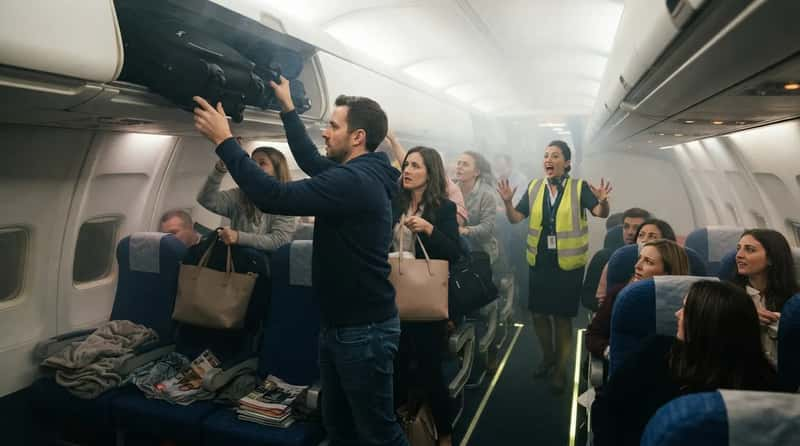
After a flight landed in Denver and smoke filled the cabin, video showed passengers grabbing their bags while flight attendants shouted for them to leave their belongings. Each person who stops to pull a bag from the bin holds up everyone behind them.
In a full long-haul cabin, an evacuation line moves only as fast as its slowest member. That is why the instruction is in every safety briefing.
If you are ever told to go, leave the bag, the coat and the camera, and move.
Smoke on a plane does not always come from a mechanical fault, and one source of it sits behind the lavatory door.
#3 – Lighting a Cigarette in the Lavatory
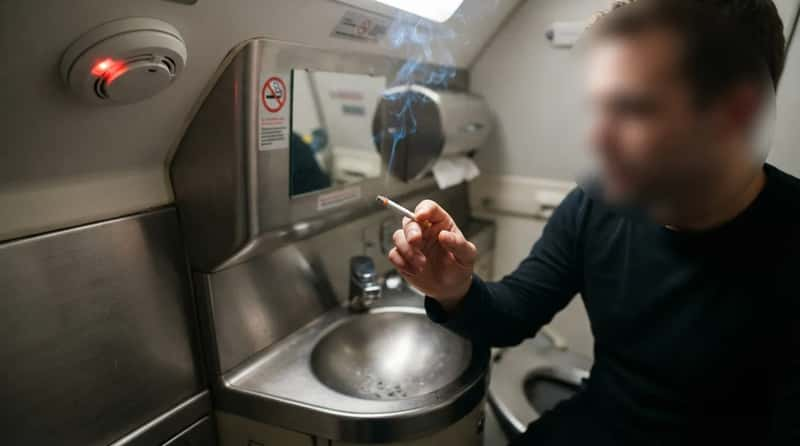
Smoking is banned on commercial flights, and the International Air Transport Association lists it among unruly passenger behaviors, alongside violence, harassment and verbal abuse. IATA also says such acts are committed by a minority of passengers but have a disproportionate impact.3
Every lavatory has a smoke detector and a placard saying that tampering with it violates federal law. A passenger who lights up does not get far before the alarm sounds.
Fast Facts
- Smoking is banned on commercial flights.
- IATA groups it with violence, harassment and verbal abuse.
- Lavatory smoke detectors carry a placard warning that tampering violates federal law.
- IATA says a minority of passengers causes a disproportionate impact.3
The penalties can stack up. One FAA enforcement case described a passenger who allegedly drank his own alcohol after being told to stop, then entered the lavatory and smoked marijuana.
Alcohol, unlike a cigarette, is legal to carry aboard, which is where some travelers go wrong.
#2 – Drinking From Your Own Mini Bottles
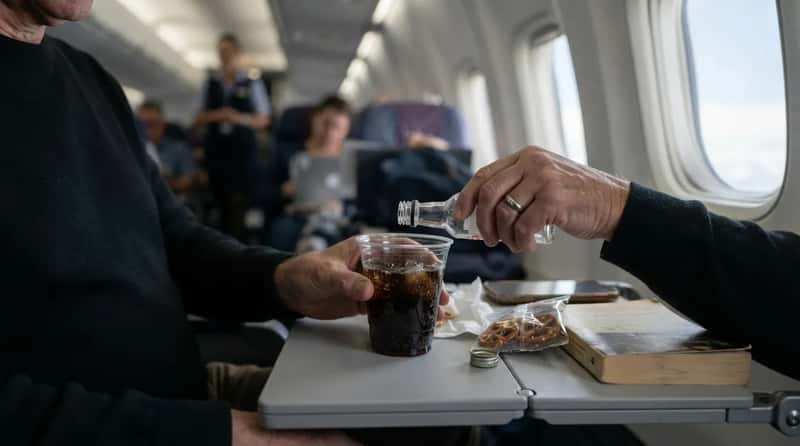
You can bring alcohol on a plane. Duty-free purchases made after security can come into the cabin, up to 5 liters of alcohol between 24% and 70% ABV.4 5
Drinking it is prohibited. An FAA spokesman put it simply: alcohol must be provided and served by the air carrier.6
Airlines add their own rules. United says you cannot drink the alcohol you bring, and American, Delta and Southwest require it to remain unopened.5
The reason goes beyond the rule. If passengers pour their own drinks, crew lose track of how much each person has had.
The temptation is the price of an onboard miniature, and that saving is not worth the exposure. Pouring your own into a soft drink does not help either, since mixing your own alcohol with airline mixers does not make it allowed.
A flight attendant’s first warning is the cheapest point to stop, and what happens after it is where the figures climb.
#1 – Carrying On After the Attendant Says Stop
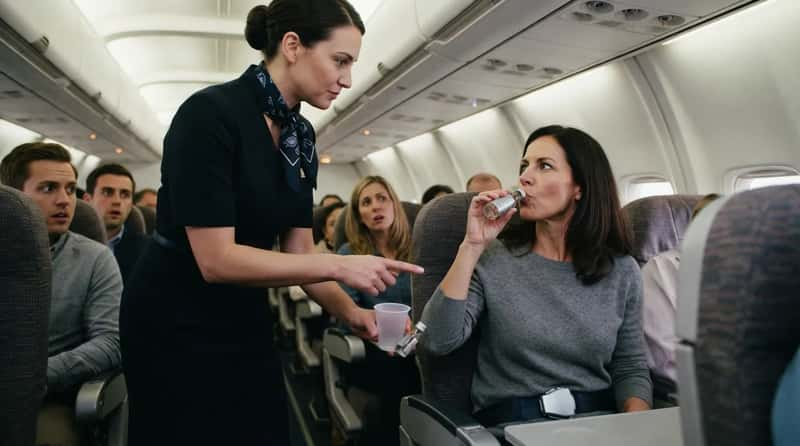
Most of the items above are fixed the moment a crew member speaks up. The expensive ones are the passengers who keep going.
TheTravel reports that when a passenger refuses to stand down after a flight attendant intervenes, the situation moves from a social faux pas to a legal violation. The FAA says it pursues legal enforcement action against any passenger who assaults, threatens, intimidates or interferes with crew, and can propose civil penalties up to $43,658 per violation.7
Unruly passengers can also face criminal charges.7 The FAA’s cases make the pattern plain.
In one, a passenger was allegedly told twice she could not drink her own mini bottles, yet kept drinking in front of a flight attendant and filmed the attendant. The first warning was the cheap exit, worth a few dollars’ worth of miniatures, and she drove right past it.
It is a small share of travelers, but the FAA tracks unruly passenger reports every year because the incidents are costly and disruptive.
Almost everything on this list happens in shared space, and almost all of it ends when someone asks. A pair of slip-on shoes, a walk down the aisle and a neck pillow each cost less than the tray table’s problems.
Treat that first request as the cheap exit, because every item here that grew into a fine started with a person who did not take it.
What small thing do you pack for a long flight that keeps your seat from becoming everyone else’s problem?
Bonus: The Galley Trick Nobody Tells You
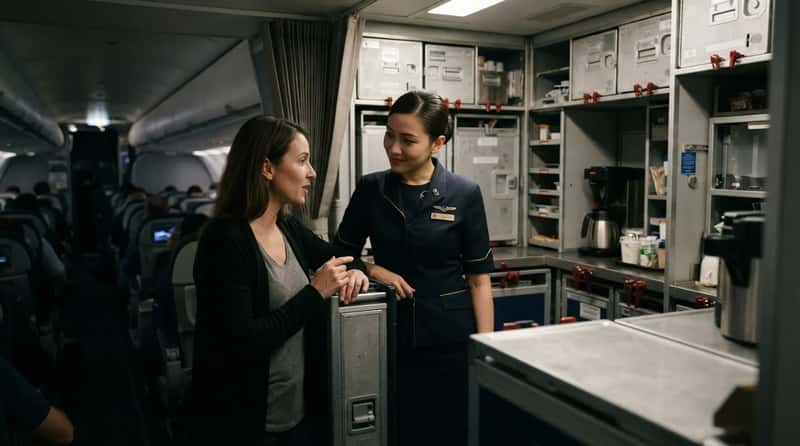
When a seatmate’s smell, cough or habits are making your flight miserable, do not confront them and do not keep hitting the call button. Walk to the galley and ask the crew quietly for a different seat.
- Time it well: Wait until the seatbelt sign is off and the crew is not in the middle of a cart service.
- Be specific: Say the problem in one sentence and name the fix you want, such as, “Is there an open seat I could move to?”
- Keep it private: Speak low and let the attendant handle the other passenger, so nothing escalates in the aisle.
- Have your seat number ready: It lets the crew check the cabin and reseat you without a long back-and-forth.
Crew cannot always move you, since a full flight leaves no empty seats. But a calm, specific request at the galley gives them the best chance to help, and it is far easier on everyone than waiting until the problem boils over.
- Travelmath Tray Table Study: https://www.cbsnews.com/news/how-risky-are-air-travel-germs/
- Auburn Cabin Pathogen Study: https://www.sciencedaily.com/releases/2014/05/140520100420.htm
- IATA Unruly Passengers Fact Sheet: https://www.iata.org/en/iata-repository/pressroom/fact-sheets/fact-sheet-unruly-passengers/
- FAA PackSafe Alcoholic Beverages: https://www.faa.gov/hazmat/packsafe/alcoholic-beverages
- Frommer’s Alcohol on Planes: https://www.frommers.com/tips/airfare/are-you-allowed-to-drink-your-own-alcohol-on-a-plane/
- Matador FAA Alcohol Rules: https://matadornetwork.com/read/bring-drink-alcohol-flight/
- FAA Unruly Passengers: https://www.faa.gov/unruly