Here’s what the airport won’t tell you: turning 60 doesn’t take a single dollar off most airline fees. Yet some travelers over 60 do walk away with a waived charge, a seat that fits their body, or a refund nobody offered them. This list covers 15 charges that really do shrink or vanish, and what actually makes it happen.
The twist is that the birthday is almost never the magic ingredient. The real keys are federal rules most agents never recite, a little agent discretion, and one well-timed sentence. We’ll start with a small fee hiding on the phone line, then work up to charges involving real money, including some that plenty of travelers assume they just have to pay.
#15 – The $25 Phone Fee That Some Agents Will Quietly Drop

Calling instead of clicking can cost you. JetBlue charges a $25 nonrefundable fee per person when a customer changes, cancels or books a new trip by phone. That stings if you simply prefer a human voice. But the airline says it will waive the phone fee for customers who tried to change flights online and ran into technical trouble.
That’s the catch, and the opportunity. Explaining calmly that the site wouldn’t let you finish is often the detail an agent listens for before applying a waiver. It’s a discretionary courtesy, not a guarantee, and it varies by airline.
The phone fee is only the warm-up. The next item is a fare the website itself never shows you.
#14 – The Senior Fare Hiding Behind a Phone Number

Yes, a few airlines still keep age-based fares, and they don’t put them on the front page. Delta’s own fares-and-discounts page admits that some discounts are not available at delta.com. Its senior discounts apply to certain markets, aren’t sold online, and require a call to check eligibility. One 2026 guide puts the typical discount at 5% to 15% off.
Don’t expect a bonanza, though. American, Delta and United still file senior fares for travelers 65 and older on select routes, but none of them publishes what the discount is worth. Southwest retired its senior fares in 2019. Treat any percentage you read online as unconfirmed until an agent prices it for you.
#13 – The 55-and-Up Promo Code That Beats Most “Senior” Fares

One budget airline has made a real play for older flyers. Frontier’s 55FOR55 promo starts at age 55, not 65. One 2026 guide described the code as 55% off base fares for travelers 55 and older. That makes it a rare case where a traveler younger than 65 gets a deal the legacy carriers don’t match.
Read the fine print before you celebrate. A base fare is only part of the total, since taxes and add-ons are billed separately. Promotions like this also come and go, so check the airline’s current offer page. If the code has expired, the agent can tell you in about ten seconds.
Quick Compare
- Frontier: The promo starts at age 55, and one 2026 guide describes it as 55% off base fares.
- American, Delta, United: Senior fares for ages 65 and up on select routes, with no published discount value.
- Southwest: Retired its senior fares in 2019.
The next charges aren’t about age at all, and they’re far harder to dodge.
#12 – The Seat Fee for a Seat You Actually Need

Seat fees annoy almost everyone. One travel site, citing a Senate subcommittee investigation, reports that seat-selection revenue topped $3 billion in 2023. But for travelers with a disability-related need, there’s a federal safety valve. Airlines must provide a seat assignment that best accommodates the disability if the passenger meets the airline’s procedures.
Note the wording: it’s about need, not age. One disability-travel resource lists free seat assignment that meets disability-related needs among the key Air Carrier Access Act protections. A healthy 62-year-old who just wants extra legroom isn’t covered. A traveler with a bad knee or a mobility limit may well be.
#11 – The “Priority Boarding” Upgrade You Don’t Have to Buy

Paid boarding tiers are a favorite airline upsell. But a passenger with a disability who tells the gate agent they need extra time or assistance to board, stow equipment or be seated is entitled to board before all other passengers. There’s no fee attached. It simply comes from asking.
Some senior-travel guides claim most carriers offer age-based early boarding. Policies differ by airline, so don’t count on it. The reliable route is the need-based one. Quietly tell the gate agent before boarding begins, and you skip the shuffle through a crowded jet bridge.
Your carry-on may hold the next surprise.
#10 – The Bag Fee That Shouldn’t Apply to a Medical Device

Budget carriers charge for carry-ons. Medical gear is a different category. Airlines must allow assistive devices in the cabin free of charge, consistent with safety rules, including medical devices and a personal amount of medication. Those devices must not count against the passenger’s carry-on limit.
In practice, that means a device bag shouldn’t be billed as your one carry-on. If a gate agent questions it, say plainly that the item is a medical device. That sentence is often all it takes.
#9 – The Checked-Bag Fee That Gets Refunded When Your Bag Is Late

This one isn’t about age, but older travelers who check bags benefit most from knowing it. Under DOT’s 2024 refund rule, airlines must refund baggage fees when a bag arrives 12 or more hours late on domestic flights. The thresholds are longer for international trips. The same rule requires refunds of fees for ancillary services an airline fails to provide.
There’s paperwork, though. DOT says the traveler must file a mishandled-baggage report with the airline to get a bag-fee refund for a significant delay. And if you booked through a travel agent, those fee refunds go to the airline, not the ticket agent. That report is the step most people skip, and skipping it can cost them the refund.
Fast Facts
- Domestic flights: a bag-fee refund applies once a bag is 12 or more hours late.
- International trips have longer delay thresholds.
- A mishandled-baggage report with the airline is the step that unlocks the refund.
- The same 2024 rule covers fees for extras an airline never delivers.
#8 – The One-Time Courtesy Waiver After a Messy Flight

After a delay or an oversold flight, an agent may have more room to help than the rules require. One travel outlet reports that agents can sometimes extend a one-time courtesy waiver to non-elite passengers, especially when the original flight was delayed or oversold. It’s anecdotal and varies by carrier.
Set expectations accordingly. DOT says airlines aren’t required to make ticket changes free of charge, so this is a favor, not a right. Lead with what happened to you, stay specific, and keep the tone friendly.
#7 – The “Non-Refundable” Ticket That Sometimes Turns Refundable

Illness has a way of ignoring cancellation rules. One senior-travel guide says travelers over 60 who can’t fly because of illness may get a refund or credit on non-refundable tickets for medical reasons. It notes that a doctor’s note and a polite call to customer service are needed.
Keep your hopes realistic. Long-running frequent-flyer forums have pointed out that such waivers are discretionary, especially when an injury doesn’t strictly prevent flying. Ask early, keep the paperwork, and check whether any travel insurance you bought applies.
The next window costs you nothing and needs no begging.
#6 – The Cancellation Fee That Vanishes for 24 Hours

Here’s a right that needs no favors. For tickets bought at least seven days before departure, airlines must either let you cancel for a full refund without penalty within 24 hours, or hold the fare for 24 hours without payment. They aren’t required to offer both.
There are two limits. The rule doesn’t apply to tickets bought through online travel agencies. And the window doesn’t give you a free change, which is why the usual advice is to cancel and rebook. Booking direct is worth the extra minute.
#5 – The Loaner Wheelchair Bill an Airline Is Supposed to Pay
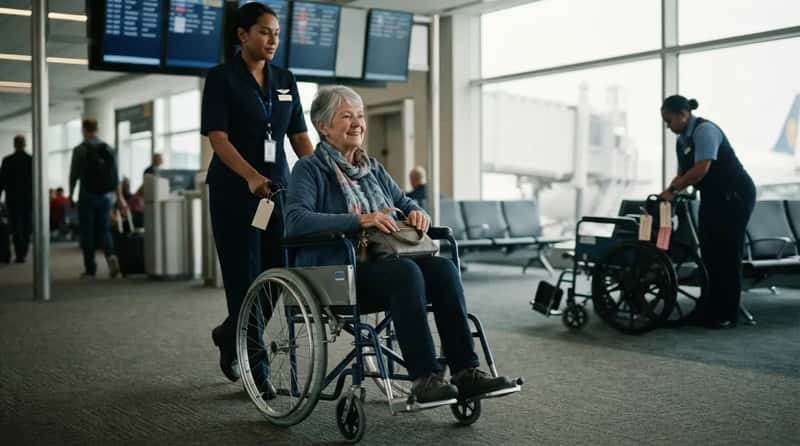
When an airline damages or loses a traveler’s wheelchair, the fallout can be costly and frightening. DOT’s December 2024 final rule adopted a requirement that carriers consult with the passenger on a loaner wheelchair or scooter that meets their needs, and pay for it while the personal device is returned, repaired or replaced. Airlines must reimburse the passenger within 30 days of receiving documentation.
Check the current status before you rely on it. DOT has since issued a notice pausing enforcement of four requirements in its disability regulation while it reconsiders them. One of those concerns airline liability when assistive devices aren’t returned in the condition received. Keep every receipt and ask the airline what it will cover.
Worth Knowing
- The December 2024 rule calls for the airline to consult with you on a suitable loaner.
- The airline pays for that loaner until your own device is returned, repaired or replaced.
- Reimbursement is due within 30 days of receiving documentation.
- DOT paused enforcement of four disability-rule requirements, so confirm the current status.
#4 – The Pet-Style Fee That Doesn’t Apply to a Service Dog
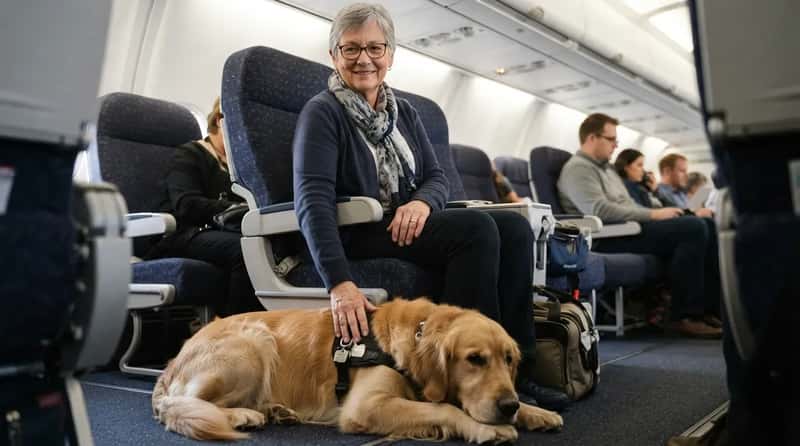
In-cabin pet fees can add up fast, but a trained service dog isn’t a pet. One disability-travel resource lists free service animal travel among the Air Carrier Access Act protections. For older travelers who rely on a dog for mobility help or medical alert, that can mean hundreds of dollars not spent on a pet ticket.
The paperwork matters. Airlines may require DOT’s service animal forms in advance, so read the airline’s current service-animal page before you book. Skipping that step is where most surprises at the airport begin.
#3 – The Baggage Fee for a Wheelchair or Scooter That Doesn’t Exist
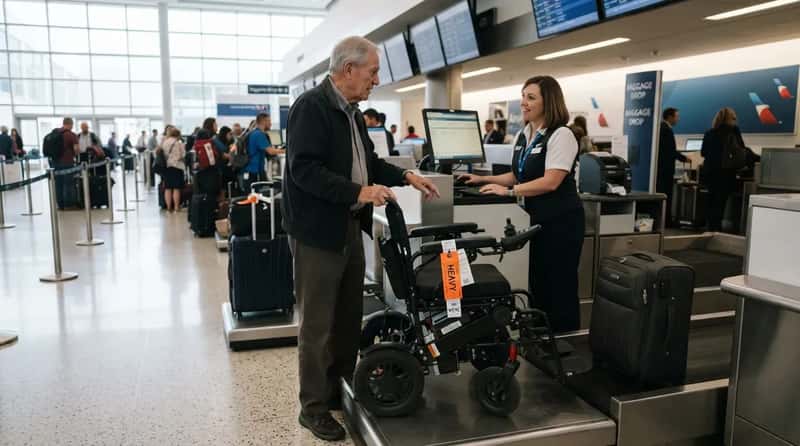
Many people assume a folding walker or scooter counts as luggage. It doesn’t. A wheelchair is considered a medical device, so it travels free. Airlines must carry mobility aids such as wheelchairs and scooters at no charge.
Limits exist, and they’re about safety and space. Airlines must accept a battery-powered wheelchair if it fits in the cargo compartment and can travel consistent with safety and security requirements. Bringing multiple wheelchairs may trigger regular baggage fees.
The last two items matter most on travel day itself.
#2 – The Fee for Help Onboard That Airlines Aren’t Allowed to Charge

Getting down the aisle can be the hardest part of a flight. A disability-travel guide states that airlines cannot charge extra for wheelchair assistance, stowage of mobility devices, or the use of an on-board wheelchair. DOT’s list of rights includes help moving to or from the lavatory, with an on-board chair if requested.
One guide notes that on-board wheelchairs are required on all twin-aisle aircraft. Smaller single-aisle planes may not carry one, so ask the airline in advance what’s available on your flight. A traveler who knows this before boarding avoids an uncomfortable moment at 35,000 feet.
At a Glance
- No extra charge for wheelchair assistance, device stowage or an on-board chair.
- Help getting to and from the lavatory is on DOT’s list of rights.
- On-board wheelchairs are required on twin-aisle aircraft.
- On single-aisle planes, ask ahead about what’s available.
#1 – The “Curb-to-Gate” Escort You’ve Already Paid For

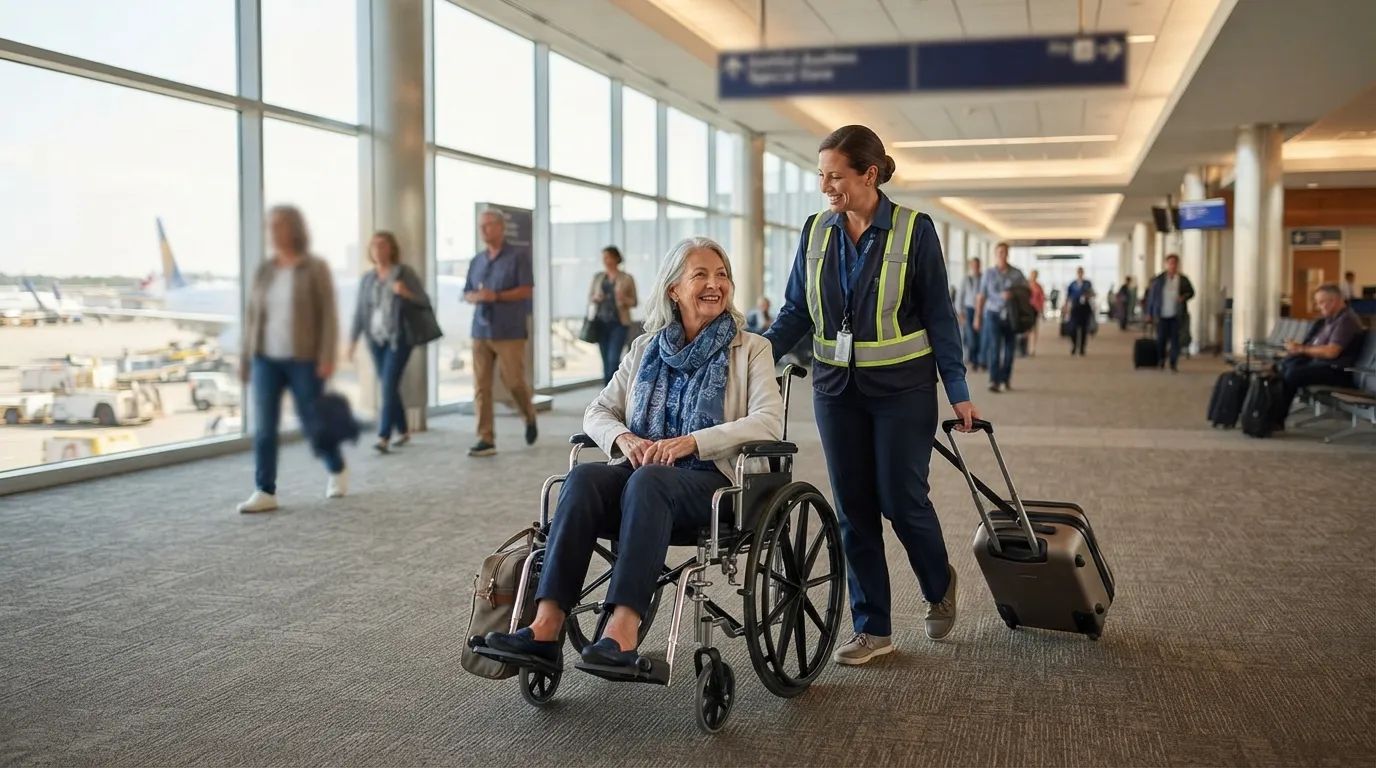
Many travelers assume terminal wheelchair help costs extra, so they struggle through a mile-long concourse instead. It doesn’t cost extra. DOT says airlines must provide prompt wheelchair or guided assistance to board, deplane or connect to another flight, and it must be performed in a safe and dignified manner. Nobody should feel awkward about requesting it.
There’s also a training angle. One 2026 guide says a DOT rule set a June 17, 2026 deadline for airlines and airport contractors to finish mandatory training for staff who physically assist wheelchair users. That means the person pushing the chair should now be better prepared. Ask when you book, and ask again at check-in.
Age alone rarely wipes out a charge. Need, timing and a polite, specific request often do. Several of these rights are written into federal rules, and the rest depend on an agent saying yes.
Policies change, and some of these protections are being revisited, so check your airline’s current rules before you fly. The most useful travel skill may be the one nobody mentions at check-in: asking.