


Ask anyone who works a hotel front desk, and they’ll tell you the same slip-ups walk through the door every day. Most come from rules nobody explains, not from anything the traveler did wrong.
The 15 below have cost older travelers money, long walks with heavy bags, nights without grab bars, even a frozen debit card on day one. Stay for the final item, because it decides whether your request is a promise or just a wish. First, the smallest mistake, which costs you little more than a nap.
#15 – Showing Up Hours Before Check-In Time

Check-in time is a rule about rooms, not about you. Early access mostly comes down to whether a clean room exists when you arrive.
Tell the hotel your expected arrival time before you travel. Then ask about early access, and whether another room in your booked category is ready.
If nothing is available, ask them to store your luggage. Call the morning you travel for the most honest answer, since staff can see exactly what’s open at that moment.
Once you’re in, the desk has a stash of comforts that never appears on any menu.
#14 – Never Asking What’s Behind the Desk
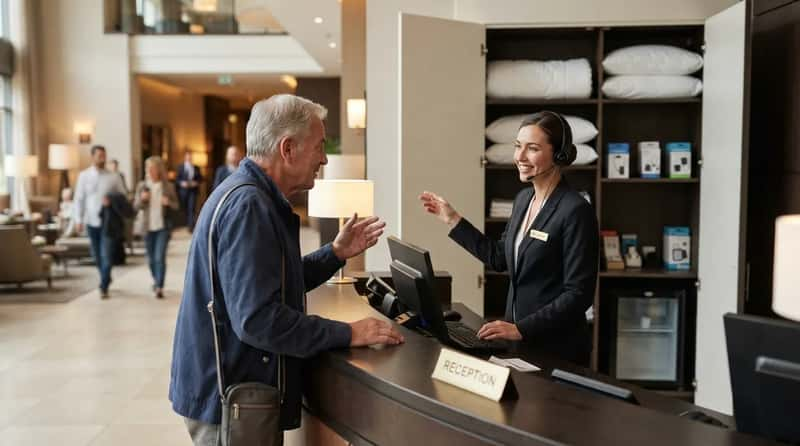
Many full-service hotels keep a closet of extras for guests. Almost nobody offers them without being asked.
Extra blankets are an easy yes, and phone chargers and adapters are often back there too. If you carry medication that needs cooling, ask about a refrigerator, which some hotels will bring up sometimes at no charge for medical needs.
Try this: ask the desk which comfort items guests can request. You’ll hear the whole list instead of guessing at it.
Comforts are free for the asking. Your spot on the floor plan is just as easy to change, but only if you’re specific.
#13 – Accepting Whatever Key You’re Handed
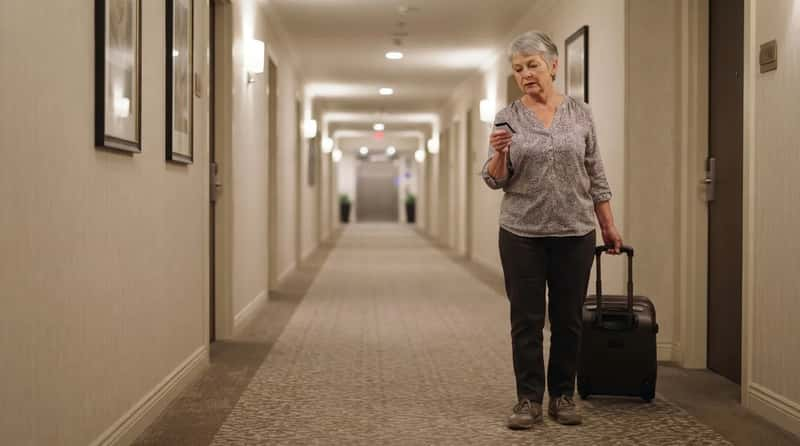
Room location is one of the easier things a front desk can adjust. The catch is how you ask.
A vague note is the most common reason a request disappears. Naming a low floor, a short walk to the elevator and a spot away from the pool gives the desk something to act on.
Here’s a trade some travelers resist: take the short walk over the silence. Earplugs cost a few dollars, while a long hallway with a rolling bag and tired knees costs you every day of the trip.
Worth Knowing
- Specific requests get acted on, and vague ones tend to vanish.
- A low floor and a short walk to the elevator are easy for a desk to check.
- Noise is fixable with earplugs, but a long hallway is not.
- Asking for a spot away from the pool is a reasonable, concrete request.
Before you accept the key, ask roughly how far the room sits from the elevator. That one question tells you what you’re getting.
A good room still leaves one gap. At 2 a.m., you may need the desk and have no idea how to reach it.
#12 – Not Knowing How to Reach the Desk at Night
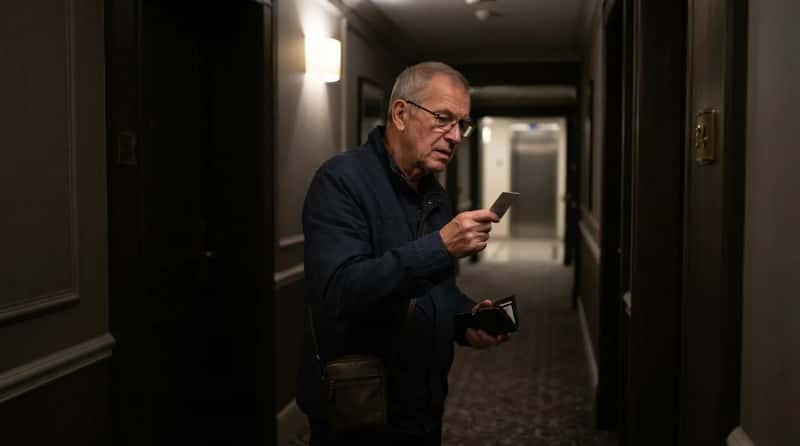
Hotel corridors look identical in the middle of the night. A dark hallway is a poor place to remember a room number.
At check-in, ask how to call the front desk from your room and whether it’s staffed around the clock. Then test the room phone once, and learn how to reach emergency services from it.
Carry a slip with your room number and the front desk number. Keep it in your wallet, not in the key sleeve, for a reason that comes up right now.
#11 – Letting the Clerk Say Your Room Number Aloud

Say a room number across a busy lobby, and everyone within earshot now has it. Ask reception to write it down instead.
The same goes for the key envelope, which often has the number printed on it. Anyone who sees it could try to charge meals to your room, so put it away right after check-in.
If the clerk announces it anyway, quietly ask for a different room. Ask the clerk to write your room number down, not say it. It takes five seconds and is routine for staff.
A private number only helps if the door behind it does its job. And some rooms have more than one door to check.
#10 – Skipping the Lock Check Until You’ve Unpacked
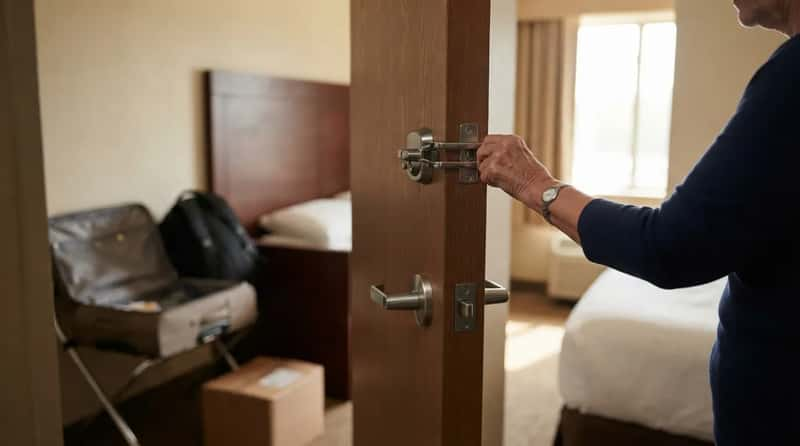
Many travelers secure the door only after they’ve unpacked. Do it the other way around.
Once you’ve confirmed the room is empty, close the security latch and walk the room. Test the deadbolt, latch, connecting door and balcony lock before you unpack.
If anything fails, ask for another room instead of working around a broken lock. The swap is far easier at 4 p.m. than at 10 p.m., when the hotel may be nearly full.
Locks stop people who shouldn’t get in. They do nothing about a knock from someone who claims to belong there.
#9 – Opening the Door to Unexpected “Staff”
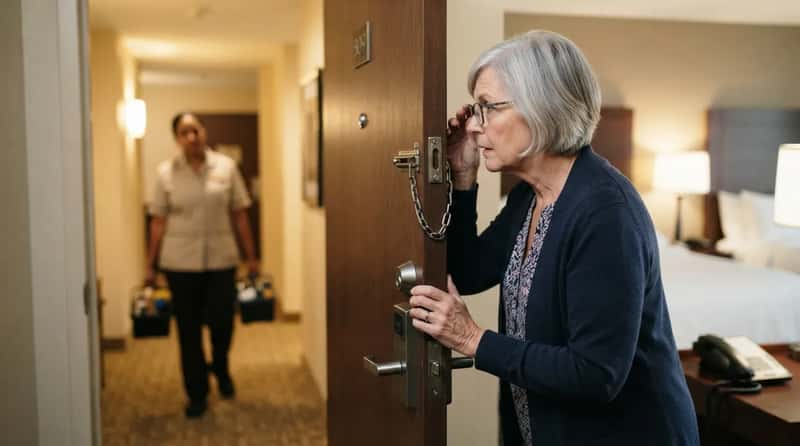
Some intruders have been known to wear hotel uniforms or pose as plainclothes security. A uniform proves nothing, but a phone call does.
Call the front desk before opening the door to anyone you didn’t expect. A real maintenance or housekeeping worker can wait a minute while you verify.
- Use the peephole before opening.
- Keep the door closed and call from the room phone or a verified hotel number.
- If the desk can’t verify the visit, ask hotel security to investigate.
Even a verified visitor shouldn’t find your passport sitting on the dresser. But the safe in the closet has limits of its own.
#8 – Trusting the In-Room Safe With Everything
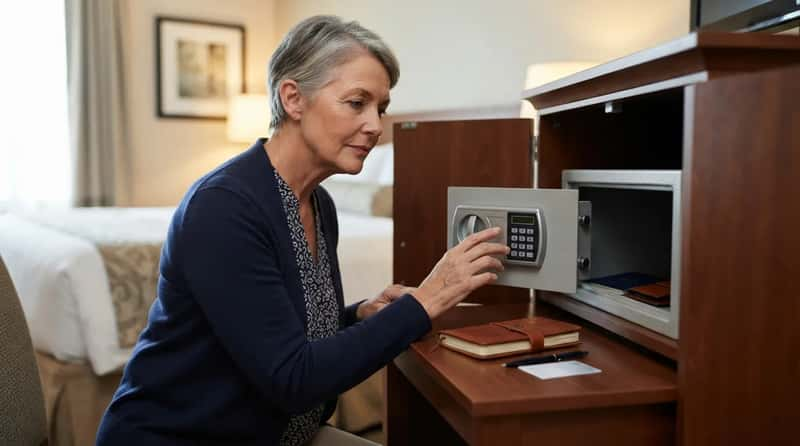
A room safe is a deterrent, not a vault. It’s fine for a passport and spare cards, and a poor place for anything you couldn’t replace.
My verdict: hand the irreplaceable items to the desk. A front-desk safe or deposit box is generally more secure.
Quick Compare
- In-room safe: Handy for a passport and spare cards.
- Front-desk safe or deposit box: Generally the better home for anything irreplaceable.
Whichever you use, set your own code rather than keeping a default. Never use a birth year, your room number or 1234.
Then use the safe every time you leave, even for a minute. Safe habits cost nothing, unlike the senior discount you may be counting on.
#7 – Expecting the Senior Discount to Appear on Its Own

Senior rates rarely announce themselves. At Choice Hotels, for example, AARP members can get 10% off at participating locations.1
You must book through a Choice direct channel with your AARP membership, then show proof at check-in.2 The discount applies to the room rate, not taxes or resort fees.
My verdict: don’t treat the AARP rate as a deal until you’ve checked. Bring your membership card, and price the AARP rate against the hotel’s own website. If it’s higher, skip it.
That fee line decides whether the discount was real. And it usually shows up later than the price does.
#6 – Learning About the Resort Fee at Checkout

A $120 room with a $25 nightly resort fee is a $145 room. The advertised rate was only part of the price.
Since May 2025, the FTC’s rule on unfair or deceptive fees has required hotels to show the total price, including mandatory resort fees, in any advertised rate. So a surprise at the desk is worth questioning.3
Remember, the AARP discount doesn’t reduce a resort or parking fee. Compare total prices, with every mandatory fee included, before you book. At check-in, ask what the fee covers and whether parking is charged separately.
Fees can drain your wallet. A hold on your card can drain your bank account.
#5 – Putting the Room on a Debit Card
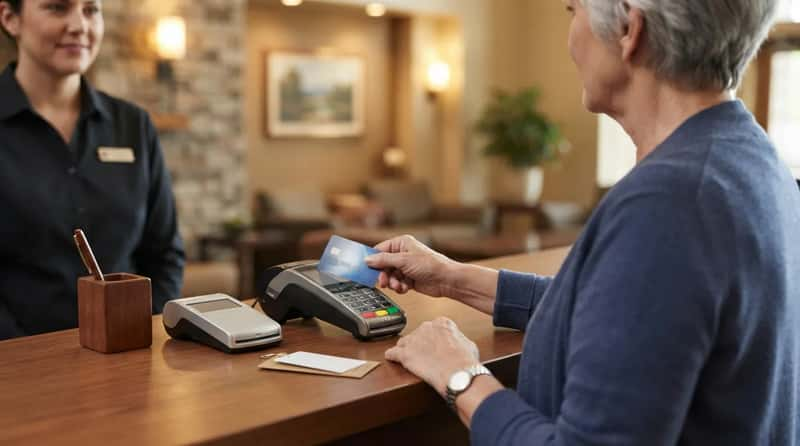
A hotel’s hold on your card isn’t a charge, but on a debit card it behaves like one. The money is gone from your account until it’s released.4
Many hotels hold somewhere between $25 and $200 per night. If that drops your balance too low, other payments can be declined or checks can bounce.
The release can take longer than checkout. Credit card holds usually clear within three to seven days, while debit card holds can last up to 14 business days.5
Fast Facts
- Typical hold: roughly $25 to $200 per night, depending on the hotel.
- Credit card holds usually clear in 3 to 7 days.
- Debit card holds can last up to 14 business days.5
- On debit, the held money leaves your available balance right away.4
My verdict: leave the debit card in your wallet and use a credit card. Policies differ by hotel, so ask exactly when the hold is released.
A hold is money you get back. The next mistake costs money you can lose outright, and the deadline hides in a time zone.
#4 – Cancelling by Your Clock Instead of Theirs

The cancellation deadline runs on the hotel’s local time, not yours. If a New York hotel’s cutoff is 6 p.m., a California traveler cancelling at 4 p.m. Pacific is already an hour late.
Missing it on a prepaid booking can mean charges for the nightly rate, taxes and fees. That’s the resort fee again, billed for a room you never used.
Booking sites add a wrinkle. Their cancellation policy may differ from the hotel’s own, and the site’s terms are the ones that control your booking.
Set a phone reminder for the hotel’s cutoff hour, in the hotel’s time zone.
Cancelling on time keeps your money. But a listing that says only “accessible” can still leave you at the desk asking for a refund.
#3 – Booking “Accessible” Without Asking What That Means
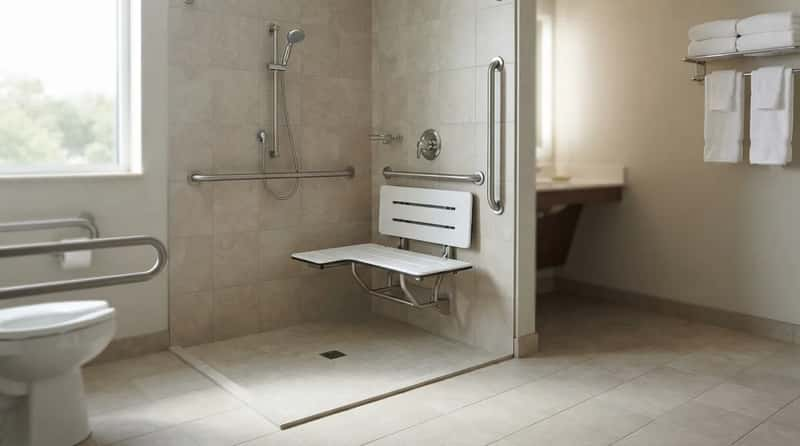
If you need grab bars, a shower seat or no steps, one word on a booking page won’t tell you whether the room delivers. Features in rooms marked ADA can vary.
The reservation should describe things like a roll-in shower versus a bathtub, the layout, grab bars and door widths. If it doesn’t, call and ask.6
Ask whether the bathroom has a roll-in shower, grab bars and a shower seat. It’s far easier to request a swap before you arrive than after you’ve seen the tub.
One more thing worth knowing: hotels can’t charge extra for an accessible room.
Getting those answers takes a phone call. But there’s a right number to dial, and it isn’t the one printed biggest on your confirmation.
#2 – Calling the 800 Number Instead of the Hotel

The toll-free line is built for booking. The agent usually can’t see what’s actually available in the building.
A note typed into a third-party booking site doesn’t always reach the people who can act on it. So call the hotel’s local number one to three days before arrival, and ask for the front office manager or manager on duty.
Need a ground-floor room? Call about a week out to confirm the request was recorded. Get the name of the person you spoke with, and follow up with a two-line email.
If the hotel can’t meet a request, ask what it can offer instead.
At a Glance
- About a week out: Confirm a ground-floor request was recorded.
- 1 to 3 days out: Call the hotel’s local number.
- Who to ask for: The front office manager or manager on duty.
- Afterward: Note the name and send a two-line email.
Even the right person can’t fix the biggest mistake of all. It comes down to whether your request is a promise or just a note, and that was decided when you booked.
#1 – Trusting the Comments Box With Something You Need

Certain room features are guaranteed when you select them as part of the room during booking. Add the same feature later as a request, and it may depend on availability when you arrive.7
Marriott’s own example is accessibility. When you book an accessible room type, those features are guaranteed, but preferences added to a standard room later can stay requests.7
This is the rule behind every earlier item. A “request noted” is not a reservation, and some hotels will say they’ve put your request in the notes instead of promising the room.
If a feature is essential, book the room type that includes it. Then ask the agent to confirm that exact room type is guaranteed.
The elevator distance and quiet room from earlier are courtesies you can live without. Grab bars and a roll-in shower are needs, so they belong in the booking, not the comment box.
Look back over the list and a pattern shows up. Almost every mix-up came from something said but never attached to anything: a note, a hold, a deadline, a discount, a room number.
So treat the desk as the place where promises get checked, not where favors get asked. Before you hang up or sign anything, ask what is guaranteed, what isn’t, and who wrote it down.
Which request will you make before your next stay, and what happened that made you start?
Bonus: The Checkout Move Nobody Tells You About

Never skip the final bill. Express checkout feels convenient, but it’s where unexpected charges slip through unnoticed, and fixing them is much easier while you’re still standing at the desk.
Do this the night before or the morning you leave:
- Ask for the itemized folio. Request a printed copy or an email of your final bill, with every line listed.
- Check each line against what you agreed to. Look for the room rate, taxes, resort fee, parking, and any minibar, restaurant or room-service items you didn’t order.
- Ask for a zero-balance receipt. It confirms you owe nothing more and shows exactly what was charged to your card.
- Keep it until your card statement arrives. Compare the two. If something doesn’t match, tell the hotel in writing and contact your card issuer promptly, since billing-error disputes on credit cards have a limited window, generally 60 days from the statement date.
A wrong charge you catch at the desk is a two-minute fix. One you discover weeks later becomes a phone-tree chase with proof you may no longer have.
- Choice Hotels AARP Discounts: https://www.choicehotels.com/en-au/deals/aarp
- Choice Hotels AARP Terms: https://www.choicehotels.com/deals/aarp
- PIRG Junk Fees Rule: https://pirg.org/edfund/articles/junk-fees-finally-new-protections-against-surprise-charges-for-event-tickets-hotels/
- Nebraska Debit Card Holds: https://ndbf.nebraska.gov/why-do-businesses-place-holds-debit-cards
- Engine Hotel Incidentals Holds: https://engine.com/blog/hotel-incidentals
- ADA Accessible Lodging Factsheet: https://adata.org/factsheet/accessible-lodging
- Marriott Accessible Room Reservations: https://support.marriott.com/s/article/reserve-accessible-room
