
Most people assume airport lounge staff are there to scan your card, pour your coffee, and point you toward the buffet. But if you’re over 60 and you’ve ever settled into a Delta Sky Club, United Club, or Priority Pass lounge, something subtle has almost certainly happened in your favor – and you walked right past it without noticing. These aren’t advertised perks. They’re quiet policies, staff-discretionary habits, and a few protections that most seniors never even know exist. The 35-year-old road warrior in the seat next to you? He’s getting exactly what’s on the menu. You’re quietly getting something more.
Lounge staff are trained to read a room fast, and the experienced ones know that a traveler over 60 often carries a different set of pressures – tighter medication schedules, longer walks behind them, more complex itineraries, more riding on a single connection. Part of their training – the part nobody advertises – is knowing when and how to quietly extend a little extra grace. Here are 15 of those favors, counted down to the one that surprises people the most.
#15 – They Quietly Steer You Toward the Calmest Corner of the Lounge
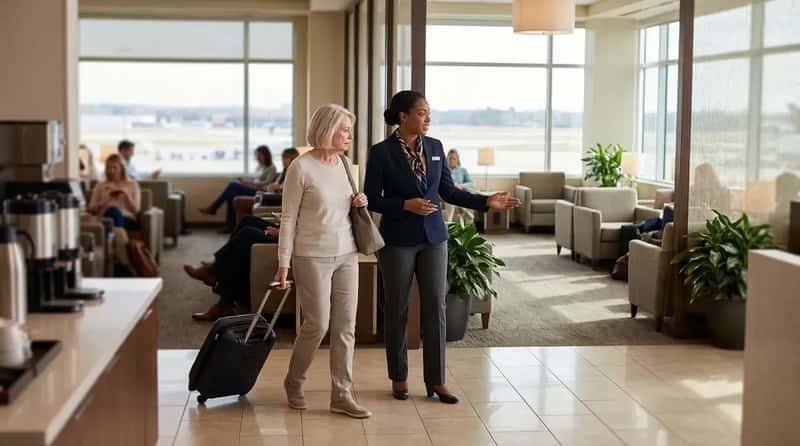
Walk into a busy lounge cold and you’ll probably drop into the first open chair near the door. But lounge staff who notice an older traveler coming in often do something small and meaningful: they casually mention that seating near the back is quieter, or that a section near the windows just opened up. It costs them thirty seconds. It changes your next two hours entirely. Dedicated quiet zones – less foot traffic, fewer overhead announcements, better light – are disproportionately useful to travelers who arrived already tired from a long drive to the airport or a slow morning through security.
Most members just pick a spot on autopilot. But experienced lounge agents know their floor plan cold, and during off-peak hours, the right corner means available power outlets, a workstation nobody’s camped at, and staff who actually have time to help if something comes up. When a senior traveler comes in looking worn or uncertain, steering them to the right chair is the kind of quiet favor that never makes it into any airline brochure – but it makes a real difference to the person sitting in it.
Fast Facts
- Peak lounge hours run roughly 6–9 AM and 4–7 PM – when quiet-zone seating disappears fastest
- Lounges at mega-hubs like ATL, ORD, and LAX can have 10+ distinct seating zones
- Power outlets and USB ports near quieter rear sections are typically less contested mid-day
- Lounge overcrowding surged sharply post-2024 as credit card access expanded, making the right seat more valuable than ever
#14 – They Keep an Informal Eye on Your Bags When You Head to the Buffet

Nobody announces this. There’s no sign, no policy posted on the wall, and no form to fill out. But lounge staff stationed near food and beverage areas tend to stay visually aware of solo older travelers who get up and leave belongings at a table. It’s a soft form of situational awareness baked into how attentive agents manage their floor – part habit, part training, part basic human decency. Airport lounges are specifically designed to offer a higher level of personal service than anything available in the main terminal, and that standard quietly extends to moments like this one.
For a traveler over 60 sitting alone, the low-grade anxiety of leaving a bag unattended – even for 90 seconds at the buffet – is real. A good lounge agent notices when a solo senior gets up, and a glance in that direction every few seconds costs nothing. It’s not a formal watch service. It’s just the kind of attentiveness that separates a great lounge team from a mediocre one – and older travelers benefit from it quietly, every single day, without ever knowing the reason the room felt a little safer than the terminal outside.
#13 – They Proactively Offer to Refrigerate Temperature-Sensitive Medications
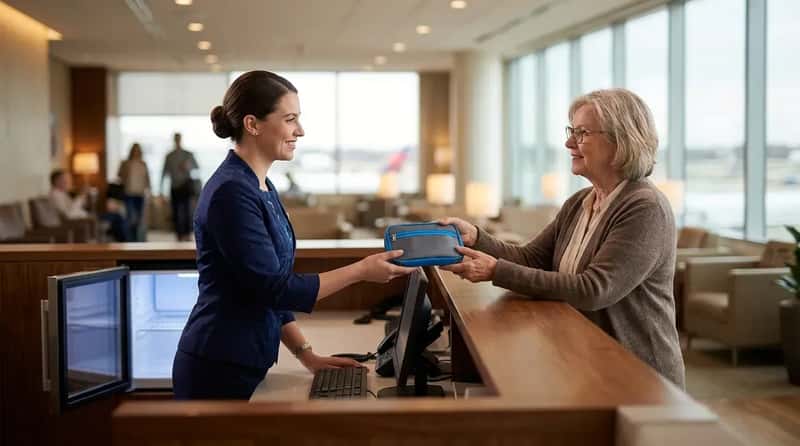
This one surprises even frequent flyers. Many airport lounges – particularly those operated by major U.S. carriers like United, Delta, and American – have refrigeration access behind the service desk. No sign announces it. No brochure lists it. But experienced staff know the protocol, and when they notice an older traveler pulling out an insulated medication pouch or mentioning a health condition in passing, the best agents will quietly offer to keep it cold until boarding. For someone managing insulin or biologics on a long layover, that offer isn’t a small thing.
It’s a staff-discretionary favor, not a published amenity – which means most travelers who need it most never think to ask. If you travel with anything temperature-sensitive, you can simply walk up to the front desk and ask. But the best lounge staff are already watching for the cue before you say a word, and they’ll bring it up themselves. That’s the difference between a lounge that functions as a waiting room and one that quietly functions as a travel ally.
#12 – They Pre-Flag Your File So Gate Staff Know You’re in the Building
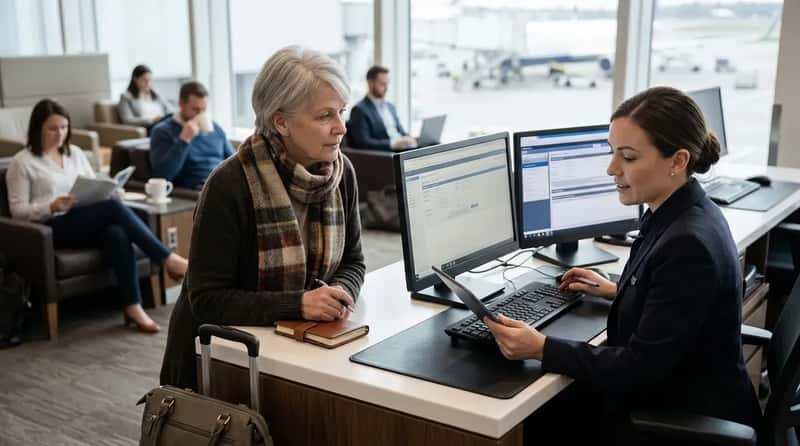
When a traveler over 60 mentions a tight connection or a mobility concern at the lounge desk, a good agent doesn’t just nod sympathetically. In many airline-operated lounges, staff have direct communication lines – and sometimes shared systems – with gate agents down the concourse. They can drop a quiet note that you’re in the lounge, especially if your departure is approaching and you haven’t moved toward the gate yet. Because lounge agents are managing a fraction of the passenger volume that gate staff handle, they can often resolve issues and relay information far faster than anyone standing in a terminal line.
This coordination happens invisibly. You’re sitting with a cup of coffee, unaware that a lounge agent just made a quick call to Gate B22 to let them know an older passenger who needs a little extra boarding time is on his way. Most members never trigger this because they never mention their situation. Travelers over 60 who do mention it – even offhandedly – often get this quiet safety net activated without realizing it. They just notice, later, that boarding felt strangely smooth.
#11 – They Quietly Fast-Track Rebooking During Delays and Cancellations
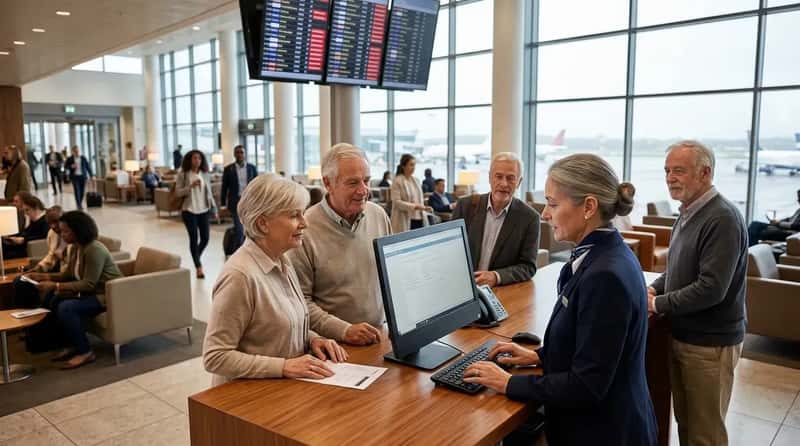
When a flight goes sideways, the terminal descends into chaos. Everyone rushes the gate desk or calls the airline’s 800 number and sits on hold while the last available seats on the next departure quietly disappear. Inside the lounge, something completely different is available. Lounge staff can assist with rebooking, seat changes, and travel disruptions – and because they’re not managing a crowd of a hundred panicked passengers, they move faster and with more flexibility than almost anyone else in the building. Walking calmly to the lounge desk during a cancellation is one of the most underused advantages of lounge membership.
But here’s the layer most members miss entirely: under airline “sensitive traveler” policies, seniors fall into a protected category alongside families with young children and passengers with medical accommodations. Lounge agents know this internally, even when they don’t say it out loud. A traveler over 60 who approaches the lounge desk during a disruption will often find their rebooking handled with a speed and priority that has nothing to do with their frequent flyer tier – and everything to do with their age. They leave thinking they got lucky. They didn’t.
At a Glance: What Lounge Staff Can Do During a Disruption
- Rebook you on the next available flight – often before the gate desk queue even forms
- Request seat reassignments using internal tools not available at self-service kiosks
- Flag your reservation for priority handling at the next gate
- Coordinate with ground crew on checked bags if your rebooking changes aircraft
- Apply “sensitive traveler” or “special assistance” notes that follow your record through the disruption
#10 – They Slow Down and Write It Down When a Gate Change Creates Confusion
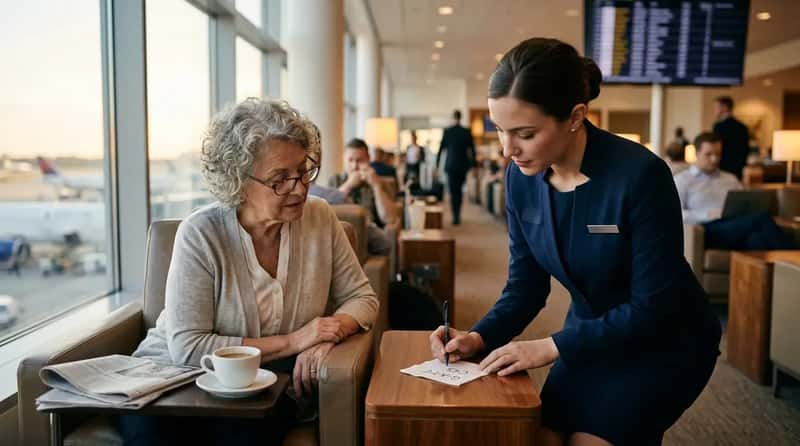
Airport information moves fast – gate switches, terminal changes, departure boards updating every few minutes. For a younger traveler with the airline app open, none of that is stressful. For a traveler over 60 who may not have notifications turned on, or whose phone screen is hard to read under bright lounge lighting, a sudden gate change can spike anxiety in an instant. Experienced lounge staff notice the shift in a guest’s expression and quietly adjust. They don’t rush through the explanation. They repeat the gate number. They sometimes write it on a cocktail napkin. They check that you’ve actually absorbed it before they move on.
This isn’t a formal accommodation – it’s human attentiveness, deployed where it does the most good. Airport lounges offer meaningfully better access to customer service representatives than anything in the main terminal, and the best agents use that advantage intentionally with guests who look uncertain. A thirty-second explanation and a handwritten note costs a lounge agent nothing. For a traveler over 60 navigating a sprawling hub like O’Hare or Atlanta Hartsfield, it can be the difference between catching a connection and watching it push back without them.
#9 – They Arrange a Carry-On Assist to the Gate Without Being Asked Twice
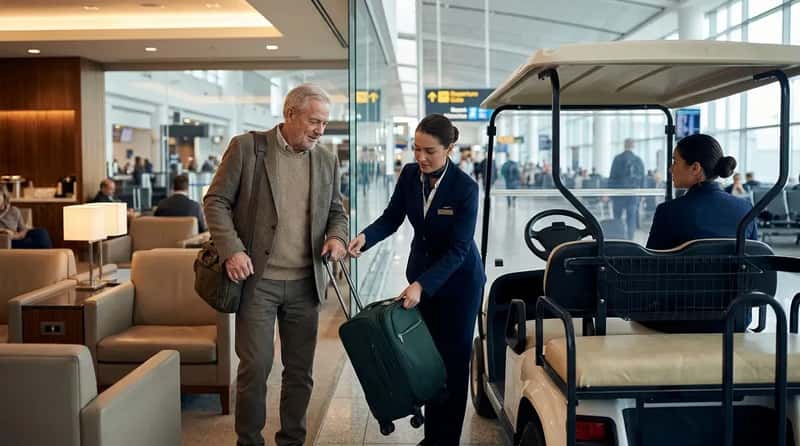
It’s one thing to know you can request mobility assistance. It’s another thing entirely when lounge staff offer to arrange it unprompted – after noticing that your roller bag looks heavy, or that you mentioned your gate is a long walk from the lounge. The formal assistance system requires you to know it exists and ask for it. The informal lounge version often requires nothing more than a staff member who pays attention. Under the Air Carrier Access Act of 1986, airlines are required to provide prompt wheelchair or other guided assistance to board, deplane, or connect to another flight – and that assistance must be performed in a safe and dignified manner, regardless of visible disability.
Most travelers over 60 don’t know this right exists, let alone that lounge staff can activate it on their behalf with a single phone call. The best lounge agents simply do it – flag the request, make the call, and let the traveler know someone will meet them at the lounge door before their flight boards. The traveler thinks it was a nice coincidence that help showed up. It wasn’t a coincidence at all.
Worth Knowing: Your Rights Under the Air Carrier Access Act
- Airlines must provide wheelchair or ambulatory escort assistance at U.S. airports when requested – at no charge
- Assistance covers the full journey: terminal entrance to gate, and gate to gate on connections
- You cannot be left unattended in a mobility device for more than 30 minutes
- Assistive devices – including collapsible wheelchairs – have priority for in-cabin storage space
- No advance notice is required to request most forms of in-airport mobility help
#8 – They Hold a Practical Seat Near the Door When They See You Coming Back
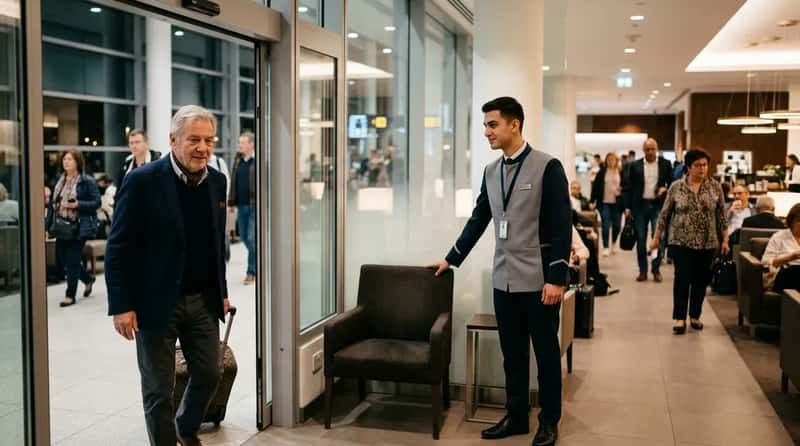
Lounges fill fast during peak hours, and seating near the entrance – or near the restrooms – is the most practical real estate in the building for an older traveler who doesn’t want to navigate a crowded room every time they get up. The same lounge that felt like a quiet retreat at 10 AM can feel like a crowded bus station by 5 PM. Peak windows – roughly 6 to 9 AM and 4 to 7 PM – coincide with the biggest departure waves, and during those hours, a lounge can go from calm to standing-room-only in under an hour. Seating near a power outlet and a clear path to the exit isn’t a luxury for every traveler. For some, it’s genuinely important.
What most members never notice is that attentive lounge staff will sometimes quietly hold back a well-placed seat for a traveler who clearly needs easier access – near the restroom, near the door, near the desk. It’s not written anywhere. It’s not a policy. It’s a small judgment call a good agent makes when they see a senior step away for a moment and realize that person is going to struggle to find a seat when they come back. Nobody announces it. The traveler just finds their chair waiting – and assumes they got lucky.
#7 – They Volunteer Dietary Guidance Before You Waste a Trip to the Buffet

The buffet at a major airline lounge looks impressive from a distance. For a traveler managing a low-sodium diet, diabetes, or any of the dietary restrictions that become more common after 60, it can also be a minefield. Most guests load a plate and sort it out after the fact. Experienced lounge staff – particularly those who work the same shift and recognize the same demographic regularly – will often volunteer information before an older traveler even picks up a plate: “The soups today are pretty heavy on sodium, but the grilled options are lighter” or “The chef can do a plain version of that if you need it.”
Airlines that operate lounges are often aligned with the same dietary considerations offered on their flights – low-sodium, diabetic-friendly, heart-healthy options are part of the same service culture. A proactive heads-up from a lounge attendant saves an older traveler a wasted plate, an awkward conversation at the buffet, and potentially a rough few hours at 35,000 feet. Younger, confident travelers rarely trigger this kind of guidance. Travelers over 60 who seem to be scanning the options carefully often get the inside track before they even reach the serving station.
#6 – They Flag Your Flight on the Monitor and Come Find You When It’s Boarding
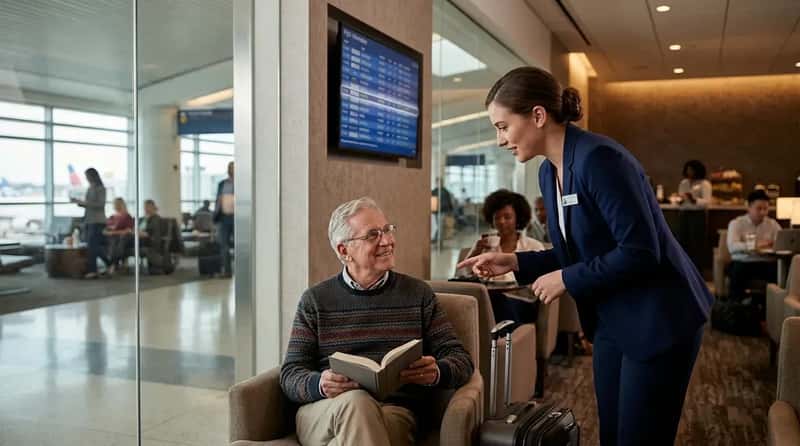
This one is genuinely underappreciated. Airport lounges are comfortable enough that time has a way of disappearing inside them – the lighting is softer, the noise level is lower, and there’s no gate crowd to signal that your flight is close. Many lounge staff – especially in smaller, quieter facilities – make a mental note of an older traveler who seems relaxed and possibly unaware of how fast the clock is moving. Lounge staff can remind you of the time, coordinate carry-on assistance, and activate priority boarding privileges when it’s needed. Most travelers over 60 experience this as a nice coincidence: a lounge attendant appearing near their chair to mention that their flight to Phoenix is boarding at Gate D14 in twelve minutes.
It is almost never a coincidence. A good agent clocked that this traveler had a departure coming up, watched the departure monitor, made a quiet lap of the lounge, and made sure they didn’t miss it. That small act of attentiveness – costing the agent maybe forty-five seconds – has saved more than a few older travelers from a missed connection. None of them ever realized it was deliberate. They just thought the lounge had good energy that day.
#5 – They Quietly Intervene When Other Guests Are Being Noisy Near a Resting Senior
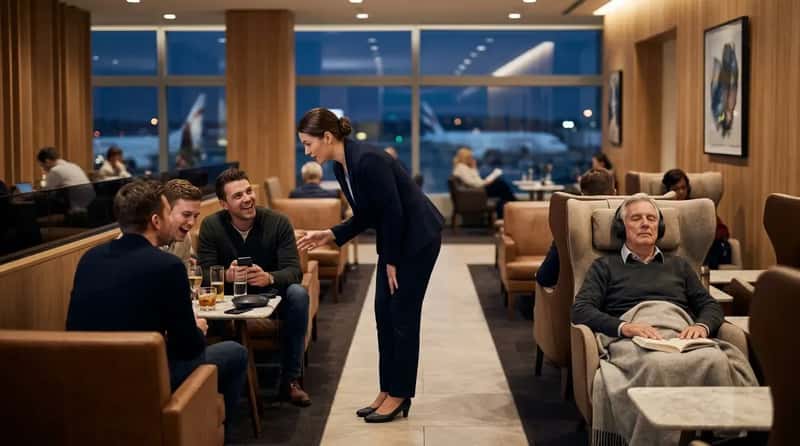
Lounge etiquette is enforced unevenly – most members already know that. What isn’t widely known is that experienced staff are far more likely to take quiet action to protect the peace around a visibly resting older traveler than around a younger guest in the same situation. Noise management – especially in quiet zones – is a real part of how attentive lounge teams manage their floor, and a nearby guest on speakerphone or a group that’s gotten louder with each round of drinks will often get a polite, low-key word from a staff member before it goes any further. The framing is always general. “We try to keep it a little quieter in this section” – never “the older gentleman asked us to say something.”
Research on crowded transit environments consistently finds that noise is one of the primary stress amplifiers for older travelers. Lounge staff who enforce a quieter standard in resting areas are providing a real service – and doing it in a way that protects the senior traveler’s dignity entirely. The person in the corner just notices it got quieter and assumes everyone around them had good manners. In reality, someone behind the desk made a small decision on their behalf, and executed it so smoothly that no one in the room had any idea it happened.
#4 – They Pull Strings on Seat Comfort Using “Accommodation” Language That Bypasses the Upgrade Queue
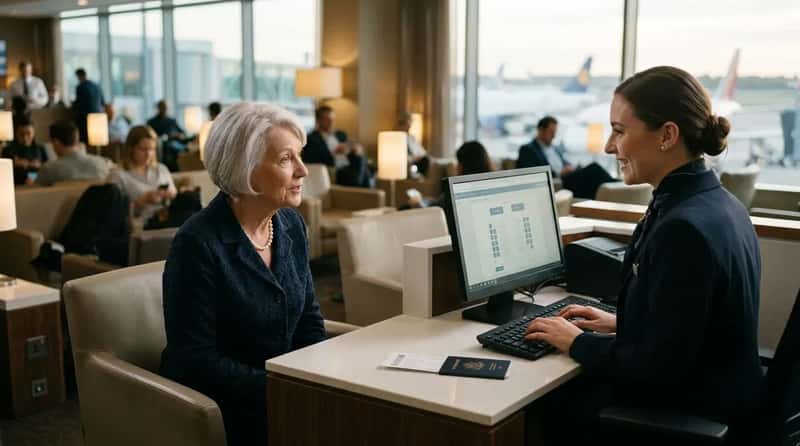
This is one of the least-known advantages that flows through lounge staff for travelers over 60. Gate agents and lounge representatives share communication channels at many major carriers, and a lounge agent who quietly notes that an older traveler has a back concern, mobility issue, or a “sensitive traveler” designation can initiate a seat reassignment request using language that routes around the standard upgrade process entirely. The framing matters enormously. “Comfort accommodation” or “medical seating need” lands differently in the system than “I’d like a better seat” – and lounge staff who know the language can use it on a traveler’s behalf without the traveler ever knowing the mechanism.
A good lounge agent who overhears an older traveler mention physical discomfort will sometimes make this call quietly – without being asked, and without drawing attention to it. The traveler boards, finds themselves in an aisle seat with more legroom, and assumes it was empty. In reality, a short conversation happened on their behalf, triggered by something they said almost in passing at the lounge desk. This kind of behind-the-scenes comfort advocacy is almost entirely invisible to the person it helps – which is exactly what makes it a real favor rather than a transaction.
Quick Compare: Asking for a Better Seat vs. How Lounge Staff Do It
- Standard passenger request: “Is there a better seat available?” → Enters the normal queue, subject to fare class and availability
- Lounge agent framing: “Comfort accommodation” or “medical seating need” → Routes through a different channel, often resolved faster
- Key difference: The language – not the request itself – is what changes the outcome
- What triggers it: An offhand comment at the lounge desk, not a formal written request
#3 – They Walk You Through Lounge Options You Didn’t Know You Had
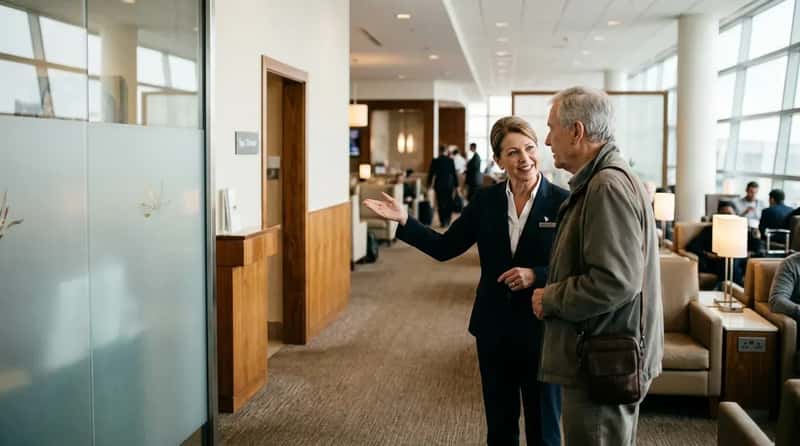
Here’s what most members get at the lounge door: a card scan and a wave-through. Here’s what travelers over 60 often quietly get from more attentive staff: a genuine orientation to what’s actually available and how to use it. That includes features most lounge members never fully explore – shower availability and how to book a slot, the quietest sections during peak hours, where the phone charging stations are that aren’t surrounded by people, and – critically – whether another lounge in the terminal might actually serve them better that day. That last piece of information is something most staff never volunteer. The best ones do.
Many lounges also offer discounted or complimentary access through AARP, AAA, or specific travel credit cards that older travelers may already carry but have never connected to lounge benefits. A savvy lounge agent will sometimes mention a lesser-known facility elsewhere in the terminal – less crowded, easier to reach, better positioned for the traveler’s gate – and help them figure out whether a day pass or an existing card benefit covers it. Good information costs nothing to give. For a traveler who assumed they only had one option, it occasionally opens up a significantly better afternoon.
#2 – They Activate “Sensitive Traveler” Protections That Most Seniors Don’t Know Exist
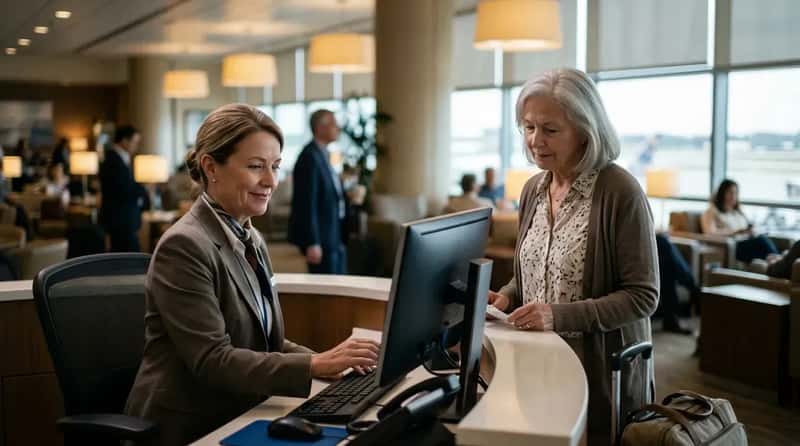
The phrase “sensitive traveler” doesn’t appear in any lounge brochure, but it exists as a real internal designation at most major U.S. carriers – and lounge staff can apply it. Once that flag is added to a traveler’s reservation, it quietly changes how every subsequent staff member along the journey treats them – from the lounge to the gate agent to the rebooking desk if a disruption hits. Under this designation, seniors are grouped alongside families traveling with young children and passengers with documented medical needs, which affects how their requests are prioritized during irregular operations. It’s a quiet but powerful piece of internal advocacy that most travelers over 60 have never heard of.
A lounge agent who spends a few minutes with an older traveler – learns they’re connecting on a tight window, traveling alone after a recent surgery, or managing something stressful – can add that flag to a reservation without the traveler ever asking for it or knowing it happened. Most reservations will be marked with a “special assistance requested” note so airport staff know to meet the traveler proactively rather than waiting to be flagged down. For travelers over 60, this invisible record update can be the single most consequential thing that happens to them inside the lounge. Virtually none of them ever find out it was done on their behalf.
#1 – They Let One Extra Guest Slide – and Never Make You Feel Small About It
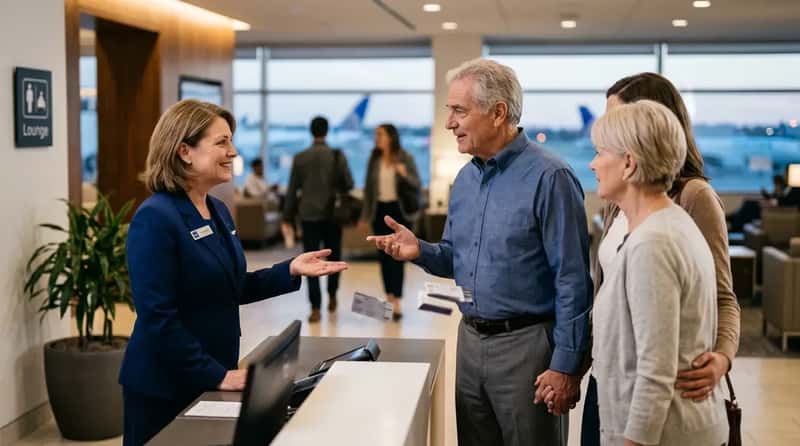
This is the favor that carries the most emotional weight – and the one that’s gotten harder to pull off. Lounge guest policies tightened significantly in 2025 and 2026 as overcrowding forced airlines and credit card issuers to draw harder lines. Delta’s February 2025 “Visit” policy capped Sky Club access at 15 visits per year for Reserve cardholders and 10 for Amex Platinum holders, while United’s May 2025 restriction confined one-time passes to a three-hour window before departure. Capital One moved to a paid-guest model at its lounges starting February 2026, charging $45 per adult guest. Bringing an extra companion – a daughter who’s walking you to the gate, a son who drove two hours to see you off – technically breaks the rules in most lounges today.
And yet. Experienced lounge staff – the ones who’ve been working the same desk for years – regularly use their discretion to look the other way when an older traveler arrives with one family member who is clearly there to help, not to exploit the breakfast buffet. No fuss. No recitation of the guest policy. No form to fill out. The agent sees a 72-year-old woman walking in with her adult son carrying her bag and her boarding pass, reads the situation in half a second, and simply smiles and waves them both through. It’s a small act of human decency performed dozens of times a day, in lounges across the country, for travelers who deserve a little more grace than the rulebook technically allows. Most of the people it happens to never even register it as a favor. They just feel, for a moment, like the world is a little kinder than it usually is.
Why It Stands Out: The Lounge Guest Policy Squeeze (2025–2026)
- Delta Sky Club capped Reserve cardholders at 15 visits/year and Amex Platinum at 10 – effective February 1, 2025
- United restricted one-time guest passes to the 3-hour pre-departure window starting May 2025
- Capital One ended free Venture X guesting at its lounges in February 2026; adult guests now pay $45
- Across the board: tighter rules make a staff member’s quiet wave-through more meaningful than ever
Most of these favors will never show up in a lounge satisfaction survey. They won’t appear in J.D. Power ratings or an airline’s annual report. They happen in the margins – a quick glance across a crowded room, a quiet call to a gate agent, a ten-second conversation that redirects an anxious traveler toward a better chair and a smoother afternoon. If you’re over 60 and you’ve ever left an airport lounge feeling like the day went a little more smoothly than it had any right to, there’s a real chance someone behind that desk made a small, invisible decision in your favor. They just didn’t mention it – and that was the whole point.