


Most of us treat the seat on the boarding pass like a verdict: take it or leave it. For travelers over 65, that quiet assumption can cost hours of aching backs, stiff knees, and long shuffles down a crowded aisle. Meanwhile, flight attendants hear seat requests all day, and the polite, specific ones often get a smooth yes.
Here’s the twist most passengers never hear. Some of these requests are backed by federal rules, while others depend entirely on a crew member’s goodwill that day. Age alone isn’t a legal golden ticket, so the way you ask matters as much as what you ask. Keep reading, because one of these comes with a feature almost nobody knows to look for.
#15 – The Empty-Row Move That Works Only If You Ask First

You spot it from the jet bridge: a whole row, three seats, not a soul in it. Plenty of passengers just drift over once they’re sure nobody’s watching, and that’s the mistake. Crews want boarding finished and the cabin settled before anyone relocates. A quiet question to a flight attendant often gets a yes, while a silent move can get you sent right back.
Give a concrete reason. A bad back, swollen ankles, or a need to stretch your legs sounds far better than “I’d just like more room.” Wait until the boarding door is closed and the crew is free to answer. A request made calmly on the ground beats a hopeful wander in the air every time.
#14 – The Over-Wing Seat Older Flyers Swear Is Gentler

Ask frequent flyers where the smoothest ride is, and many point straight to the seats over the wings. Those rows sit near the plane’s center of gravity, so bumps feel milder than they do in the back. Travelers with sensitive stomachs, bad knees, or a dread of turbulence often request one. Crews tend to oblige when the seat is open.
Here’s the part people miss. Some over-wing rows are exit rows, and those come with strict rules about who can sit there. If you ask for a wing seat, don’t be surprised if the crew steers you one row over. And what if the seat you’re already in is the real problem?
#13 – The “Please Move Me, This Seat Is Broken” Swap
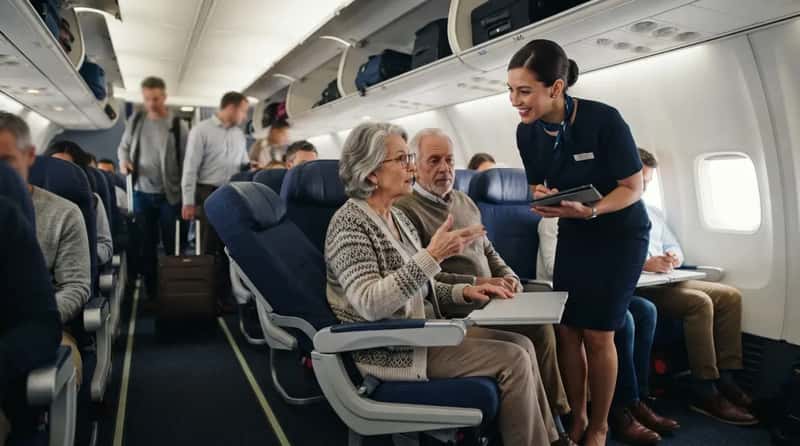
Plenty of seats quietly misbehave. Recline buttons jam, tray tables hang loose, and some vents blast cold air straight at your neck. Passengers often suffer through it, assuming nothing can be done. Crews would rather fix the problem, and they can often reseat you if there’s a free spot.
Name the specific fault. “My seat won’t stay upright and it’s hurting my back” gets action faster than a vague complaint. A seat with a real defect is one of the easiest reasons to get moved. Say something before takeoff, because the options shrink once the cabin fills and settles. If the flight is completely full, the crew may not have a spot to offer, but they’ll at least know about the problem.
Worth Knowing
- Speak up before the boarding door closes, while open seats are still easy to spot.
- Describe the fault and what it does to you, such as a stuck recline hurting your back.
- Expect a move within your own cabin class, not an automatic upgrade.
- On a packed flight, a report still lets the crew note the problem.
#12 – The Seat Close to Where Your Bag Actually Landed

Overhead bins fill up unevenly, and the results can be absurd. A traveler in row 28 can end up with a carry-on stowed all the way up in row 9. For someone with a sore shoulder, that’s a real problem, because the bag is hard to reach and the aisle is jammed. Many crews will help find space closer to your seat.
Flight attendants aren’t required to lift every bag. In practice, though, many step in when they see someone struggling, especially if you asked for help early. Asking for a hand up front tends to work far better than waiting until you’re stuck in the aisle. If your bag has to travel far, ask whether it can go nearer. And sometimes the thing you can’t bear to be separated from isn’t luggage at all.
#11 – Sitting Next to Your Spouse When the Seat Map Said No

Couples married 40 or 50 years get split up by seat maps all the time. Airlines don’t guarantee side-by-side seats unless you’ve paid or arranged it, but crews often try to help when they can. A flight attendant can quietly ask a neighbor whether they’d mind swapping.
Let the crew make the ask. Standing in the aisle pleading with strangers tends to backfire. If there’s a medical reason you need to sit together, say so plainly. Even a split couple on a full flight can often be reunited with one polite conversation. But what if you don’t need to sit near anyone, just near a door?
#10 – The Seat Near the Door for a Tight Connection

A short layover turns a long airport walk into a race. Passengers with limited mobility often ask for a seat near the front so they can get off early and make the next gate. Crews hear this one often and usually do what they can. A row near the door can be the difference between making your connection and watching it leave.
Wheelchair assistance can also be arranged for the whole airport trip. U.S. rules cover help from your seat on an arriving flight through to your connecting gate. That’s worth requesting before you travel, not at the jet bridge. The next request is about location too, and it comes up constantly.
#9 – The Front-of-Cabin Seat Older Passengers Quietly Prefer

Many older travelers choose a seat near the front, and the reasons are refreshingly practical. It shortens the walk to the lavatory and speeds up getting on and off the plane. Fewer rows to squeeze past means fewer awkward moments in a packed aisle.
The best time to ask is at booking or check-in, when the seat map still has options. If the rows near the front are taken, ask at the gate, since agents can sometimes release held seats. Crews can also suggest the next-best row if your first choice is gone. Another seat choice comes next, and this one is all about your legs.
#8 – The Aisle Seat That Keeps Your Legs From Stiffening

On a long flight, sitting still is the real enemy. Travelers recovering from surgery or dealing with circulation issues often ask for an aisle seat. It makes it easier to stand, stretch, and walk without climbing over two strangers. Flight attendants hear this one so often that it barely raises an eyebrow.
Quick Compare
- Aisle: easiest to stand and stretch, but you’ll get bumped by carts and passersby.
- Window: a wall to lean on and no one climbing over you, but you have to ask neighbors to move.
- Middle: the least room to shift, and usually the first seat people trade away.
The aisle comes with a trade-off. You’ll get bumped by carts and passing travelers, and that’s the price of freedom. Many older passengers decide it’s worth every elbow. If the aisle seats are gone, ask a crew member whether anyone would swap. Once you’re in the aisle, there’s a second choice most people never think about: which side of the plane.
#7 – Picking the Side of the Aisle That Fits Your Injury

A bad hip or knee doesn’t care what the seat map says. Left or right can decide whether you can swing your leg out easily. Federal seating rules actually recognize this idea for some passengers with a fused or immobilized leg. The seat is supposed to be on the side of the aisle that better accommodates the disability.
Even without a formal disability designation, crews often work with a clear explanation. Say which leg or hip is the problem and which side helps. Specific requests are far easier to grant than vague ones. Still, there’s one seat that crews will actively move you out of.
#6 – Getting Out of the Exit Row Without Any Drama

Exit rows have the most legroom, so travelers grab them the moment they can. But they come with rules. Passengers must be able to help in an emergency, such as opening a heavy exit door. If you can’t confidently do that, crews will move you. Asking to be reseated isn’t just allowed, it’s exactly what they want.
No one will demand proof or make a fuss. Tell the agent or flight attendant you’d prefer a different seat, and they handle the rest. Plenty of older passengers book these rows by accident, lured by the legroom alone. The move is routine, and the next request depends on equipment in the cabin.
#5 – A Seat With Space for Your Portable Oxygen Concentrator

Many travelers rely on a portable oxygen concentrator. The device has to fit under the seat in front, and it can’t block the aisle or an exit. Airlines generally have rules about approved models and advance notice, so contact them before you fly. Crews can help with seating once the paperwork is in place.
Fast Facts
- Only FAA-approved portable oxygen concentrators are allowed to run on board.
- Many airlines want advance notice, and some ask for 48 hours or more, so check yours.
- Airlines may ask you to carry enough battery power to cover about 150% of the flight time.
- Exit rows are generally off-limits when you’re traveling with this equipment.
Don’t wait until boarding to sort this out. Notify the airline at booking and confirm again at the gate. Ask which rows have the most floor space, because a quick check beforehand prevents a stressful seat shuffle at the door. From here on, the requests have real legal backing.
#4 – A Bulkhead Seat When a Service Animal Rides Along

Service animals need room to settle, and the seat makes all the difference. Under U.S. rules, a passenger with a service animal can request a bulkhead or other seat that best fits the animal. Airlines are required to provide the seat on request if the passenger identifies the need. That’s a firm right, not a favor.
The rules say the seat must be in the same cabin class you bought. That means no automatic upgrade, but it does mean a good fit within your ticket. Plan ahead and keep your paperwork handy. The next request is about people, not animals.
#3 – The Seat Next to Your Helper, Guaranteed in Certain Cases

Some travelers need a companion to assist them during the flight. U.S. rules require airlines to provide an adjoining seat for certain helpers. That includes a personal care attendant, a reader for a blind passenger, or an interpreter for a deaf passenger. It also covers a safety assistant if the passenger can’t manage their own evacuation.
At a Glance
- Covered: personal care attendant, reader, interpreter, or safety assistant.
- Not automatically covered: a spouse or friend who simply wants to sit together.
- The trigger: the need must tie to a disability, and you must tell the airline.
The rule doesn’t cover every companion. The need has to be tied to the passenger’s disability, and the passenger must identify it to the airline. If that applies to you, say so clearly when you book, because a confirmed adjoining seat beats hoping for goodwill. The last two requests carry the biggest legal weight of all.
#2 – Extra Legroom for a Leg That Doesn’t Bend

A fused or immobilized leg turns a standard economy seat into a trap. U.S. rules say that passenger can request a bulkhead or other seat with more legroom. The seat is supposed to be on the side of the aisle that best fits the disability. Crews know this rule well.
Airlines must meet these requests through a block method, a priority method, or preboarding. Contact them at booking to learn which one they use. Self-identifying is what triggers the accommodation. Now for the one that almost nobody has heard of.
#1 – The Aisle Seat With a Movable Armrest Most Passengers Never Hear About

Some aisle seats have armrests that lift out of the way. They exist so a passenger using an aisle chair can slide over without hauling themselves across a fixed barrier. Federal rules require airlines to provide such a seat to passengers who need one. Many older travelers don’t know the option exists, or that it’s more than a courtesy.
Request it when you book, and confirm at the gate that your assigned seat actually has one. Older or smaller aircraft may not have any. Agents can usually name the exact rows, so don’t assume the seat is yours just because you asked once.
The Bottom Line: The best seat requests aren’t magic words. They’re specific, early, and tied to a real need. Some are protected by U.S. rules, while others depend on a crew member’s discretion on the day.
Age alone won’t unlock a better seat, but a clear need, asked kindly and in time, opens more doors than most travelers ever try. Which of these have you tried, and which one surprised you most?


